Kirjojen hintavertailu. Mukana 11 244 527 kirjaa ja 12 kauppaa.

Kirjahaku

Etsi kirjoja tekijän nimen, kirjan nimen tai ISBN:n perusteella.

1000 tulosta hakusanalla Matthew C. Stelly

Invasion of the Booty Snatchers: The Nebraska Tradition of Leeching For Grant Money and How Omaha Contributes to Fiscal Insolvency
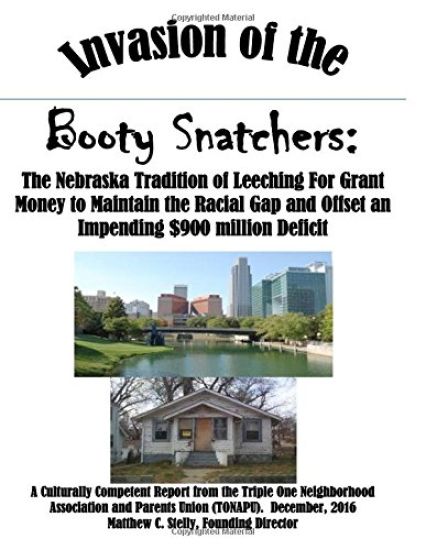
The title of this book is lengthy but quite definitive. Invasion of the Booty Snatchers: The Nebraska Tradition of Leeching For Grant Money to Maintain the Racial Gap and Offset an Impending $900 million Deficit describes the past, present and future "vision" of the Cornhusker state and its largest city, Omaha, Nebraska. "Booty," as we know, it a synonym for "treasure" and the ceaseless pursuit of profit, bereft of an intelligent vision and plan, is why Nebraska is in the present financial crisis it finds itself in (even as its largest city basks in freakishness, frolic and financial profiteering). For the past century, the state of Nebraska has been able to survive in a relatively "controlled" situation made up of people who do not study, who refuse to engage in research and who consider the label "cornhusker" a compliment. It is a state whose largest city is made up of people of leisure, who are laid back and traditional - you know - hicks. This book answers questions that Omaha leadership has not answered because to do so would unmask the long-time bamboozling that has been imposed on its population. As a Black Studies scholar I have studied well the art and science of oppression and when it comes to "taxation without representation," Omaha's treatment of African-Americans reigns without rival. In this book I address the unicameral legislature, the only one in the nation and some selected "controversies" that offer a taste of how and why the state's largest city can get away with the on-going leeching for Federal funding using the poverty of First Nation, Latino and African-American people as its "target populations." In addition to background on the state, information on Omaha's electoral politics, the lack of originality and modernity, its poor vision and management which have led to tax revenue shortages will be offered. Following a section on Nebraska tourism, this book deals with statewide entrepreneurship and on-going attempts at "tax relief." Moreover, insights on the abuse of poverty grants, short-lived "minority programs" and the "racial gap" in Omaha will be explored. Omaha's concept of "community development" and its "reinvent the wheel" tendencies toward educational paradigms will be examined. Other issues to be covered include "the farmland crisis," the health care industry, the judiciary and penal systems and the social service system which is perennially under Federal scrutiny. This book tells it like it is since so few people in Omaha (read: none) dare to do so.
Viva la Revolucion!: Ten (10) Movies (and a short story) About Revolutionary Uprisings in America
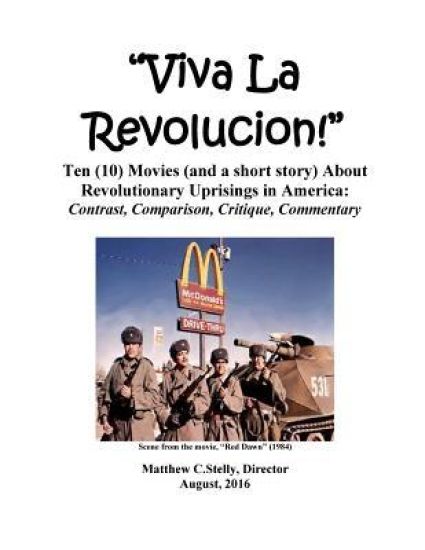
"Viva la Revolucion " translates to mean "Long live the revolution." This book is dedicated to those popular culture tidbits that carried a revolutionary theme, ten movies and a short story. This book is written because there appears to be a systematic attempt by the American power structure to use its awesome media to "dilute" the word revolution in much the same way that its overuse of such terms as "cool," "booty call," "get-go" and "funky" have done. White folks use of a term is a sign to black folks that it's time to switch up and change our terminology, our dance moves, our handshakes and other cultural nuances that the majority culture tends to rip off in order to sound and appear "urbane." The word revolution is not new to America because America was conceived in one. But America was fighting for white privilege and what you are seeing in the America of the present-day are battles being waged by the very groups that the white male omitted even when he was claiming this to be "one country, indivisible." This book is a primer for these newfangled "warriors" who want to make a statement but when all is said and done, don't really know their collective asses from a hole in the ground. This book includes a popular seller that I wrote in tribute to Sam Greenlee, a 38-year retrospective of The Spook Who Sat by the Door. Other movies that contain a revolutionary theme include Invasion of the Body Snatchers, " both versions of "Red Dawn," "Badge 373," "Invasion USA," the "Rampage Series" (three movies - 'Rampage, ' 'Rampage: Capital Punishment' and 'Rampage: President Down') and "Triple 9." A short story by Thomas Wolfe, "A Child by Tiger" is also added for reasons that will be explained. I conclude with an excerpt dedicated to Assata Shakur and a conclusion that asks, "Is revolution possible?" After reading this tome, you be the judge.
Quinn Martin's "The Invaders": : A Chronological TV Review and Case Study in Intergalactic White Privilege
White supremacy is what it is - the umbrella ideology -- but it has a plethora of supporting mechanisms aimed at control and domination of those they oppress. One of those mechanisms is the media in general and television, in particular. Like money, television is a tool that can project images that serve as the ultimate confounding of things: these images can make the small appear large, the weak appear strong, the ugly appear beautiful, the impotent appear virile, the cowardly appear courageous and so on. "The Invaders," in my view, was one such mechanism - a powerful and well-done television show. Time was taken with the set and location selections, the wardrobe and the way that each room was set up. By today's standards the technology was someone antiquated, but nevertheless I was captivated by the overall theme of the show: one man has to convince the world of something that they are not ready to accept. At the time of its airing I was only 13 years old, but I was labeled a "gifted and talented" student and so I observed, talked and wrote about things that bored the shit out of my friends and associates. But there is no doubt that I was at home in the evening when "The Invaders" came on, because I wanted to see what would happen when this white man was treated like a pariah, much the same way that black people have been over the years. I arrived in the California Bay Area at the height of the Black Power movement in 1966, one year after the Watts Riot woke up black people all over the country. As the nation burned and I was still in intermediate school (some people call it "middle school"), this show was able to stay on the air for two years without showing hardly any black people. With the exception of one episode during Season 2 (titled, "The Vise"), it was white aliens versus white earthlings and the only way you could tell the difference was that the aliens had a malformed "pinkie" finger (as they call it) that remained extended; they couldn't bleed and had no heartbeat or pulse. Although it was claimed that these aliens wanted to either destroy or enslave the inhabitants of Earth, these aliens got the benefit of the doubt. For instance, these aliens continued to be referred to as "people" and on-going statements that, "they look just like us." As I stated earlier, it wasn't until season 2, episode 22 that they decided to feature some Black people in starring roles - which is why I devote an entire section to that particular episode under the sub-heading, "Fade to Black." As a narration from the episode called, "The Peacemaker" stated, "For two years, David Vincent has been waging war on two fronts. One against the aliens, the second an attempt to enlist allies in high places - while there is still time." And even as the last episode ended, David was still fighting, and the group that he was able to form over the years - the "believers" - were right there with him, getting more and more attention from the powers that be, convincing them that these aliens were already here and were not bullshitting around. For these reasons I rate "The Invaders" far above the televised versions of either "Star Trek" or "Battlestar Galactica." I admired Vincent's tenacity, courage, perseverance and eloquence. He believed in something and acted on what he believed in. There are a lot of people today who don't believe in anything. From what I was able to observe he paid for his own gas, plane tickets and registration fees to various "conferences" that the aliens were sponsoring in their quest to bamboozle witless earthlings. And of course, he had the advantage of "white privilege" which time and time again enabled him to get into military bases, hotels, government offices and the like, sans credentials, simply because of his whiteness.
Huey P. Newton: Supreme Commander, Black Revolutionary or Glorified Pimp?

Huey P. Newton: Supreme Commander, Black Revolutionary or Glorified Pimp?

Matthew C. Stelly

Createspace Independent Publishing Platform
2018
nidottu
I've probably written more on the black nationalist movement and the role of that movement in the raising of cultural consciousness in the black community than nearly anyone in this nation. As a result I have maintained copious notes on various characters, personalities and activities of said movement. One component was the Black Panther Party. The recent spate of half-truths about the Federal Bureau of Investigation (FBI) and how "honorable" the organization is as it chases down the crimes of President Donald Trump is an insult to black people everywhere. It was the FBI and its leadership that attacked, infiltrated and sabotaged the Black Nationalist movement throughout the 1960s and 1970s. They attacked every single branch and with the help of snitches like Louis Tackwood and Earl Anthony brought down the west and east coast factions. But the most real faction, the most serious of the Black Panther Party organizations were the bruthas and sistahs of Omaha, Nebraska. Believe it or not, they were the most feared, even by the west coast Panthers themselves. Why? Because Omaha didn't just engage in Custer Stands and on-going rap sessions, what the elders called "jackin' off at the mouth." They stood for something, feared no one, and circulated important literature that raised the consciousness of Black Omahans. Two of the leaders of the organization, Ed Poindexter and David Rice, were set up and ended up serving life sentences. David has already died behind bars and Ed is not faring well. But they should never be forgotten for bringing the racism of the Omaha Police Department to the attention of the community. And to them, this book is dedicated. This book deals with the Black Panther Party and its self-diminishing discussions of personalities and its original components. I outline why I use a "critical race theory" approach to addressing the Party because in far too many cases the group on the west coast is viewed in mythical and legendary terms and as I hope to show, it does not deserve to be. I share the Black Panther Party Ten-Point Program, a clone of the program outlined by the Nation of Islam, and provide examples of the "tombstone courage" that was displayed - while reaping nothing. I pay homage to the Omaha chapter, which was so progressive that they changed their name to the Committee to Combat Fascism. After that I deal with Huey P. Newton, co-founder, megalomaniac, bully and genius. Along similar lines I discuss the street element of the Panthers, and the extension of street gangs in some cases. I discuss the leather coats, the pimp mentality and the "cool posing," complete with rifles and berets. Far too few books on these bruthas discuss the misogyny that was rampant in the party and the "crazy nigga" syndrome. Among those discussed in this latter area are Eldridge Cleaver, George Sams, Alex Rackley, Frank "Captain Crutch" Diggs and of course, Huey himself. The issue of "race, black nationalists and white women" will also be explored because this area drove a wedge between the hard-working sistahs in the party and the so-called "down" bruthas. This book addresses Huey's pursuit of his doctorate and his concept of "intercommunalism" even as he began to get increasingly insane. His crack addiction led to his death, which prompts a chapter that asks, was he a "savior or psychotic." In the final analysis, you can be the judge.
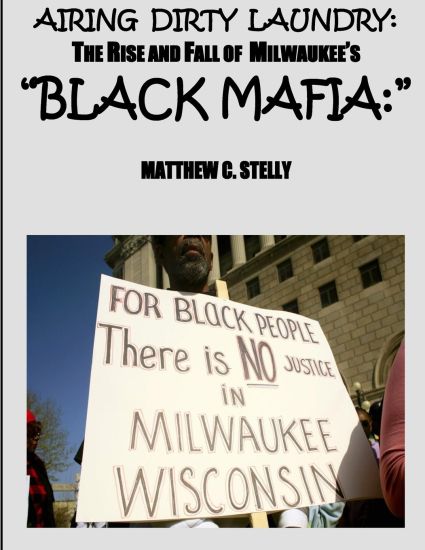
Airing Dirty Laundry: The Rise and Fall of Milwaukee's "Black Mafia"

Airing Dirty Laundry: The Rise and Fall of Milwaukee's "Black Mafia"

Matthew C. Stelly

Createspace Independent Publishing Platform
2018
nidottu
When I arrived in Milwaukee in August of 1987 I came loaded for bear. I was teaching at one of the largest two year colleges in the nation, Milwaukee Area Technical College and after my only year there I won "Teacher of the Year" and was co-winner of "Advisor of the Year." That imprint was made on the entire Milwaukee community so from there I became editor of the largest black newspaper in the city and talk show host on a popular AM station where I dominated black nationalist thought for five years. With nearly perfect recall I began to see why Milwaukee, despite its large black population, numerous nonprofits and black political representation on the Common Council, in the Wisconsin Legislature and on the Milwaukee County Board of Supervisors, was so bereft of awareness, so slow with progress and so easy to control by white folks who were hardly the sharpest knives in the drawer. But neither was the black leadership. Most of it was self-appointed and these are the ones that named themselves "the Black Mafia," an insult to the Italian Mafia in name and purpose. The Italians are nationalists and use their power to take care of their own people, their elders and to advance the economic base of their enclaves. These black people did nearly the exact opposite and were so poor that a "cash and carry" strategy was the order of the day. I establish this most clearly in this book. After going into detail about ideological deficiencies, I came to the conclusion that a former alderman, who was deemed a "militant" by the white power brokers and the largely ignorant black population, was really nothing more than a "radical integrationist." I prove this on the pages within. Controversies permeated the city's landscape as I was editor and lead writer for the newspaper, and top black talk show host on the air, long before McGee and his friend came up with the oxymoronic name for a show called "Word Warriors." On my watch, I galvanized the community with dozens of "SolutionFEST forums" that were jam packed, the creation of the New Kemet Planning Bureau which called for separation from the city and application for the Community Development funds that the city was ripping off, and the organizer of the first-ever and only "Tri City Summit," which brought together the black communities of Milwaukee, Racine and Milwaukee for a three-day conference held at the Masonic Lodge in the heart of Milwaukee. My work was being witnessed and I became a threat to the scam-happy Black Mafia. Controversies that led to extortion-oriented demands included the "Usinger Sausage Scare," the rise of the "De Mau Mau," Frank Crivello and McGee working to build in the black community, and housing programs like North Division Neighborhood Residents and Phoenix Redevelopment, two more groups that under-performed but were over-paid. The rest of the Black Mafia are named in the book, and the most illiterate among them had regular paychecks funned to them by Carl Gee, director of OIC, who went to prison, causing the rest of the Black Mafia to scatter like roaches. A state senator went to jail, a so-called "scholar" from UWM was part of the group before he cut and ran to North Carolina, and others shared in the bravado and threats that shook down foreign merchants, controlled liquor licenses and held huge events where they took up collection and were never accountable for what was collected.
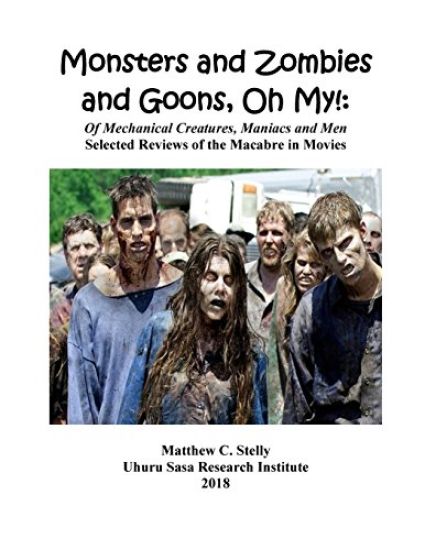
Monsters and Zombies and Goons: Oh My!: Of Mechanical Creatures, Maniacs and Men - Selected Reviews of the Macabre in Movies
Monsters, Zombies and Goons: Oh My Is a collection of fifteen films addressing these topics and the role of science and the white man's buffoonery in how these creatures are brought into fruition and become a threat to humanity. The role of science in each of these movies is linked to the very existence of most of these creatures, and this is a reflection of the message and theme that is a precursor of the fate and future of humanity as we know it. The fact of the matter is that the white man is going to keep on seeking and being awarded grant money to wage his experiments in secret, all being done in the name of humanity. If it gets out of control or if some ethical rule is violated, all of this information is kept secret, away from the knowledge of the American public. These are the issues that reviewers and other writers seem to have missed, opting instead to rank the movies based on special effects, photography, location and other irrelevant bullshit. The fact is that art imitates life, and how much proof is needed to show that those in power are literally insane with their quest for power and will do whatever it takes to turn over a rock, work toward creating life, or dig up anything in the name of "discovery." And that is the real point of this book. You can read a review anywhere. What I do is take a component of popular culture - in this case, the movies - and view it as an extension of the white man's mentality. I ask questions, what was on this writer's mind? What is the point of the screenplay that laid out the tenets of this flick? How does this movie benefit the white race because all movies have that as a goal through "mass appeal"? If more of our scholars were critical instead of descriptive, Black folks and other people of color wouldn't be so prone to fall for this system's manipulated manifestations of reality. The book consists of fifteen (15) randomly selected movies (the methodology is explained). These movies run the range of flicks from 1958 through 2013 and each has its own creature feature to deal with, from zombies to giant blobs of jelly; from men with monster-like qualities to monsters who are morphed into humanoids. Where possible, the variable of "race" is interjected so as to more realistically place the creatures/monsters into a more realistic perspective. After all, none of these creatures (except for the Frankenstein monster) has white skin. He's in the science lab screwing around and comes up with something that gets out of is control. He's playing with a virus and loses it. He's got a machine and something goes wrong and now he's got some kind of maniacal creature on the prowl or he's morphed into a fly. He's looking around for a place to colonize and he comes across a creature that is minding its own business and then that creature becomes "the enemy." Just like in the movie "Frankenstein" I offer that Frankenstein was the name of the creator of the monster in that movie. And this is the way it is in all of these movies: the real monster lies in the mind of the individual who wrote it, the people who put it on the screen and the white people in the final product who use every weapon at their disposal to kill that creature while ignoring the social problems in their own world. Read and learn. The real monster is not what is put on the screen. The real monster is the person who created the culture and the weapon.
Invasion of the White Women: Feminism, the "Me Too Movement," "Inclusion Riders," and the Concept of Perennial 'Tricknology'
This book could easily have been more than 272 pages. As a Black Studies scholar I have an obligation to study and analyze all forces that impact upon Black people. No force has been more detrimental than the white race. The tendency has been to place the blame solely on the white man without understanding that the white female is the short- and long-term key to oppression the world over. As the saying teaches, "The hand that rocks the cradle rules the throne." My theory, "The Process of Samsonization" is a metaphor for the role that white woman has had in controlling the world's biggest oppressor. Delilah did not cut Samson's hair; she manipulated and ordered barbers to do it. And that is the key to power. Power is the ability to get people to do what you want them to do, whether they want to do it or not. Samsonization is relevant because Black men are the most creative and unique beings on earth. Even the diluted versions in this country who foolishly call themselves African-Americans, are really an African people. After a chapter on the white woman in a global perspective, I offer up a snippet of her in the history of racism, along with a section called "The History of the Blonde Bombshell." Studies or her role in starting riots in such places from Springfield (IL), Atlanta (GA) and Tulsa (OK) to Rosewood, (FL) and Omaha (NE). In each of these cases her lies and claims served as the basis for the murders of black people and the destruction of black communities that would follow. Today's history books want to gloss over such historical factoids. My theory is that the white woman is the new white man sans penis. I refer to it as "cutting the authoritarian umbilical cord." I discuss the gender overthrow which even now is being perfected as the white female, driven by the need to avenge her millennium long abuse by her mate, is on the attack. Tactics such as divorce and other extra-legal tactics will be explored. As for the myth of sacred white womanhood, I go back to the destruction of black communities with specific names and places. I will address such personalities as Agnes Lobeck, Fannie Taylor, Amanda Knox, the Central Par k 5 incident and many others. Many of them came forward and confessed to their lies only on their death beds as they prepared to author books. Her role in popular culture and the "payback flick" is an important male-financed strategy but a female tactic. Movies about revenge ("Heaven hath no fury like love to hate turned/Hell hath no fury like a woman scorned") will be briefly analyzed, ranging from "Bad Match," "Single White Female," "Fatal Attaction," "First Wives Club" and "The Bride Wore Black" and others, will deliver the basic point. She has not forgotten the role of "whore/high priestess" that her mate imposed on her and circulated all over the world. Now it's time for "payback." Revenge The use of the word "invasion" might throw some of you off. But I know of what I speak. She invaded the misogynistic gender roles imposed on her by reversing them. Now she wants to invade the power relationships by taking over the throne of oppression. She's not saying "get off the throne"; she's saying, "Scoot over, let me show you how it's done." And since in either case it is my people - Africans all - who are feeling the sting of the lash, what difference does it make what gender it is who is issuing the flogging? It may well be as feminist Gloria Steinem one said: "The truth will set you free. But first, it will piss you off."
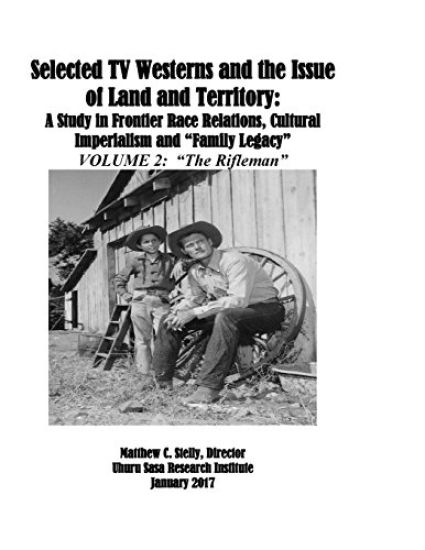
Selected TV Westerns and the Issue of Land and Territory: : VOLUME 2: The RIfleman

Selected TV Westerns and the Issue of Land and Territory: : VOLUME 2: The RIfleman

Matthew C. Stelly

Createspace Independent Publishing Platform
2018
nidottu
Westerns were among the most racist of the white man's repertoire of racist genre. Everything he touches is about white supremacy and black degradation, but among the first strategies was the western. His mother movies simply omitted black people or featured them as maids and butlers. But the western focused on white versus red - the invading peckerwood taking over the country and using the media to make the First Nation people appear to be the enemies. Defending themselves and their culture, they were presented to white and black households as "Indian massacres." The atrocities of white folks were rarely mentioned, and most of the land that they procured was presented as having been "earned" or God-given - hence, the concept of what came to be known as "Manifest Destiny." This particular book is one of three dedicated to westerns (the other two being "Bonanza" and "Laramie"). In this volume, dedicated to "The Rifleman", there were 168 episodes, and ran from 1958 to 1963. I watched the majority of the episodes on You Tube and on cable television for research preparing for this book. A channel called MeTV aired back-to-back episodes for several years and I caught a number of episodes using that process. In my view, Lucas McCain and his son Mark had the most impressive and thought-provoking father-son relationship in the history of television, with the possible exception of Andy Griffith and his TV son "Opie" during the reign of "The Andy Griffith Show". It is for that reason that the cover of this volume of the trilogy featured Lucas and Mark without McCain's vaunted rifle. He may have been a sharpshooter, but above all else he was an incredibly devoted father. A number of episodes highlight the relationship between father and son - without a shot being fired. Another point worthy of mention is that Lucas McCain may have been one of the first or few male feminists on television. Sure, he held on to the "woman's place is in the kitchen and the bedroom" stereotypes, but he also defended women's rights, supported the General store when it was headed by three different women over the years, and backed up any woman who was insulted by a man, and passed on these lessons to young Mark. These incidents will be pointed out in this analysis. In this writer's view, land, territory and on-going struggles to maintain ranches that were indirectly pilfered from First Nation people. Hence, this book and the hope that those who read it will conduct additional research on how this country was formed and the myth of the white cowboy at a time when black cowboys were in the majority and Mexican vaqueros were riding all over the land. When Mexicans were featured they were usually of the "bandito" variety, but of course the Mexican women were seductive and fine. The few natives who were featured became friends of Lucas and Mark, such as was the case in the episode titled, "The Silent Knife" which featured a native teen named Brad Western, two episodes involving Native marshal Sam Buckhart (played by Michael Ansara) in two episodes, "The Indian" and "The Raid." There were also two episodes that featured the late, great Sammy Davis, Jr. They were, "Two Ounces of Tin" and "The Most Amazing Man." Despite the weaponized title of the show, "The Rifleman" was what Lucas McCain became known as. In fact, there were a number twenty-eight (28) episodes where no shots were fired at all. At the end of each episode review/analysis the words "no shots fired" will be listed.
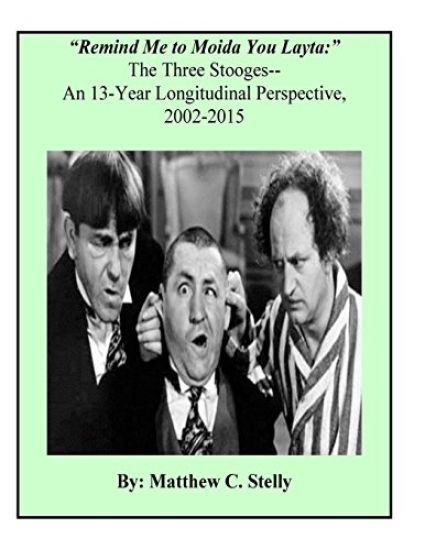
Remind Me to Moida You Later - The Three Stooges: A 13-Year Longitudinal Perspective, 2002-2015
In April of 2003, CBS aired a program celebrating the 75th Anniversary of the Three Stooges. The program was very informative and was aired after prime time because even now, the decisionmakers - Jews themselves - knew that what these men was doing was incredibly violent and dangerous. Personally, I enjoyed watching their antics and any other program that shows white people dogging out other whites - the same way they got gut laughs off of Amos n' Andy, Stepin Fetchit, Mantan Moreland, "Good Times," "The Jeffersons" and other coons and the movies and TV shows they starred in. At any rate, the accolades, kudos and praise showered upon Moe, Larry, Curly Joe, Shemp and Joe should be counter-balanced - and in some cases augmented - with a black perspective. For the most part, the Stooges were talented, though racist; they were pioneers in comedy, but still sexist (some would say outright misogynistic). In other words, their skits were a reflection and reinforcement of the times. Much of the snippets about each Stooges episode and information outlining each segment was found on line, as a few people took the time to document the TV "shorts" and a few even bothered to provide a short overview of them. Some of this information was gleaned through research on-line, including a document called The Three Stooges Scrapbook. The topics they tackled, the fact that they were a reflection of their times (rampant sexism, racism and class issues permeate their work), are all important to me and as a result, this is more than just a puff piece; it is an anthropological and critical race theory look at these funny men, addressing issues and concerns that the reader may not find all that "funny." They had sibling issues just like the rest of us. Shemp was Curly's big brother and Curly replaced him for a while. But in 1946 Curly suffered a stroke and Shemp returned to the team. Some might say this is a waste of time. But any time spend studying something and analyzing it from a perspective that can help black and other minority kids learn how to "critically think," is never time wasted. The fact is, someone has to document or provide a black view of what these five Jews (Moe, Joe, Shemp, Larry and Curly) did in the name of "laughs" so that future generations won't be naively believing that it was all "innocent fun." They were, to put it mildly, a reflection of the times. Furthermore, there were 190 episodes, all told. That is a track record of almost two full decades of slaps, kicks, pokes and so on. They are to be commended for their stick-to-it-tiveness. In my brief reviews I highlight the jokes and laughs, but also point to issues of racism and gender bias when and wherever necessary. And we can't overlook the sadism masked in slapstick and silliness. This content analysis is the product of a great deal of television viewing. The inspiration to undertake this project started in 2002 when a cable television channel, A&E, aired an hour of Stooges movies and shorts. I watched nearly every Stooge movie made during the year or so, and documented the dates of each viewing. Many of them had repetitive themes and, in fact, I have categorized those which are similar (female gold diggers, haunted houses, the stooges as repairmen, etc.). The genius of these men should not be undermined, however. The sound effects of the pokes in the eyes were the plucking of strings on a ukelele; the slaps were oftentimes real with sounds effects magnifying them; the blows to the gut came from a bass drum; Larry's hair being ripped out was paper being torn, etc. etc. Their comedy was far more than just slapstick however; keenly honed puns and jokes placed the Stooges in a league far ahead of their time, in my view. And as I stated earlier, the outright sadism cannot be overstated.
The Kaepernick Syndrome and the Manhunt Tradition: Police Shootings as Race - Based Standards and Practices for Control of Black Communities
This book, The Kaepernick Syndrome and The Manhunt Tradition: Police Shootings as Race-Based Standards and Practices for Control of Black Communities, is geared toward providing historical, social and ideological information regarding police-community relations as they relate to the spate of police shootings of unarmed black men, a point that has been brought to the fore by former NFL quarterback turned activist Colin Kaepernick. The book, with emphasis on "The manhunt tradition," as coined by the late great Dr. Oliver C. Cox in his incredible work, Caste, Class and Race: A Study in Social Dynamics, describes the background of the "policing" of black communities with emphasis on the hunting down of African-American males. This information is being offered so that those who do not study will understand the gravity and importance of young Kaepernick's "movement" and how long these kinds of policing actions have been occurring. The book offers insights and information in several ways. There is a chapter that defines the "manhunt tradition" followed up by a section that applies the tradition to traditional police tactics. There is a section that describes such a tradition, as conducted by everyday townfolk as described in a short story by Thomas Wolfe called, "The Child By Tiger." Another short story, "The Most Dangerous Game, places emphasis on the "manhunt tradition" and the idea of using human beings as targets "for fun." Then we turn back to reality with the story of young Omar Thornton, a black man who grew tired of harassment and ridicule at work and, in 2010, picked up a gun, said goodbye to his loved ones, and began gunning down the racist white people who, for years, had made his life a living hell. Following his taking of his own life after being surrounded, the response to white folks in the town is worthy of notice because they are akin to what is heard today in 2018 when the police explanations are immediately backed up by their captains, then by a grand jury, and then "excused" as the community moves on as if nothing ever happened. In the final chapter, the manhunt tradition is summarized and kudos are paid to Colin Kaepernick for taking a stand against what appears to be a "blue epidemic" when it comes to these "oops I did it again" type police shootings of Black men.
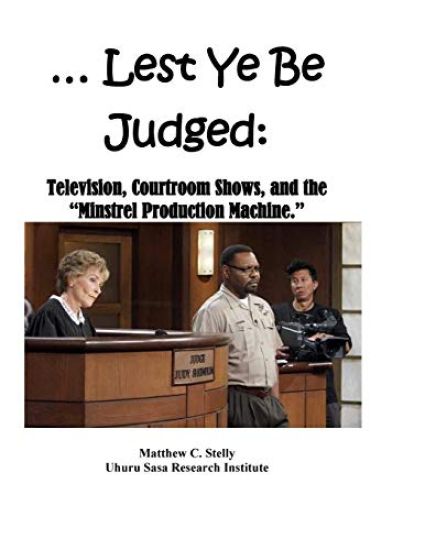
... Lest Ye Be Judged --: Television, Courtroom Shows, and the "Minstrel Production Machine."
"Judge not, that ye be not judged. For with what judgment ye judge, ye shall be judged: and with what measure ye mete, it shall be measured to you again. - Matthew 7:1. So-called Christian soldiers It's time to do your business or get off the pot Order in the court - which is sorely lacking in most of these court TV shows, a point that will be explained in this book about those programs and the people who sit in as "judges." And yet these television judges - really arbitrators and mediators - sit in judgment of na ve litigants five days a week using a wide range of "judges" to make decisions about the lives of everyday people who have been vetted to ensure that they will appear on television and make utter clowns of themselves for the pleasure of the viewing audience. This book deals with the most popular court TV programs and gives them a going-over in the same way that far too many of those sitting on that bench do to litigants who have literally signed their lives away in exchange for a shot at stardom. Move over Koko, Bozo and Shakes: there is a new crop of "clowns" on the horizon. And many of them are your next door neighbors. The judges analyzed in this book include Alex Ferrer, the "Couples Court" with the Cutler family, Marilyn Milian of "The People's Court" and Jeanine Pirro, President Donald Trump's mouthpiece. Others include Lynn Toler, the queen of bipolar disorder, Karen Mills-Francis a sistah with dyed blond hair, Faith Jenkins who looks like she should be in grade school and Greg Mathis, the "street brutha" who never hesitates to remind the audience of that and to bring up the subject of "crack" whenever possible. I close out with Joe Brown, Lauren Lake of "Paternity Court" and then comes the one I enjoyed criticizing the most: Judge Judy Sheindlin of "Judge Judy." Additional analysis is included in sections on which shows I deem "the best" and "the worst" and a final word on "the minstrel production machine."
Introduction to Africentric Sociourban Planning: : Concepts and Characteristics

Introduction to Africentric Sociourban Planning: : Concepts and Characteristics

Matthew C. Stelly

Createspace Independent Publishing Platform
2018
nidottu
This book offers the elements of a theory whose time has come. The "browning of America" is what most people fear and as a result, those who are the targets of that fear must be in a position to be in charge of their own defense and development. Existing urban planning paradigms, from "advocacy planning," "equity planning" and "neighborhood planning" to jive-time programs like urban renewal, Model Cities and Enterprise Zones don't cut it because the people in charge don't look like the people being planned for. In this book I challenge some leading urban planning scholars and add the variable of "race" to their visions and perceptions of reality. I address the history of urban planning, central city "predators" and a host of issues that helped foster and fan the segregation that we continue to see today. I also offer some urban models of black leadership and several of my own proposals, including the "Agenda for Autonomy" and "the New Birth Initiative." Issues of zoning, the land question and Eminent Domain will be tackled. Long-time neighborhood approaches, from the neighborhood maintenance approach and the social work approach to the political activist approach will be analyzed. The proposed Africentric Sociourban Paradigm will be defined and explained in terms of its relevance to the future of American society and its on-going demographic transition. Another point is that "urban planning" also goes by names like "city planning," "urban development," "and "town planning." But in each of these you will find a gross neglect of discussions of race. The "human settlements" that are of importance are white ones, and blacks do not come into the picture until after black migration to the north. In fact, the black presence in the north accelerated the work of the urban planners to make sure that low-income people and blacks were separated from the "normal white folks." This is the REAL American history. My concept of Africentric Sociourban planning is not something brand new or sui generis. It just far more humane and the motivations are rooted in the future, not pacification plans for the present. In urban planning we find various forms of planning that attempted to show a concern for and commitment to the black community such as advocacy planning, neighborhood planning and equity planning. In sum, the Africentric Sociourban Paradigm is an idea whose time has come and rests on a present-day as well as a futuristic tenet - leadership by people of color FOR people of color with the future of a "browning of America" being inevitable. White people can no longer teach what they don't know and lead what they don't know, as has been the traditional tendency and historical pattern.
The Lyrics of ?Love? as ?Lifenotes?: The ?True? Songs From the Heart: From Flirtations and Fondness to Fervor and "Forevermore"
This book consists of eighty-seven (87) "songs of love" that I have personally selected for analysis. It is actually the final chapter from the fourth volume of my series, "Love Songs You Might Want to Hate." I saved it for last for a reason: it is the most warmhearted chapter in the entire collection and as such, it deserved to be a book of its own. After all, the original title was "True" Love Songs." With that having been shared, I coined the phrase "LifeNotes" to be more than just journal entries or diary references. These are more mental, more cerebral than anything else. The feelings that we have and exhibit that represent love come in many forms and for many reasons. We love our children, our parents, our relatives, some of our friends and when it comes to the oppressed, it appears that we even have love for those who have proven to be our enemies. This book is about love but it is not sugar-coated. I write using terms that some people may find offensive. But then again, some people find love offensive. Some people do dirt, commit crimes, kill and claim that they did it out of or because of love. In this case we say, "to each his own" and then move along collecting more "lifenotes" as we wander through life gathering new experiences with each passing day. In some of my analyses you will see how I take a look at the "games" that are played in the name of love, some of the negative responses to the abuse of what is viewed as love, and some of the long-term impact that losing a love can have on one's mind and life. Sometimes it is not a pretty picture. But the key is to overturn the actual and continue to pursue the possible. That's why it's called life and that is why I call the collection of these 87 selections, and the trials and triumphs therein, "lifenotes." If you ever really loved someone, you never just stop on a dime and move on, as some of these songs may imply. "Moving on" simply means that you are attempting to deal with or address the hurt you may feel. But when all is said and done, tomorrow is another day and life goes on. As you can probably tell, this is the most subjective and biased book on the topic of "love" that you may ever read because it consists of MY own selected songs, songs that bring back memories and have made their way into my lifenotes. What follows are MY choices, my views of what the "true" love songs are. That is why as a writer and thinker, I reserve the choice to make selections such as these and then share then with you all, who are mostly followers, readers and people who are easy to influence. These songs all bring something to the table that we can use in our own personal lives or, at very least, be able to relate to on some level. And that is what makes them "true.
Jemimas Assemble!: Women of Color Who Sell Out the Race

Jemimas Assemble!: Women of Color Who Sell Out the Race

Matthew C. Stelly

Createspace Independent Publishing Platform
2018
nidottu
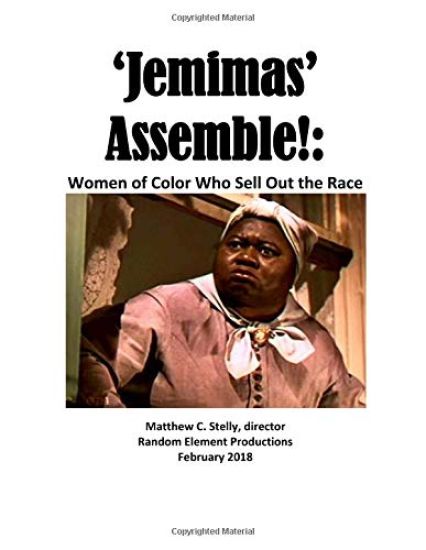
A scholar named Doneghy (2018) offered an excellent article on the history of Aunt Jemima and the image. Of key importance was the following statement: Aunt Jemima was first introduced as a character in a minstrel show - an American form of entertainment developed in the late 19th century. Each show consisted of comic skits, variety acts, dancing, and music. The shows were performed by white people in blackface for the purpose of playing the roles of black people. Minstrel shows portrayed black people as dimwitted, lazy, easily frightened, chronically idle, superstitious, happy-go-lucky buffoons. (Doneghy, 2018 - emphasis added) So in other words, Aunt Jemima's image was conceived in a racist, negative portrayal of black folks. Those minstrel shows were the white man's way of degrading African people. To them it was "entertainment" in the way that watching blacks form "prayer vigils" and "protests" against the racism that has always been there is also a barrel of laughs. The concept of blacks as lazy, easily frightened, and the rest remains behind although it has been fine-tuned. But the concept of the "buffoon" is alive and well and some of the black women highlighted in this book make that point amazingly clear with their comments and actions. You see them in every city and scenario: the so-called "black leaders" (known back in the day as "negro leaders"). These people are either self-appointed or they somehow get the white stamp of approval from some white man. If they help out with an election, they'll get a position, a title and maybe a set of keys that don't fit anything. If they side with the white man publicly, they'll be rewarded. If they're ministers or represent a bunch of passive black people in some religious setting, they'll get paid under the table to continue to do the bidding of the system. Milwaukee is full of them, from the state legislatures to the common council; Dallas has them at the Congressional level as well as the county and city council; and Omaha even has a few. In all these cases these opportunistic people can openly sell out the black community and continue to get away with it. These are today's "house negroes." The world sees Black people in America as a group that they are related to, but as a group that is passive and opportunistic. Many of them wonder "why don't you have any power?" or "why aren't you doing better?" The fact is that black people have become passive and smugly satisfied with the crumbs from the white man's table. So beaten down from over 300 years of enslavement - an experience that would have eliminated most other groups - Africans trapped in America nevertheless survived but a part of that enslavement experience was a dehumanization process that included a massive brainwashing. No other slve system in history was as brutal and as psychologically damaging as the one that white people placed on African people in the Americas. Today in 2018, black people are still staggering from the effects of that dehumanization process. There are those of us out there seeking to provide information and motivate, answering questions that are people pose out of ignorance and fear. You hear the same questions time and time again, and even when solutions are provided - such as those in my books - fear takes over and black people scurry to the one institution that has duped them for centuries and that they continue to be beholden to: the black church. This book names those African-American beauties who have been co-opted, on some level, by the system that oppresses us all. There are tens of thousands more. You know who you are.
CBS' King of Queens: Of Caucasians, Coloreds and Comedic Relationships

CBS' King of Queens: Of Caucasians, Coloreds and Comedic Relationships

Matthew C. Stelly

Createspace Independent Publishing Platform
2018
nidottu
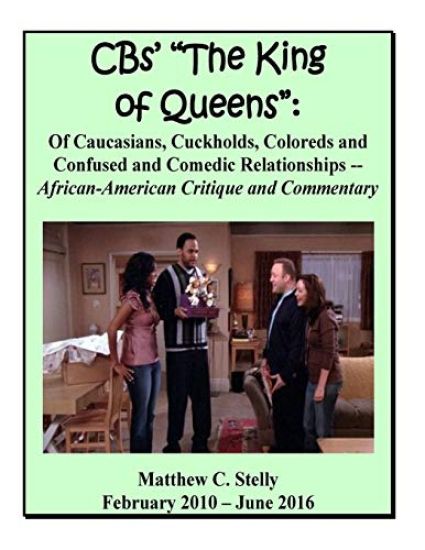
Most people sit and run their mouths with friends, relatives or at the bar. I act and I want to leave a legacy of being someone who cared enough about certain things to commit them not only to memory, but to pen and paper. It was an old poem that contained the words, ""For of all sad words of tongue or pen, The saddest are these: 'It might have been '" So, "striking while the iron's hot," I write about what I like and what I don't like, The CBS show "The King of Queens" fits squarely near the top of the former category. In this book I have taken time to review more than 100 episodes and broke them down into categories - the mark of a true social scientist. These categories are: Cast of Characters, Methodology, Carrie Heffernan as "Skank": An Analysis, The Carrie-Doug Dyad: An Assessment of 'Power Relations', Carrie's Infatuation With Deacon: Jungle Fever or Just Jivin'?, Doug as Wannabe "Thug" and The Doug-Deacon Friendship: Most Equitable on Television." Other areas of analysis are, Spence and Danny: Gay or Just Gregarious?, Arthur Spooner and "The Basement" as a Metaphor for Treatment of the Elderly: Critique and Commentary, Deacon Palmer: A Black Man With Dignity on Television and a realistic appraisal from an African-American scholar's point of view. Nothing can be deemed a "waste of time" if it offers teaching moments and learning experiences. The show itself opened up some eyes on some important aspects of blue collar life that may not have been appreciated before. Enjoy.
Today's Negro Leadership: Made and Manufactured in America

Today's Negro Leadership: Made and Manufactured in America

Matthew C. Stelly

Createspace Independent Publishing Platform
2018
nidottu
"Today's Negro Leadership: Made and Manufactured in America. Because of the 400 year dehumanization process during enslavement, no statement could be more germane in these days and times of the black sellout, the treacherous Quisling and the duplicitous race betrayer. Some call this "post-racial America"; this book will prove that the black overseer, the "house negro" as Malcolm X called them, are alive and well and living in America. This book is not about name-calling but about "defining." At a time when there is a dearth of Black leadership in America - perhaps the lowest in the history of blacks in this country - there is a need to ask questions and investigate into why this is the case. My main concern is how influence peddlers - known to most of you as "leaders" - are being pawned off as power brokers, when nothing could be further from the truth. In this book I name people whose comments, actions and attitudes have filtered down and influenced hundreds of thousands - perhaps millions - of impressionable black folk, young and old alike. Among those mentioned and discussed in this book are Clarence Thomas, Supreme Court Justice; Jesse Owens, winner at the 1936 Olympics whose perpetual butt kissing is still being held up by the system as some kind of "model"; Raven-Symone and Stacey Dash (both who have publicly rejected their own blackness); Rev. Al Sharpton, a professional poverty pimp; Omarosa Manigault Newman, the biggest sellout since Ward Connerly; Diana Ross, Charles Barkley (who hides his personal life but has the gall to speak out on black issues), Whoopi Goldberg and several others. I once read where Audre Lorde wrote, "When I dare to be powerful - to use my strength in the service of my vision, then it becomes less and less important whether I am afraid." You have your views and I have mine. Mine are published. So read and enjoy.
Bill Cosby: Lost, Stolen or Strayed?

Bill Cosby: Lost, Stolen or Strayed?

Matthew C. Stelly

Createspace Independent Publishing Platform
2018
nidottu
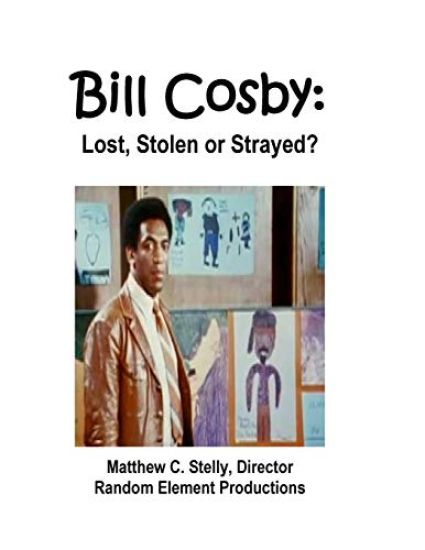
This book, "Bill Cosby: Lost, Stolen or Strayed" is not like any other book written on the man who is considered "America's Dad." This book is not only a review and analysis, but also a sociological, psychological and anthropological examination of a man who appears to have never really given a damn about Black people other than to work with the system to exploit them and to make fun of them through cartoons, comic recordings, movies and on television. This book recalls the 1968 movie that Cosby narrated, "Black History: Lost, Stolen or Strayed" and raises that question, focused on Cosby's own life, some half century later. That documentary, considered by many to be "militant" is transcribed and analyzed in-depth, along with the man who wrote the script, Andy Rooney of "60 Minutes" fame. Also in this book is a look at Cosby's standup comedy and his Saturday morning cartoon show, "The Cosby Kids." This writer offers and hopes to have proven that there have been few cartoons as degrading and insultingly "coonish" as the Cosby Kids and what they presented to black and white America. This book touches on the Autumn Jackson controversy, where child's out of wedlock child tried to extort $40 million from him and on the death of his son Ennis. Using legal analysis this writer views Ennis' death as a cover-up of sorts and raises issues not raised elsewhere. Then it's on to TV and the silver screen. The latter is represented by five randomly selected movies: "Man and Boy" (1972¬¬), "Uptown Saturday Night" (1974), "Let's Do It Again" (1975), "A Piece of the Action" (1977) and "Leonard Part 6" (1987). At the end of the book are sections addressing the concept of being "lost, stolen or strayed" and a section dealing with his wife Camille and her views on black business. In closing a discussion of what psychologist Roderick W. Pugh called "the we-ain't-ready syndrome: " and two of Cosby's degrading lectures: the "Pound Cake" speech of 2004 and his presentation to the graduating class of Temple University in 2012. Then, the issue of the sexual abuse allegations and selected views of what "black celebrities" think of the case. After being found guilty I ask, "What now for America's Dad?
Classic Movies, 1940-1970: Messages, Memories and Magnitude - An African-American Film Critic's Perspective
From 1940 through 1970. Movies by and about black people, and a few other movies of an "exotic" nature (i.e., "The Manster") are of particular interest to me. These were the formative years of race relations in this country and Black people paved the way so others could come in afterwards and win the rights that they, too, had been denied. These sixteen (16) movies are the product of a writer who reserves the right to pick and choose movies that the race - African people - can benefit from in retrospect and prospect. Some may seem a little out of bounds ("Manster," "Monster from Green Hell") but the racial implications of these movies and the clear messages all of them send represent teaching moments. So it shall be done. I did not see all of these movies. Relying on YouTUBE for snippets and some reviews of these flicks, I used my more than four decades of background in black studies, history and culture to analyze these movies and not just simply "review" them. What is important is the real impact that each of these movies can have on black audiences, both when they were released and in present-day times. That is what concerns me because, as Malcolm X taught, "Of all our studies, history is best qualified to reward our research." In other words, each movie represents a potential "teaching moment" relevant to the black historical experience. Even the movies that are not about black people offer relevant cultural lessons that we can learn from. I shall briefly go through each of them. The movies are a diverse bunch, some of them from the science fiction genre, some are political in nature, and others are of the romantic drama variety. As the analyst of these movies I reserve the right - and took full advantage of it - to interject the variable of "race" into my assessment of each of these flicks. Please read and enjoy and share these titles with the younger members of your family. There is much that can be learned because in far too many instances, "The past is prologue."