Kirjojen hintavertailu. Mukana 11 244 527 kirjaa ja 12 kauppaa.

Kirjahaku

Etsi kirjoja tekijän nimen, kirjan nimen tai ISBN:n perusteella.

1000 tulosta hakusanalla Matthew Crawford

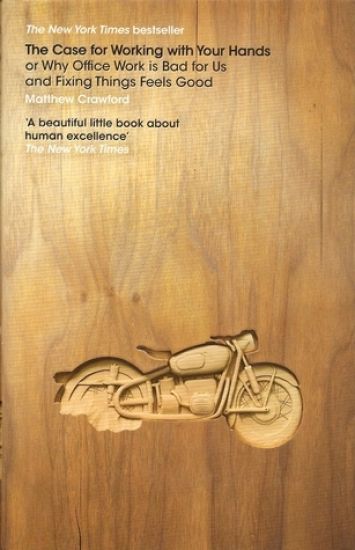
The Case for Working with Your Hands

The Case for Working with Your Hands

Matthew Crawford

Penguin Books Ltd
2010
pokkari
It's time to rethink our attitudes to work.For too long we have convinced ourselves that the only jobs worth doing involve sitting at a desk. Generations of school-leavers head for university lacking the skills to fix or even understand the most basic technology. And yet many of us are not suited to office life, while skilled manual work provides one of the few and most rewarding paths to a secure living.Drawing on the work of our greatest thinkers, from Aristotle to Heidegger, from Karl Marx to Iris Murdoch, as well as on his own experiences as an electrician and motorcycle mechanic, Matthew Crawford's irreverent and inspiring manifesto will change the way you think about work forever.
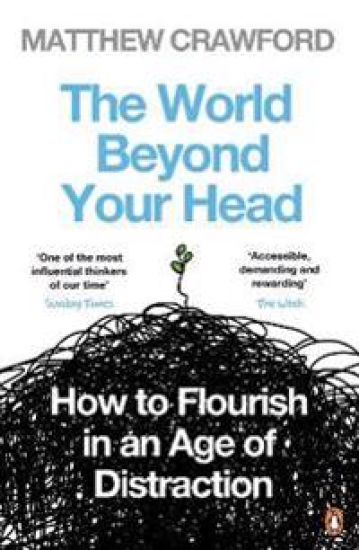
The World Beyond Your Head

The World Beyond Your Head

Matthew Crawford

Penguin Books Ltd
2016
pokkari
From 'one of the most influential thinkers of our time' (Sunday Times): how to respond to today's demands on our attentionIn this brilliant follow-up to The Case for Working with Your Hands, Matthew Crawford investigates the challenge of mastering one's own mind. With ever-increasing demands on our attention, and with capitalism increasingly invading every space, how do we focus on what's really important in our lives?Exploring the intense focus of ice-hockey players, the flow of a cook in their element, and the inherited craft of building pipe organs, Crawford argues that in order to flourish, we need to return to lives where we establish meaningful connections with objects and the people around us.
The Gladiolus (Esprios Classics)

The Gladiolus (Esprios Classics)

Matthew Crawford

Blurb
2024
pokkari
"This little book is written with a view to being of service to those inexperienced admirers A] of the gladiolus who wish to become better acquainted with its nature, and more familiar with the details of its cultivation. The language used is plain and easily understood, and the absence of technical terms, which might seem a fault to the skilled grower, will probably enhance the value of the work to the learner, for whom it is prepared. While it is written from the view-point of the commercial grower, the interests of the amateur are kept in mind throughout, and the instructions are as carefully adapted to the management of a little garden as to that of an extensive field."
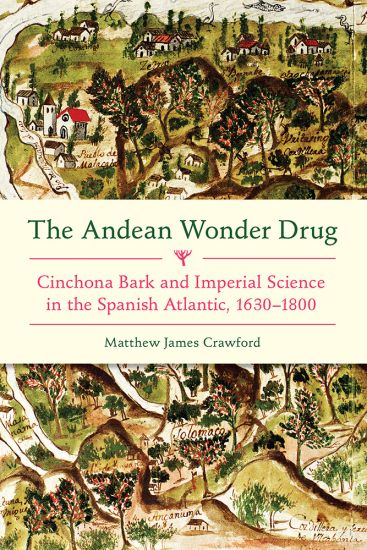
Andean Wonder Drug, The

Andean Wonder Drug, The

Matthew James Crawford

University of Pittsburgh Press
2016
sidottu
In the eighteenth century, malaria was a prevalent and deadly disease, and the only effective treatment was found in the Andean forests of Spanish America: a medicinal bark harvested from cinchona trees that would later give rise to the antimalarial drug quinine. In 1751, the Spanish Crown asserted control over the production and distribution of this medicament by establishing a royal reserve of "fever trees" in Quito. Through this pilot project, the Crown pursued a new vision of imperialism informed by science and invigorated through commerce. But ultimately this project failed, much like the broader imperial reforms that it represented. Drawing on extensive archival research, Matthew Crawford explains why, showing how indigenous healers, laborers, merchants, colonial officials, and creole elites contested European science and thwarted imperial reform by asserting their authority to speak for the natural world. The Andean Wonder Drug uses the story of cinchona bark to demonstrate how the imperial politics of knowledge in the Spanish Atlantic ultimately undermined efforts to transform European science into a tool of empire.
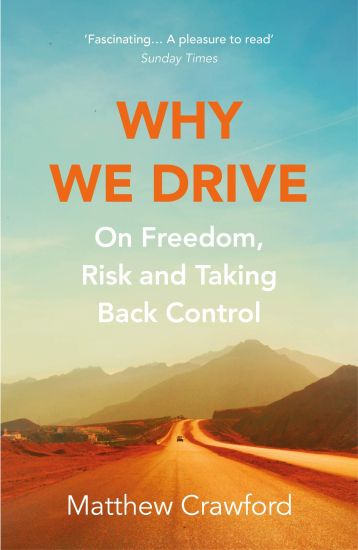
Why We Drive: Toward a Philosophy of the Open Road
A brilliant and defiant celebration of driving as a unique pathway of human freedom, by "one of the most influential thinkers of our time" (Sunday Times)"Why We Drive weaves philosophers, thinkers, and scientific research with shade-tree mechanics and racers to defend our right to independence, making the case that freedom of motion is essential to who we are as a species. ... We hope you'll read it." --Road & TrackOnce we were drivers, the open road alive with autonomy, adventure, danger, trust, and speed. Today we are as likely to be in the back seat of an Uber as behind the wheel ourselves. Tech giants are hurling us toward a shiny, happy "self-driving" future, selling utopia but equally keen to advertise to a captive audience strapped into another expensive device. Are we destined, then, to become passengers, not drivers? Why We Drive reveals that much more may be at stake than we might think.Ten years ago, in the New York Times-bestselling Shop Class as Soulcraft, philosopher-mechanic Matthew B. Crawford--a University of Chicago PhD who owned his own motorcycle shop--made a revolutionary case for manual labor, one that ran headlong against the pretentions of white-collar office work. Now, using driving as a window through which to view the broader changes wrought by technology on all aspects of contemporary life, Crawford investigates the driver's seat as one of the few remaining domains of skill, exploration, play--and freedom. Blending philosophy and hands-on storytelling, Crawford grounds the narrative in his own experience in the garage and behind the wheel, recounting his decade-long restoration of a vintage Volkswagen as well as his journeys to thriving automotive subcultures across the country. Crawford leads us on an irreverent but deeply considered inquiry into the power of faceless bureaucracies, the importance of questioning mindless rules, and the battle for democratic self-determination against the surveillance capitalists. A meditation on the competence of ordinary people, Why We Drive explores the genius of our everyday practices on the road, the rewards of "folk engineering," and the existential value of occasionally being scared shitless.Witty and ingenious throughout, Why We Drive is a rebellious and daring celebration of the irrepressible human spirit.
Why We Drive: Toward a Philosophy of the Open Road

Why We Drive: Toward a Philosophy of the Open Road

Matthew B. Crawford

William Morrow Large Print
2020
nidottu
A brilliant and defiant celebration of driving as a unique pathway of human freedom, by "one of the most influential thinkers of our time" (Sunday Times)"Why We Drive weaves philosophers, thinkers, and scientific research with shade-tree mechanics and racers to defend our right to independence, making the case that freedom of motion is essential to who we are as a species. ... We hope you'll read it." --Road & TrackOnce we were drivers, the open road alive with autonomy, adventure, danger, trust, and speed. Today we are as likely to be in the back seat of an Uber as behind the wheel ourselves. Tech giants are hurling us toward a shiny, happy "self-driving" future, selling utopia but equally keen to advertise to a captive audience strapped into another expensive device. Are we destined, then, to become passengers, not drivers? Why We Drive reveals that much more may be at stake than we might think.Ten years ago, in the New York Times-bestselling Shop Class as Soulcraft, philosopher-mechanic Matthew B. Crawford--a University of Chicago PhD who owned his own motorcycle shop--made a revolutionary case for manual labor, one that ran headlong against the pretentions of white-collar office work. Now, using driving as a window through which to view the broader changes wrought by technology on all aspects of contemporary life, Crawford investigates the driver's seat as one of the few remaining domains of skill, exploration, play--and freedom. Blending philosophy and hands-on storytelling, Crawford grounds the narrative in his own experience in the garage and behind the wheel, recounting his decade-long restoration of a vintage Volkswagen as well as his journeys to thriving automotive subcultures across the country. Crawford leads us on an irreverent but deeply considered inquiry into the power of faceless bureaucracies, the importance of questioning mindless rules, and the battle for democratic self-determination against the surveillance capitalists. A meditation on the competence of ordinary people, Why We Drive explores the genius of our everyday practices on the road, the rewards of "folk engineering," and the existential value of occasionally being scared shitless.Witty and ingenious throughout, Why We Drive is a rebellious and daring celebration of the irrepressible human spirit.
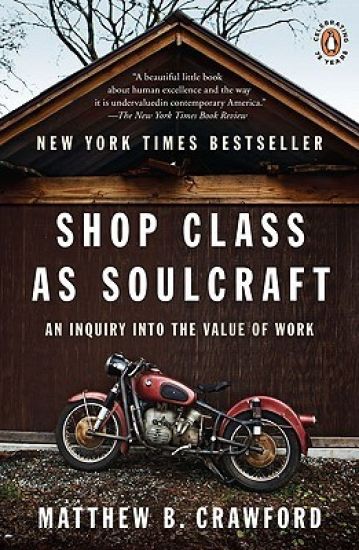
Shop Class as Soulcraft: An Inquiry Into the Value of Work
A philosopher/mechanic's wise (and sometimes funny) look at the challenges and pleasures of working with one's hands "This is a deep exploration of craftsmanship by someone with real, hands-on knowledge. The book is also quirky, surprising, and sometimes quite moving." --Richard Sennett, author of The Craftsman Called "the sleeper hit of the publishing season" by The Boston Globe, Shop Class as Soulcraft became an instant bestseller, attracting readers with its radical (and timely) reappraisal of the merits of skilled manual labor. On both economic and psychological grounds, author Matthew B. Crawford questions the educational imperative of turning everyone into a "knowledge worker," based on a misguided separation of thinking from doing. Using his own experience as an electrician and mechanic, Crawford presents a wonderfully articulated call for self-reliance and a moving reflection on how we can live concretely in an ever more abstract world.
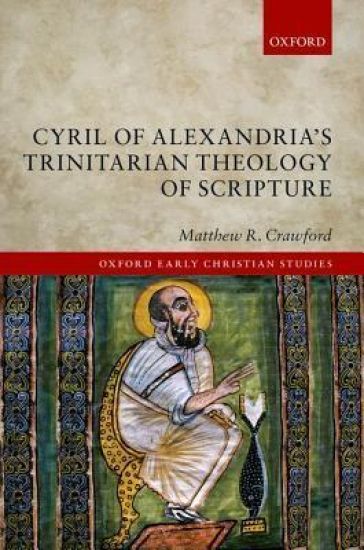
Cyril of Alexandria's Trinitarian Theology of Scripture

Cyril of Alexandria's Trinitarian Theology of Scripture

Matthew R. Crawford

Oxford University Press
2014
sidottu
More exegetical literature survives from the hand of Cyril of Alexandria than nearly any other Greek patristic author, yet this sizable body of work has scarcely received the degree of attention it deserves. In this work, Matthew R. Crawford reconstructs the intellectual context that gave rise to this literary output and highlights Cyril's Trinitarian theology, received as an inheritance from the fourth century, as the most important defining factor. Cyril's appropriation of pro-Nicene Trinitarianism is evident in both of his theology of revelation and his theology of exegesis, the two foci that comprise his doctrine of Scripture. Revelation, in his understanding, proceeds from the Father, through the Son, and in the Spirit, following the order of Trinitarian relations. Moreover, this pattern applies to the inspiration of Scripture as well, insofar as inspiration occurs when the Son indwells human authors by the Spirit and speaks the words of the Father. Although Cyril's interpretation of revelation may consequently be called 'Trinitarian', it is also resolutely Christological, since the divine and incarnate Son functions as the central content and mediator of all divine unveiling. Corresponding to this divine movement towards humanity in revelation is humanity's appropriation of divine life according to the reverse pattern--in the Spirit, through the Son, unto the Father. Applied to exegesis, this Trinitarian pattern implies that the Spirit directs the reader of Scripture to a Christological interpretation of the text, through which the believer beholds the incarnate Son, the exemplar of virtue and the perfect image of the Father, and accordingly advances in both virtue and knowledge. This process continues until the final eschatological vision when the types and riddles of Scripture will be done away with in light of the overwhelming clarity of the Christologically-mediated Trinitarian vision.
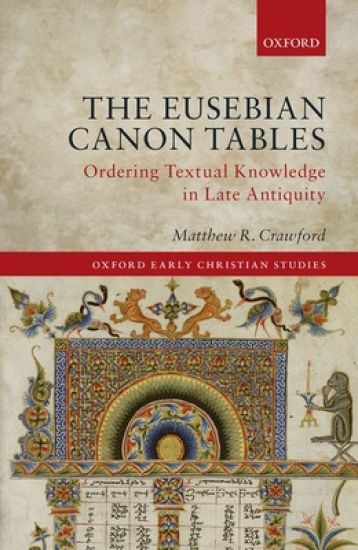
The Eusebian Canon Tables

The Eusebian Canon Tables

Matthew R. Crawford

Oxford University Press
2019
sidottu
One of the books most central to late-antique religious life was the four-gospel codex, containing the Gospels of Matthew, Mark, Luke, and John. A common feature in such manuscripts was a marginal cross-referencing system known as the Canon Tables. This reading aid was invented in the early fourth century by Eusebius of Caesarea and represented a milestone achievement both in the history of the book and in the scholarly study of the fourfold gospel. In this work, Matthew R. Crawford provides the first book-length treatment of the origins and use of the Canon Tables apparatus in any language. Part one begins by defining the Canon Tables as a paratextual device that orders the textual content of the fourfold gospel. It then considers the relation of the system to the prior work of Ammonius of Alexandria and the hermeneutical implications of reading a four-gospel codex equipped with the marginal apparatus. Part two transitions to the reception of the paratext in subsequent centuries by highlighting four case studies from different cultural and theological traditions, from Augustine of Hippo, who used the Canon Tables to develop the first ever theory of gospel composition, to a Syriac translator in the fifth century, to later monastic scholars in Ireland between the seventh and ninth centuries. Finally, from the eighth century onwards, Armenian commentators used the artistic adornment of the Canon Tables as a basis for contemplative meditation. These four case studies represent four different modes of using the Canon Tables as a paratext and illustrate the potential inherent in the Eusebian apparatus for engaging with the fourfold gospel in a variety of ways, from the philological to the theological to the visual.
Oral History and Business

Oral History and Business

Robert Crawford; Matthew Bailey

TAYLOR FRANCIS LTD
2024
nidottu
This book introduces business historians to oral history methodologies and approaches.Using four distinct oral history case studies to explore ideas of disruption and continuity in business history over the second half of the twentieth century, Robert Crawford and Matthew Bailey demonstrate how critical engagement with oral history approaches serves to enhance and enliven business history as well as its relationship with other historical fields. The focus on disruption is used to encompass a broad set of processes such as technological change, the impact of external forces, informal business networks, social constructions of gender, knowledge transfer, firm adaptability and cultural change. The use of oral histories to interpret responses to disruption in the past, and to explore the features characterising business continuity, provides an opportunity to consider the human dimensions, subjective experiences and personal insights of workplace, firm and industry change. It also sheds light on the ways that people and firms respond to disruptive forces through innovation and adaptation – both successfully and unsuccessfully.This succinct and accessible account is essential reading for business historians with little experience in using oral history, as well as those looking to gain deeper insights from their oral history data.
Oral History and Business

Oral History and Business

Robert Crawford; Matthew Bailey

TAYLOR FRANCIS LTD
2022
sidottu
This book introduces business historians to oral history methodologies and approaches.Using four distinct oral history case studies to explore ideas of disruption and continuity in business history over the second half of the twentieth century, Robert Crawford and Matthew Bailey demonstrate how critical engagement with oral history approaches serves to enhance and enliven business history as well as its relationship with other historical fields. The focus on disruption is used to encompass a broad set of processes such as technological change, the impact of external forces, informal business networks, social constructions of gender, knowledge transfer, firm adaptability and cultural change. The use of oral histories to interpret responses to disruption in the past, and to explore the features characterising business continuity, provides an opportunity to consider the human dimensions, subjective experiences and personal insights of workplace, firm and industry change. It also sheds light on the ways that people and firms respond to disruptive forces through innovation and adaptation – both successfully and unsuccessfully.This succinct and accessible account is essential reading for business historians with little experience in using oral history, as well as those looking to gain deeper insights from their oral history data.
The World Beyond Your Head: On Becoming an Individual in an Age of Distraction
In his bestselling book Shop Class as Soulcraft, Matthew B. Crawford explored the ethical and practical importance of manual competence, as expressed through mastery of our physical environment. In his brilliant follow-up, The World Beyond Your Head, Crawford investigates the challenge of mastering one's own mind. We often complain about our fractured mental lives and feel beset by outside forces that destroy our focus and disrupt our peace of mind. Any defense against this, Crawford argues, requires that we reckon with the way attention sculpts the self. Crawford investigates the intense focus of ice hockey players and short-order chefs, the quasi-autistic behavior of gambling addicts, the familiar hassles of daily life, and the deep, slow craft of building pipe organs. He shows that our current crisis of attention is only superficially the result of digital technology, and becomes more comprehensible when understood as the coming to fruition of certain assumptions at the root of Western culture that are profoundly at odds with human nature. The World Beyond Your Head makes sense of an astonishing array of common experience, from the frustrations of airport security to the rise of the hipster. With implications for the way we raise our children, the design of public spaces, and democracy itself, this is a book of urgent relevance to contemporary life.
Why We Drive: Toward a Philosophy of the Open Road
From the author of the landmark Shop Class as Soulcraft, a brilliant, first-of-its-kind celebration of driving as a unique pathway of human freedom, one now critically threatened by automation. A thoughtful, entertaining, and substantive work about the joys of driving. --Wall Street Journal Once we were drivers, the open road alive with autonomy, adventure, danger, trust, and speed. Today we are as likely to be in the back seat of an Uber as behind the wheel ourselves. Tech giants are hurling us toward a shiny, happy "self-driving" future, selling utopia but equally keen to advertise to a captive audience strapped into another expensive device. Are we destined, then, to become passengers, not drivers? Why We Drive reveals that much more may be at stake than we might think.Ten years ago, in the New York Times-bestselling Shop Class as Soulcraft, philosopher-mechanic Matthew B. Crawford--a University of Chicago PhD who owned his own motorcycle shop--made a revolutionary case for manual labor, one that ran headlong against the pretentions of white-collar office work. Now, using driving as a window through which to view the broader changes wrought by technology on all aspects of contemporary life, Crawford investigates the driver's seat as one of the few remaining domains of skill, exploration, play--and freedom. Blending philosophy and hands-on storytelling, Crawford grounds the narrative in his own experience in the garage and behind the wheel, recounting his decade-long restoration of a vintage Volkswagen as well as his journeys to thriving automotive subcultures across the country. Crawford leads us on an irreverent but deeply considered inquiry into the power of faceless bureaucracies, the importance of questioning mindless rules, and the battle for democratic self-determination against the surveillance capitalists. A meditation on the competence of ordinary people, Why We Drive explores the genius of our everyday practices on the road, the rewards of "folk engineering," and the existential value of occasionally being scared shitless.Witty and ingenious throughout, Why We Drive is a rebellious and daring celebration of the irrepressible human spirit.