Kirjojen hintavertailu. Mukana 11 244 527 kirjaa ja 12 kauppaa.

Kirjahaku

Etsi kirjoja tekijän nimen, kirjan nimen tai ISBN:n perusteella.

1000 tulosta hakusanalla Matthew F. Delmont

The Nicest Kids in Town

The Nicest Kids in Town

Matthew F. Delmont

University of California Press
2012
sidottu
"American Bandstand", one of the most popular television shows ever, broadcast from Philadelphia in the late fifties, a time when that city had become a battleground for civil rights. Counter to host Dick Clark's claims that he integrated "American Bandstand", this book reveals how the first national television program directed at teens discriminated against black youth during its early years and how black teens and civil rights advocates protested this discrimination. Matthew F. Delmont brings together major themes in American history - civil rights, rock and roll, television, and the emergence of a youth culture - as he tells how white families around "American Bandstand's" studio mobilized to maintain all-white neighborhoods and how local school officials reinforced segregation long after Brown vs. Board of Education. "The Nicest Kids in Town" powerfully illustrates how national issues and history have their roots in local situations, and how nostalgic representations of the past, like the musical film Hairspray, based on the "American Bandstand" era, can work as impediments to progress in the present.
The Nicest Kids in Town

The Nicest Kids in Town

Matthew F. Delmont

University of California Press
2012
pokkari
"American Bandstand", one of the most popular television shows ever, broadcast from Philadelphia in the late fifties, a time when that city had become a battleground for civil rights. Counter to host Dick Clark's claims that he integrated "American Bandstand", this book reveals how the first national television program directed at teens discriminated against black youth during its early years and how black teens and civil rights advocates protested this discrimination. Matthew F. Delmont brings together major themes in American history - civil rights, rock and roll, television, and the emergence of a youth culture - as he tells how white families around "American Bandstand's" studio mobilized to maintain all-white neighborhoods and how local school officials reinforced segregation long after Brown vs. Board of Education. "The Nicest Kids in Town" powerfully illustrates how national issues and history have their roots in local situations, and how nostalgic representations of the past, like the musical film Hairspray, based on the "American Bandstand" era, can work as impediments to progress in the present.
Why Busing Failed

Why Busing Failed

Matthew F. Delmont

University of California Press
2016
sidottu
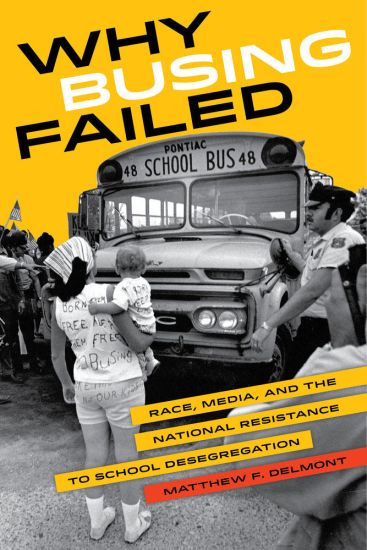
In the decades after the landmark Brown v. Board of Education Supreme Court decision, busing to achieve school desegregation became one of the nation's most controversial civil rights issues. Why Busing Failed is the first book to examine the pitched battles over busing on a national scale, focusing on cities such as Boston, Chicago, New York, and Pontiac, Michigan. This groundbreaking book shows how school officials, politicians, the courts, and the media gave precedence to the desires of white parents who opposed school desegregation over the civil rights of black students. This broad and incisive history of busing features a cast of characters that includes national political figures such as then-president Richard Nixon, Chicago mayor Richard J. Daley, and antibusing advocate Louise Day Hicks, as well as some lesser-known activists on both sides of the issue-Boston civil rights leaders Ruth Batson and Ellen Jackson, who opposed segregated schools, and Pontiac housewife and antibusing activist Irene McCabe, black conservative Clay Smothers, and Florida governor Claude Kirk, all supporters of school segregation. Why Busing Failed shows how antibusing parents and politicians ultimately succeeded in preventing full public school desegregation.
Why Busing Failed

Why Busing Failed

Matthew F. Delmont

University of California Press
2016
pokkari
In the decades after the landmark Brown v. Board of Education Supreme Court decision, busing to achieve school desegregation became one of the nation's most controversial civil rights issues. Why Busing Failed is the first book to examine the pitched battles over busing on a national scale, focusing on cities such as Boston, Chicago, New York, and Pontiac, Michigan. This groundbreaking book shows how school officials, politicians, the courts, and the media gave precedence to the desires of white parents who opposed school desegregation over the civil rights of black students. This broad and incisive history of busing features a cast of characters that includes national political figures such as then-president Richard Nixon, Chicago mayor Richard J. Daley, and antibusing advocate Louise Day Hicks, as well as some lesser-known activists on both sides of the issue-Boston civil rights leaders Ruth Batson and Ellen Jackson, who opposed segregated schools, and Pontiac housewife and antibusing activist Irene McCabe, black conservative Clay Smothers, and Florida governor Claude Kirk, all supporters of school segregation. Why Busing Failed shows how antibusing parents and politicians ultimately succeeded in preventing full public school desegregation.
Making Roots

Making Roots

Matthew F. Delmont

University of California Press
2016
sidottu
When Alex Haley's book Roots was published by Doubleday in 1976, it became an immediate bestseller. The television series, broadcast by ABC in 1977, became the most popular miniseries of all time, captivating over a hundred million Americans. For the first time, Americans saw slavery as an integral part of the nation's history. With a remake of the series in 2016 by A&E Networks, Roots has again entered the national conversation. In Making "Roots," Matthew F. Delmont looks at the importance, contradictions, and limitations of mass culture and examines how Roots pushed the boundaries of history. Delmont investigates the decisions that led Alex Haley, Doubleday, and ABC to invest in the story of Kunta Kinte, uncovering how Haley's original, modest book proposal developed into an unprecedented cultural phenomenon.
Until the Last Gun Is Silent: A Story of Patriotism, the Vietnam War, and the Fight to Save America's Soul
The untold story of the Black patriots--from soldiers in combat to peace protesters--who ended the Vietnam War and defended the soul of American democracy, from a pre-eminent civil rights historian and the award-winning author of Half American As the civil rights movement blazed through America, more than 300,000 Black troops were drafted and sent to fight in the Vietnam War. These soldiers, often from disadvantaged backgrounds and subjected to the brutalities of racism back home, found themselves thrust onto the frontlines of a war many saw as unjust. On the homefront, Black antiwar activists faced another battle: Opposition to the Vietnam War, vilified by key allies in the media and government as anti-American, jeopardized the fight for civil rights. For Black Americans, the Vietnam War forced a generation to question what it truly meant to fight for justice. Award-winning civil rights historian Matthew F. Delmont weaves together the stories of two Black heroes of the Vietnam War era: Coretta Scott King, who bravely championed the antiwar cause--and eventually persuaded her husband to do the same--and Dwight "Skip" Johnson, a Medal of Honor recipient whose life ended tragically after returning from battle to his native Detroit. Together, these extraordinary accounts expose the contradictions of Black activism and military service during the Vietnam War. Through rich storytelling, Delmont offers a portrait of this period unlike any other, shedding light on a fractured civil rights movement, a generation of veterans failed by the country they served, and the valor of Black servicemen and peace advocates in the midst of it all. Vivid, revelatory, and meticulously researched, Until the Last Gun Is Silent: How a Civil Rights Icon and Vietnam War Hero Changed America is essential reading for anyone looking to understand the enduring legacy of Black military service, protest, and patriotism in the United States.
Half American

Half American

Matthew F. Delmont

Penguin Adult
2024
nidottu
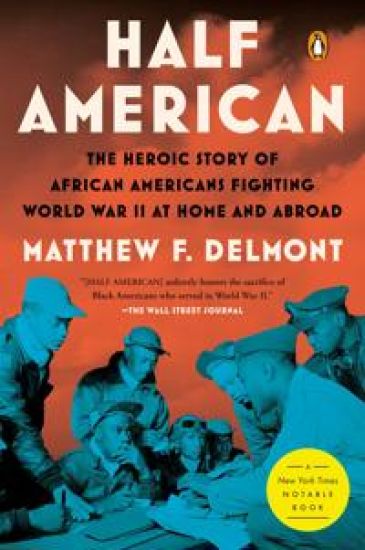
The definitive history of World War II from the African American perspective, by award-winning historian and civil rights expert Winner of the 2023 Anisfield-Wolf Book Award in Nonfiction A New York Times Notable Book of 2022 A 2022 Book of the Year from TIME, Publishers Weekly, Booklist, and more More than one million Black soldiers served in World War II. Black troops were at Normandy, Iwo Jima, and the Battle of the Bulge, serving in segregated units while waging a dual battle against inequality in the very country for which they were laying down their lives. The stories of these Black veterans have long been ignored, cast aside in favor of the myth of the "Good War" fought by the "Greatest Generation." And yet without their sacrifices, the United States could not have won the war. Half American is World War II history as you've likely never read it before. In these pages are stories of Black military heroes and civil rights icons such as Benjamin O. Davis Jr., the leader of the legendary Tuskegee Airmen, who fought to open the Air Force to Black pilots; Thurgood Marshall, the chief lawyer for the NAACP, who investigated and publicized violence against Black troops and veterans; poet Langston Hughes, who worked as a war correspondent for the Black press; Ella Baker, the civil rights leader who advocated on the home front for Black soldiers, veterans, and their families; and James G. Thompson, the twenty-six-year-old whose letter to a newspaper laying bare the hypocrisy of fighting against fascism abroad when racism still reigned at home set in motion the Double Victory campaign. Their bravery and patriotism in the face of unfathomable racism is both inspiring and galvanizing. An essential and meticulously researched retelling of the war, Half American honors the men and women who dared to fight not just for democracy abroad but for their dreams of a freer and more equal America.
Le Jazz

Le Jazz

Matthew F. Jordan

University of Illinois Press
2010
sidottu
In Le Jazz, Matthew F. Jordan deftly blends textual analysis, critical theory, and cultural history in a wide-ranging and highly readable account of how jazz progressed from a foreign cultural innovation met with resistance by French traditionalists to a naturalized component of the country's identity. Jordan draws on sources including ephemeral critical writing in the press and twentieth-century French literature to trace the country's reception of jazz, from the Cakewalk dance craze and the music's significance as a harbinger of cultural recovery after World War II to its place within French ethnography and cultural hybridity. Countering the histories of jazz's celebratory reception in France, Jordan delves in to the reluctance of many French citizens to accept jazz with the same enthusiasm as the liberal humanists and cosmopolitan crowds of the 1930s. Jordan argues that some listeners and critics perceived jazz as a threat to traditional French culture, and only as France modernized its identity did jazz become compatible with notions of Frenchness. Le Jazz speaks to the power of enlivened debate about popular culture, art, and expression as the means for constructing a vibrant cultural identity, revealing crucial keys to understanding how the French have come to see themselves in the postwar world.
Le Jazz

Le Jazz

Matthew F. Jordan

University of Illinois Press
2010
nidottu
In Le Jazz, Matthew F. Jordan deftly blends textual analysis, critical theory, and cultural history in a wide-ranging and highly readable account of how jazz progressed from a foreign cultural innovation met with resistance by French traditionalists to a naturalized component of the country's identity. Jordan draws on sources including ephemeral critical writing in the press and twentieth-century French literature to trace the country's reception of jazz, from the Cakewalk dance craze and the music's significance as a harbinger of cultural recovery after World War II to its place within French ethnography and cultural hybridity. Countering the histories of jazz's celebratory reception in France, Jordan delves in to the reluctance of many French citizens to accept jazz with the same enthusiasm as the liberal humanists and cosmopolitan crowds of the 1930s. Jordan argues that some listeners and critics perceived jazz as a threat to traditional French culture, and only as France modernized its identity did jazz become compatible with notions of Frenchness. Le Jazz speaks to the power of enlivened debate about popular culture, art, and expression as the means for constructing a vibrant cultural identity, revealing crucial keys to understanding how the French have come to see themselves in the postwar world.
The Bare Bones

The Bare Bones

Matthew F. Bonnan

Indiana University Press
2016
sidottu
What can we learn about the evolution of jaws from a pair of scissors? How does the flight of a tennis ball help explain how fish overcome drag? What do a spacesuit and a chicken egg have in common? Highlighting the fascinating twists and turns of evolution across more than 540 million years, paleobiologist Matthew Bonnan uses everyday objects to explain the emergence and adaptation of the vertebrate skeleton. What can camera lenses tell us about the eyes of marine reptiles? How does understanding what prevents a coffee mug from spilling help us understand the posture of dinosaurs? The answers to these and other intriguing questions illustrate how scientists have pieced together the history of vertebrates from their bare bones. With its engaging and informative text, plus more than 200 illustrative diagrams created by the author, The Bare Bones is an unconventional and reader-friendly introduction to the skeleton as an evolving machine.
America and Egypt

America and Egypt

Matthew F. Holland

Praeger Publishers Inc
1996
sidottu
This book discusses the relations between the United States and Egypt from Roosevelt to Eisenhower. To protect the free flow of oil, American policymakers looked to Egypt to provide the progressive, pro-Western leadership they believed would insure stability to the region. America's attempts to balance the needs of its British allies with those of Egypt coupled with Egypt's quest for regional hegemony proved to be a recipe for trouble. In the end, America failed in grooming Egypt as the pro-Western leader, could not bring peace to the region, and could not prevent the Soviet Union from gaining a foothold. Yet, the oil continued to flow.
Eisenhower Between the Wars

Eisenhower Between the Wars

Matthew F. Holland

Praeger Publishers Inc
2001
sidottu
Dwight D. Eisenhower achieved prominence as a military leader during World War II and as a statesman following the conflict, but less is known about his ambitions and preparation between the wars that served as the foundation for his later success. The first modern analysis of Eisenhower's career before his rise to fame, this study examines Ike's intellectual ideas concerning politics, military strategy, and history in the decades between the wars. Holland details Eisenhower's quest to make himself the best officer in the U.S. Army and to prepare for the next war--which he firmly believed was coming.Based upon the voluminous collection at the Eisenhower Library, this book includes discussion of Eisenhower's intellectual development, family life, military education, the roles of mentors and friends, as well as his political and international experiences. Throughout the 1920s and 1930s, Ike labored thanklessly in an army marked by budget cuts and incompetence. Despite this atmosphere, he persevered to become a pioneer in mechanized and aerial warfare, the author of an official history of World War I, the creator of the first industrial mobilization plan in American history, a one man public relations section for the War Department, and the organizer of the Philippine army. Through it all, Ike remained a man with a big heart, a man equally able to work with presidents or privates without losing his common touch.
A Single Shot

A Single Shot

Matthew F Jones; Daniel Woodrell

Little, Brown Company
2011
pokkari
After the loss of his family farm, John Moon is a desperate man. A master hunter, his ability to poach game in-season or out is the only thing that stands between him and the soup kitchen line. Until Moon trespasses on the wrong land, hears a rustle in the brush, and fires a single fateful shot.Following the bloody trail, he comes upon a shocking scene: an illegal, deep woods campground filled with drugs, bundles of cash and the body of a dead young woman, killed by Moon's stray bullet.Faced with an ultimate dilemma, Moon has to make a choice: does he take the money and ignore his responsibility for the girl's death? Or confess?But before he has a chance to decide, Moon finds himself on the run, pursued by those who think the money is theirs. Men who don't care about right and wrong and who want only one thing from John Moon: his body, face down in a ditch.Matthew F. Jones' A Single Shot is a rare, visionary thriller reminiscent of the work of Tom Franklin, Ron Rash, Daniel Woodrell, and Cormac McCarthy.
Danger Sound Klaxon!

Danger Sound Klaxon!

Matthew F. Jordan

UNIVERSITY OF VIRGINIA PRESS
2023
sidottu
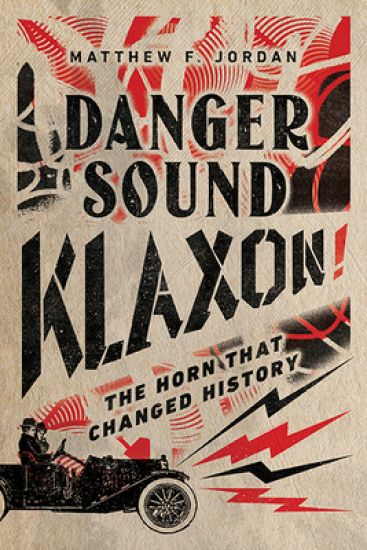
Danger Sound Klaxon! reveals the untold story of the Klaxon automobile horn, one of the first great electrical consumer technologies of the twentieth century. Although its metallic shriek at first shocked pedestrians, savvy advertising strategies convinced consumers across the United States and western Europe to adopt the shrill Klaxon horn as the safest signaling technology available in the 1910s. The widespread use of Klaxons in the trenches of World War I, however, transformed how veterans heard this car horn, and its traumatic association with gas attacks ultimately doomed this once ubiquitous consumer technology.By charting the meteoric rise and eventual fall of the Klaxon, Matthew Jordan highlights how perceptions of sound-producing technologies are guided by, manipulated, and transformed through advertising strategies, public debate, consumer reactions, and governmental regulations. Jordan demonstrates in this fascinating history how consumers are led toward technological solutions for problems themselves created by technology.
Danger Sound Klaxon!

Danger Sound Klaxon!

Matthew F. Jordan

UNIVERSITY OF VIRGINIA PRESS
2023
pokkari
Danger Sound Klaxon! reveals the untold story of the Klaxon automobile horn, one of the first great electrical consumer technologies of the twentieth century. Although its metallic shriek at first shocked pedestrians, savvy advertising strategies convinced consumers across the United States and western Europe to adopt the shrill Klaxon horn as the safest signaling technology available in the 1910s. The widespread use of Klaxons in the trenches of World War I, however, transformed how veterans heard this car horn, and its traumatic association with gas attacks ultimately doomed this once ubiquitous consumer technology.By charting the meteoric rise and eventual fall of the Klaxon, Matthew Jordan highlights how perceptions of sound-producing technologies are guided by, manipulated, and transformed through advertising strategies, public debate, consumer reactions, and governmental regulations. Jordan demonstrates in this fascinating history how consumers are led toward technological solutions for problems themselves created by technology.
The San Diego World's Fairs and Southwestern Memory, 1880-1940

The San Diego World's Fairs and Southwestern Memory, 1880-1940

Matthew F. Bokovoy

University of New Mexico Press
2005
sidottu
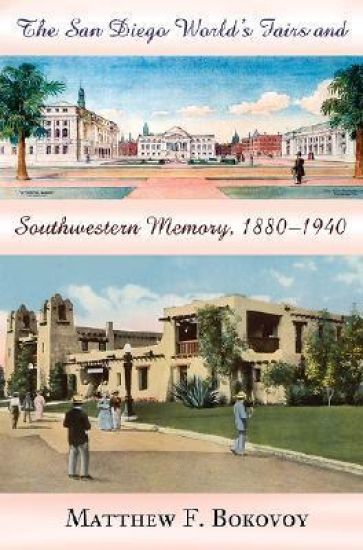
In the American Southwest, no two events shaped modern Spanish heritage more profoundly than the San Diego Expositions of 1915-16 and 1935-36. Both San Diego fairs displayed a portrait of the Southwest and its peoples for the American public. The Panama-California Exposition of 1915-16 celebrated Southwestern pluralism and gave rise to future promotional events including the Long Beach Pacific Southwest Exposition of 1928, the Santa Fe Fiesta of the 1920s, and John Steven McGroarty's The Mission Play. The California-Pacific International Exposition of 1935-36 promoted the Pacific Slope and the consumer-oriented society in the making during the 1930s. These San Diego fairs distributed national images of southern California and the Southwest unsurpassed in the early twentieth century. By examining architecture and landscape, American Indian shows, civic pageants, tourist imagery, and the production of history for celebration and exhibition at each fair, Matthew Bokovoy peels back the rhetoric of romance and reveals the legacies of the San Diego World's Fairs to re-imagine the Indian and Hispanic Southwest. In tracing how the two fairs reflected civic conflict over an invented San Diego culture, Bokovoy explains the emergence of a myth in which the city embraced and incorporated native peoples, Hispanics, and Anglo settlers to benefit its modern development.
The San Diego World's Fairs and Southwestern Memory, 1880-1940

The San Diego World's Fairs and Southwestern Memory, 1880-1940

Matthew F. Bokovoy

UNIVERSITY OF NEW MEXICO PRESS
2023
pokkari
In the American Southwest, no two events shaped modern Spanish heritage more profoundly than the San Diego Expositions of 1915-1916 and 1935-1936. Both San Diego fairs displayed a portrait of the Southwest and its peoples for the American public.By examining architecture and landscape, American Indian shows, civic pageants, tourist imagery, and the production of history for celebration and exhibition at each fair, Matthew F. Bokovoy peels back the rhetoric of romance and reveals the legacies of the San Diego World's Fairs to reimagine the Indian and Hispanic Southwest. In tracing how the two fairs reflected civic conflict over an invented San Diego culture, Bokovoy explains the emergence of a myth in which the city embraced and incorporated native peoples, Hispanics, and Anglo settlers to benefit its modern development.
Uncovering America's First War

Uncovering America's First War

Matthew F. Schmader; Richard Flint; Shirley Cushing Flint; Theodore S. Jojola

UNIVERSITY OF NEW MEXICO PRESS
2025
sidottu
By the 1530s, Indigenous Pueblo populations in the American Southwest reached tens of thousands of people with a rich culture expressed through stunning architecture, ceramic technology, and ceremonial life. Then, into that world came outsiders—an army of foreigners from the south led by Francisco Vázquez de Coronado. Coronado's expedition was sent from Spain's new colony in Mexico, seeking overland routes to Asia. Not finding what they sought, the strangers made steep demands on the Pueblo people, and the Pueblos fought back. First contacts at the western Pueblos of Zuni, Hopi, and Acoma led to open warfare.Coronado continued eastward into an area settled by ancestors of today's Rio Grande Pueblos, where thousands lived in large villages along the river. The Spanish called the area "Tiguex," which became the overwintering place for Coronado by the end of 1540. Increasing tensions and resistance that winter spilled over into violence in America's earliest named war: the Tiguex War. The largest and most intact battle site of that fierce conflict is known as Piedras Marcadas Pueblo, situated within present-day Albuquerque, New Mexico. Coronado's men were armed with crossbows and muskets while their Mexican Indigenous allies relied on stone arrows and slingstones. The Puebloans mounted a courageous defense of their largest village, piling rocks on the rooftops and hurling them down on the attackers. Today, hundreds of artifacts found at Piedras Marcadas reveal the colliding cultures who fought each other within those ancient walls and plazas that are now silent but were once the focal point of a life-and-death contest for survival.