Kirjahaku
Etsi kirjoja tekijän nimen, kirjan nimen tai ISBN:n perusteella.
1000 tulosta hakusanalla Maureen Duffy

A compelling mystery blending the witch trials of the past with a contemporary case of academic intrigue from this brilliant, well-loved novelist. Jade Green is a solicitor with her own practice, Lost Causes, that she runs from her London flat. She struggles to keep her business afloat, and supplements her income by delivering for the local Chinese takeaway. Her life changes with a single phonecall. Dr Gilbert has been dismissed from his post teaching the history of science at the University of Wessex. Allegations have been made that he was corrupting the students with Satanism; the professor himself suspects the university to be controlled by a fundamentalist Christian sect. As Jade delves into this bizarre case, she finds herself drawn into a seventeenth-century manuscript, the original of which has been stolen from the Professor's briefcase at the university. It is ‘The Memorial of Amyntas Boston’, a young woman – raised as a boy – who is awaiting trial for dabbling in the black arts and in alchemy. Taken into service by Mary Sidney, she had fallen in love with her mistress and ultimately found herself betrayed by her. The two stories intertwine as Jade feels her life – her hidden identities and her secret love – mysteriously resonate with Amyntas's. In this sweeping novel, Maureen Duffy combines the pleasures of detection with the mysteries of fraud, alchemy, early science and witchcraft. By turns passionate and drily witty, this is an immensely compelling tale.
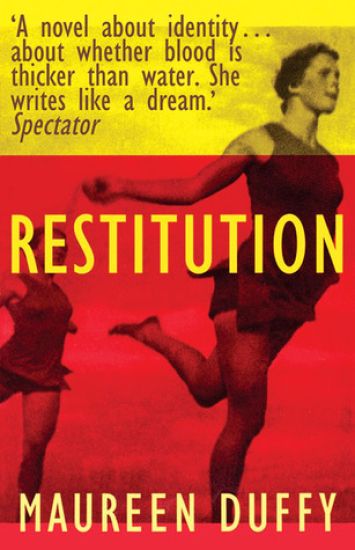
The new novel from ‘a major writer by any standards: technique, curiosity, erudition, plus the sheer body, range and quality of her work’ (Independent on Sunday). Restitution is the compelling story of a young woman in search of her identity at the end of the century. Betony Falk is in her late 20s. Both her parents died when she was young, and she was brought up by her grandmother. With time on her hands between jobs she decides to find out more about her father’s death, which her grandmother has always surrounded in mystery. She finds no death certificate for Henry, her father’s name, but only one for Herman Falk – no birth certificates for either. The death certificate hints at suicide. Betony confronts her grandmother with her findings and the latter confesses that the boy she brought up was a German Jewish refugee baby, a substitute for her own stillborn Henry. Her own sense of identity undermined, Betony sets out on a heartrending quest for the truth which takes her to Germany and into the past, only to discover that the more she finds out the less she knows who she is now. Spanning three centuries and seen from the viewpoints of Betony, her grandfather and Gill, her flatmate, RESTITUTION traces a family that fled as Jacobites from England, and again as Jews from Germany, and asks what relevance nationality and the past have for a young woman at the end of the twentieth century.

Most of the other residents in the cavernous Victorian house - and the friends and acquaintances Al meets in tow local pubs, the bohemian and relaxed crowd at the Nevern and the slightly more ambiguous and dangerous crowd at the Knacker's - are Londoners by adoption, some temporary exiles, some permanent.

Their lovemaking throughout the book forms a recurring lietmotif, a counterpoint to the examination of the spiritual death of the characters. In a South London environment of pub and fairground, home and work, the wounds of 20th century experience are evoked in prose which is both lyrical and precise.



1981. A different Britain. When Norman Forrester of the Defence Ministry's Experimental Institute effects a successful fertilisation of a female gorilla with human sperm, an infant is born. Gordon, known as Gor, is his son in two senses. But Gor's parentage must remain a secret. He has no legal existence as an individual because his existence has never been divulged to the government data bank. In more than one way, Gor is a 'non-person'.Operated on so that he is capable of speech, Gor grows through boyhood and adolescence into a strong, intelligent youth. When he discovers his true identity, he is devastated by his outcast destiny. But is there the possibility of a home amongst some of the exiles from a computer-dominated class-oriented society? And if Gor can find them, will they accept him?Maureen Duffy's novel offers both an enthralling, fast-moving narrative and a vivid parable of the individual's struggle to win acceptance from his fellows and to overcome the forces that seek to destroy human individuality in any age.
Controversial erosions of individual liberties in the name of anti-terrorism are ongoing in liberal democracies. The focus of this book is on the manner in which strategic discourse has been used to create accepted political narratives. It specifically links aspects of that discourse to problematic and evolving terrorism detention practices that happen outside of traditional criminal and wartime paradigms, with examples including the detentions at Guantanamo Bay and security certificates in Canada. This book suggests that biased political discourse has, in some respects, continued to fuel public misconceptions about terrorism, which have then led to problematic legal enactments, supported by those misconceptions. It introduces this idea by presenting current examples, such as some of the language used by US President Donald Trump regarding terrorism, and it argues that such language has supported questionable legal responses to terrorism. It then critiques political arguments that began after 9/11, many of which are still foundational as terrorism detention practices evolve. The focus is on language emanating from the US, and the book links this language to specific examples of changed detention practices from the US, Canada, and the UK.Terrorism is undoubtedly a real threat, but that does not mean that all perceptions of how to respond to terrorism are valid. As international terrorism continues to grow and to change, this book offers valuable insights into problems that have arisen from specific responses, with the objective of avoiding those problems going forward.

Maureen Duffy’s double-bill tells the story of two remarkable women.The Choice is the story of a very unsaintly saint. Hilda of Whitby, who brought Christianity to the Anglo-Saxons, was a businesswoman, teacher and adviser to kings.In A Nightingale in Bloomsbury Square, Virginia Woolf looks back on her life, uncovering the hidden stories behind her iconic novels. From the torture of depression to the scandal of her lesbian affairs, Virginia goes down fighting.As the saying goes: well-behaved women don’t make history…
Controversial erosions of individual liberties in the name of anti-terrorism are ongoing in liberal democracies. The focus of this book is on the manner in which strategic discourse has been used to create accepted political narratives. It specifically links aspects of that discourse to problematic and evolving terrorism detention practices that happen outside of traditional criminal and wartime paradigms, with examples including the detentions at Guantanamo Bay and security certificates in Canada. This book suggests that biased political discourse has, in some respects, continued to fuel public misconceptions about terrorism, which have then led to problematic legal enactments, supported by those misconceptions. It introduces this idea by presenting current examples, such as some of the language used by US President Donald Trump regarding terrorism, and it argues that such language has supported questionable legal responses to terrorism. It then critiques political arguments that began after 9/11, many of which are still foundational as terrorism detention practices evolve. The focus is on language emanating from the US, and the book links this language to specific examples of changed detention practices from the US, Canada, and the UK.Terrorism is undoubtedly a real threat, but that does not mean that all perceptions of how to respond to terrorism are valid. As international terrorism continues to grow and to change, this book offers valuable insights into problems that have arisen from specific responses, with the objective of avoiding those problems going forward.

As he listens he grows convinced they are predicting London's future. Meepers, homeless and dishevelled, yet an enlightened and mystically knowing amateur archeologist, seeks to understand the destruction of London in the Dark Ages, hoping to predict the capital's future.
These are tough poems, full of love and harm, good and damage, rage and compassion. They show us dealing well and also very badly with our kind and with the rest of the living planet. They are made of the rough substance of real lives. Their hallmark is loyalty: a steadfast, clear-sighted, unsentimental loyalty. Their truth is a 'being true to'. And they are a beautiful answering back against the worst. Maureen Duffy reminds us how funny people are, how vulnerable, lovable, bizarre and heroic. Her own voice is umistakeable in every line. And every poem is a sort of fighting between two lines: 'Mortality's at best a dodgy state' and 'It's not over yet; rejoice.'

Maureen Duffy's new collection centres on environments - human, insect and animal - some experienced personally, some observed, some imagined. Though strictly contemporary in her concerns, she reaches back in her poetry to a vividly remembered childhood, and beyond that in her imagination to cultural figures of the past - John Donne, Edward Elgar, Toulouse Lautrec, Ralph Vaughan Williams - bringing them lucidly and memorably to life. With their hallmark of compassion and fair play, Duffy's poems reflect her lifelong support for progressive social and political movements; they also display a beautiful lyricism and technical skill that grows out of her love of the classical world and Old and Mediaeval English. As so often in her work, the city past and present provides the backdrop to her real and imagined life-stories: of love and loss, forebears and friends, the humorous and sometimes painful experiences of old age.
"There were no pictures on the walls of the rented rooms my mother and I lived in when I was a child. But there were pictures on the school walls, details of exhibitions and the lives of great painters in Everybody's Weekly, and, when we could afford it, we would treat ourselves to a trip to the nearest city and its travelling exhibitions of prints, which was how I saw most of Van Gogh that wasn't at school."For Duffy, pictures were and still are magical creations and recreations of the visible world - of history, mythologies, landscape, love and death - where the artists who make them attempt risk-taking feats analogous to a poet's with words. Pictures abound in this collection, ushering the reader from canvas to screen via x-rays and iPhone snapshots, the latter inspiring the closing sequence 'Burdsong'. Above all, Pictures from an Exhibition celebrates the mind's eye, which is its own exhibition gallery: transforming Darlington Station into an upturned ship's hull or a mauled pigeon into a still life, and glorying in the lives, loves and creations of painters from Veronese to Anselm Kiefer.

An administrator known for her innovative on-the-job thinking becomes the target of anonymous rumors about financial mismanagement of her department. The rumors are proven baseless but her boss decides that she can't work with "that woman" anymore and prevents her from attending key meetings. The administrator sees a cardiologist for the first time in her life because of increasing chest pain, and her family doctor prescribes antidepressants "to get her over the hump." The administrator whose identity is interwoven with her job and company is bewildered by what is happening to her at work and says she doesn't know who she is anymore. A middle school student is the target of relentless name-calling and slurs by a group of other kids at school. The slurs include derogatory comments about his sexuality, appearance, and family. The taunting has increased over several months, and many teachers have witnessed it. The student was the subject of a recent conversation in the faculty lounge, where some faculty members said the student needed to "toughen up," while others expressed concern for his well-being. The student's main strategy has been to try and keep away from the group of kids, but he finds himself trusting fewer of his "friends," feeling both angry and sad, and having a hard time concentrating. What features of these two situations are almost identical, and why are they both classic instances of workplace and school mobbing? Mobbing is not the same as bullying, as the authors of this volume explain with cogent analysis of the organizational and contextual frameworks within which mobbing always occurs. From the Salem witch trials to workers trying to do the best they can at work, to kids whose humiliation in school has made the headlines, the authors offer numerous illustrations of mobbing, followed by insightful analyses and discussions of lessons learned. Duffy and Sperry provide a wealth of research to demonstrate the devastating toll that mobbing takes on its victims, their families, and the organizations where it occurs. The authors painstakingly avoid simplistic solutions to mobbing, such as removing the "bad apples," and instead, move the conversation forward by showing how bold and compassionate organizational leadership is required to improve conditions for the benefit of both individuals and their organizations.

Mobbing is a destructive social process in which individuals, groups, or organizations target a person for ridicule, humiliation, and removal from the workplace. It can lead to deteriorating physical and mental health, workplace violence, and even suicide. Studies indicate that as many as 37% of American workers have experienced workplace abuse at some time in their working lives. Overcoming Mobbing is an informative, comprehensive guidebook written for the victims of mobbing and their families who often can't make sense of the experience or mobilize resources for recovery. In an engaging, reader-friendly style, the book distinguishes mobbing from bullying in that it takes place within organizational or institutional settings and involves organizational dynamics. Mobbing is not about the occasional negative experience at work; it is ongoing negative acts, both overt and covert, over time, that erode workers' confidence in themselves and in their workplaces and that no amount of sophistication or maturity can make sense of. Duffy and Sperry, leading authorities on this special type of aggression, provide effective strategies for recovery from mobbing as well as for prevention, and they demystify the experience through the use of case vignettes. More than a simple self-help book, this volume brings the concept and terminology relating to mobbing into the public vocabulary by virtue of its strong foundation in psychological and organizational research. It offers a detailed presentation of the causes and consequences of mobbing, helps readers avoid falling into the trap of misplacing blame, and holds organizations at the center of responsibility for preventing the abuse. In addition to those who have experienced mobbing themselves, this book is an invaluable resource for workplace managers and human resources personnel who wish to prevent or reverse mobbing within their own professional settings.