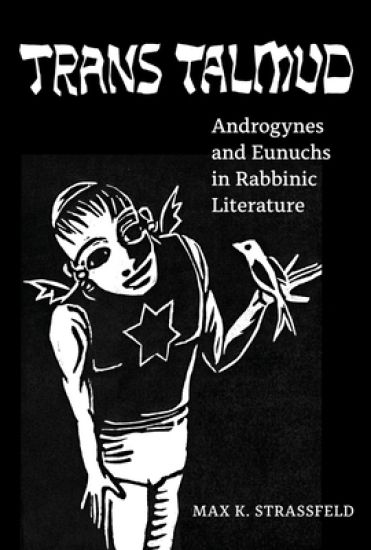
Trans Talmud places eunuchs and androgynes at the center of rabbinic literature and asks what we can learn from them about Judaism and the project of transgender history. Rather than treating these figures as anomalies to be justified or explained away, Max K. Strassfeld argues that they profoundly shaped ideas about law, as the rabbis constructed intricate taxonomies of gender across dozens of texts to understand an array of cultural tensions. Showing how rabbis employed eunuchs and androgynes to define proper forms of masculinity, Strassfeld emphasizes the unique potential of these figures to not only establish the boundary of law but exceed and transform it. Trans Talmud challenges how we understand gender in Judaism and demonstrates that acknowledging nonbinary gender prompts a reassessment of Jewish literature and law.
Trans Talmud places eunuchs and androgynes at the center of rabbinic literature and asks what we can learn from them about Judaism and the project of transgender history. Rather than treating these figures as anomalies to be justified or explained away, Max K. Strassfeld argues that they profoundly shaped ideas about law, as the rabbis constructed intricate taxonomies of gender across dozens of texts to understand an array of cultural tensions. Showing how rabbis employed eunuchs and androgynes to define proper forms of masculinity, Strassfeld emphasizes the unique potential of these figures to not only establish the boundary of law but exceed and transform it. Trans Talmud challenges how we understand gender in Judaism and demonstrates that acknowledging nonbinary gender prompts a reassessment of Jewish literature and law.
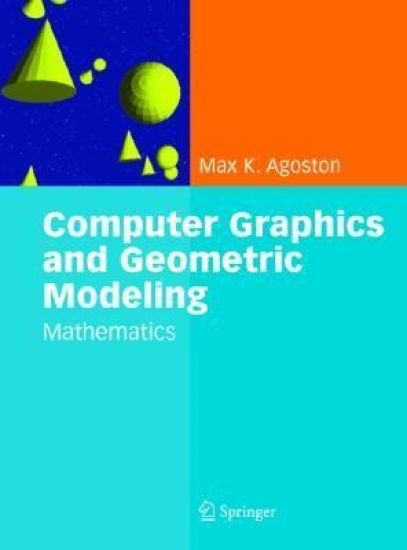
Possibly the most comprehensive overview of computer graphics as seen in the context of geometric modelling, this two volume work covers implementation and theory in a thorough and systematic fashion. Computer Graphics and Geometric Modelling: Mathematics, contains the mathematical background needed for the geometric modeling topics in computer graphics covered in the first volume. This volume begins with material from linear algebra and a discussion of the transformations in affine & projective geometry, followed by topics from advanced calculus & chapters on general topology, combinatorial topology, algebraic topology, differential topology, differential geometry, and finally algebraic geometry. Two important goals throughout were to explain the material thoroughly, and to make it self-contained. This volume by itself would make a good mathematics reference book, in particular for practitioners in the field of geometric modelling. Due to its broad coverage and emphasis on explanation it could be used as a text for introductory mathematics courses on some of the covered topics, such as topology (general, combinatorial, algebraic, and differential) and geometry (differential & algebraic).
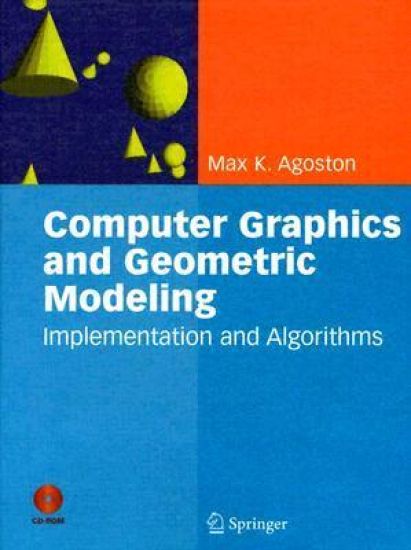
Possibly the most comprehensive overview of computer graphics as seen in the context of geometric modelling, this two volume work covers implementation and theory in a thorough and systematic fashion. Computer Graphics and Geometric Modelling: Implementation and Algorithms, covers the computer graphics part of the field of geometric modelling and includes all the standard computer graphics topics. The first part deals with basic concepts and algorithms and the main steps involved in displaying photorealistic images on a computer. The second part covers curves and surfaces and a number of more advanced geometric modelling topics including intersection algorithms, distance algorithms, polygonizing curves and surfaces, trimmed surfaces, implicit curves and surfaces, offset curves and surfaces, curvature, geodesics, blending etc. The third part touches on some aspects of computational geometry and a few special topics such as interval analysis and finite element methods. The volume includes two companion programs.
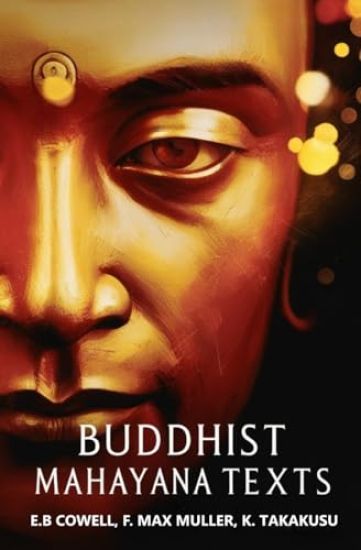
This collection of Buddhist Mahayana texts, translated by renowned scholars E.B. Cowell, F. Max Muller, and K. Takakusu, presents a profound exploration of the Mahayana tradition. Key scriptures, such as the Diamond Sutra, unfold the essential teachings of compassion, emptiness, and enlightenment. Through these texts, readers encounter transformative insights that delve into the nature of reality and the path to spiritual awakening. By highlighting the philosophical and ethical principles central to Mahayana Buddhism, this compilation offers an invaluable resource for both scholars and practitioners seeking to deepen their understanding of Buddhist thought. Engaging and enlightening, this volume encapsulates the timeless wisdom of the Mahayana tradition, offering readers an opportunity to explore the depth and beauty of these revered teachings.
India: What Can It Teach Us? A Course of Lectures DELIVERED BEFORE THE UNIVERSITY OF CAMBRIDGE BY F. Max Muller, K.M. TEXT AND FOOT-NOTES COMPLETE. WITH AN INTRODUCTION AND NOTES BY PROF. ALEXANDER WILDER, M.D. CONTENTS. Dedication, Introduction, LectureI. What Can India Teach us? "II.On The Truthful Character of the Hindus, "III.The Human Interest of Sanskrit Literature, "IV.Objections, "V.The Lessons of the Veda, "VI.Vedic Deities, "VII.Veda and Ved nta,
Thank you for checking out this book by Theophania Publishing. We appreciate your business and look forward to serving you soon. We have thousands of titles available, and we invite you to search for us by name, contact us via our website, or download our most recent catalogues. THE name of R makrishna has lately been so often mentioned in Indian, American, and English newspapers that a fuller account of his life and doctrine seemed to me likely to be welcome, not only to the many who take an interest in the intellectual and moral state of India, but to the few also to whom the growth of philosophy and religion, whether at home or abroad, can never be a matter of indifference. I have therefore tried to collect as much information as I could about this lately-deceased Indian Saint (died in 1886), partly from his own devoted disciples, partly from Indian newspapers, journals, and books in which the principal events of his life were chronicled, and his moral and religious teaching described and discussed, whether in a friendly or unfriendly spirit. Whatever may be said about the aberrations of the Indian ascetics to whom R makrishna belonged, there are certainly some of them who deserve our interest, nay even our warmest sympathy. The tortures which some of them, who hardly deserve to be called Samny sins, for they are not much better than jugglers or Hathayogins, inflict on themselves, the ascetic methods by which they try to subdue and annihilate their passions, and bring themselves to a state of extreme nervous exaltation accompanied by trances or fainting fits of long duration, are well known to all who have lived in India and have become acquainted there not only with Rajahs and Maharajahs, but with all the various elements that constitute the complicated system of Indian society. Though some of the stories told of these martyrs of the flesh and of the spirit may be exaggerated, enough remains of real facts to rouse at all events our curiosity. When some of the true Samny sins, however, devote their thoughts and meditations to philosophical and religious problems, their utterances, which sway large multitudes that gather round them in their own country, cannot fail to engage our attention and sympathy, particularly if, as in the case of R makrishna, their doctrines are being spread by zealous advocates not only in India, but in America also, nay even in England.
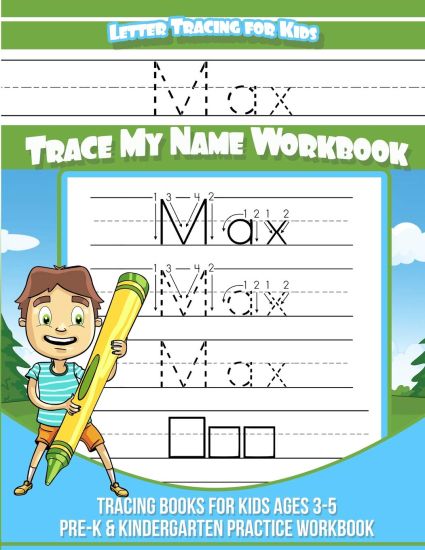
MAX Name Tracing Workbook - Preschoolers Kindergarten Practice Workbook - Toddlers Writing Notebook - Learn How to Write MAX - Preschoolers Activities Teaching your child the basics of writing is a difficult task especially if he or she is full of energy and finds it more difficult to focus. In order to give him a push in the first years of school or kindergartner, we are presenting a revolutionary way of teaching your baby the basics of the alphabet: the name tracing workbook for children. Why our workbook? The name tracing workbook has been designed specifically to teach children the basic of spelling and writing. By learning to write his own name, your child will develop the abilities and skills needed in the first years of schools while having fun. The 100 pages activity book is the perfect choice if you are searching to invest in your child's education from the beginning so don't hesitate and get him the only workbook he needs LEARNING THE FIRST LETTERS teaching your toddler the first letters and how to spell his or her name is difficult, which is why we have designed a special workbook that will make the learning process easier and a lot more fun, adding to the baby's educational fund. PERSONALIZED WORKING: the name is the first word any child should learn how to spell, but it is almost impossible to find special help for that task. MAX Name Tracing Workbook is divided in 12 themed chapters that will teach your toddler how to spell his or her name in a fun and interactive way. WHAT IT CONTAINS: MAX Name Tracing Workbook counts no less than 100 pages divided in 12 themed sheets that propose recognition activities, letter tracing practice and letter games, that are sure to teach your child the basics of writing and spelling. FOR TODDLERS: MAX Name Tracing Workbook is made especially for children aged 3 to 6 so your son or daughter will be well prepared for both kindergarten and first grade Learning the alphabet will be a piece of cake if your kid will already have the foundation letter tracing so why not give him a head start in school. THE PERFECT GIFT: offering a present to a toddler that is both fun and parents-approved is an almost impossible task, but the name tracing workbook has it all: it is educational, personalized and made especially for youngsters ages 3 to 6 so, if you're trying to bring a smile on a kid's face, this is it
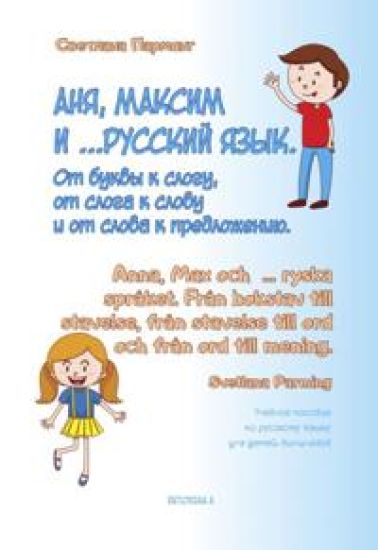
Uchebnoe posobie "Anja, Maksim i... russkij jazyk. Ot bukvy k slogu, ot sloga k slovu i ot slova k predlozheniju" prednaznacheno dlja detej-bilingvov, prozhivajuschikh za predelami Rossii. Posobie napisano pedagogom s 20-letnim stazhem, predsedatelem Assotsiatsii russkikh uchitelej Shvetsii (CARTS) Svetlanoj Parming pod redaktsiej doktora pedagogicheskikh nauk, professora Instituta Mezhdunarodnykh Ekonomicheskikh Svjazej g. Ajzenshtadt (Avstrija) Anatolija Berdichevskogo.Kniga adresovana detjam-bilingvam 7-8 let, kotorye rodilis za rubezhom i izuchajut russkij jazyk kak rodnoj ili vtoroj v nejazykovoj srede. Glavnoj otlichitelnoj chertoj dannogo posobija javljaetsja opora na jazyk i kulturu strany prozhivanija s tselju preodolenija mezhkulturnoj i mezhjazykovoj interferentsii.Posobie postroeno po kontsentricheskomu printsipu podachi materiala: ot prostogo k slozhnomu, s mnogokratnym povtoreniem materiala na bolee vysokom urovne, s rasshireniem aktivnogo slovarja i razvitiem myshlenija i rechi bilingvov.Zadanija napravleny na formirovanie navyka smyslovogo chtenija i postepennoe vovlechenie uchaschikhsja v protsess pisma. Material daetsja v takoj posledovatelnosti, chtoby deti shesti-semi let razvivali umenie strukturirovat informatsiju i vydeljat glavnoe. Obuchenie chteniju i pismu postroeno po kommunikativnomu printsipu na osnove dialogov rebjat, zhelajuschikh izuchat russkij jazyk cherez igru, chto sposobstvuet razvitiju slukhovoj, zritelnoj i motorno-dvigatelnoj pamjati uchaschikhsja."Uroki v posobii sostavleny v vide dialogov. Ja ikh ne pridumyvala, oni rozhdalis na urokakh, - otmechaet Svetlana Parming. - Prosto kogda pytaeshsja obuchat detej chemu-to, nado khorosho prislushivatsja k tomu, kak oni vosprinimajut to, chto ty im govorish, i umet verno korrektirovat sebja bez uscherba dlja obrazovatelnogo protsessa".Posobie vkljuchaet v sebja 70 urokov-dnej i rasschitano na odin uchebnyj god. V nem osuschestvljaetsja formirovanie navykov orfografii russkogo jazyka s uchjotom ejo morfemnogo printsipa, cherez zvukobukvennyj analiz slov i praktiku ustnoj i pismennoj rechi uchaschikhsja. Zadanija rasshirjajut aktivnyj slovar rebjonka, rasshirjajut krug tem ego obschenija, razvivajut ego myshlenie i rech.Posobie napravleno v pervuju ochered dlja raboty na urokakh russkogo jazyka kak vtorogo rodnogo (parallelnogo) v shvedskikh shkolakh, v tseljakh podderzhanija jazyka v seme, a takzhe v kruzhkakh i dopolnitelnykh shkolakh vykhodnogo dnja.Kniga javljaetsja vtoroj v serii: v 2019 godu v izdatelstve "Retorika A" uvidelo svet pervoe posobie Svetlany Parming, dajuschee junym uchaschimsja predstavlenie o grammaticheskikh pravilakh russkogo jazyka.Illjustratsii: Brigita BashkirovaPod redaktsiej A.L. Berdichevskogo