Kirjojen hintavertailu. Mukana 11 342 296 kirjaa ja 12 kauppaa.

Kirjahaku

Etsi kirjoja tekijän nimen, kirjan nimen tai ISBN:n perusteella.

1000 tulosta hakusanalla Mazur Joseph

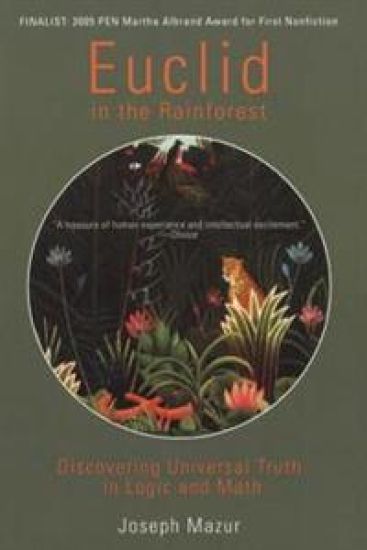
Euclid In The Rainforest

Euclid In The Rainforest

Mazur Joseph

Plume
2006
nidottu
This work talks about the logic of nature and the nature of logic. Like Douglas Hofstadter's Godel, Escher, Bach, and David Berlinski's "A Tour of the Calculus", "Euclid in the Rainforest" combines the literary with the mathematical to explore logic - the one indispensable tool in man's quest to understand the world. Through adventure stories and historical narratives populated with a rich and quirky cast of characters, Mazur artfully reveals the less-than-airtight nature of logic and the muddled relationship between maths and the real world. Ultimately, Mazur argues, logical reasoning is not purely robotic. At its most basic level, it is a creative process guided by our intuitions and beliefs about the world.
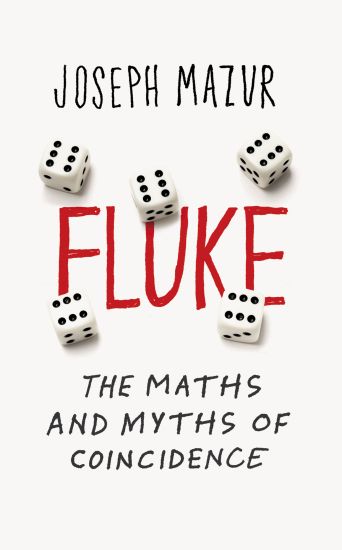
Fluke

Fluke

Mazur Joseph

Oneworld Publications
2016
nidottu
What are the chances?! This exclamation greets the scarcely believable coincidence – you’re picked up by the same taxi driver several years and thousands of miles apart or, in a second-hand bookshop far from home, you find your own childhood copy of Winnie-the-Pooh on the shelf. But the unlikely is more probable than you think. Against every fibre of common sense, the fact is that it’s quite likely that some squirrel, somewhere, will be struck by lightning as it crosses the road. The chaos and unpredictability of our lives is an illusion. There is a rational order to the universe, and it’s called mathematics. Fluke is a fascinating investigation into the true nature of chance, a must-read for maths enthusiasts and avid storytellers alike, it tears down the veil of improbability to reveal the wonderfully possible.
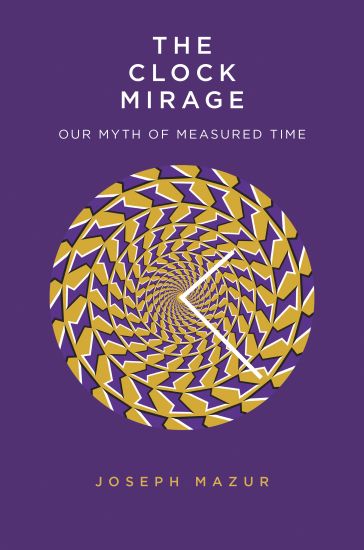
The Clock Mirage

The Clock Mirage

Joseph Mazur

Yale University Press
2020
sidottu
Named one of Book Riot’s Six Great Nonfiction Books about Time: a tour of clocks throughout the centuries—from the sandglass to the telomere—that reveals the physical, biological, and social nature of time“[A] mind-stretching book. . . . Skilfully written.”—John Carey, Sunday Times (London) What is time? This question has fascinated philosophers, mathematicians, and scientists for thousands of years. Why does time seem to speed up with age? What is its connection with memory, anticipation, and sleep cycles? Award-winning author and mathematician Joseph Mazur provides an engaging exploration of how the understanding of time has evolved throughout human history and offers a compelling new vision, submitting that time lives within us. Our cells, he notes, have a temporal awareness, guided by environmental cues in sync with patterns of social interaction. Readers learn that, as a consequence of time’s personal nature, a forty-eight-hour journey on the space shuttle can feel shorter than a six-hour trip on the Soyuz capsule, that the Amondawa of the Amazon do not have ages, and that time speeds up with fever and slows down when we feel in danger. With a narrative punctuated by personal stories of time’s effects on truck drivers, Olympic racers, prisoners, and clockmakers, Mazur’s journey is filled with fascinating insights into how our technologies, our bodies, and our attitudes can change our perceptions. Ultimately, time reveals itself as something that rides on the rhythms of our minds. The Clock Mirage presents an innovative perspective that will force us to rethink our relationship with time, and how best to use it.
Zeno's Paradox

Zeno's Paradox

Joseph Mazur

Plume
2008
pokkari
The fascinating story of an ancient riddle and what it reveals about the nature of time and space Three millennia ago, the Greek philosopher Zeno constructed a series of logical paradoxes to prove that motion is impossible. Today, these paradoxes remain on the cutting edge of our investigations into the fabric of space and time. Zeno's Paradox uses the motion paradox as a jumping-off point for an exploration of the twenty-five-hundred-year quest to uncover the true nature of the universe. From Galileo to Einstein to Stephen Hawking, some of the greatest minds in history have tackled the problem and made spectacular breakthroughs, but through it all, the paradox of motion remains.
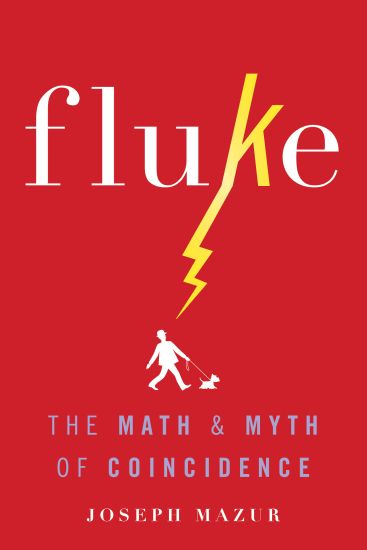
Fluke

Fluke

Joseph Mazur

Basic Books
2016
sidottu
What are the chances? This is the question we ask ourselves when we encounter the strangest and most seemingly impossible coincidences, like the woman who won the lottery four times or the fact that Lincoln's dreams foreshadowed his own assassination. But, when we look at coincidences mathematically, the odds are a lot better than any of us would have thought.In Fluke , mathematician Joseph Mazur takes a second look at the seemingly improbable, sharing with us an entertaining guide to the most surprising moments in our lives. He takes us on a tour of the mathematical concepts of probability, such as the law of large numbers and the birthday paradox, and combines these concepts with lively anecdotes of flukes from around the world. How do you explain finding your college copy of Moby Dick in a used bookstore on the Seine on your first visit to Paris? How can a jury be convinced beyond a reasonable doubt that DNA found at the scene of a heinous crime did not get there by some fluke? Should we be surprised if strangers named Maria and Francisco, seeking each other in a hotel lobby, accidentally meet the wrong Francisco and the wrong Maria, another pair of strangers also looking for each other? As Mazur reveals, if there is any likelihood that something could happen, no matter how small, it is bound to happen to someone at some time.In Fluke , Mazur offers us proof of the inevitability of the sublime and the unexpected. He has written a book that will appeal to anyone who has ever wondered how all of the tiny decisions that happen in our lives add up to improbable wholes. A must-read for math enthusiasts and storytellers alike, Fluke helps us to understand the true nature of chance.
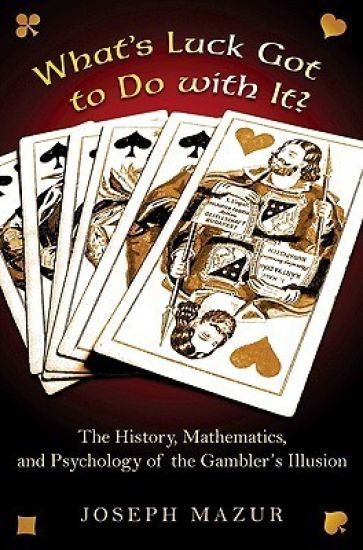
What's Luck Got to Do with It?

What's Luck Got to Do with It?

Joseph Mazur

Princeton University Press
2010
sidottu
Why do so many gamblers risk it all when they know the odds of winning are against them? Why do they believe dice are "hot" in a winning streak? Why do we expect heads on a coin toss after several flips have turned up tails? What's Luck Got to Do with It? takes a lively and eye-opening look at the mathematics, history, and psychology of gambling to reveal the most widely held misconceptions about luck. It exposes the hazards of feeling lucky, and uses the mathematics of predictable outcomes to show when our chances of winning are actually good. Mathematician Joseph Mazur traces the history of gambling from the earliest known archaeological evidence of dice playing among Neolithic peoples to the first systematic mathematical studies of games of chance during the Renaissance, from government-administered lotteries to the glittering seductions of grand casinos, and on to the global economic crisis brought on by financiers' trillion-dollar bets. Using plenty of engaging anecdotes, Mazur explains the mathematics behind gambling--including the laws of probability, statistics, betting against expectations, and the law of large numbers--and describes the psychological and emotional factors that entice people to put their faith in winning that ever-elusive jackpot despite its mathematical improbability. As entertaining as it is informative, What's Luck Got to Do with It? demonstrates the pervasive nature of our belief in luck and the deceptive psychology of winning and losing.
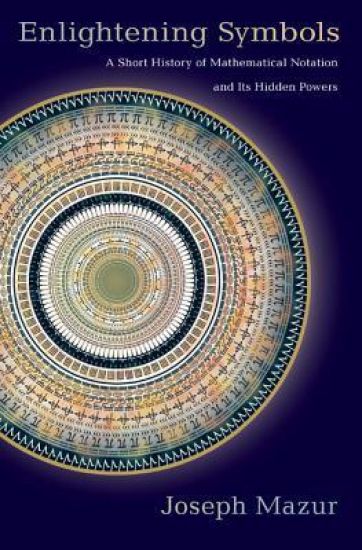
Enlightening Symbols

Enlightening Symbols

Joseph Mazur

PRINCETON UNIVERSITY PRESS
2014
sidottu
While all of us regularly use basic math symbols such as those for plus, minus, and equals, few of us know that many of these symbols weren't available before the sixteenth century. What did mathematicians rely on for their work before then? And how did mathematical notations evolve into what we know today? In Enlightening Symbols, popular math writer Joseph Mazur explains the fascinating history behind the development of our mathematical notation system. He shows how symbols were used initially, how one symbol replaced another over time, and how written math was conveyed before and after symbols became widely adopted. Traversing mathematical history and the foundations of numerals in different cultures, Mazur looks at how historians have disagreed over the origins of the numerical system for the past two centuries. He follows the transfigurations of algebra from a rhetorical style to a symbolic one, demonstrating that most algebra before the sixteenth century was written in prose or in verse employing the written names of numerals. Mazur also investigates the subconscious and psychological effects that mathematical symbols have had on mathematical thought, moods, meaning, communication, and comprehension. He considers how these symbols influence us (through similarity, association, identity, resemblance, and repeated imagery), how they lead to new ideas by subconscious associations, how they make connections between experience and the unknown, and how they contribute to the communication of basic mathematics. From words to abbreviations to symbols, this book shows how math evolved to the familiar forms we use today.
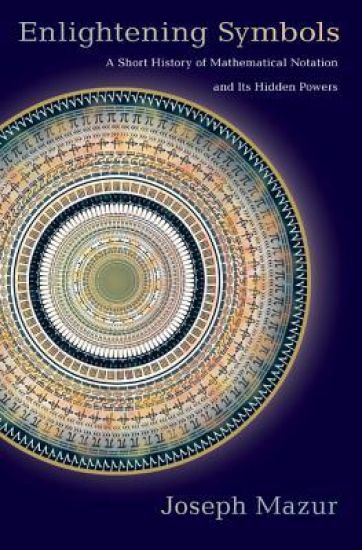
Enlightening Symbols

Enlightening Symbols

Joseph Mazur

Princeton University Press
2016
pokkari
While all of us regularly use basic math symbols such as those for plus, minus, and equals, few of us know that many of these symbols weren't available before the sixteenth century. What did mathematicians rely on for their work before then? And how did mathematical notations evolve into what we know today? In Enlightening Symbols, popular math writer Joseph Mazur explains the fascinating history behind the development of our mathematical notation system. He shows how symbols were used initially, how one symbol replaced another over time, and how written math was conveyed before and after symbols became widely adopted. Traversing mathematical history and the foundations of numerals in different cultures, Mazur looks at how historians have disagreed over the origins of the numerical system for the past two centuries. He follows the transfigurations of algebra from a rhetorical style to a symbolic one, demonstrating that most algebra before the sixteenth century was written in prose or in verse employing the written names of numerals. Mazur also investigates the subconscious and psychological effects that mathematical symbols have had on mathematical thought, moods, meaning, communication, and comprehension. He considers how these symbols influence us (through similarity, association, identity, resemblance, and repeated imagery), how they lead to new ideas by subconscious associations, how they make connections between experience and the unknown, and how they contribute to the communication of basic mathematics. From words to abbreviations to symbols, this book shows how math evolved to the familiar forms we use today.
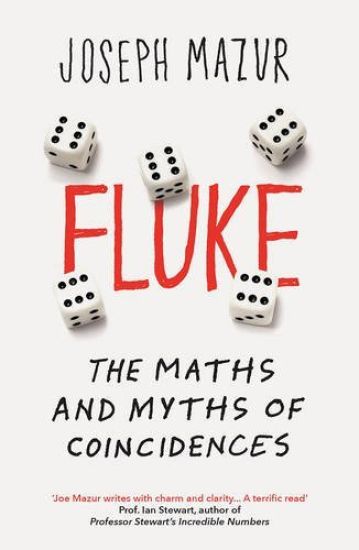
Fluke

Fluke

Joseph Mazur

Oneworld Publications
2017
nidottu
What are the chances?! This exclamation greets the scarcely believable coincidence – you’re picked up by the same taxi driver several years and thousands of miles apart or, in a second-hand bookshop far from home, you find your own childhood copy of Winnie-the-Pooh on the shelf. But the unlikely is more probable than you think. Against every fibre of common sense, the fact is that it’s quite likely that some squirrel, somewhere, will be struck by lightning as it crosses the road. The chaos and unpredictability of our lives is an illusion. There is a rational order to the universe, and it’s called mathematics. Fluke is a fascinating investigation into the true nature of chance, a must-read for maths enthusiasts and avid storytellers alike, it tears down the veil of improbability to reveal the wonderfully possible.
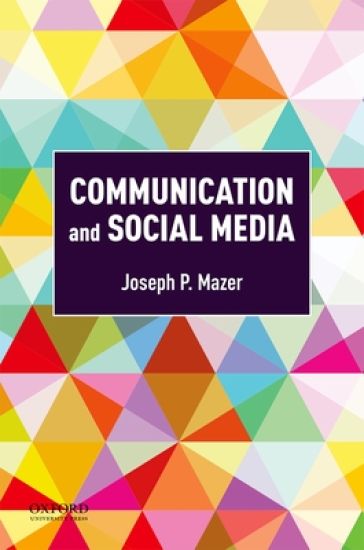
Communication and Social Media

Communication and Social Media

Joseph Mazer

Oxford University Press
2019
nidottu
With engaging story lines, unpredictable plot twists, and realistic characters, the case studies in Communication and Social Media tackle real-life issues that are relevant for students. Written by communication scholars with specific expertise in social media and new technologies, the cases are presented as stories and reflect recent theory and research. The text encourages students to discuss, develop, and analyze potential solutions to the problems illustrated in each case study, including dating on social media and career development through social media. This approach increases students' interest in communication, furthers their desire to learn, and reminds them to think critically about their communication as they navigate their relationships with others through social media and new technologies.
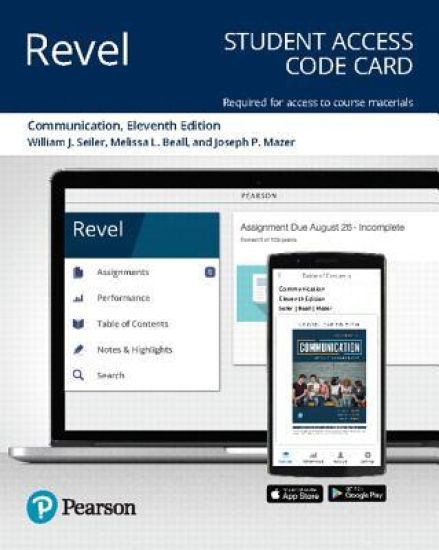
Revel for Communication

Revel for Communication

William Seiler; Melissa Beall; Joseph Mazer

Pearson
2019
lisenssiavain
For courses in Introduction to Speech Communication Connect. Communicate. Thrive. Revel™ Communication: Making Connections helps students make connections in their daily lives, communicate more effectively, and succeed in our ever-changing world. Authors William Seiler, Melissa Beall, and Joseph Mazer balance a thorough yet straightforward explanation of basic principles with a solid theoretical foundation, backed by the most up-to-date research. The 11th Edition offers expanded and updated coverage of key contemporary issues — such as the proliferation of social media and cultural diversity — which have important implications for the communication field. Revel is Pearson’s newest way of delivering our respected content. Fully digital and highly engaging, Revel replaces the textbook and gives students everything they need for the course. Informed by extensive research on how people read, think, and learn, Revel is an interactive learning environment that enables students to read, practice, and study in one continuous experience — for less than the cost of a traditional textbook. NOTE: Revel is a fully digital delivery of Pearson content. This ISBN is for the standalone Revel access card. In addition to this access card, you will need a course invite link, provided by your instructor, to register for and use Revel.
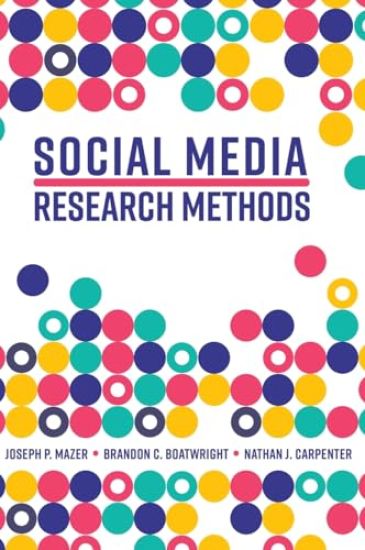
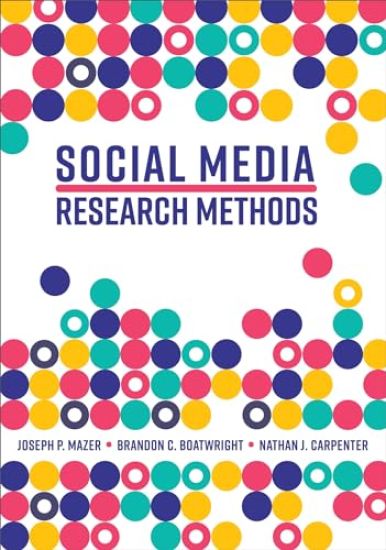
Social Media Research Methods

Social Media Research Methods

Joseph P Mazer; Nathan J Carpenter; Brandon C Boatwright

Cognella Academic Publishing
2023
sidottu
Filling a gap in the literature and featuring an emphasis on using new media in communication research, Social Media Research Methods introduces students to a variety of social media research methods and data analysis strategies. The text recognizes the richness of the data available within social media platforms and underscores the importance of employing effective research methods to make meaning of that data. By integrating applied concepts, theories, and practical advice for working with and presenting social media data, the textbook arms students with the latest research and social media tools. It begins by introducing students to scholarly and industry applications of social media research methods before outlining the complete process of developing social media research questions and data collection procedures. The book then transitions to devoting individual chapters to a social media analysis tool. The final chapter outlines the process of writing and presenting social media research for scholarly and industry audiences. Each chapter features interactive, applied examples and exercises, as well as review questions, to bring the material to life and reinforce key learnings. A comprehensive resource designed to help students use cutting-edge, timely research methods within the discipline, Social Media Research Methods is an exemplary textbook for courses in communication research methods.
Mémoire Pour DOM Joseph Delrue, Supérieur Général de la Congrégation de Saint Maur, Intimé,
Memoire pour dom Joseph Delrue, superieur general de la Congregation de Saint Maur, intime, contre Dom Jean Faure, Dom Denis-Emmanuel-Marie Lymeirac et consors, appellans comme d'abus. Paris, 10 janvier 1764.]Date de l'edition originale: 1764Ce livre est la reproduction fidele d'une oeuvre publiee avant 1920 et fait partie d'une collection de livres reimprimes a la demande editee par Hachette Livre, dans le cadre d'un partenariat avec la Bibliotheque nationale de France, offrant l'opportunite d'acceder a des ouvrages anciens et souvent rares issus des fonds patrimoniaux de la BnF.Les oeuvres faisant partie de cette collection ont ete numerisees par la BnF et sont presentes sur Gallica, sa bibliotheque numerique.En entreprenant de redonner vie a ces ouvrages au travers d'une collection de livres reimprimes a la demande, nous leur donnons la possibilite de rencontrer un public elargi et participons a la transmission de connaissances et de savoirs parfois difficilement accessibles.Nous avons cherche a concilier la reproduction fidele d'un livre ancien a partir de sa version numerisee avec le souci d'un confort de lecture optimal. Nous esperons que les ouvrages de cette nouvelle collection vous apporteront entiere satisfaction.Pour plus d'informations, rendez-vous sur www.hachettebnf.fr
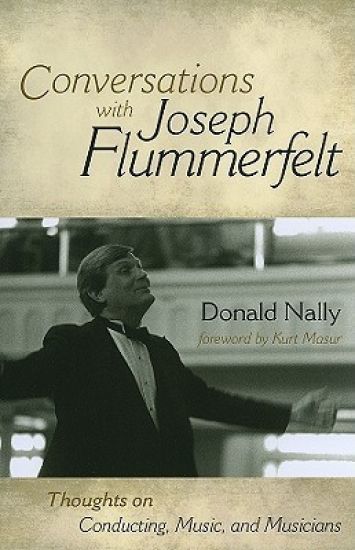
Conversations with Joseph Flummerfelt

Conversations with Joseph Flummerfelt

Donald Nally; Kurt Masur

Scarecrow Press
2010
nidottu
In Conversations with Joseph Flummerfelt: Thoughts on Conducting, Music, and Musicians, Donald Nally presents a window into the mind and heart of one of America's most celebrated and distinguished choral conductors. Through questions from Nally, his former student, Flummerfelt provides a captivating narrative tracing his formative years and influences, his most important artistic collaborations, and his approach to conducting and music. The conversation further develops into a philosophical discussion on cultural influences and obstacles in art, how one teaches conducting, and the foundations of ensemble music-making. Through these intimate conversations, Flummerfelt reveals his life, art, and ideas, from his close collaborations with some of the world's greatest orchestral conductors to his work as Artistic Director of Westminster Choir College. The topics range from his approaches to style, conducting gesture, sound generation, and choral sound to the psychology of music-making and the contemporary environment of art-making. Nally's interview style captures the energy and rhythm of Flummerfelt's speech so that the conductor's "voice" and passion is easily perceived, and the material is presented as a highly organized yet spontaneous and free conversation. Flummerfelt discusses his early career influences from such musicians as Robert Shaw and Nadia Boulanger and reveals his thoughts on composers like Igor Stravinsky, Samuel Barber, Benjamin Britten, and Olivier Messiaen. The more than 30 photos present a visual record of Flummerfelt's collaborations with many of the great musicians of our time, and a biographical timeline, a list of collaborating orchestras and conductors, and a discography are also included.
Social Media Research Methods

Social Media Research Methods

Joseph P. Mazer; Brandon C. Boatwright; Nathan J. Carpenter

Cognella, Inc
2023
pokkari
Filling a gap in the literature and featuring an emphasis on using new media in communication research, Social Media Research Methods introduces students to a variety of social media research methods and data analysis strategies. The text recognizes the richness of the data available within social media platforms and underscores the importance of employing effective research methods to make meaning of that data.By integrating applied concepts, theories, and practical advice for working with and presenting social media data, the textbook arms students with the latest research and social media tools. It begins by introducing students to scholarly and industry applications of social media research methods before outlining the complete process of developing social media research questions and data collection procedures. The book then transitions to devoting individual chapters to a social media analysis tool. The final chapter outlines the process of writing and presenting social media research for scholarly and industry audiences. Each chapter features interactive, applied examples and exercises, as well as review questions, to bring the material to life and reinforce key learnings.A comprehensive resource designed to help students use cutting-edge, timely research methods within the discipline, Social Media Research Methods is an exemplary textbook for courses in communication research methods.