Headache: Through the Centuries illuminates the history of headaches with a particular interest in how the disorder has been understood and treated since the earliest recorded accounts, dating from around 4000 BC. Different types of headache were being recognized as early as the 2nd century AD. Over the years, though, the classification of types of headache has changed so that headache patterns described in the past are often difficult to relate to present-day types of headache. Since that time, a great deal of material on the topic has become available, the full gamut of manifestations of the disorder has been described, and considerable insight into its mechanisms has been obtained, though no completely satisfactory explanation of the disorder has yet become available. Providing an extensive history and the development of our understanding of headache over the course of six millennia, Headache: Through the Centuries is thought-provoking and relevant reading for neurologists, medical historians, and anyone interested in headaches.
In Australia, clinical neurology emerged as a specialised area of medical practice a century ago, in the aftermath of World War I. Some twenty-five years later, the eight men then involved in neurological practice founded a professional association devoted to its further development. That founding generation and most of their immediate successors are no longer living but from the beginning they created Australian neurology has developed progressively, and its story and that of The Australian and New Zealand Association of Neurologists is now extended to the present day in this new edition of The Flowering of a Waratah.
This volumes focuses on the theory of statistical inference under inequality constraints, providing a unified and up-to-date treatment of the methodology. The scope of applications of the presented methodology and theory in different fields is clearly illustrated by using examples from several areas, especially sociology, econometrics, and biostatistics. The authors also discuss a broad range of other inequality constrained inference problems, which do not fit well in the contemplated unified framework, providing meaningful access to comprehend methodological resolutions.
"Smelling the Roses: Memoir of an Irish Philosopher", by Mervyn Brady, is the story of a spiritual teacher's childhood journey, told in his own humorous and eloquent words, with insightful commentary by those who loved him. By turns hilarious and heart-wrenching, intellectual and inspiring, Mervyn Brady's story celebrates the life and legacy of a man who started out a mischievous boy running with a scrappy gang of urchins on the streets of Dublin and ended up a beloved philosopher leading a community of spiritual seekers from the U.S., Mexico, the U.K., Australia and South Africa. "Smelling the Roses" takes us on the personal journey of one of the most beautiful and evolved human beings to grace our complicated world. Whether you had the good fortune to know him, or will meet him for the first time in these pages, you will certainly be enchanted by Mervyn's stories and his wisdom. And perhaps you will also feel a certain joy and the relief that comes from finally meeting someone who really understands us, as individuals and as one, as we move along on our spiritual journeys.
Soviet-Cuban Relations 1985 to 1991 is a comprehensive and critical resource for the study of Soviet foreign policy. It analyzes the dynamic relationship between the Soviet Union and Cuba during the Gorbachev era. Mikhail S. Gorbachev served as the General Secretary of the Communist Party of the Soviet Union between March 1985 and August 1991, leading to significant changes in the Soviet's domestic and international relations. Mervyn J. Bain analyzes the politics and policies of the Soviet Union's glasnost and perestroika programs, Cuba's response to these programs, and the subsequent interactions between the two countries. Bain updates and contextualizes existing research on Soviet-Cuban relations to reinforce the importance of this critical period and its continuing influence on today's world. Soviet-Cuban Relations 1985 to 1991 is important reading for scholars interested in the complexities of socialist politics and international relations.
This book addresses the relationship between the Russian Federation and Cuba from 1992 to the present, the period since the disintegration of the Soviet Union. Mervyn J. Bain analyzes the reasons why the relationship between Havana and Moscow continues to thrive even after the end of the Cold War and the death of international socialism. He argues that there are five main areas to be studied in order to understand why the Russians and Cubans have maintained close cultural and political ties well into the twenty-first century. Bain first explores the effects the disintegration of the Soviet Union had on the relationship between Moscow and Havana in the years since 1992. He goes on to describe how the two countries have adapted (or failed to adapt) to the New World Order and the ways in which their foreign policy have changed the shape of their dialogue with each other. The third and fourth sections detail both the impact of globalization and the increased cultural, economic, and military exchange between Russians and Cubans. Bain concludes by showing readers the importance of placing the Russian-Cuban relationship in an international context, especially highlighting the influence of the United States over it. This book will be of interest to those interested in post-Soviet Russian foreign policy, Cuban foreign policy, and international relations.
This book addresses the relationship between Moscow and Havana in the period between the Russian and Cuban Revolutions, i.e. from November 1917 to January 1959. It analyzes the reasons why in this era before the Cuban Revolution, which is traditionally thought to have ignited Moscow’s interest in the Caribbean island, a relationship existed between the two countries at a variety of different levels. In order to do this, both the attention that the Third International, or Comintern, gave to Cuba, as well as Moscow’s formal state-to-state relations with Havana, are examined. In addition, United States policy towards both socialism and the Soviet Union are analyzed, due to the role that Washington played in Cuba prior to the Cuban Revolution. Following this, an examination of the events, process and dynamics that characterized the nature of the relationship between Moscow and Havana from 1917 to 1959 will be conducted. A number of conclusions will be given, but the primary one is that prior to January 1959, the Kremlin took considerable interest in Cuba and did not suffer from “geographical fatalism,” as has traditionally been thought. This is significant in itself, but also in light of the relationship that rapidly developed between Moscow and Havana in the aftermath of the Cuban Revolution, as a number of factors that were important in the pre-1959 relationship would also be significant after 1959. Furthermore, this analysis is also important for the contemporary bilateral relationship between Russia and Cuba, as both governments have made increasing reference to the multifaceted relationship that existed prior to 1959.
This book addresses the relationship between Moscow and Havana in the period between the Russian and Cuban Revolutions, i.e. from November 1917 to January 1959. It analyzes the reasons why in this era before the Cuban Revolution, which is traditionally thought to have ignited Moscow’s interest in the Caribbean island, a relationship existed between the two countries at a variety of different levels. In order to do this, both the attention that the Third International, or Comintern, gave to Cuba, as well as Moscow’s formal state-to-state relations with Havana, are examined. In addition, United States policy towards both socialism and the Soviet Union are analyzed, due to the role that Washington played in Cuba prior to the Cuban Revolution. Following this, an examination of the events, process and dynamics that characterized the nature of the relationship between Moscow and Havana from 1917 to 1959 will be conducted. A number of conclusions will be given, but the primary one is that prior to January 1959, the Kremlin took considerable interest in Cuba and did not suffer from “geographical fatalism,” as has traditionally been thought. This is significant in itself, but also in light of the relationship that rapidly developed between Moscow and Havana in the aftermath of the Cuban Revolution, as a number of factors that were important in the pre-1959 relationship would also be significant after 1959. Furthermore, this analysis is also important for the contemporary bilateral relationship between Russia and Cuba, as both governments have made increasing reference to the multifaceted relationship that existed prior to 1959.
This book addresses the relationship between Moscow and Havana in the period from the Russian Revolution through the present, i.e. from November 1917 onwards. Its release is particularly timely, due to both November 2017 being the 100th anniversary of the Russian Revolution, as well as the historic election in Cuba in April 2018, when Miguel Díaz-Canel replaced Raúl Castro as the President of Cuba. Traditionally, Moscow’s interest in Cuba has been thought to have been ignited by the Cuban Revolution in January 1959 and ended by the implosion of the Soviet Union in December 1991. This book examines why a bilateral relationship has existed throughout the last century, specifically in three distinct periods: (1) from the time of the Russian Revolution until the Cuban Revolution, (2) from January 1959 until December 1991 and (3) the post-Soviet period from 1992 until the present. It also analyzes the questions of what within the relationship drew the two countries together in these three disparate periods when in only one, January 1959 to December 1991, did the relationship exist between two socialist governments. It offers a number of different conclusions, including that although each period of the relationship has its own peculiarities and nuances, a number of commonalities exist between the three eras. Consequently, it is posited that due to these commonalities, the contemporary bilateral relationship remains important for both countries, and is likely to continue in its present form for the short to medium term, despite the historic change which occurred in Cuba in April 2018.
Back Office and Operational Risk is a core text for ACI, The Financial Markets Association.This fully revised and updated third edition of the groundbreaking book Back Office and Beyond, now retitled Back Office and Operational Risk, is an essential read for anyone working in a financial organisation: whether front, middle or back office; trainee, staff or manager.With practical guidance and advice throughout, including key excerpts from international financial authorities, this book details all you need to know to ensure your organisation avoids the various pitfalls of operational risk. It provides rigorous instruction and information including:– Basic responsibilities and systems at all levels.– Specific demands of numerous deal types and products, from capture to clearing.– Reconciliations and investigations.– Risk management, identification and control.In the aftermath of the 2008-2009 financial crisis, there has never been a more important time for institutions to ensure they are secure from the hazards of operational risk. This book is written by an expert in the field of operations, a former designer of the ACI Dealing Certificate with over twenty years' senior treasury experience, and should help ensure that any organisation both survives and thrives in the face of widespread daily hazards.With so many banks offering similar products and pricing, accurate and speedy settlements have become a competition issue not to be ignored. The first two editions of this book became the benchmark references for best practice in back office procedures, and this new edition builds on this solid foundation to offer a fully updated and revised guide.
This book is intended for use as the textbook in a second course in applied statistics that covers topics in multiple regression and analysis of variance at an intermediate level. Generally, students enrolled in such courses are p- marily graduate majors or advanced undergraduate students from a variety of disciplines. These students typically have taken an introductory-level s- tistical methods course that requires the use a software system such as SAS for performing statistical analysis. Thus students are expected to have an - derstanding of basic concepts of statistical inference such as estimation and hypothesis testing. Understandably, adequate time is not available in a ?rst course in stat- tical methods to cover the use of a software system adequately in the amount of time available for instruction. The aim of this book is to teach how to use the SAS system for data analysis. The SAS language is introduced at a level of sophistication not found in most introductory SAS books. Important features such as SAS data step programming, pointers, and line-hold spe- ?ers are described in detail. The powerful graphics support available in SAS is emphasized throughout, and many worked SAS program examples contain graphic components.
The aim of this textbook (previously titled SAS for Data Analytics) is to teach the use of SAS for statistical analysis of data for advanced undergraduate and graduate students in statistics, data science, and disciplines involving analyzing data.The book begins with an introduction beyond the basics of SAS, illustrated with non-trivial, real-world, worked examples. It proceeds to SAS programming and applications, SAS graphics, statistical analysis of regression models, analysis of variance models, analysis of variance with random and mixed effects models, and then takes the discussion beyond regression and analysis of variance to conclude.Pedagogically, the authors introduce theory and methodological basis topic by topic, present a problem as an application, followed by a SAS analysis of the data provided and a discussion of results. The text focuses on applied statistical problems and methods. Key features include: end of chapter exercises, downloadable SAScode and data sets, and advanced material suitable for a second course in applied statistics with every method explained using SAS analysis to illustrate a real-world problem.New to this edition:• Covers SAS v9.2 and incorporates new commands• Uses SAS ODS (output delivery system) for reproduction of tables and graphics output• Presents new commands needed to produce ODS output• All chapters rewritten for clarity• New and updated examples throughout• All SAS outputs are new and updated, including graphics• More exercises and problems• Completely new chapter on analysis of nonlinear and generalized linear models• Completely new appendixMervyn G. Marasinghe, PhD, is Associate Professor Emeritus of Statistics at Iowa State University, where he has taught courses in statistical methods and statistical computing.Kenneth J. Koehler, PhD, is University Professor of Statistics at Iowa State University, where he teaches courses in statistical methodology at both graduate and undergraduate levels and primarily uses SAS to supplement his teaching.
This work has been selected by scholars as being culturally important and is part of the knowledge base of civilization as we know it.This work is in the public domain in the United States of America, and possibly other nations. Within the United States, you may freely copy and distribute this work, as no entity (individual or corporate) has a copyright on the body of the work.Scholars believe, and we concur, that this work is important enough to be preserved, reproduced, and made generally available to the public. To ensure a quality reading experience, this work has been proofread and republished using a format that seamlessly blends the original graphical elements with text in an easy-to-read typeface.We appreciate your support of the preservation process, and thank you for being an important part of keeping this knowledge alive and relevant.
This work has been selected by scholars as being culturally important and is part of the knowledge base of civilization as we know it.This work is in the public domain in the United States of America, and possibly other nations. Within the United States, you may freely copy and distribute this work, as no entity (individual or corporate) has a copyright on the body of the work.Scholars believe, and we concur, that this work is important enough to be preserved, reproduced, and made generally available to the public. To ensure a quality reading experience, this work has been proofread and republished using a format that seamlessly blends the original graphical elements with text in an easy-to-read typeface.We appreciate your support of the preservation process, and thank you for being an important part of keeping this knowledge alive and relevant.
A residential LED lighting guide written by an interior designer, offering lay-friendly advice for creatively lighting every room of a home. As incandescent lighting continues to diminish, the creative use of LEDs requires a new approach to residential lighting. Written in a conversational voice by an award-winning interior designer, Lighting beyond Edison is structured to be a comprehensive guide for everyone from consumers to designers and building-industry pros. More than 200 color photographs and diagrams demystify LEDs and illustrate how to use them in every room of the house. QR codes direct readers to the most up-to-date information, and an index and glossary make it a handy reference book. Among other things, you will learn: • How many lumens per square foot are recommended in each room of a house, including closets and hallways • How to read LED labels • How different kinds of lampshades disperse light • How to balance light in a room • How to design home office lighting that is both energizing and restful • How to choose the right LEDs and fixture materials for outdoor lighting • How to create fun and flexible landscape lighting
Exploring the paranormal through musical phenomena, this encyclopedia covers a range of anomalies, from musical mediumship to locations throughout the world where music has been heard with no obvious source. Other manifestations, such as the abilities of musical savants and the anesthetic use of music during surgical procedures, are included with a focus on paraphysical aspects. Entries describe examples from earliest history up to the present--interpretation is left to the reader. Broader themes and concepts are discussed in appendices, with additional references provided for further study.
Do not buy this book if you want to read a biased account of the famous Enfield Poltergeist Case from 1977 through to 1978. There are many other choices you could make which will either try to convince you of the genuineness of the phenomena produced or its fraudulent origins according to the interpretation of the authors concerned. I do not mind whether you have a wide-open mind or a totally shut one, since I shall not be trying to convince you one way or the other.Do buy this book if you want to know what really happened I have listened and transcribed all of the several hundred audio tapes that were made by Maurice Grosse and Guy Playfair during their investigation of the alleged poltergeist case that took place in Enfield some 40 years ago and I shall present, in chronological order, what occurred. It will then be your decision as to whether you believe the phenomena came from spirit entities; psychic forces; mistaken interpretations; hallucinations; naughty children or any other source you might wish to present. I shall strive very hard not to be influenced by what I have read, however intelligent it might be, and instead rely on my ears to describe what was happening via the tapes.I shall leave out the many hours of general conversation that took place between the parties concerned since I do not believe that the reader will be particularly interested in the weather; special offers in the local supermarket; or what happened in Coronation Street ... except, of course, when any of these discussions may have been pertinent to the phenomena. I shall include some of the more humorous occurrences since the events occasionally demanded this. Perhaps some light relief from the sometimes all-pervading chaos. Because of their age some of the audio tapes were corrupted beyond recognition and at other times the sound quality was poor. I have therefore had to listen very carefully to unravel the indistinct voices especially when people were often talking at the same time or were not specifically identified by name. There is substantial screaming at times which was difficult to distinguish between the children concerned, so I may have attributed the wrong name to a 'screamer' at times...sorry, but I've tried to get it right The language used is extremely crude, abusive and explicit at times, so the reader should be aware that parts of the book should be 'X' rated, as films used to be in bygone days.If all this hasn't put you off then read on and prepare to possibly find out what happened in Enfield from 31, August 1977 onwards.
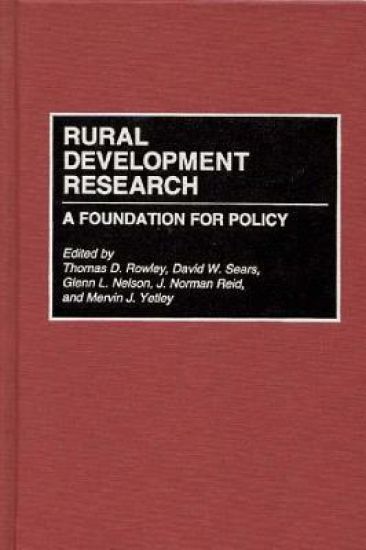
Currently, the research community lacks the capacity to provide accurate, up-to-date information about conditions and trends in rural areas. Bringing together some of the best known rural development researchers, this volume begins to build an information base that can serve as a foundation for rural development policy. It deals with four components of development—education, entrepreneurship, physical infrastructure, and social infrastructure. The opening chapters address two aspects of each component—the use of the component to achieve rural development and measuring the impact of its use. The volume then applies specific analytic methods of measuring impact to each component.The opening chapters address two aspects of each component—the concept of using that component to achieve rural development and the concept of measuring its impact. The volume then examines analytic methods of measuring impact. Following an overview of analytic methods, chapters apply a different analytic technique to each of the components. The techniques considered include econometric models, computable general equilibrium models, input-output analysis, and the case-study method.