Kirjojen hintavertailu. Mukana 11 244 527 kirjaa ja 12 kauppaa.

Kirjahaku

Etsi kirjoja tekijän nimen, kirjan nimen tai ISBN:n perusteella.

1000 tulosta hakusanalla Michael A. Genovese

Memo to a New President

Memo to a New President

Michael A. Genovese

Oxford University Press Inc
2007
nidottu
So you've gotten yourself elected president--now what? Help is here in the form of an imaginary memo from your former professor, who integrates the works of the great thinkers (Aristotle, Plato, Machiavelli, etc.) with contemporary scholarship to address the strengths, limitations, and possibilities of presidential leadership. Michael A. Genovese, a highly esteemed presidential scholar, culls numerous nuggets of wisdom about presidential leadership, including past presidents, condensing detailed and academically grounded insights into an engaging and entertaining read. All essential topics are covered, including: presidential character and personality; political institutions and opportunities; power versus leadership; and sources of and limits to presidential power. In-depth coverage of crisis management and wartime decision-making are unique strengths of the book. Chapters are brief and concise, making Memo to a New President far more interesting than supplements such as case studies or documents. Genovese's presentation allows readers to identify with the various constraints on America's chief executive and gives them an opportunity to apply their knowledge and preconceptions (often misconceptions) to the political realities that presidents routinely face. Students are left to grapple with a central question of the book: Is an effective presidency possible without undermining the essence of a democratic republic?
A Presidential Nation

A Presidential Nation

Michael A. Genovese

Routledge
2019
sidottu
The Washington Monument, the Lincoln Memorial, the Jefferson Memorial. Why do we devote monuments to the presidents? Why do we honor them, instead of Congress, or the courts? A Presidential Nation examines how the presidency (an office limited by the Constitution and separation of powers) became the centerpiece of American government. Michael A. Genovese argues that in rebelling against the British, the Framers of the Constitution invented a circumscribed presidency to guard against executive tyranny. Yet, over time, presidential power has risen and congressional power declined to a point where the United States has a near imperial presidency. Reexamining the status of presidential power in the post-9/11 world, Dr. Genovese considers the alternatives, if any, to the current model of presidential power. A Presidential Nation is perfect for students of American Presidency and Federal Governance courses and anyone interested in the changing authority of the American political system.
The Nixon Presidency

The Nixon Presidency

Michael A. Genovese

Praeger Publishers Inc
1990
sidottu
Although much material concerning the Nixon presidency remains unavailable to scholars, Michael A. Genovese has successfully pieced together the many puzzles that make up Richard Nixon and his presidency. A study of the Nixon presidency, it is also a study of the nature of the presidency broadly defined that is informed by the concerns of both traditional political biography and of contemporary presidential scholarship. As such, the volume raises many vital issues and questions relating to the office of president. Focusing on Nixon as a political leader and on his style of decision-making and management, The Nixon Presidency is the first book to bring together all the key elements of Nixon's presidency into an integrated and interrelated whole, tracing Nixon's rise and fall and the how and why of Watergate.The first four chapters present a biographical sketch of Nixon's early years and rise in politics; assess Nixon's personality and how he approached and organized his administration; and document his domestic, economic, and foreign policies. Chapter five examines the events that led to Watergate and the collapse of the Nixon presidency. Balanced yet critical, the study concludes with an analysis of the impact and legacy of Richard Nixon on the presidency and the U.S. and an assessment of Nixon within the broader comparative perspective of other United States presidents. A most readable book for the informed generalist and a valuable addition to college-level courses in the Presidency, U.S. Government, and Modern U.S. History.
The Presidential Dilemma

The Presidential Dilemma

Michael A. Genovese

Routledge
2017
sidottu
This brief, thought-provoking text evaluates the performance of recent presidents from Johnson to Bush, finding that, overall, each has failed to live up to public expectations. Written by one of the top presidency scholars today, The Presidential Dilemma reflects on the idea that as our country's problems grow, our politicians seem to shrink. Arguing that American presidents of the last 40 years have largely failed to meet the needs, expectations, and responsibilities placed upon them, the book discusses how presidents might better maximize their opportunities for leadership and suggests a distinctive theory of presidential politics: presidents, facing a system of multiple veto points, seek to maximize power and influence.The third edition of Genovese's stimulating book is thoroughly updated to reflect presidential development in recent years, and a new introduction brings his arguments current. As he demonstrates, the emergence of democracy as a new social and political paradigm undermined traditional authority and legitimacy. Subjects no longer automatically follow; now citizens must be persuaded. They may give to a leader their authority and power, or not. As Genovese notes, in a world of mass consumerism, those wishing to lead have precious little to offer by way of inducement.Genovese's goal is to examine the reasons why the performance of recent presidents has been underwhelming, discuss how they might maximize their opportunities for leadership, and ask a key question: Can presidents be both powerful and accountable? The book follows a clear format and tries to show why America's officeholders have so rarely been leaders and how presidents can become leaders instead of mere officeholders.
The Presidential Dilemma

The Presidential Dilemma

Michael A. Genovese

AldineTransaction
2011
nidottu
This brief, thought-provoking text evaluates the performance of recent presidents from Johnson to Bush, finding that, overall, each has failed to live up to public expectations. Written by one of the top presidency scholars today, The Presidential Dilemma reflects on the idea that as our country's problems grow, our politicians seem to shrink. Arguing that American presidents of the last 40 years have largely failed to meet the needs, expectations, and responsibilities placed upon them, the book discusses how presidents might better maximize their opportunities for leadership and suggests a distinctive theory of presidential politics: presidents, facing a system of multiple veto points, seek to maximize power and influence.The third edition of Genovese's stimulating book is thoroughly updated to reflect presidential development in recent years, and a new introduction brings his arguments current. As he demonstrates, the emergence of democracy as a new social and political paradigm undermined traditional authority and legitimacy. Subjects no longer automatically follow; now citizens must be persuaded. They may give to a leader their authority and power, or not. As Genovese notes, in a world of mass consumerism, those wishing to lead have precious little to offer by way of inducement.Genovese's goal is to examine the reasons why the performance of recent presidents has been underwhelming, discuss how they might maximize their opportunities for leadership, and ask a key question: Can presidents be both powerful and accountable? The book follows a clear format and tries to show why America's officeholders have so rarely been leaders and how presidents can become leaders instead of mere officeholders.
The Watergate Crisis

The Watergate Crisis

Michael A. Genovese

Greenwood Press
2020
sidottu
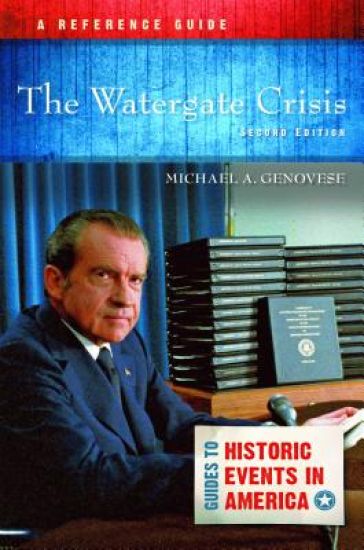
This reference provides background information about the Watergate crisis and discusses its significance to U.S. politics today.Relatively insignificant at first glance, the Watergate crisis led to the downfall of a president and emerged as the most important constitutional crisis since the Civil War. Journalists and the media were instrumental in shedding light on Watergate and exposing political corruption at the highest levels of government. Watergate became part of American popular culture and synonymous with presidential corruption. This book surveys the background of the Watergate crisis and links it to contemporary American politics.The first part of the book provides a narrative overview and examination of the Watergate crisis, with a consideration of what happened and why, and the relevance of Watergate to today's political issues. The book considers such topics as political corruption and impeachment, the role of the media, and the abuse of presidential power. The book also offers biographical sketches of key players in the Watergate crisis, a chronology, glossary, primary source document excerpts, and an annotated bibliography.
Art, Power, and Politics

Art, Power, and Politics

Michael A. Genovese

BLOOMSBURY PUBLISHING PLC
2023
sidottu
Stories matter. They help us digest information, make sense of our world, learn valuable lessons, understand ourselves, store information, find meaning, and remember. Our stories can define us, tell us who we are, and who we might yet become. Researchers tell us that stories are one of the most elemental ways we process information. We understand the world through stories. Stories are accessible to our brains; we can more easily process narratives. They make sense to us. This book takes political storytelling seriously. Research on the brain indicates that humans learn from and profit from narratives. They help us make sense of a complex world, teach us important lessons, socialize us into society, are agents of education, information, and entertainment. How best to receive and process new information? As stories are important to us, so too are political narrative as a key to our identities. So many of our political views and subsequent behavior have roots in the myths and stories of America. This book examines stories of our lives as presented in paintings, music, and films. When the legend becomes fact, print the legend.
Building Tomorrow's Leaders Today

Building Tomorrow's Leaders Today

Michael A. Genovese

Routledge
2013
sidottu
This book focuses on leadership -- what it is, how it works, and how complex, multi-layered and multi-dimensional it is -- and how it will change in the years ahead. If we are to build tomorrow’s leaders today, we need to anticipate what skills, temperaments, and specific competencies will be valuable as we face future needs. If the past is a predictor of the future, the world of tomorrow will be characterized by rapid change, new technology, greater diversity, increased globalization, and the need for lifelong learning.As a political scientist and presidential scholar, Michael Genovese incorporates a wide range of disciplinary perspectives and research on leadership in this book to give students, practitioners, and leadership scholars a welcome and engaging look to the future.
Building Tomorrow's Leaders Today

Building Tomorrow's Leaders Today

Michael A. Genovese

Routledge
2013
nidottu
This book focuses on leadership -- what it is, how it works, and how complex, multi-layered and multi-dimensional it is -- and how it will change in the years ahead. If we are to build tomorrow’s leaders today, we need to anticipate what skills, temperaments, and specific competencies will be valuable as we face future needs. If the past is a predictor of the future, the world of tomorrow will be characterized by rapid change, new technology, greater diversity, increased globalization, and the need for lifelong learning.As a political scientist and presidential scholar, Michael Genovese incorporates a wide range of disciplinary perspectives and research on leadership in this book to give students, practitioners, and leadership scholars a welcome and engaging look to the future.
The Legacy of Watergate and the Nixon Presidency

The Legacy of Watergate and the Nixon Presidency

Michael A. Genovese

Springer International Publishing AG
2023
sidottu
This book examines the Nixon presidency, reviews the events surrounding Watergate and the President’ resignation, and unpacks the effects of Watergate on our politics and public attitudes about the political process. Genovese, a prolific scholar of the American presidency who has published three previous books on Nixon and Watergate, argues that the roots of modern political dysfunction and slash-and-burn politics can be traced to the impact of the Vietnam War, the Watergate Crisis, the policies and activities of the Nixon presidency, and the hyper-partisanship they spawned. Now, 50 years on from the scandal, it is time for a reappraisal of Nixon’s impact and a review of the impact he has had on our political system and political culture.
The Legacy of Watergate and the Nixon Presidency

The Legacy of Watergate and the Nixon Presidency

Michael A. Genovese

Springer International Publishing AG
2024
nidottu
This book examines the Nixon presidency, reviews the events surrounding Watergate and the President’ resignation, and unpacks the effects of Watergate on our politics and public attitudes about the political process. Genovese, a prolific scholar of the American presidency who has published three previous books on Nixon and Watergate, argues that the roots of modern political dysfunction and slash-and-burn politics can be traced to the impact of the Vietnam War, the Watergate Crisis, the policies and activities of the Nixon presidency, and the hyper-partisanship they spawned. Now, 50 years on from the scandal, it is time for a reappraisal of Nixon’s impact and a review of the impact he has had on our political system and political culture.
Presidential Power and Nuclear Arms

Presidential Power and Nuclear Arms

Michael A. Genovese

Springer International Publishing AG
2025
sidottu
This book traces the development of US strategy on nuclear weapons and how presidents from Truman to Biden have wrestled with the question of how best to employ nuclear arms in a dangerous world. Michael Genovese examines how each president tried to solve the problems raised by the possession and spread of nuclear arms. Some presidents were aware of the grave dangers; others imagined that nuclear weapons could be useful battlefield weapons; still others tried to build up the nuclear arsenal while others sought to cut the arsenals. This book also analyzes the role of nuclear weapons and the rise of presidential power. The nuclear age has contributed to the dominance of the American presidency in foreign policy and war. To policy makers and politicians alike, the nuclear threat meant that command and control had to be placed in the hands of a central commander: the President of the United States. It concludes with an examination of the ethical and pragmatic issues regarding nuclear weapons and their use.
The Presidency and Domestic Policy

The Presidency and Domestic Policy

Michael A. Genovese; Todd L. Belt; William W. Lammers

TAYLOR FRANCIS LTD
2024
nidottu
This book systematically examines the first terms of every president from FDR to Joe Biden and assesses the leadership style and policy agenda of each. Success in bringing about policy change is shown to hinge on the leadership style and skill in managing a variety of institutional and public relationships. Presidents are evaluated based on the level of opportunity they faced. The third edition of this timely book adds chapters on Donald Trump and Joe Biden and focuses on the significant domestic policy challenges of their respective times. For students of presidential history, leadership, and public policy, The Presidency and Domestic Policy provides unique insights into contemporary presidential leadership in a highly partisan age.New to the Third EditionTwo new chapters focusing on Trump and Biden, showing its policy similarities as well as differences from earlier administrationsA reassessment of the domestic policy legacies of Bill Clinton (especially in regard to crime and the financial services industries)A sharper focus on racial politics resulting from both the Clinton and Obama erasAn exploration of administrative approaches to governing domestically and unilateral decision making—normally reserved for the foreign policy arena but now applied on the domestic side as well (e.g., executive orders)The increasing linkage between domestic and foreign policy issue arenas, particularly in the areas of immigration, trade, and environmental policyAn assessment of judicial politics in the framework of the four leadership dimensions presidents bring to office, and also in terms of the impact on domestic policy outputs
The Presidency and Domestic Policy

The Presidency and Domestic Policy

Michael A. Genovese; Todd L. Belt; William W. Lammers

TAYLOR FRANCIS LTD
2024
sidottu
This book systematically examines the first terms of every president from FDR to Joe Biden and assesses the leadership style and policy agenda of each. Success in bringing about policy change is shown to hinge on the leadership style and skill in managing a variety of institutional and public relationships. Presidents are evaluated based on the level of opportunity they faced. The third edition of this timely book adds chapters on Donald Trump and Joe Biden and focuses on the significant domestic policy challenges of their respective times. For students of presidential history, leadership, and public policy, The Presidency and Domestic Policy provides unique insights into contemporary presidential leadership in a highly partisan age.New to the Third EditionTwo new chapters focusing on Trump and Biden, showing its policy similarities as well as differences from earlier administrationsA reassessment of the domestic policy legacies of Bill Clinton (especially in regard to crime and the financial services industries)A sharper focus on racial politics resulting from both the Clinton and Obama erasAn exploration of administrative approaches to governing domestically and unilateral decision making—normally reserved for the foreign policy arena but now applied on the domestic side as well (e.g., executive orders)The increasing linkage between domestic and foreign policy issue arenas, particularly in the areas of immigration, trade, and environmental policyAn assessment of judicial politics in the framework of the four leadership dimensions presidents bring to office, and also in terms of the impact on domestic policy outputs
The War Power in an Age of Terrorism

The War Power in an Age of Terrorism

Michael A. Genovese; David Gray Adler

Palgrave Macmillan
2016
sidottu
This book features a lively debate between two prominent scholars—Michael A. Genovese and David Gray Adler—on the critical issue of whether the Constitution, written in the 18th Century, remains adequate to the national security challenges of our time. The question of the scope of the president’s constitutional authority—if any—to initiate war on behalf of the American people, long the subject of heated debate in the corridors of power and the groves of academe, has become an issue of surpassing importance for a nation confronted by existential threats in an Age of Terrorism. This question should be thoroughly reviewed and debated by members of Congress, and considered by all Americans before they are asked to go to war. If the constitutional allocation of powers on matters of war and peace is outdated, what changes should be made? Is there a need to increase presidential power? What role should Congress play in the war on terror?
The War Power in an Age of Terrorism

The War Power in an Age of Terrorism

Michael A. Genovese; David Gray Adler

Palgrave Macmillan
2018
nidottu
This book features a lively debate between two prominent scholars—Michael A. Genovese and David Gray Adler—on the critical issue of whether the Constitution, written in the 18th Century, remains adequate to the national security challenges of our time. The question of the scope of the president’s constitutional authority—if any—to initiate war on behalf of the American people, long the subject of heated debate in the corridors of power and the groves of academe, has become an issue of surpassing importance for a nation confronted by existential threats in an Age of Terrorism. This question should be thoroughly reviewed and debated by members of Congress, and considered by all Americans before they are asked to go to war. If the constitutional allocation of powers on matters of war and peace is outdated, what changes should be made? Is there a need to increase presidential power? What role should Congress play in the war on terror?
The Post-Heroic Presidency

The Post-Heroic Presidency

Michael A. Genovese; Todd L. Belt

Praeger Publishers Inc
2016
sidottu
This book examines how presidents from Nixon to Obama have faced the challenges of global leadership in a dramatically changing world—one with more limited resources and an increasing number of threatening challengers.The immediate post-World War II era was undeniably a period of American power and influence. Even during the Cold War, the United States was the leader of the West, exerting wide-ranging power internationally. But beginning with the Vietnam War, America began experiencing a series of setbacks and challenges to its power. The Post-Heroic Presidency: Leveraged Leadership in an Age of Limits examines how U.S. presidents have attempted to reverse or contend with this new era of limited power in which presidential leadership is hamstrung due to an increasingly globalized and interdependent world—one where power is more diffuse and the system of checks and balances bind a president in an age of hyper-partisanship.The book examines presidents of the 20th and 21st centuries, explaining how the first U.S. president to confront this new age was Richard Nixon, who—along with Henry Kissinger—developed a sophisticated approach to deal with the recalibration of American power. It documents how other recent presidents have either tried to make peace with limited power (Jimmy Carter), reverse the decline (Ronald Reagan), ignore the implications of limits (George W. Bush), or find ways to lead that were less ambitious, more prudent, and less unilateral (George H.W. Bush, Bill Clinton, and Barack Obama). In the cases of Clinton and Obama, this shift to using "soft power," persuasion, and multilateralism earned them criticism that they are "weak," thereby undermining their efforts to lead—both at home and abroad.