Kirjojen hintavertailu. Mukana 11 244 527 kirjaa ja 12 kauppaa.

Kirjahaku

Etsi kirjoja tekijän nimen, kirjan nimen tai ISBN:n perusteella.

1000 tulosta hakusanalla Michael B. Katz

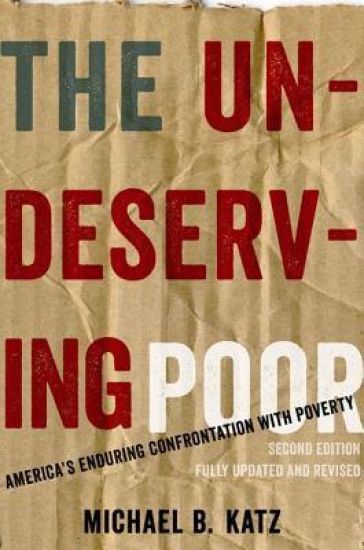
The Undeserving Poor

The Undeserving Poor

Michael B. Katz

Oxford University Press Inc
2013
nidottu
First published in 1989, The Undeserving Poor was a critically acclaimed and enormously influential account of America's enduring debate about poverty. Taking stock of the last quarter century, Michael B. Katz's new edition of this classic is virtually a new book. As the first did, it will force all concerned Americans to reconsider the foundations of our policies toward the poor, especially in the wake of the Great Recession that began in 2008. Katz highlights how throughout American history, the poor have been regarded as undeserving: people who do not deserve sympathy because they brought their poverty on themselves, either through laziness and immorality, or because they are culturally or mentally deficient. This long-dominant view sees poverty as a personal failure, serving to justify America's mean-spirited treatment of the poor. Katz reminds us, however, that there are other explanations of poverty besides personal failure. Poverty has been written about as a problem of place, of resources, of political economy, of power, and of market failure. Katz looks at each idea in turn, showing how they suggest more effective approaches to our struggle against poverty. The Second Edition includes important new material. It now sheds light on the revival of the idea of culture in poverty research; the rehabilitation of Daniel Patrick Moynihan; the resurgent role of biology in discussions of the causes of poverty, such as in The Bell Curve; and the human rights movement's intensified focus on alleviating world poverty. It emphasizes the successes of the War on Poverty and Great Society, especially at the grassroots level. It is also the first book to chart the rise and fall of the "underclass" as a concept driving public policy. A major revision of a landmark study, The Undeserving Poor helps readers to see poverty-and our efforts to combat it--in a new light.
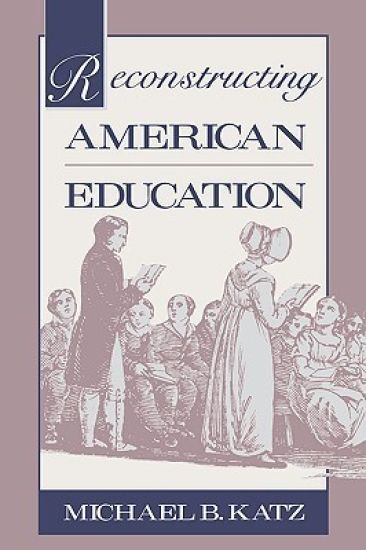
Reconstructing American Education

Reconstructing American Education

Michael B. Katz

Harvard University Press
1989
nidottu
One of the leading historians of education in the United States here develops a powerful interpretation of the uses of history in educational reform and of the relations among democracy, education, and the capitalist state. Michael Katz discusses the reshaping of American education from three perspectives. First is the perspective of history: How did American education take shape? The second is that of reform: What can a historian say about recent criticisms and proposals for improvement? The third is that of historiography: What drives the politics of educational history? Katz shows how the reconstruction of America’s educational past can be used as a framework for thinking about current reform. Contemporary concepts such as public education, institutional structures such as the multiversity, and modern organizational forms such as bureaucracy all originated as solutions to problems of public policy. The petrifaction of these historical products—which are neither inevitable nor immutable—has become, Katz maintains, one of the mighty obstacles to change.The book’s central questions are as much ethical and political as they are practical. How do we assess the relative importance of efficiency and responsiveness in educational institutions? Whom do we really want institutions to serve? Are we prepared to alter institutions and policies that contradict fundamental political principles? Why have some reform strategies consistently failed? On what models should institutions be based? Should schools and universities be further assimilated to the marketplace and the state? Katz’s iconoclastic treatment of these issues, vividly and clearly written, will be of interest to both specialists and general readers. Like his earlier classic, The Irony of Early School Reform (1968), this book will set a fresh agenda for debate in the field.
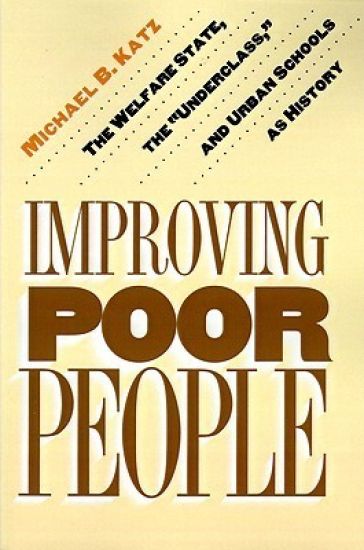
Improving Poor People

Improving Poor People

Michael B. Katz

Princeton University Press
1997
pokkari
"There are places where history feels irrelevant, and America's inner cities are among them," acknowledges Michael Katz, in expressing the tensions between activism and scholarship. But this major historian of urban poverty realizes that the pain in these cities has its origins in the American past. To understand contemporary poverty, he looks particularly at an old attitude: because many nineteenth-century reformers traced extreme poverty to drink, laziness, and other forms of bad behavior, they tried to use public policy and philanthropy to improve the character of poor people, rather than to attack the structural causes of their misery. Showing how this misdiagnosis has afflicted today's welfare and educational systems, Katz draws on his own experiences to introduce each of four topics--the welfare state, the "underclass" debate, urban school reform, and the strategies of survival used by the urban poor. Uniquely informed by his personal involvement, each chapter also illustrates the interpretive power of history by focusing on a strand of social policy in the nineteenth and twentieth centuries: social welfare from the poorhouse era through the New Deal, ideas about urban poverty from the undeserving poor to the "underclass," and the emergence of public education through the radical school reform movement now at work in Chicago. Why have American governments proved unable to redesign a welfare system that will satisfy anyone? Why has public policy proved unable to eradicate poverty and prevent the deterioration of major cities? What strategies have helped poor people survive the poverty endemic to urban history? How did urban schools become unresponsive bureaucracies that fail to educate most of their students? Are there fresh, constructive ways to think about welfare, poverty, and public education? Throughout the book Katz shows how interpretations of the past, grounded in analytic history, can free us of comforting myths and help us to reframe discussions of these great public issues.
The Price of Citizenship

The Price of Citizenship

Michael B. Katz

University of Pennsylvania Press
2008
pokkari
For Michael B. Katz, the term "welfare state" describes the intricate web of government programs, employer-provided benefits, and semiprivate organizations intended to promote economic security and to guarantee the basic necessities of life for all citizens: food, shelter, medical care, protection in childhood, and support in old age. In this updated edition of his seminal work The Price of Citizenship, Katz traces the evolution of the welfare state from colonial relief programs through the war on poverty and into our own age, marked by the "end of welfare as we know it." Katz argues that in the last decades, three great forces-a ferocious war on dependence, which has singled out the most vulnerable; the devolution of authority within both government and the private sector; and the application of market models to social policy-have permeated all aspects of the social contract. The Price of Citizenship shows how these changes have propelled America toward a future of increased inequality and decreased security as individuals compete for success in an open market with ever fewer protections against misfortune, power, and greed. A new chapter, written for this edition, explains how these trends continue in the post-9/11 era and how the response to Hurricane Katrina exposed the weaknesses of America's social safety net. Offering grounds for modest optimism, the new chapter also points to countervailing trends that may modify and even partially reverse the effects of recent welfare history.
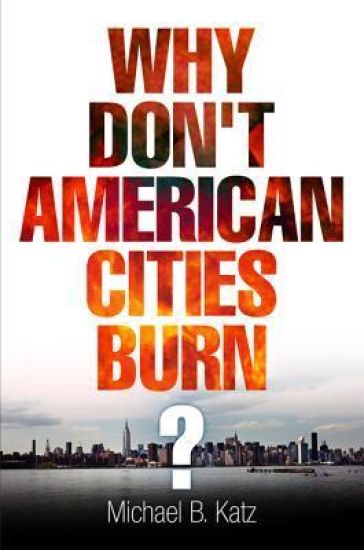
Why Don't American Cities Burn?

Why Don't American Cities Burn?

Michael B. Katz

University of Pennsylvania Press
2013
pokkari
At 1:27 on the morning of August 4, 2005, Herbert Manes fatally stabbed Robert Monroe, known as Shorty, in a dispute over five dollars. It was a horrific yet mundane incident for the poor, heavily African American neighborhood of North Philadelphia-one of seven homicides to occur in the city that day and yet not make the major newspapers. For Michael B. Katz, an urban historian and a juror on the murder trial, the story of Manes and Shorty exemplified the marginalization, social isolation, and indifference that plague American cities. Introduced by the gripping narrative of this murder and its circumstances, Why Don't American Cities Burn? charts the emergence of the urban forms that underlie such events. Katz traces the collision of urban transformation with the rightward-moving social politics of late twentieth- and early twenty-first-century America. He shows how the bifurcation of black social structures produced a new African American inequality and traces the shift from images of a pathological black "underclass" to praise of the entrepreneurial poor who take advantage of new technologies of poverty work to find the beginning of the path to the middle class. He explores the reasons American cities since the early 1970s have remained relatively free of collective violence while black men in bleak inner-city neighborhoods have turned their rage inward on one another rather than on the agents and symbols of a culture and political economy that exclude them. The book ends with a meditation on how the political left and right have come to believe that urban transformation is inevitably one of failure and decline abetted by the response of government to deindustrialization, poverty, and race. How, Katz asks, can we construct a new narrative that acknowledges the dark side of urban history even as it demonstrates the capacity of government to address the problems of cities and their residents? How can we create a politics of modest hope?
Nominations of Michael B. Thornton, Joseph W. Nega, and F. Scott Kieff

Nominations of Michael B. Thornton, Joseph W. Nega, and F. Scott Kieff

United States Senate; Committee On Finance; United States Congress

Createspace Independent Publishing Platform
2017
nidottu
Nominations of Michael B. Thornton, Joseph W. Nega, and F. Scott Kieff: hearing before the Committee on Finance, United States Senate, One Hundred Thirteenth Congress, first session, on the nominations of Michael B. Thornton, to be a judge of the United States Tax Court; Joseph W. Nega, to be a judge of the United States Tax Court; and F. Scott Kieff, to be a member of the United States Int
Proceedings Of The House Of Representatives And Obituary Addresses On The Occasion Of The Death Of Hon. Michael B. Lemon
This work has been selected by scholars as being culturally important, and is part of the knowledge base of civilization as we know it. This work was reproduced from the original artifact, and remains as true to the original work as possible. Therefore, you will see the original copyright references, library stamps (as most of these works have been housed in our most important libraries around the world), and other notations in the work.This work is in the public domain in the United States of America, and possibly other nations. Within the United States, you may freely copy and distribute this work, as no entity (individual or corporate) has a copyright on the body of the work.As a reproduction of a historical artifact, this work may contain missing or blurred pages, poor pictures, errant marks, etc. Scholars believe, and we concur, that this work is important enough to be preserved, reproduced, and made generally available to the public. We appreciate your support of the preservation process, and thank you for being an important part of keeping this knowledge alive and relevant.
B Movie

B Movie

Michael B Druxman

Createspace Independent Publishing Platform
2014
pokkari
On September 14, 1951, the front page of virtually every major newspaper in the United States carried the story of how B picture actor Tom Neal had brutally beaten dapper leading man Franchot Tone's face into a bloody pulp over the affections of sultry blonde actress Barbara Payton.The sordid narrative surrounding this ill-fated triangle would have "legs". Only Franchot Tone's career would survive the disgraceful events. Barbara Payton would soon descend into a desperate world of drugs and prostitution and, in the 1960s, Tom Neal would be prosecuted for first degree murder.B MOVIE dramatizes the most notorious scandal to hit Hollywood during the first half of the 1950s.2 Men; 1 Woman. Simple Open Set.
Pump it up Magazine - INGRAM STREET - Brotherly Love And A Perfect Blend Of R&B!
Greeting Readers We're thrilled to announce that Ingram Street is this month's cover star on Pump it up magazine You need to know about Minquel and Woody, a popular R&B duo, if you want to be hip to the latest music Pump it up magazine will cover different great topics to prepare you for an amazing new year Find out how to look like a celebrity in our fashion section. There will be no more excuses for not getting fit in 2023 You'll want to check out our fitness feature You'll find all about natural ways to fight wrinkles on the beauty pages. If you're thinking about traveling in a motor home, our article will tell you the pros and cons of it. Our learn French feature will help you get read if you're planning a trip to Paris. We've got a great selection of music for your road trip vacation Our movie section also features some of the best Oscar-worthy films of the year. We will also share some strategies for getting your music heard by more people in our top tips section Finally, in our humanitarian awareness section, you will learn how to help stop human trafficking.Happy New Year Anissa