Kirjojen hintavertailu. Mukana 12 083 983 kirjaa ja 12 kauppaa.

Kirjahaku

Etsi kirjoja tekijän nimen, kirjan nimen tai ISBN:n perusteella.

1000 tulosta hakusanalla Michael J. O'Donnell

Lift Up Your Hearts Year A: Eucharistic Prayers Based on the Revised Common Lectionary

Lift Up Your Hearts Year A: Eucharistic Prayers Based on the Revised Common Lectionary

Michael J. O'Donnell O. S. L.

Createspace Independent Publishing Platform
2014
nidottu
Eucharistic Prayers based on the Revised Common Lectionary, Year A. The eucharistic prayers (Great Thanksgivings) in this book are written for those pastors who are leading the people of God toward more frequent reception of the means of grace through the sacrament of Holy Communion and who follow the lections of the Revised Common Lectionary (1992). Prayers are included for all of the Sundays of the year, some Holy Days, and the days of Holy Week. The prayers follow the pattern of Word and Table II and III in The United Methodist Hymnal: Book of United Methodist Worship. Presiders who follow other patterns of eucharistic prayer will soon discover the flow of this form and will be able to adapt them easily.
Lift Up Your Hearts Year B: Eucharistic Prayers Based on the Revised Common Lectionary

Lift Up Your Hearts Year B: Eucharistic Prayers Based on the Revised Common Lectionary

Michael J. O'Donnell O. S. L.

Createspace Independent Publishing Platform
2014
nidottu
Eucharistic Prayers based on the Revised Common Lectionary. The eucharistic prayers (Great Thanksgivings) in this book are written for those pastors who are leading the people of God toward more frequent reception of the means of grace through the sacrament of Holy Communion and who follow the lections of the Revised Common Lectionary (1992). Prayers are included for all of the Sundays of the year, some Holy Days, and the days of Holy Week. The prayers follow the pattern of Word and Table II and III in The United Methodist Hymnal: Book of United Methodist Worship. Presiders who follow other patterns of eucharistic prayer will soon discover the flow of this form and will be able to adapt them easily.
Cannabis Banking

Cannabis Banking

Erin O'Donnell; J. Michael Beird; Meridith Beird

JOHN WILEY SONS INC
2025
sidottu
Unlock the financial potential of the cannabis industry Cannabis Banking: Legal Frameworks and Practical Solutions for Cultivating Compliance offers a deep dive into a critical issue facing cannabis businesses worldwide: the challenge of accessing essential financial and banking services. Written by a team of experienced finance professionals and entrepreneurs, this guide is tailored to demystify the complex world of banking regulations and present practical solutions for cannabis enterprises. As the cannabis sector continues to expand at an unprecedented rate, many businesses find themselves hindered by regulatory uncertainties, preventing them from accessing the financial services necessary for growth. Cannabis Banking not only addresses these challenges but also opens the door for finance professionals, entrepreneurs, and investors to explore substantial business opportunities within the industry. You'll also find: Detailed discussions on the pending SAFER legislation that grants safe harbor to banks who do business with cannabis enterprisesStrategies for maintaining compliance and optimizing fiscal opportunities when banking cannabis firmsUp-to-date guidance, practical tips, and real-world case studies of cannabis finance and banking Whether you are a bank and credit union personnel, compliance officer, risk analyst, or fintech professional involved with the cannabis sector, Cannabis Banking is your go-to resource for navigating the complexities of cannabis finance. Equip yourself with the knowledge to foster efficient, compliant financial operations and propel your cannabis business or financial career forward.
The Rise and Fall of Culture History

The Rise and Fall of Culture History

R. Lee Lyman; Michael J. O'Brien; Robert C. Dunnell

Kluwer Academic/Plenum Publishers
1997
sidottu
VJver forty years ago Gordon R. Willey (1953b:361) stated that "[t]he objectives of archeology ...are approached by the study and manipulation of three basic factors: form, space, and time. " A few years later, Albert C. Spaulding (1960b:439) repeated this thought using different words: "[AJrchaeology can be defined minimally as the study of the interrelation- ship of form, temporal locus, and spatial locus exhibited by artifacts. In other words, archaeologists are always concerned with these interrelation- ships, whatever broader interests they may have, and these interrelation- ships are the special business of archaeology. " Many of the means Americanist archaeologists use to examine formal variation in artifacts and the distribution of that variation across space and through time were formulated early in the twentieth century. The analytical tenets, or principles, underlying the various methods and techniques were formalized and axiomatized in later years such that by the 1930s they con- stituted the first formal paradigm for Americanist archaeology-a paradigm commonly termed culture history. This paradigm began with a very specific goal-to document the history of the development of prehistoric cultures in the Americas. Although it fell from favor in the 1960s, many of its central tenets were carried over to newer paradigms and thus continue to be fun- damental within Americanist archaeology. With Willey's and Spaulding's conceptions as our guide, we elsewhere reprinted (Lyman et al.
The Rise and Fall of Culture History

The Rise and Fall of Culture History

R. Lee Lyman; Michael J. O'Brien; Robert C. Dunnell

Kluwer Academic/Plenum Publishers
1997
nidottu
VJver forty years ago Gordon R. Willey (1953b:361) stated that "[t]he objectives of archeology ...are approached by the study and manipulation of three basic factors: form, space, and time. " A few years later, Albert C. Spaulding (1960b:439) repeated this thought using different words: "[AJrchaeology can be defined minimally as the study of the interrelation- ship of form, temporal locus, and spatial locus exhibited by artifacts. In other words, archaeologists are always concerned with these interrelation- ships, whatever broader interests they may have, and these interrelation- ships are the special business of archaeology. " Many of the means Americanist archaeologists use to examine formal variation in artifacts and the distribution of that variation across space and through time were formulated early in the twentieth century. The analytical tenets, or principles, underlying the various methods and techniques were formalized and axiomatized in later years such that by the 1930s they con- stituted the first formal paradigm for Americanist archaeology-a paradigm commonly termed culture history. This paradigm began with a very specific goal-to document the history of the development of prehistoric cultures in the Americas. Although it fell from favor in the 1960s, many of its central tenets were carried over to newer paradigms and thus continue to be fun- damental within Americanist archaeology. With Willey's and Spaulding's conceptions as our guide, we elsewhere reprinted (Lyman et al.
The Tweetable Pope: A Spiritual Revolution in 140 Characters
Boston Globe journalist and Catholic commentator Michael O'Loughlin opens a wonderful window into the heart and revolutionary mission of Pope Francis by examining his extensive and revelatory use of social media--published to coincide with the pontiff's visit to the United States in September 2015.Michael O'Loughlin uses Pope Francis's almost daily "tweets" to his 21 million followers to explain why this pope has captured the world's imagination and to explore his strategy and vision for the Catholic Church. Grouped by the Pope's most pressing concerns--forgiveness, mercy, injustice, poverty, war, joy, the environment, and more--The Tweetable Pope uses Francis' pithy 140-character (or fewer) missives as a prism to view the biographical, historical, and spiritual context of his messages and how each is part of a larger vision.O'Loughlin contends that these seemingly simple communications provide a direct line to the Pope's heart, illuminating a peaceful, loving, and courageous visionary committed to restoring the church to the original Christian tenets of its founder, Jesus Christ--love, mercy, grace, and compassion--and reshaping it as a force for change to help the most needy. A thoughtful and enlightening examination of how the pope is using this exciting and fascinating new medium to communicate directly to his flock, The Tweetable Pope is an inspiring and moving testimony of how we, too, can be more centered on what matters most to God.
The Importance of Small Decisions

The Importance of Small Decisions

Michael J. O'Brien; R. Alexander Bentley; William A. Brock; John Maeda

MIT Press
2019
sidottu
How people make decisions in an era of too much information and fake news.Humans originally evolved in a world of few choices. Prehistoric, preindustrial, and predigital eras required fewer decisions than today's all-access, always-on world of too much information. Economists have largely discarded the idea that agents act rationally and the market follows suit. It seems that no matter how small or innocuous a decision might seem, there's almost no way to guess the effect it might have. The authors of The Importance of Small Decisions view decisions and their outcomes from a different perspective: as key elements in the evolution of culture. In this trailblazing book, they examine different kinds of decisions and map the outcomes, both short- and long-term. Drawing on this, they introduce a map of social behavior that captures the essential elements of human decision-making.The authors look at the New England Patriots' decision in 2000 to draft an underachieving college quarterback named Tom Brady; they consider Warren Buffett's investment strategy; and they chart the "dancing landscape" of a college applicant's decision-making environment. Finally, they show that decisions can be ranked according to transparency of choice and social influence. When fake news seems indistinguishable from real news and when the internet offers a cacophony of voices, they warn, we can't afford to crowdsource our decisions.
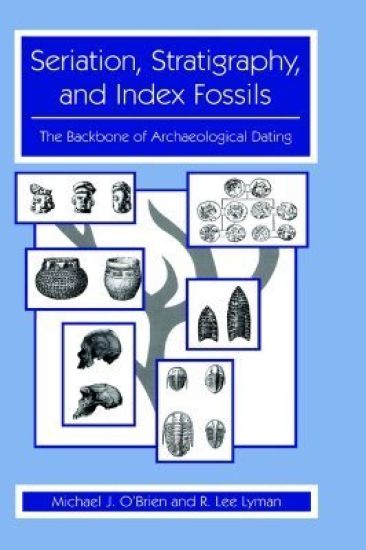
Seriation, Stratigraphy, and Index Fossils

Seriation, Stratigraphy, and Index Fossils

Michael J. O'Brien; R. Lee Lyman

Kluwer Academic/Plenum Publishers
1999
sidottu
It is difficult for today's students of archaeology to imagine an era when chronometric dating methods were unavailable. However, even a casual perusal of the large body of literature that arose during the first half of the twentieth century reveals a battery of clever methods used to determine the relative ages of archaeological phenomena, often with considerable precision. Stratigraphic excavation is perhaps the best known of the various relative-dating methods used by prehistorians. Although there are several techniques of using artifacts from superposed strata to measure time, these are rarely if ever differentiated. Rather, common practice is to categorize them under the heading `stratigraphic excavation'. This text distinguishes among the several techniques and argues that stratigraphic excavation tends to result in discontinuous measures of time - a point little appreciated by modern archaeologists. Although not as well known as stratigraphic excavation, two other methods of relative dating have figured important in Americanist archaeology: seriation and the use of index fossils. The latter (like stratigraphic excavation) measures time discontinuously, while the former - in various guises - measures time continuously. Perhaps no other method used in archaeology is as misunderstood as seriation, and the authors provide detailed descriptions and examples of each of its three different techniques. Each method and technique of relative dating is placed in historical perspective, with particular focus on developments in North America, an approach that allows a more complete understanding of the methods described, both in terms of analytical technique and disciplinary history. This text will appeal to all archaeologists, from graduate students to seasoned professionals, who want to learn more about the backbone of archaeological dating.
Applying Evolutionary Archaeology

Applying Evolutionary Archaeology

Michael J. O'Brien; R. Lee Lyman

Kluwer Academic/Plenum Publishers
2000
sidottu
Anthropology, and by extension archaeology, has had a long-standing interest in evolution in one or several of its various guises. Pick up any lengthy treatise on humankind written in the last quarter of the nineteenth century and the chances are good that the word evolution will appear somewhere in the text. If for some reason the word itself is absent, the odds are excellent that at least the concept of change over time will have a central role in the discussion. After one of the preeminent (and often vilified) social scientists of the nineteenth century, Herbert Spencer, popularized the term in the 1850s, evolution became more or less a household word, usually being used synonymously with change, albeit change over extended periods of time. Later, through the writings of Edward Burnett Tylor, Lewis Henry Morgan, and others, the notion of evolution as it applies to stages of social and political development assumed a prominent position in anthropological disc- sions. To those with only a passing knowledge of American anthropology, it often appears that evolutionism in the early twentieth century went into a decline at the hands of Franz Boas and those of similar outlook, often termed particularists. However, it was not evolutionism that was under attack but rather comparativism— an approach that used the ethnographic present as a key to understanding how and why past peoples lived the way they did (Boas 1896).
Applying Evolutionary Archaeology

Applying Evolutionary Archaeology

Michael J. O'Brien; R. Lee Lyman

Kluwer Academic/Plenum Publishers
2000
nidottu
Anthropology, and by extension archaeology, has had a long-standing interest in evolution in one or several of its various guises. Pick up any lengthy treatise on humankind written in the last quarter of the nineteenth century and the chances are good that the word evolution will appear somewhere in the text. If for some reason the word itself is absent, the odds are excellent that at least the concept of change over time will have a central role in the discussion. After one of the preeminent (and often vilified) social scientists of the nineteenth century, Herbert Spencer, popularized the term in the 1850s, evolution became more or less a household word, usually being used synonymously with change, albeit change over extended periods of time. Later, through the writings of Edward Burnett Tylor, Lewis Henry Morgan, and others, the notion of evolution as it applies to stages of social and political development assumed a prominent position in anthropological disc- sions. To those with only a passing knowledge of American anthropology, it often appears that evolutionism in the early twentieth century went into a decline at the hands of Franz Boas and those of similar outlook, often termed particularists. However, it was not evolutionism that was under attack but rather comparativism— an approach that used the ethnographic present as a key to understanding how and why past peoples lived the way they did (Boas 1896).
Mississippian Community Organization

Mississippian Community Organization

Michael J. O'Brien

Kluwer Academic/Plenum Publishers
2001
sidottu
The Powers Phase Project was a multiyear archaeological program undertaken in southeastern Missouri by the University of Michigan in the late 1960s and early 1970s. The project focused on the occupation of a large Pleistocene-age terrace in the Little Black River Lowland—a large expanse of lowlying land just east of the Ozark Highland—between roughly A. D. 1250 and A. D. 1400. The largest site in the region is Powers Fort—a palisaded mound center that - ceived archaeological attention as early as the late nineteenth century. Archa- logical surveys conducted south of Powers Fort in the 1960s revealed the pr- ence of numerous smaller sites of varying size that contained artifact assemblages similar to those from the larger center. Collectively the settlement aggregation became known as the Powers phase. Test excavations indicated that at least some of the smaller sites contained burned structures and that the burning had sealed household items on the floors below the collapsed architectural e- ments. Thus there appeared to be an opportunity to examine a late prehistoric settlement system to a degree not possible previously. Not only could the s- tial relation of communities in the system be ascertained, but the fact that str- tures within the communities had burned appeared to provide a unique opp- tunity to examine such things as differences in household items between and among structures and where various activities had occurred within a house. With these ideas in mind, James B. Griffin and James E.
Measuring Workplace Performance

Measuring Workplace Performance

Michael J. O'Neill

CRC Press
2019
nidottu
Most Fortune 1000 companies still struggle with workspace planning and design issues. They invest millions of dollars each year with the expectation that new buildings and major renovations will help transform their culture, support innovation, strengthen desired behaviors and increase organizational effectiveness. Providing a biological framework, this book explores how the design of the work environment can be used as a tool to further business goals as well as improve individual and group performance. The second edition of a bestseller, the book includes many new case studies with Fortune 1000 companies. It features a new section on Six Sigma measurement methods for assessing office workspace effectiveness. The Case Studies demonstrate how office workspace design affects employee performance, and how to use this information to optimize workplace design for individuals and groups. It focuses on the emergence and application of Six-Sigma quality principles and methods in the evaluation and improvement of workspaces.
Hotel Management and Operations

Hotel Management and Operations

Michael J. O'Fallon; Denney G. Rutherford

John Wiley Sons Inc
2010
nidottu
This newly updated edition is a compilation of readings, divided into nine sections, each examining a specific hotel department or activity. Each topic is examined through a variety of viewpoints on the duties, responsibilities, problems, and opportunities encountered there. Multidimensional case studies, taking a practical approach, challenge readers to identify the central issues involved in complex management problems, understand the structure and resources of the department in question, and find solutions that may help in managing other hotel resources and departments.