Kirjojen hintavertailu. Mukana 11 699 587 kirjaa ja 12 kauppaa.

Kirjahaku

Etsi kirjoja tekijän nimen, kirjan nimen tai ISBN:n perusteella.

1000 tulosta hakusanalla Michael J. Trebilcock

Dealing with Losers

Dealing with Losers

Michael J. Trebilcock

Oxford University Press Inc
2015
nidottu
Whenever governments change policies--tax, expenditure, or regulatory policies, among others--there will typically be losers: people or groups who relied upon and invested in physical, financial, or human capital predicated on, or even deliberately induced by the pre-reform set of policies. The issue of whether and when to mitigate the costs associated with policy changes, either through explicit government compensation, grandfathering, phased or postponed implementation, is ubiquitous across the policy landscape. Much of the existing literature covers government takings, yet compensation for expropriation comprises merely a tiny part of the universe of such strategies. Dealing with Losers: The Political Economy of Policy Transitions explores both normative and political rationales for transition cost mitigation strategies and explains which strategies might create an aggregate, overall enhancement in societal welfare beyond mere compensation. Professor Michael J. Trebilcock highlights the political rationales for mitigating such costs and the ability of potential losers to mobilize and obstruct socially beneficial changes in the absence of well-crafted transition cost mitigation strategies. This book explores the political economy of transition cost mitigation strategies in a wide variety of policy contexts including public pensions, U.S. home mortgage interest deductions, immigration, trade liberalization, agricultural supply management, and climate change, providing tested examples and realistic strategies for genuine policy reform.
The Limits of Freedom of Contract

The Limits of Freedom of Contract

Michael J. Trebilcock

Harvard University Press
1997
nidottu
Our legal system is committed to the idea that private markets and the law of contracts that supports them are the primary institutions for allocating goods and services in a modern economy. Yet the market paradigm, this book argues, leaves substantial room for challenge. For example, should people be permitted to buy and sell blood, bodily organs, surrogate babies, or sexual favors? Is it fair to allow people with limited knowledge about a transaction and its consequences to enter into it without guidance from experts?
Paradoxes of Professional Regulation

Paradoxes of Professional Regulation

Michael J. Trebilcock

UNIVERSITY OF TORONTO PRESS
2022
sidottu
Occupational licensure, including regulation of the professions, dates back to the medieval period. While the guilds that performed this regulatory function have long since vanished, professional regulation continues to this day. For instance, in the United States, 22 per cent of American workers must hold licenses simply to do their jobs. While long-established professions have more settled regulatory paradigms, the case studies in Paradoxes of Professional Regulation explore other professions, taking note of incompetent services and the serious risks they pose to the physical, mental, or emotional health, financial well-being, or legal status of uninformed consumers. Michael J. Trebilcock examines five case studies of the regulation of diverse professions, including alternative medicine, mental health care provision, financial planning, immigration consulting, and legal services. Noting the widely divergent approaches to the regulation of the same professions across different jurisdictions – paradoxes of professional regulation – the book is an attempt to develop a set of regulatory principles for the future. In its comparative approach, Paradoxes of Professional Regulation gets at the heart of the tensions influencing the regulatory landscape, and works toward practical lessons for bringing greater coherence to the way in which professions are regulated.
Public Inquiries

Public Inquiries

Michael J. Trebilcock

UNIVERSITY OF TORONTO PRESS
2022
sidottu
An internationally renowned scholar of law and economics, Michael J. Trebilcock has spent over fifty years teaching and researching at the intersection between ideas, interests, and institutions. In Public Inquiries, Trebilcock reflects on his extensive experiences and sheds light on the role of scholars in engaging with the Canadian public policy-making process. Drawing on a number of case studies, Public Inquiries gives an informed overview of the role of ideas and interests in shaping the policy-making process. Trebilcock takes readers through his personal experiences and what he has learned throughout his career. He puts forward general lessons about the public policy-making process and reform in areas including consumer protection, competition policy, trade policy, electricity reform, and legal aid. By showing that not all experiences have been triumphant, and that disappointments can be as revealing as successes, Trebilcock draws out personal lessons and insights with a view to improving the structure and effectiveness of public inquiries.
Navigating the Free Trade–Fair Trade Fault-Lines

Navigating the Free Trade–Fair Trade Fault-Lines

Michael J. Trebilcock

Edward Elgar Publishing Ltd
2021
sidottu
Is Free Trade desirable? Does it primarily benefit the wealthy? And what are its impacts on individual autonomy and human dignity?These are some of the fundamental questions that acclaimed trade law expert, Michael Trebilcock, sets out to answer in this pithy and insightful journey through the past, present and future of international trade agreements and trade policy.Exploring both the historical and contemporary conflicts and controversies surrounding the free trade vs fair trade debate, from the perspective of both developed and developing countries, the book illuminates the nuances of such issues as trade deficits, currency, subsidies, intellectual property rights, health and safety and environmental standards and competition policy. Navigating the Free Trade - Fair Trade Fault-lines completes the journey by bringing us squarely into our times with a discussion on the implications of worldwide pandemics for international trade, and with an additional focus on the current trade conflict between the US and China.Packed with insight and reasoned analysis, this short but powerful book will be an essential read for seasoned experts and newcomers alike. The book offers thought-provoking guidance to policy makers, lawyers, economists, scholars and anyone with a stake in the future of the international trading system.
Navigating the Free Trade–Fair Trade Fault-Lines

Navigating the Free Trade–Fair Trade Fault-Lines

Michael J. Trebilcock

Edward Elgar Publishing Ltd
2021
nidottu
Is Free Trade desirable? Does it primarily benefit the wealthy? And what are its impacts on individual autonomy and human dignity?These are some of the fundamental questions that acclaimed trade law expert, Michael Trebilcock, sets out to answer in this pithy and insightful journey through the past, present and future of international trade agreements and trade policy.Exploring both the historical and contemporary conflicts and controversies surrounding the free trade vs fair trade debate, from the perspective of both developed and developing countries, the book illuminates the nuances of such issues as trade deficits, currency, subsidies, intellectual property rights, health and safety and environmental standards and competition policy. Navigating the Free Trade - Fair Trade Fault-lines completes the journey by bringing us squarely into our times with a discussion on the implications of worldwide pandemics for international trade, and with an additional focus on the current trade conflict between the US and China.Packed with insight and reasoned analysis, this short but powerful book will be an essential read for seasoned experts and newcomers alike. The book offers thought-provoking guidance to policy makers, lawyers, economists, scholars and anyone with a stake in the future of the international trading system.
The Law and Economics of Canadian Competition Policy

The Law and Economics of Canadian Competition Policy

Michael J. Trebilcock; Edward M. Iacobucci; Ralph A. Winter; Paul Collins

University of Toronto Press
2003
pokkari
Offering a unique cross-disciplinary approach to scholarship in law and economics, this much-needed work expounds and critically evaluates all of the major doctrines of Canadian competition policy. The topics addressed, each in a separate chapter, include: Canadian competition policy in an historical context; basic economic concepts; multi-firm conduct; horizontal agreements; the merger review process; predatory pricing and price discrimination; vertical restraints; intra-brand competition; inter-brand competition; abuse of dominance; competition policy and intellectual property rights; competition policy and trade policy; competition policy and regulated industries; and enforcement. The treatment of each substantive topic is organized first around a discussion of the relevant body (or bodies) of economic theory and then the pertinent bodies of legal doctrine, including case law. Each chapter contains a critique of existing law in light of contemporary economic theory. This is the only book available that offers an up-to-date integrated analysis of economic theory and legal doctrine in the context of Canadian competition policy.
What Makes Poor Countries Poor?

What Makes Poor Countries Poor?

Michael J. Trebilcock; Mariana Mota Prado

Edward Elgar Publishing Ltd
2011
sidottu
This important book focuses on the idea that institutions matter for development, asking what lessons we have learned from past reform efforts, and what role lawyers can play in this field. What Makes Poor Countries Poor? provides a critical overview of different conceptions and theories of development, situating institutional theories within the larger academic debate on development. The book also discusses why, whether and how institutions matter in different fields of development. In the domestic sphere, the authors answer these questions by analyzing institutional reforms in the public (rule of law, political regimes, bureaucracy) and the private sectors (contracts, property rights, and privatization). In the international sphere, they discuss the importance of institutions for trade, foreign direct investment, and foreign aid. This book will be essential reading for those interested in a concise introduction to the academic debates in this field, as well as for students, practitioners and policy makers in law and development.
What Makes Poor Countries Poor?

What Makes Poor Countries Poor?

Michael J. Trebilcock; Mariana Mota Prado

Edward Elgar Publishing Ltd
2011
nidottu
This important book focuses on the idea that institutions matter for development, asking what lessons we have learned from past reform efforts, and what role lawyers can play in this field. What Makes Poor Countries Poor? provides a critical overview of different conceptions and theories of development, situating institutional theories within the larger academic debate on development. The book also discusses why, whether and how institutions matter in different fields of development. In the domestic sphere, the authors answer these questions by analyzing institutional reforms in the public (rule of law, political regimes, bureaucracy) and the private sectors (contracts, property rights, and privatization). In the international sphere, they discuss the importance of institutions for trade, foreign direct investment, and foreign aid. This book will be essential reading for those interested in a concise introduction to the academic debates in this field, as well as for students, practitioners and policy makers in law and development.
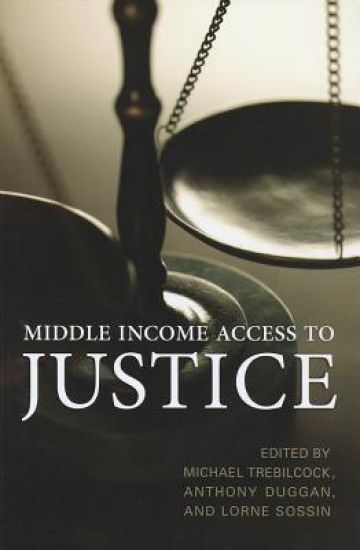
Middle Income Access to Justice

Middle Income Access to Justice

Michael J. Trebilcock; Anthony Duggan; Lorne Sossin

University of Toronto Press
2012
pokkari
Though most conceptions of the rule of law assume equality before the law – and hence equal access to the justice system – this basic right is not being met for many low and middle income Canadians. This book focuses on the problem of civil access to justice for middle income earners – those whose household income is high enough to disqualify them from legal aid but not high enough to cover the costs of litigation. Featuring contributions by leading Canadian and international scholars, practitioners, and members of the judiciary, this multidisciplinary collection draws on scholarship in the fields of law, social science, and public policy. There is a particular emphasis on family law, consumer law, and employment law, as these are the areas where research has indicated that unmet legal needs are highest. Middle Income Access to Justice presents a variety of innovative solutions, from dispute resolution process reforms to the development of non-lawyer forms of assistance and new methods for funding legal expenses. In doing so, it lays the foundation for the development of a much-needed new delivery model to provide early intervention for legal services.
Middle Income Access to Justice

Middle Income Access to Justice

Michael J. Trebilcock; Anthony Duggan; Lorne Sossin

University of Toronto Press
2012
sidottu
Though most conceptions of the rule of law assume equality before the law – and hence equal access to the justice system – this basic right is not being met for many low and middle income Canadians. This book focuses on the problem of civil access to justice for middle income earners – those whose household income is high enough to disqualify them from legal aid but not high enough to cover the costs of litigation. Featuring contributions by leading Canadian and international scholars, practitioners, and members of the judiciary, this multidisciplinary collection draws on scholarship in the fields of law, social science, and public policy. There is a particular emphasis on family law, consumer law, and employment law, as these are the areas where research has indicated that unmet legal needs are highest. Middle Income Access to Justice presents a variety of innovative solutions, from dispute resolution process reforms to the development of non-lawyer forms of assistance and new methods for funding legal expenses. In doing so, it lays the foundation for the development of a much-needed new delivery model to provide early intervention for legal services.
Debtor and Creditor

Debtor and Creditor

Michael J. Trebilcock; Barry J. Reiter; John B. Laskin

UNIVERSITY OF TORONTO PRESS
1979
pokkari
Developed over a period of some six years by teachers of the subject at the University of Toronto’s Faculty of Law, this book provides the first comprehensive and integrated teaching tool for the very basic field of debtor and creditor relations. The carefully designed text considers first the nature of the credit market and the setting in which debtor-creditor relations are formed. It proceeds to examine self-help collection, execution, garnishment, reviewable transactions, and bankruptcy. Other sections consider the rights of various special creditors (including government creditors and mechanics’ lien claimants), and proposals for comprehensive reform of the debt collection process. The authors attempt to deal with law from a national perspective. While considering in detail the statutory provisions relevant to debtor-creditor relations in Ontario, they also treat significant legislation of other provinces and examine the suitability of differing responses to similar legal issues. Their book should as well be welcomed as the first attempt to treat in detail the current proposals for reform of federal bankruptcy legislation. The authors have accepted the distinct probability that the draft legislation pending before Parliament will be enacted, and have considered the significance of these proposals in the light of the existing law. Throughout the book are extensive introductory notes, explanatory notes, questions and problems; a set of review problems concludes the text. The authors have attempted to make it unnecessary to provide detailed background in lectures. The materials have been designed both to guide the students easily through the technical areas of debtor-creditor relations and to highlight the more interesting issues that arise from legislation.
Advanced Introduction to International Trade Law

Advanced Introduction to International Trade Law

Michael J. Trebilcock; Joel Trachtman

Edward Elgar Publishing Ltd
2020
nidottu
Written by two leading scholars with 60 years of collective experience in the area, this insightful and updated second edition provides a clear and concise introduction to the fundamental components of international trade law, presenting the basic structure and principles of this complex area of law, alongside elucidation of specific GATT and WTO legal rules and institutions.Key features include:a nuanced yet highly readable summary of the areaplacement of trade law into historical, political and economic contexts, including new analysis of populist critiquesreferences to the most recent cases, decisions, treaty negotiation developments and economic and legal scholarshipanalysis of new areas including digital trade, migration and security exceptions to alert students to developments in international trade lawlinks and connections between different areas of trade law to provide students with an integrated overview of the topic.Interdisciplinary in nature, this second edition will be an indispensable guide for students in law, economics, political science and international relations. Comprehensive and accessible, it will be essential reading for non-specialist scholars and policy advisors seeking to further their understanding of international trade law. 'This Advanced Introduction provides an excellent succinct yet accurate summary of the international trade rules applicable, inter alia, to trade in goods, services, intellectual property, and investment. It also explores international standards, social issues such as development, environment, labour, human rights, and it addresses the institutional framework and the future of the world trading system. As an experienced practitioner in this field, I highly recommend this book to government officials, business people, and students who will all get a clear interdisciplinary tour d'horizon in the field of international trade.' - Gabrielle Marceau, University of Geneva, Switzerland and Senior Counsellor at the WTO
Rule of Law Reform and Development

Rule of Law Reform and Development

Michael J. Trebilcock; Ronald J. Daniels

Edward Elgar Publishing Ltd
2008
sidottu
This important book addresses a number of key issues regarding the relationship between the rule of law and development. It presents a deep and insightful inquiry into the current orthodoxy that the rule of law is the panacea for the world's problems. The authors chart the precarious progress of law reforms both in overall terms and in specific policy areas such as the judiciary, the police, tax administration and access to justice, among others. They accept that the rule of law is necessarily tied to the success of development, although they propose a set of procedural values to enlighten this institutional approach. The authors also recognize that states face difficulties in implementing this institutional structures and identify the probable impediments, before proposing a rethink of law reform strategies and offering some conclusions about the role of the international community in the rule of law reform.Reviewing the progress in the rule of law reform in developing countries, specifically four regions - Latin America, Africa, Central and Eastern Europe, and Asia - this book makes a significant contribution to the literature. It will be of great interest to scholars and advanced students, as well as practitioners in the field, including international and bilateral aid agencies working on rule of law reform projects, and international and regional non-governmental organizations (NGOs) that focus on rule of law reform as a major aspect of their mandate.
Rule of Law Reform and Development

Rule of Law Reform and Development

Michael J. Trebilcock; Ronald J. Daniels

Edward Elgar Publishing Ltd
2009
nidottu
This important book addresses a number of key issues regarding the relationship between the rule of law and development. It presents a deep and insightful inquiry into the current orthodoxy that the rule of law is the panacea for the world's problems. The authors chart the precarious progress of law reforms both in overall terms and in specific policy areas such as the judiciary, the police, tax administration and access to justice, among others. They accept that the rule of law is necessarily tied to the success of development, although they propose a set of procedural values to enlighten this institutional approach. The authors also recognize that states face difficulties in implementing this institutional structures and identify the probable impediments, before proposing a rethink of law reform strategies and offering some conclusions about the role of the international community in the rule of law reform.Reviewing the progress in the rule of law reform in developing countries, specifically four regions - Latin America, Africa, Central and Eastern Europe, and Asia - this book makes a significant contribution to the literature. It will be of great interest to scholars and advanced students, as well as practitioners in the field, including international and bilateral aid agencies working on rule of law reform projects, and international and regional non-governmental organizations (NGOs) that focus on rule of law reform as a major aspect of their mandate.
Rethinking the Welfare State

Rethinking the Welfare State

Ronald J. Daniels; Michael J. Trebilcock

Routledge
2005
sidottu
Rethinking the Welfare State offers a comprehensive and comparative analysis of social welfare policy in an international context, with a particular emphasis on the US and Canada.The authors investigate the claim that a decentralized delivery of government supported goods and services enables policy objectives to be achieved in a more innovative and efficient way, but at a lower cost. Secondly they examine the effectiveness of the voucher system as a solution to problematic welfare concerns. While this system has shown much promise in improving welfare, there have been problems for institutions unable to attract enough voucher-assisted consumers to ensure their survival.In this context, the authors examine major social programmes such as food stamps, primary and secondary education, post-secondary education, labour market training, childcare, healthcare, legal aid, low-income housing, long-term care and pensions.
Rethinking the Welfare State

Rethinking the Welfare State

Ronald J. Daniels; Michael J. Trebilcock

Routledge
2005
nidottu
Rethinking the Welfare State offers a comprehensive and comparative analysis of social welfare policy in an international context, with a particular emphasis on the US and Canada.The authors investigate the claim that a decentralized delivery of government supported goods and services enables policy objectives to be achieved in a more innovative and efficient way, but at a lower cost. Secondly they examine the effectiveness of the voucher system as a solution to problematic welfare concerns. While this system has shown much promise in improving welfare, there have been problems for institutions unable to attract enough voucher-assisted consumers to ensure their survival.In this context, the authors examine major social programmes such as food stamps, primary and secondary education, post-secondary education, labour market training, childcare, healthcare, legal aid, low-income housing, long-term care and pensions.
Hard Choices, Soft Law

Hard Choices, Soft Law

John J. Kirton; Michael J. Trebilcock

Ashgate Publishing Limited
2004
sidottu
An important read for academics and policy-makers alike, Hard Choices, Soft Law asserts that voluntary standards, or 'soft' law, are an important supplement to international law in a number of areas. This key work firstly outlines the approach taken to combining soft and hard law and trade, environment and labour values in the WTO and NAFTA, and in the prospective Millennium Round. Then, using the forestry sector - a realm where formal international law remains largely absent - the book provides a detailed examination of the role of soft law in action. It demonstrates how soft and hard law can be combined to promote trade, environmental and social cohesion, in ways that also permit sustainable development. The book presents a wealth of knowledge from a range of contributors familiar with the work of the G7/G8, the OECD, the Biodiversity Convention and the Codex Alimentarius.
Hard Choices, Soft Law

Hard Choices, Soft Law

John J. Kirton; Michael J. Trebilcock

Routledge
2016
nidottu
An important read for academics and policy-makers alike, Hard Choices, Soft Law asserts that voluntary standards, or 'soft' law, are an important supplement to international law in a number of areas. This key work firstly outlines the approach taken to combining soft and hard law and trade, environment and labour values in the WTO and NAFTA, and in the prospective Millennium Round. Then, using the forestry sector - a realm where formal international law remains largely absent - the book provides a detailed examination of the role of soft law in action. It demonstrates how soft and hard law can be combined to promote trade, environmental and social cohesion, in ways that also permit sustainable development. The book presents a wealth of knowledge from a range of contributors familiar with the work of the G7/G8, the OECD, the Biodiversity Convention and the Codex Alimentarius.
The Making of the Mosaic

The Making of the Mosaic

Ninette Kelley; Michael J. Trebilcock

University of Toronto Press
2010
pokkari
Immigration policy is a subject of intense political and public debate. In this second edition of the widely recognized and authoritative work The Making of the Mosaic, Ninette Kelley and Michael Trebilcock have thoroughly revised and updated their examination of the ideas, interests, institutions, and rhetoric that have shaped Canada's immigration history. Beginning their study in the pre-Confederation period, the authors interpret major episodes in the evolution of Canadian immigration policy, including the massive deportations of the First World War and Depression eras as well as the Japanese-Canadian internment camps during World War Two. New chapters provide perspective on immigration in a post-9/11 world, where security concerns and a demand for temporary foreign workers play a defining role in immigration policy reform. A comprehensive and important work, The Making of the Mosaic clarifies the attitudes underlying each phase and juncture of immigration history, providing vital perspective on the central issues of immigration policy that continue to confront us today.