Kirjojen hintavertailu. Mukana 11 244 527 kirjaa ja 12 kauppaa.

Kirjahaku

Etsi kirjoja tekijän nimen, kirjan nimen tai ISBN:n perusteella.

1000 tulosta hakusanalla Michael Moriarty

Pascal: Reasoning and Belief

Pascal: Reasoning and Belief

Michael Moriarty

Oxford University Press
2020
sidottu
This book is a study of Blaise Pascal's defence of Christian belief in the Pensées. Michael Moriarty aims to expound--and in places to criticize--what he argues is a coherent and original apologetic strategy. Setting out the basic philosophical and theological presuppositions of Pascal's project, the present volume draws the distinction between convictions attained by reason and those inspired by God-given faith. It also presents Pascal's view of the contradictions within human nature, between the 'wretchedness' (our inability to live the life of reason, to attain secure and durable happiness) and the 'greatness' (the power of thought, manifested in the very awareness of our wretchedness). His mind-body dualism and his mechanistic conception of non-human animals are discussed. Pascal invokes the biblical story of the Fall and the doctrine of original sin as the only credible explanation of these contradictions. His analysis of human occupations as powered by the twin desire to escape from painful thoughts and to gratify one's vanity is subjected to critical examination, as is his conception of the self and self-love. Pascal argues that just as Christianity propounds the only explanation for the human condition, so it offers the only kind of happiness that would satisfy our deepest longings. He thus reasons that we have an interest in investigating its truth-claims as rooted in the Bible and in history. The closing chapters of this book discuss Pascal's view of Christian morality and the famous 'wager' argument for opting in favour of Christian belief.
Early Modern French Thought

Early Modern French Thought

Michael Moriarty

Oxford University Press
2003
sidottu
This book is an examination of three major French thinkers of the seventeenth century, Descartes, Pascal, and Malebranche, of whom the latter two are comparatively little studied in the English-speaking world. It deals with a common attitude of suspicion towards everyday experience, which they see as dominated and obscured by sensation, imagination, and the presence of the body. This attitude, however, obliges them to develop detailed and sophisticated accounts of the shaping of experience not only by the body but by interpersonal and social relationships, and of the tension between human nature as it is and as we experience it. The treatment of Descartes thus challenges the interpretation that sees him as eliminating the body from 'subjectivity', while that of Pascal and Malebranche shows how their critical attitude towards experience (a fertile source for twentieth-century French thinkers) is linked with their religious doctrines, especially their Augustinian emphasis on Original Sin.
Fallen Nature, Fallen Selves

Fallen Nature, Fallen Selves

Michael Moriarty

Oxford University Press
2006
sidottu
From the late sixteenth to the late seventeenth centuries, French writing is especially concerned with analysing human nature. The ancient ethical vision of man's nature and goal (we achieve fulfilment by living our lives according to reason, the highest and noblest element of our nature) survives, even, to some extent, in Descartes. But it is put into question especially by the revival of St Augustine's thought, which focuses on the contradictions and disorders of human desires and aspirations. Analyses of behaviour display a powerful suspicion of appearances. Human beings are increasingly seen as motivated by self-love: they are driven by the desire for their own advantage, and take a narcissistic delight in their own image. Moral and religious writers re-emphasize the traditional imperative of self-knowledge, but in such a way as to suggest the difficulties of knowing oneself. Operating with the Cartesian distinction between mind and body, they emphasize the imperceptible influence of bodily processes on our thought and attitudes. They analyse human beings' ignorance (due to self-love) of their own motives and qualities, and the illusions under which they live their lives. Their critique of human behaviour is no less searching than that of writers who have broken with traditional religious morality, such as Hobbes and Spinoza. A wide range of authors is studied, some well-known, others much less so: the abstract and general analyses of philosophers and theologians (Descartes, Jansenius, Malebranche) are juxtaposed with the less systematic and more concrete investigations of writers like Montaigne and La Rochefoucauld, not to mention the theatre of Corneille, Molière, and Racine.
Disguised Vices

Disguised Vices

Michael Moriarty

Oxford University Press
2011
sidottu
The notions of virtue and vice are essential components of the Western ethical tradition. But in early modern France they were called into question, as writers, most famously La Rochefoucauld, argued that what appears as virtue is in fact disguised vice: people carry out praiseworthy deeds because they stand to gain in some way; they deserve no credit for their behaviour because they have no control over it; they are governed by feelings and motives of which they may not be aware. Disguised Vices analyses the underlying logic of these arguments, and investigates what is at stake in them. It traces the arguments back to their sources in earlier writers, showing how ancient philosophers, particularly Aristotle and Seneca, formulated the distinction between behaviour that counts as virtuous and behaviour that only seems so. It explains how St Augustine reinterpreted the distinction in the light of the difference between pagans and Christians, and how medieval and early modern theologians strove to reconcile Augustine's position with that of Aristotle. It examines the restatement of Augustine's position by his hard-line early modern followers (especially the Jansenists), and the controversy to which this gave rise. Finally, it examines La Rochefoucauld's critique of virtue and assesses the extent of its links with the Augustinian current of thought.
Taste and Ideology in Seventeenth-Century France

Taste and Ideology in Seventeenth-Century France

Michael Moriarty

Cambridge University Press
2009
pokkari
This book analyses the use of the crucial concept of 'taste' in the works of five major seventeenth-century French authors, Méré, Saint Evremond, La Rochefoucauld, La Bruyère and Boileau. It combines close readings of important texts with a thoroughgoing political analysis of seventeenth-century French society in terms of class and gender. Dr Moriarty shows that far from being timeless and universal, the term 'taste' is culture-specific, shifting according to the needs of a writer and his social group. The notion of 'taste' not only helped to shape a new dominant culture, but also registered the conflicts within that culture between a view of taste that presupposted the values of 'polite society' as an exclusive (though not necessarily aristocratic) group, and a view that stressed the value of the classical-humanist tradition as a source of standards ratified by a broader public. this study sheds light not only on the central concept, but also on the individual authors discussed and on the norms of French classical literature in general.
Roland Barthes

Roland Barthes

Michael Moriarty

Polity Press
1991
nidottu
This book provides a lively introduction to the work of Roland Barthes, one of the twentieth century's most important literary and cultural theorists. The book covers all aspects of Barthes's writings including his work on literary theory, mass communications, the theatre and politics. Moriarty argues that Barthes's writing must not be seen as an unchanging body of thought, and that we should study his ideas in the contexts within which they were formulated, debated and developed.
The Awakening of Humanity

The Awakening of Humanity

Michael Moriarty

Lulu.com
2017
pokkari
The book will seek to orient the newly-awakened to the situation that they find themselves in on this planet: to how they seem to be powerless but, in truth, are in possession of all power. It will show them how they can liberate themselves from their seeming slavery. Finally, it will show them that, by applying the Law of Attraction in order to create their own version of "Paradise on Earth," they can help heal Humanity, heal the Earth, and reintegrate the planet into the Galactic community as an ascended 4th Density civilization.
Earthrise

Earthrise

Michael Moriarty

Lulu.com
2017
pokkari
This book picks up where my last book, The Awakening of Humanity: What You Need to Know, left off--with a possible future timeline that leads to a New Earth. The political and economic foundation of that New Earth civilization lies in UBUNTU/Contributionism Communities. In this book, I explain what it will take to create/attract such Communities, and why it is of some urgency that those who wish to live in them begin to create/attract them now.
The Art and Science of Creation

The Art and Science of Creation

Michael Moriarty

Lulu.com
2017
pokkari
The book will seek to explain how each of us creates his/her own personal reality, and how we co-create shared experiences together. Emphasis is placed on how the science of creation can be made practical in the reader's daily life. To that end, common stumbling blocks to manifestation are discussed and techniques for overcoming them given. The book brings the science of creation down to the art of living so that the reader may create, consciously and deliberately, a life of joy.
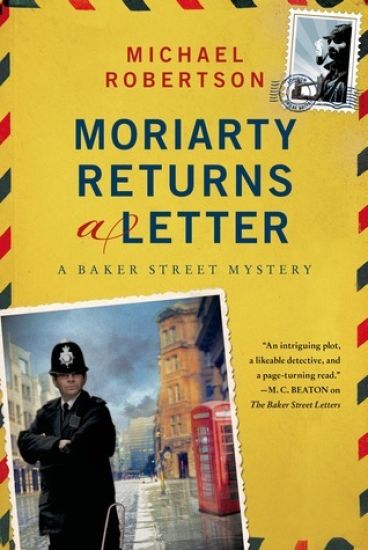
Moriarty Returns a Letter: A Baker Street Mystery
Michael Robertson has delighted mystery readers and Sherlock Holmes aficionados everywhere with his charming and innovative Baker Street mystery series, where brothers Reggie and Nigel Heath are charged with answering letters to Holmes that arrive at their law office, located at 221B Baker Street. Now, Reggie and Nigel are back in a case that would confound even Sherlock himself. An exhibition of vintage Sherlock Holmes letters has opened at the Marylebone Hotel. As Reggie and his beloved Laura embark on a pre-wedding trip, someone from Reggie and Nigel's past--someone whom they thought was long gone--reappears, causing a whole slew of new problems for the brothers. Written with Robertson's characteristic charm, Moriarty Returns a Letter is a standout mystery in a much-loved series, perfect for fans of the smash hit television shows "Sherlock" and "Elementary."
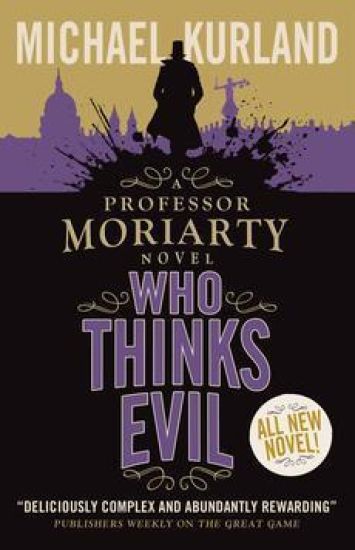
Who Thinks Evil (A Professor Moriarty Novel)

Who Thinks Evil (A Professor Moriarty Novel)

Michael Kurland

Titan Books Ltd
2014
nidottu
Moriarty is awaiting trial for murder when Queen Victoria's grandson mysteriously disappears. In exchange for his release and the murder charges (of which he's innocent) being dropped, the so-called "Napoleon of Crime" must track down the missing prince and find out who is behind his disappearance and the brutal murders left in his wake.