This title is part of Pearson's Bug Club - the first whole-school reading programme that joins books and an online reading world to teach today's children to read. In this book: Cars have changed our world. And cars have changed over time. Mini cars, family cars, racing cars... what is your favourite car? This title is suitable for ages 6-7 (Turquoise level)
This report text talks about how people and animals manage to live in some of the most difficult conditions in the world. There are sections on deserts, rainforests, the Arctic and Antarctica. Part of the Bug Club reading series used in over 3500 schools Helps your child develop reading fluency and confidence Suitable for children age 6-7 (Year 2) Book band: Turquoise B Phonics phase: 6
This title is part of Pearson’s Bug Club - the first whole-school reading programme that joins books and an online reading world to teach today’s children to read. In this book: Life in extreme places can be hard. Find out how people and animals have ways to help them live there. This title is suitable for ages 6-7 (Turquoise level)
Fundamentals of Microwave and RF Design enables mastery of the essential concepts required to cross the barriers to a successful career in microwave and RF design. Extensive treatment of scattering parameters, that naturally describe power flow, and of Smith-chart-based design procedures prepare the student for success. The emphasis is on design at the module level and on covering the whole range of microwave functions available. The orientation is towards using microstrip transmission line technologies and on gaining essential mathematical, graphical and design skills for module design proficiency. This book is derived from a multi volume comprehensive book series, Microwave and RF Design, Volumes 1-5, with the emphasis in this book being on presenting the fundamental materials required to gain entry to RF and microwave design. This book closely parallels the companion series that can be consulted for in-depth analysis with referencing of the book series being familiar and welcoming.Key Features: A companion volume to a comprehensive series on microwave and RF design; Open access ebook editions are hosted by NC State University Libraries; 59 worked examples; An average of 24 exercises per chapter; Answers to selected exercises; Emphasis on module-level design using microstrip technologies; Extensive treatment of design using Smith charts; A parallel companion book series provides a detailed reference resource.
Microwave and RF Design: Radio Systems is a circuits- and systems-oriented approach to modern microwave and RF systems. Sufficient details at the circuits and sub-system levels are provided to understand how modern radios are implemented. Design is emphasized throughout. The evolution of radio from what is now known as 0G, for early radio, through to 6G, for sixth generation cellular radio, is used to present modern microwave and RF engineering concepts. Two key themes unify the text: 1) how system-level decisions affect component, circuit and subsystem design; and 2) how the capabilities of technologies, components, and subsystems impact system design. This book is suitable as both an undergraduate and graduate textbook, as well as a career-long reference book.Key Features: The first volume of a comprehensive series on microwave and RF design; Open access ebook editions are hosted by NC State University Libraries; 31 worked examples; An average of 38 exercises per chapter; Answers to selected exercises; Coverage of cellular radio from 1G through 6G; Case study of a software defined radio illustrating how modern radios partition functionality between analog and digital domains; A companion book, Fundamentals of Microwave and RF Design, is suitable as a comprehensive undergraduate textbook on microwave engineering.
Microwave and RF Design: Transmission Lines builds on the concepts of forward- and backward-traveling waves. Many examples are included of advanced techniques for analyzing and designing transmission line networks with microstrip lines primarily used in design examples. Coupled-lines are an important functional element in microwave circuits, and circuit equivalents of coupled lines are introduced as fundamental building blocks in design. The text and examples introduce the often hidden design requirements of mitigating parasitic effects and eliminating unwanted modes of operation. This book is suitable as both an undergraduate and graduate textbook, as well as a career-long reference book.Key Features: The second volume of a comprehensive series on microwave and RF design; Open access ebook editions are hosted by NC State University Libraries; 56 worked examples; An average of 31 exercises per chapter; Answers to selected exercises; Focus on planar lines including microstrip; A companion book, Fundamentals of Microwave and RF Design, is suitable as a comprehensive undergraduate textbook on microwave engineering.
Microwave and RF Design: Networks presents the tools and techniques required to analyze and design microwave and RF circuits. Because of the finite speed of light, microwave circuits must be considered to be spatially distributed and so there is not a single ground. As such metrics that can be used to describe power flow are of most use. The topics covered include scattering parameters, signal flow graphs, and Smith charts. Acquiring expertise in these is the biggest barriers to a successful career in microwave and RF engineering. This book is suitable as both an undergraduate and graduate textbook, as well as a career-long reference book. Key Features: The third volume of a comprehensive series on microwave and RF design; Open access ebook editions are hosted by NC State University Libraries; 49 worked examples; An average of 30 exercises per chapter; Answers to selected exercises; Detailed coverage of Smith charts and how they are used in design and in interpretation; Extensive treatment of broadband matching; A companion book, Fundamentals of Microwave and RF Design, is suitable as a comprehensive undergraduate textbook on microwave engineering.
Microwave and RF Design: Modules focuses on the design of systems based on microwave modules. The use of modules has become increasingly important in RF and microwave engineering for rapidly realizing high performance microwave systems. When integration is ultimately to be used, building a system up using modules provides a rapid means of prototyping and testing system concepts. A wide variety of RF modules including amplifiers, local oscillators, switches, circulators, isolators, phase detectors, frequency multipliers and dividers, phase-locked loops, and direct digital synthesizers are considered. Detailed design strategies for synthesizing filters based on parallel coupled lines are presented. The reader will gain an appreciation of design by synthesis. This book is suitable as both an undergraduate and graduate textbook, as well as a career-long reference book.Key Features: The fourth volume of a comprehensive series on microwave and RF design; Open access ebook editions are hosted by NC State University Libraries; 23 worked examples; An average of 21 exercises per chapter; Answers to selected exercises; 6 case studies illustrating design procedures; Emphasis on synthesis as well as building a rich library of microwave functions; A companion book, Fundamentals of Microwave and RF Design, is suitable as a comprehensive undergraduate textbook on microwave engineering.
Microwave and RF Design: Amplifiers and Oscillators presents the design of amplifiers and oscillators in a way that enables state-of-the-art designs to be realized. Detailed strategies and case studies are presented. Design of competitive microwave amplifiers and oscillators is particularly challenging as many trade-offs are required in design, and the design decisions cannot be reduced to a formulaic flow. The emphasis is on developing design skills. This book is suitable as both an undergraduate and graduate textbook, as well as a career-long reference book.Key Features: The fifth volume of a comprehensive series on microwave and RF design; Open access ebook editions are hosted by NC State University Libraries; 9 worked examples; An average of 23 exercises per chapter; Answers to selected exercises; 6 extensive case studies following the design of competitive amplifiers and oscillators with world leading performance; Volume 5 of a five volume series on microwave and RF design, all available as open access ebooks; A companion book, Fundamentals of Microwave and RF Design, is suitable as a comprehensive undergraduate textbook on microwave engineering.
"Multifunctional Adaptive Microwave Circuits and Systems" is a state-of-the-art survey on Multi-functional, Adaptive Radio Radar and Sensor, or MARRS, systems and summarizes the findings of a five year project entitled "MARRS: Multifunctional Adaptive Radio Radar and Sensors" that ran from 2001 to 2006.The book presents a systematic approach to the system level design required to develop MARRS technology. Developments of the most viable tunable and reconfigurable components are described. These are Micro Electro-Mechanical System (MEMS) switches and varactors. The book describes electrically-tunable varactors made from ferroelectric materials. Applications in tunable switches, tunable filters, tunable matching networks, and tunable antennas are presented. Concepts and architectures for RF transmitters designed to optimize performance by adapting to variable loads, power levels, and linearity requirements are explored, as well as reconfigurable and tunable RF filters using both semiconductor and ferroelectric varactors. The book also discusses retro-directive antenna arrays. Finally, a multifunction radar, communication and radiometry system that utilizes a retro-directive antenna array is described.
Vingböckerna är kvalitetsböcker utöver det vanliga, med en härlig samling karaktärer och engagerande texter. De gör det möjligt för nybörjarläsaren att redan från första början få uppleva läsning som både underhållande och meningsfull, och som inte lämnar läsaren med en känsla av "Än sen då?" i slutet av boken.Böckerna är ordnade i olika steg. På pärmens insida längst bak i varje bok anges på vilket steg boken är placerad, och antalet ord i boken.Vingböckerna steg 1–12 omfattar:• 60 titlar fördelade på 12 steg• 5 olika böcker på varje steg• 16 sidor i varje bok (steg 1–10)• 24 sidor i varje bok (steg 11–12)• Lärarpärm med handledningar inkl. arbetsblad till alla böcker• DiagnosmaterialVingböckerna är avsedda i första hand för år F–2, att användas vid självständig läsning och vid så kallad guidad läsning då läraren undervisar en grupp elever i lässtrategier för såväl avkodning som läsförståelse–strategier som eleverna ska lära sig använda på egen hand för att bli aktiva läsare. Färdiga underlag för läsprotokoll underlättar för läraren att fastställa elevens starka och svaga lässtrategier. Läsprotokollen ger också läraren info om vilken svårighetsgrad, vilket steg, som passar en viss elev vid självständig läsning, liksom vid guidad läsning.Med Vingböckerna ges eleverna de bästa förutsättningar att lyckas med sin läsinlärning och att få en god läsutveckling med ökat självförtroende. Tack vare Vingböckernas utformning och uppläggning kan undervisningen lägga lika stor vikt på läs- och skrivglädje som på läs- och skrivfärdighet.Vingböckernas karaktärDetta är basen för Vingböckernas uppläggning och innehåll:• Upprepande struktur – allt från en enda mening som upprepas genom hela boken med bara ett nytt ord sist i varje ny mening till längre stycken som upprepas 2–3 gånger i boken med flera byten av ord i varje ny upprepning. Fördelen med detta är att eleverna får se mönster i meningar, satser, ord och uttryck, mycket övning på vissa ord och uttryck på kort tid, snabbt uppleva känslan av att kunna läsa med flyt, dvs. med god hastighet, uttrycksfullt och med få omläsningar.• Logiskt händelseförlopp i varje bok – allt från en episod och en karaktär till mer komplicerade berättelser där fler och fler karaktärer kommer in i handlingen. Den logiska gången underlättar för eleverna att dra rimliga slutsatser om hur berättelsen ska fortsätta.• Bildstöd – allt från att vara mycket stort med en tydlig bild som illustrerar varje menings nya ord, till att illustrera en situation som beskrivs i ett längre textavsnitt. När dialoger introduceras står repliken på samma sida som den karaktär som talar.• En poäng, knorr eller en sensmoral i slutet av varje bok. Detta gör det värt besväret att läsa hela boken, och det stimulerar till reflektioner runt bokens handling...
Vingböckerna är kvalitetsböcker utöver det vanliga, med en härlig samling karaktärer och engagerande texter. De gör det möjligt för nybörjarläsaren att redan från första början få uppleva läsning som både underhållande och meningsfull, och som inte lämnar läsaren med en känsla av "Än sen då?" i slutet av boken.Böckerna är ordnade i olika steg. På pärmens insida längst bak i varje bok anges på vilket steg boken är placerad, och antalet ord i boken.Vingböckerna steg 1–12 omfattar:• 60 titlar fördelade på 12 steg• 5 olika böcker på varje steg• 16 sidor i varje bok (steg 1–10)• 24 sidor i varje bok (steg 11–12)• Lärarpärm med handledningar inkl. arbetsblad till alla böcker• DiagnosmaterialVingböckerna är avsedda i första hand för år F–2, att användas vid självständig läsning och vid så kallad guidad läsning då läraren undervisar en grupp elever i lässtrategier för såväl avkodning som läsförståelse – strategier som eleverna ska lära sig använda på egen hand för att bli aktiva läsare. Färdiga underlag för läsprotokoll underlättar för läraren att fastställa elevens starka och svaga lässtrategier. Läsprotokollen ger också läraren info om vilken svårighetsgrad, vilket steg, som passar en viss elev vid självständig läsning, liksom vid guidad läsning.Med Vingböckerna ges eleverna de bästa förutsättningar att lyckas med sin läsinlärning och att få en god läsutveckling med ökat självförtroende. Tack vare Vingböckernas utformning och uppläggning kan undervisningen lägga lika stor vikt på läs- och skrivglädje som på läs- och skrivfärdighet.Vingböckernas karaktärDetta är basen för Vingböckernas uppläggning och innehåll:• Upprepande struktur – allt från en enda mening som upprepas genom hela boken med bara ett nytt ord sist i varje ny mening till längre stycken som upprepas 2–3 gånger i boken med flera byten av ord i varje ny upprepning. Fördelen med detta är att eleverna får se mönster i meningar, satser, ord och uttryck, mycket övning på vissa ord och uttryck på kort tid, snabbt uppleva känslan av att kunna läsa med flyt, dvs. med god hastighet, uttrycksfullt och med få omläsningar.• Logiskt händelseförlopp i varje bok – allt från en episod och en karaktär till mer komplicerade berättelser där fler och fler karaktärer kommer in i handlingen. Den logiska gången underlättar för eleverna att dra rimliga slutsatser om hur berättelsen ska fortsätta.• Bildstöd – allt från att vara mycket stort med en tydlig bild som illustrerar varje menings nya ord, till att illustrera en situation som beskrivs i ett längre textavsnitt. När dialoger introduceras står repliken på samma sida som den karaktär som talar.• En poäng, knorr eller en sensmoral i slutet av varje bok. Detta gör det värt besväret att läsa hela boken, och det stimulerar till reflektioner runt bokens handling...
ColourMuse is a tried & tested piano method for beginners (& rebeginners) which uses coloured noteheads to aid legibility and understanding of music notation. Book 3 helps the pianist to transition to reading black notes - where the same music is printed in both colour and black notes, so that the player becomes familiar with the shape of the coloured notes on the page, and can then read them easily in black notation,
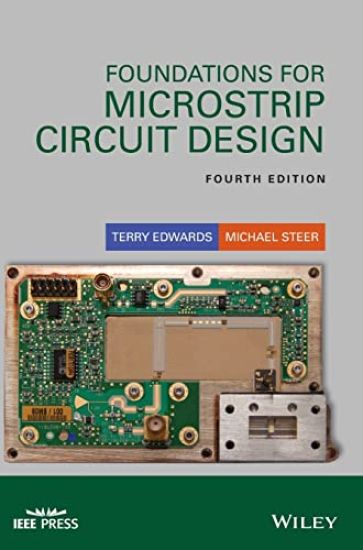
Building on the success of the previous three editions, Foundations for Microstrip Circuit Design offers extensive new, updated and revised material based upon the latest research. Strongly design-oriented, this fourth edition provides the reader with a fundamental understanding of this fast expanding field making it a definitive source for professional engineers and researchers and an indispensable reference for senior students in electronic engineering. Topics new to this edition: microwave substrates, multilayer transmission line structures, modern EM tools and techniques, microstrip and planar transmision line design, transmission line theory, substrates for planar transmission lines, Vias, wirebonds, 3D integrated interposer structures, computer-aided design, microstrip and power-dependent effects, circuit models, microwave network analysis, microstrip passive elements, and slotline design fundamentals.
Enniskerry, A History describes the development of this beautiful village from its beginnings as a small settlement by a bridge crossing the Glencullen river to the vibrant centre it is today. Using original research, eighteenth-century travel literature, and the Powerscourt Papers, the author examines the development of the village over the last 200 years. He goes on to look at the lives of the people who have been a part of this history, how their stories are intertwined with the changing nature of education, religion and social life of the area. Of course, no history of Enniskerry would be complete without an examination of the presence and influence of the Powerscourt Estate, and how it has shaped the lives and the landscape of one of Ireland’s most beautiful places.