**The perfect gift for young couples and families that provides a lifetime of knowledge and guidance** UPDATED in 2023 Following his widely successful book, The Early Investor: How Teens & Young Adults Can Become Wealthy, Michael Zisa brings us his next essential and influential investing book for all types of families. Michael, an experienced financial literacy educator, speaker, and independent financial advisor, uses his knowledge and proven techniques to translate complex material into easy-to-understand explanations and examples. In this book, you will learn how to: Establish and maintain a budget Create realistic financial goals Stay out of unnecessary debt Choose an appropriate home loan Understand various types of investments Select a retirement account that offers you the greatest tax advantages Plan and invest for future education expenses Strategies to protect your wealth Avoid identity theft and financial fraudThe Family Investor is a unique book that is ideal for newlyweds, couples, and all families that provides the power of personal finance and investing knowledge.
Bronislaw Malinowski (1884–1942) was one of the most colorful and charismatic social scientists of the twentieth century. His contributions as a founding father of social anthropology and his complex personality earned him international notoriety and near-mythical status. This landmark book presents a vivid portrait of Malinowski’s early life, from his birth in Cracow to his departure in 1920 from the Trobriand Islands of the South Pacific. At the age of 36, he had already created the innovative fieldwork methods and techniques that would secure his intellectual legacy.Drawing on an exceptionally rich array of primary documents, including Malinowski’s letters and unpublished diaries and manuscripts, Michael Young provides significant new information about the anthropologist’s personality, private life, and career. The author describes Malinowski’s restless life of travel, connections with intellectuals and artists, Nietzschean belief in his own destiny, and legendary fieldwork. The singular man who emerges from these pages fascinates on every level—as a volatile friend and lover, a provocative colleague, a passionate diarist, and a brilliant thinker who pioneered radical change in the field of anthropology.
This title is part of UC Press's Voices Revived program, which commemorates University of California Press’s mission to seek out and cultivate the brightest minds and give them voice, reach, and impact. Drawing on a backlist dating to 1893, Voices Revived makes high-quality, peer-reviewed scholarship accessible once again using print-on-demand technology. This title was originally published in 1983.
This title is part of UC Press's Voices Revived program, which commemorates University of California Press’s mission to seek out and cultivate the brightest minds and give them voice, reach, and impact. Drawing on a backlist dating to 1893, Voices Revived makes high-quality, peer-reviewed scholarship accessible once again using print-on-demand technology. This title was originally published in 1983.
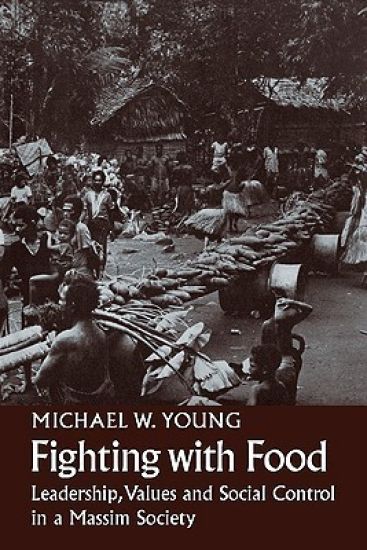
The Melanesians of Goodenough Island, off the eastern coast of New Guinea, have developed the principle of gift-giving to an extraordinary degree. Instead of resorting to arms in their quarrels or demanding compensation for offences, they present enemies and offenders with pigs and yams in order to shame them. This custom of coercive gift-giving operates at various organizational levels and through two main institutional forms: competitive food exchange and festivals. Dr Young analyses in depth the social and political structure of a single village, dealing in detail with its system of social control and those vexed topics of Melanesian ethnography - leadership and sorcery. Of particular interest is the author's description of the configuration of values which makes food-giving-to-shame meaningful to the Goodenough Islander for whom 'happiness is a rotting yam', and the worst evil 'hunger-producing sorcery'. The careful use of case material gives vivid insights into the lifestyle, world view and humanity of these proud and fractious people.
He walked on the Moon. He flew six space missions in three different programs--more than any other human. He served with NASA for more than four decades. His peers called him the ""astronaut's astronaut.""Enthusiasts of space exploration have long waited for John Young to tell the story of his two Gemini flights, his two Apollo missions, the first-ever Space Shuttle flight, and the first Spacelab mission. Forever Young delivers all that and more: Young's personal journey from engineering graduate to fighter pilot, to test pilot, to astronaut, to high NASA official, to clear-headed predictor of the fate of Planet Earth.Young, with the assistance of internationally distinguished aerospace historian James Hansen, recounts the great episodes of his amazing flying career in fascinating detail and with wry humor. He portrays astronauts as ordinary human beings and NASA as an institution with the same ups and downs as other major bureaucracies. He frankly discusses the risks of space travel, including what went wrong with the Challenger and Columbia shuttles.Forever Young is one of the last memoirs produced by an early American astronaut. It is the first memoir written by a chief of the NASA astronaut corps. Young's experiences and candor make this book indispensable to everyone interested in the U.S. space program.
A visually intuitive approach to statistical data analysis Visual Statistics brings the most complex and advanced statistical methods within reach of those with little statistical training by using animated graphics of the data. Using ViSta: The Visual Statistics System-developed by Forrest Young and Pedro Valero-Mora and available free of charge on the Internet-students can easily create fully interactive visualizations from relevant mathematical statistics, promoting perceptual and cognitive understanding of the data's story. An emphasis is placed on a paradigm for understanding data that is visual, intuitive, geometric, and active, rather than one that relies on convoluted logic, heavy mathematics, systems of algebraic equations, or passive acceptance of results. A companion Web site complements the book by further demonstrating the concept of creating interactive and dynamic graphics. The book provides users with the opportunity to view the graphics in a dynamic way by illustrating how to analyze statistical data and explore the concepts of visual statistics. Visual Statistics addresses and features the following topics: * Why use dynamic graphics? * A history of statistical graphics * Visual statistics and the graphical user interface * Visual statistics and the scientific method * Character-based statistical interface objects * Graphics-based statistical interfaces * Visualization for exploring univariate data This is an excellent textbook for undergraduate courses in data analysis and regression, for students majoring or minoring in statistics, mathematics, science, engineering, and computer science, as well as for graduate-level courses in mathematics. The book is also ideal as a reference/self-study guide for engineers, scientists, and mathematicians. With contributions by highly regarded professionals in the field, Visual Statistics not only improves a student's understanding of statistics, but also builds confidence to overcome problems that may have previously been intimidating.
Brewing is designed for those involved in the malting, brewing, and allied industries who have little or no formal training in brewing science. While some elementary knowledge of chemistry and biology is necessary, the book clearly presents the essentials of brewing science and its relationship to brewing technology. Brewing focuses on the principles and practices most central to an understanding of the brewing process, including preparation of malt, hops, and yeast; the fermentation process; microbiology and contaminants; and finishing, packaging, and flavor. The second edition gives more emphasis to engineering and technological aspects, with the three new chapters on water, engineering and analysis. Brewing, Second Edition, is both a basic text for traditional college, short, and extension courses in brewing science, and a basic reference for anyone in the brewing industry.
A collection of essays by international historians which explore British diplomatic policy in the decade following the end of World War II. Topics include propaganda, atomic policy, Imperial problems, European unity and Britain's response to political crises in the Middle East and Far East.
A compilation of 26 original hymns written by Kevin G. Pace for SATB voices. Hymns volume 15 could be used by any Christian congregation, choir, quartet or soloist. Though written from the perspective of the Church of Jesus Christ of Latter-day Saints, the themes in many of these hymns are non-specific to any single creed, praising God and His Son, Jesus Christ, with unique fervor and beauty appropriate for any congregation.
This collection features four peer-reviewed reviews on the nutritional benefits of milk.The first chapter highlights the important role of milk and dairy products in human diets due to the amount of energy (calories) they provide and their ability to compensate for foods in the diet with lesser nutritional value. The chapter also reviews the dairy matrix concept and how this matrix can influence human physiology.The second chapter provides an overview of major and minor milk proteins, including caseins, whey proteins and indigenous milk enzymes. The chapter discusses a selection of milk protein products which are produced on an industrial scale to support human health and growth, such as the use of whey protein in infant formula and dietary supplements. The third chapter reviews current knowledge on bioactive components existing in cow’s milk and colostrum, their biological and nutritional functionalities, as well as how these components can be exploited for the benefit of human health and physiological metabolism function.The final chapter provides an overview of the nutritional properties of dairy carbohydrates and major glycoproteins in cow’s milk. The chapter considers the contribution of lactose as a substrate for beneficial colonic fermentation to short-chain fatty acids, as well as the importance of glycoproteins in infant diets.
Ion Beam Analysis: Fundamentals and Applications explains the basic characteristics of ion beams as applied to the analysis of materials, as well as ion beam analysis (IBA) of art/archaeological objects. It focuses on the fundamentals and applications of ion beam methods of materials characterization.The book explains how ions interact with solids and describes what information can be gained. It starts by covering the fundamentals of ion beam analysis, including kinematics, ion stopping, Rutherford backscattering, channeling, elastic recoil detection, particle induced x-ray emission, and nuclear reaction analysis. The second part turns to applications, looking at the broad range of potential uses in thin film reactions, ion implantation, nuclear energy, biology, and art/archaeology. Examines classical collision theoryDetails the fundamentals of five specific ion beam analysis techniquesIllustrates specific applications, including biomedicine and thin film analysisProvides examples of ion beam analysis in traditional and emerging research fields Supplying readers with the means to understand the benefits and limitations of IBA, the book offers practical information that users can immediately apply to their own work. It covers the broad range of current and emerging applications in materials science, physics, art, archaeology, and biology. It also includes a chapter on computer applications of IBA.
Ion Beam Analysis: Fundamentals and Applications explains the basic characteristics of ion beams as applied to the analysis of materials, as well as ion beam analysis (IBA) of art/archaeological objects. It focuses on the fundamentals and applications of ion beam methods of materials characterization.The book explains how ions interact with solids and describes what information can be gained. It starts by covering the fundamentals of ion beam analysis, including kinematics, ion stopping, Rutherford backscattering, channeling, elastic recoil detection, particle induced x-ray emission, and nuclear reaction analysis. The second part turns to applications, looking at the broad range of potential uses in thin film reactions, ion implantation, nuclear energy, biology, and art/archaeology. Examines classical collision theoryDetails the fundamentals of five specific ion beam analysis techniquesIllustrates specific applications, including biomedicine and thin film analysisProvides examples of ion beam analysis in traditional and emerging research fields Supplying readers with the means to understand the benefits and limitations of IBA, the book offers practical information that users can immediately apply to their own work. It covers the broad range of current and emerging applications in materials science, physics, art, archaeology, and biology. It also includes a chapter on computer applications of IBA.
Michael Wellner Posp sil's photographs of the spaces and objects that typically go unseenMichael Wellner Posp sil's (born 1955) black-and-white photographs of Prague and Paris capture hidden corners, fleeting encounters and seemingly ordinary objects that we pass without noticing possess but which nonetheless provide room for rewarding interpretation.
This volume is a collection of essays written by colleagues and friends in honor of Michael W. Blastic, O.F.M., on the occasion of his 70th birthday. The contributing scholars endeavored to address significant issues within the academic areas in which Fr. Blastic has taught and published. Three essays are devoted to the Writings of Saint Francis; seven are dedicated to particular issues in Franciscan history, hagiography, spirituality and several texts; five deal specifically with women during the Middle Ages; and three final essays explore aspects of Franciscan theology and philosophy. Fr. Michael Blastic has taught at the Washington Theological Union, the Franciscan Institute at St. Bonaventure University and Siena College and served as a widely-respected retreat master. Contributors are Maria Pia Alberzoni, Luciano Bertazzo, O.F.M. Conv., Joshua C. Benson, Aaron Canty, Joseph Chinnici, O.F.M., Michael F. Cusato, O.F.M., Jay M. Hammond, J.A. Wayne Hellmann, O.F.M. Conv., Timothy J. Johnson, Lezlie Knox, Pietro Maranesi, Steven J. McMichael, O.F.M. Conv., Benedikt Mertens, O.F.M., Catherine M. Mooney, Luigi Pellegrini, Michael Robson, and William J. Short, O.F.M.
Michael Allen's e-Learning Library Most e-learning that is produced for classroom training is created using instructional models that were introduced more than thirty years ago. To update design solutions for today's online learners, Michael Allen's e- Learning Library offers a review of the basics of instructional design and then lifts the lid on some common misconceptions that arise from what people think they know about ISD. Michael Allen's e- Learning Library is designed to help use time and resources effectively and to build the best e-learning experiences possible. Filled with illustrative examples, the book is pragmatic and contains easy-to-apply solutions. Successful e-Learning Interface is the third book in the Michael Allen's e-Learning Library series. Using this hands-on resource will maximize your CEO impact—connect, empower, and orchestrate. You will understand how to connect with your learners, how to empower learners to make the most of e-learning's capabilities, and how to orchestrate learning events. Praise for Michael Allen's e-Learning Library "Once again Michael Allen has zeroed in on a critical, yet often overlooked, aspect of e-learning development. This book sheds light on the importance of learner interface design, and offers readers clear guidelines for designing interfaces that support the learner and increase impact. It will be a valuable asset for any e-learning developer who is committed to producing truly world-class e-learning." —David Holcombe, president and CEO, The eLearning Guild and publisher, Learning Solutions Magazine "With this easy-to-apply and practical book, Michael Allen raises the bar on creating exceptional e-learning experiences." —Lance Dublin, CEO and chief solution architect, Dublin Consulting "Michael Allen continues to be a strong voice in the e-learning industry. The topics addressed in this book are especially timely, helping the creators of training appeal to a new generation of learners while addressing the concerns of more mature learning audiences." —Jennifer Hofmann, president, InSync Training and author, The Synchronous Trainer's Survival Guide and Tailored Learning: Designing The Blend That Fits
Explore effective learning programs with the father of e-learning Michael Allen's Guide to e-Learning: Building Interactive, Fun, and Effective Learning Programs for Any Company, Second Edition presents best practices for building interactive, fun, and effective online learning programs. This engaging text offers insight regarding what makes great e-learning, particularly from the perspectives of motivation and interactivity, and features history lessons that assist you in avoiding common pitfalls and guide you in the direction of e-learning success. This updated edition also considers changes in technology and tools that facilitate the implementation of the strategies, guidelines, and techniques it presents. E-learning has experienced a surge in popularity over the past ten years, with education professionals around the world leveraging technology to facilitate instruction. From hybrid courses that integrate technology into traditional classroom instruction to full online courses that are conducted solely on the internet, a range of e-learning models is available. The key to creating a successful e-learning program lies in understanding how to use the tools at your disposal to create an interactive, engaging, and effective learning experience. Gain a new perspective on e-learning, and how technology can facilitate educationExplore updated content, including coverage regarding learner interface, gamification, mobile learning, and individualizationDiscuss the experiences of others via targeted case studies, which cover good and not so good e-learning projectsUnderstand key concepts through new examples that reinforce essential ideas and demonstrate their practical application Michael Allen's Guide to e-Learning: Building Interactive, Fun, and Effective Learning Programs for Any Company, Second Edition is an essential resource if you are studying for the e-Learning Instructional Design Certificate Program.