Kirjojen hintavertailu. Mukana 11 342 296 kirjaa ja 12 kauppaa.

Kirjahaku

Etsi kirjoja tekijän nimen, kirjan nimen tai ISBN:n perusteella.

1000 tulosta hakusanalla Michal Oginski

24 Polonaises for Piano

24 Polonaises for Piano

Michal Oginski

Lan, Planeta muzyki
2018
muu
Mikhail Kleofas Oginsky is known to many as the author of the popular Polonaise "Farewell to the Motherland". However, the composer wrote a number of piano works, in which the genre of Polonaise plays an important role. In this collection, for the first time in Russian edition, all Oginskys polonaises are presented for two three and four hand. The collection is intended for students of music schools and Children's Arts schools, as well as for piano music lovers.
Michal

Michal

Royce M Carpenter

Proving Press
2024
pokkari
How do you handle the challenges of life?What do you do when you are mistreated by others but no one notices?Will you self-destruct, or will you bounce back?These are the questions and decisions Michal and Bathsheba had to grapple with, and so do we all. No one is immune to the complexities of life, but how you confront them will impact your destiny. The three-volume series focuses on Michal, Bathsheba, and David's stories of traversing life's challenges. However, their stories still resonate in the 21st century as we all deal with triumphs and tragedies. Life, love, and perspective change depending on who tells their story. In this first volume, Michal struggles with life and all the complex choices and decisions that sometimes cause all of us to fall. Let's venture into the perspective of Michal in volume one, a wounded woman, without any preconceived notions but to hear from a perspective that may be like your child, neighbor, co-worker, or maybe your own. Bathsheba's perspective will be fully revealed in volume two and David's perspective will close out the series in volume three.
Collected Works of Michal Kalecki: Volume I. Capitalism: Business Cycles and Full Employment
This is the first volume in a new, definitive, seven-volume edition of the works of Michal Kalecki, one of the twentieth century's most distinguished economists. Kalecki was one of the three contemporary economists to arrive at the conclusions publicized by Keynes, although Kalecki arguably presented these views even earlier than Keynes. Volume I contains Kalecki's writings on the theory of the business cycle and full employment. His seminal Essay on the Business Cycle Theory is preceded by his earlier theoretical studies and followed by publications which developed and defended its main concepts and ideas. This volume also contains the 1939 book Essays in the Theory of Economic Fluctuations, the work which established his reputation. Also included are papers documenting his confrontation with Keynes's General Theory, including Kalecki's review of that work, and his various studies on the theory and policies relating to full employment, both the well known `Political Aspects of Full Employment' and `Three Ways to Full Employment', and those which have unfairly received less attention. The editorial comments and annexes at the end of the volume, besides giving valuable information on the background to the main texts, include illuminating exchanges of correspondence between Kalecki and Keynes, Joan Robinson, and others.
Collected Works of Michal Kalecki: Volume II. Capitalism: Economic Dynamics
The seven volumes will comprise the definitive scholarly edition of the works of Michal Kalecki, one of the most distinguished of twentieth-century economists and one of the trio who arrived at the conclusions promulgated by Keynes around the same time as - and in Kalecki's case, arguably earlier than - Keynes himself. Nearly half the material to appear in the seven volumes has never been previously published in English and includes revisions and additions made in the light of recent research, including information about the relationship of Kalecki's ideas to the ideas of contemporary economic theory. This volume deals with the capitalist economy and contains Kalecki's studies on the theory of income distribution in oligopolistic capitalism and on its economic dynamics. Each part of the book consists of essays devoted to a similar topic and individual papers in each part are arranged in chronological order. The editorial comments and annexes at the end of the volume, besides giving valuable information on the background to the main texts, include illuminating exchanges of correspondence between Kalecki and Keynes, Joan Robinson, and others.
Collected Works of Michal Kalecki: Volume III. Socialism: Functioning and Long-Run Planning
This is the third of seven volumes comprising the definitive scholarly edition of the works of Michal Kalecki, one of the most distinguished twentieth-century economists and one of the trio who arrived at the conclusions promulgated by Keynes around the time - and in Kalecki's case arguably earlier - than Keynes himself. Nearly half the material to appear in the seven volumes has never been previously published in English and includes revisions and additions made in the light of recent research, including information about the relationship of Kalecki's ideas to the ideas of contemporary economic theory. This third volume contains Kalecki's studies on the functioning of the socialist economy and on long-run planning, with special reference to Poland. Kalecki made an extensive contribution to the debates on Poland's post-war reconstruction, and especially on the system of planning and management of the Polish economy in 1955-64 and much of his work was unpublished until the 1980's. His activities throughout this period were so varied - on the practical level as well as on the theoretical - that the volume contains nearly all the material which has survived - Kalecki's correspondence, notes, records of his contribution to debates, and memoranda, providing an opportunity to survey Kalecki's activities related to the functioning of the Polish post-war economy.
Collected Works of Michal Kalecki: Volume IV: Socialism: Economic Growth and Efficiency of Investment
This volume contains Kalecki's writings on the theory of growth of a socialist economy and the theory of economic efficiency of investment. These are supplemented by essays on some economic and social problems of People's Poland. Though quite theoretical in nature, both the Introduction to the Theory of Growth in a Socialist Economy and Kalecki's many studies in the theory of economic efficiency of investment projects are deeply rooted in his practical experience as an economic planner. It is only in this light that the significance of his contributions to the theory of economic efficiency of investments can be assessed, and his ideas on socialist reproduction can be seen as a whole. Its central point is economic planning, which for Kalecki was the fundamental feature of a socialist economy.
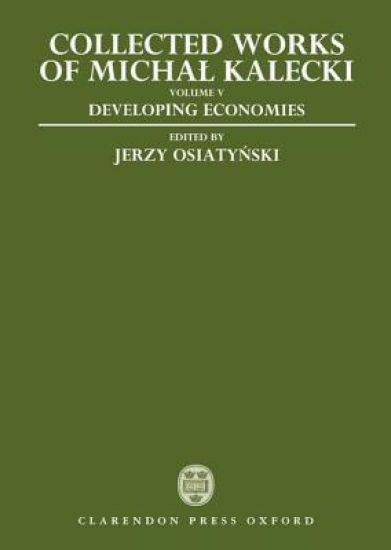
Collected Works of Michal Kalecki: Volume V: Developing Economies
This is the fifth of seven volumes comprising the definitive scholarly edition of the works of Michal Kalecki, one of the most distinguished 20th-century economists. This volume contains Kalecki's studies on the theory and practice of economic development. Its first part is devoted to general problems of economic underdevelopment. `Observations on Social and Economic Aspects of "Intermediate Regimes"' is his best-known paper here, but the other two papers are equally important for the understanding of Kalecki's approach to problems of the underdeveloped non-socialist countries. In Part 2, `The Problem of Financing Economic Development', published in Mexico in 1953, attracted great interest and possibly gave rise to a new school of thought (that is, Structuralism) in development economics. Part 3 contains Kalecki's four empirical case studies on development problems of Israel, India, Cuba, and Bolivia. As in the case of his work on the capitalist and the socialist economies, his studies on the economic development of underdeveloped countries are deeply rooted in their specific social and political conditions.
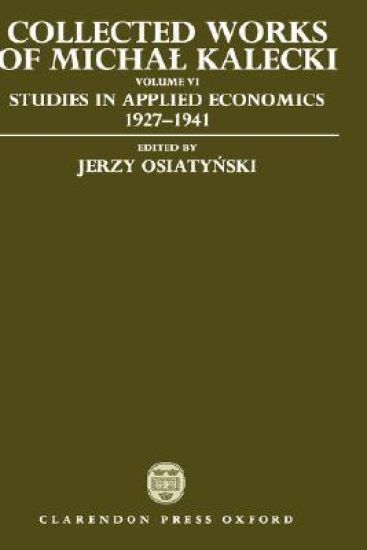
Collected Works of Michal Kalecki: Volume VI: Studies in Applied Economics 1927-1941
The sixth volume of the Collected Works of Michal Kalecki, one of the twentieth-century's pre-eminent economists, contains his empirical studies of the capitalist economy, published primarily in pre-war Poland. The first part of the book collects together reviews of business conditions in commodity markets, studies of the structure and operations of large companies and cartels, and articles on international economic relations. These studies, written between 1928 and 1935, demonstrate Kalecki's keen insight into the international consequences of the Great Crisis of 1929-33, and into the developments in Nazi Germany. The second part contains Kalecki's papers on the methodological problems of examining business fluctuations and on constructing indicators of economic trends. Part 3 comprises, Kalecki's estimates (together with Ludwik Landau) of the national income in Poland and of its structure. These studies, conducted between 1931 and 1935, were unique at the time in taking into account the distribution of aggregate income between the main social classes. The editorial notes and annexes at the end of the volume not only provide invaluable background information and explanatory glosses on the main text, but also give invaluable insights into the development of Kalecki's thought.
Collected Works of Michal Kalecki: Volume VII: Studies in Applied Economics 1940-1967; Miscellanea
The seventh volume of the Collected Works of Michal Kalecki, one of the twentieth century's preeminent economists, contains his empirical studies of the wartime and post-war economy in Britain and the USA, together with papers on the work of other economists and miscellanea. The first part of the book collects together his articles on the economic conditions of Britain during the Second World War, focusing on the rationing of consumption and war finance, and its post-war reconstructions. These articles are among Kalecki's best known, and contributed significantly to his world renown as an economist. Part two contains studies of post-war America, comparing the economy with the situation before the War. Part three contains a group of articles under the title `Political economy and economists', and includes book reviews and essays on the study of economics. Part four collects essays on a variety of topics, including Polish economic planning, construction engineering, and the theory of numbers. As in previous volumes, editorial notes and annexes by Professor Osiatynski provide invaluable background information and explanatory glosses on the main text. Among other things, they reveal details of Kalecki's work for the United Nations. Since this is the final volume of the Collected Works, it concludes with a chronology of biographical information and a complete bibliography of Kalecki's writings from 1927 to 1987.
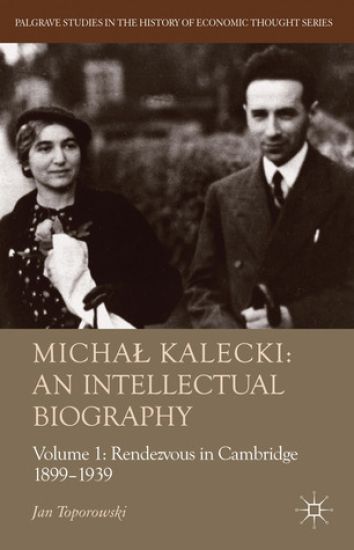
Michal Kalecki: An Intellectual Biography

Michal Kalecki: An Intellectual Biography

J. Toporowski

Palgrave Macmillan
2013
sidottu
This volume of intellectual biography takes the Polish economist Micha Kalecki (1899-1970) from the shattering of his prosperous childhood, in Tsarist Lódz in the 1905 Revolution, to Cambridge and the failure of his co-operative research with John Maynard Keynes's supporters in Cambridge.
Michal's Moral Dilemma

Michal's Moral Dilemma

Jonathan Y. Rowe

T. T.Clark Ltd
2013
nidottu
Michal's Moral Dilemma proposes that attention should be paid to the moral goods that feature in the text, before arguing that the family, a central feature of Old Testament morality, should be understood as a set of practices rather than an institution. Jonathan Rowe discusses the use of "models" of social action to comprehend the social world of the Bible, and suggests a modified version of Bakhtin's theory of heteroglossic voices can help readers appreciate how authors present a moral vision by approving some characters' actions whilst undermining others.The discussion of Michal's moral dilemma adduces anthropological theories and ethnographic data concerning violence, lying, and the relationship between fathers and daughters. Given that the conflicts of moral goods are "resolved" by characters choosing to act in a certain way, Rowe enquires after the author's assessment of each character's moral choices, arguing that Michal's loyalty to David and deception of Saul was counter-cultural. By approving of her choice the author affirms the importance of loyalty to the Davidic dynasty.
Michal's Moral Dilemma

Michal's Moral Dilemma

Jonathan Y. Rowe

T. T.Clark Ltd
2011
sidottu
This title uses anthropology to investigate the moral dilemma facing Saul's daughter in "1 Samuel 19", concluding that her choice of David (over Saul) is counter-cultural. "Michal's Moral Dilemma" proposes that attention should be paid to the moral goods that feature in the text, before arguing that the family, a central feature of Old Testament morality, should be understood as a set of practices rather than an institution. Jonathan Rowe discusses the use of 'models' of social action to comprehend the social world of the Bible, and suggests a modified version of Bakhtin's theory of heteroglossic voices can help readers appreciate how authors present a moral vision by approving some characters' actions whilst undermining others. The discussion of Michal's moral dilemma adduces anthropological theories and ethnographic data concerning violence, lying, and the relationship between fathers and daughters. Given that the conflicts of moral goods are "resolved" by characters choosing to act in a certain way, Rowe enquires after the author's assessment of each character's moral choices, arguing that Michal's loyalty to David and deception of Saul was counter-cultural. By approving of her choice the author affirms the importance of loyalty to the Davidic dynasty. Over the last 30 years this pioneering series has established an unrivaled reputation for cutting-edge international scholarship in Biblical Studies and has attracted leading authors and editors in the field. The series takes many original and creative approaches to its subjects, including innovative work from historical and theological perspectives, social-scientific and literary theory, and more recent developments in cultural studies and reception history.
Michal – A Novel

Michal – A Novel

Jill Eileen Smith

Revell, a division of Baker Publishing Group
2009
nidottu
As the daughter of King Saul, Michal lives a life of privilege--but one that is haunted by her father's unpredictable moods and by competition from her beautiful older sister. When Michal falls for young David, the harpist who plays to calm her father, she has no idea what romance, adventures, and heartache await her.As readers enter the colorful and unpredictable worlds of King Saul and King David, they will be swept up in this exciting and romantic story. Against the backdrop of opulent palace life, raging war, and desert escapes, Jill Eileen Smith takes her readers on an emotional roller-coaster ride as Michal deals with love, loss, and personal transformation as one of the wives of David. A sweeping tale of passion and drama, readers will love this amazing story.
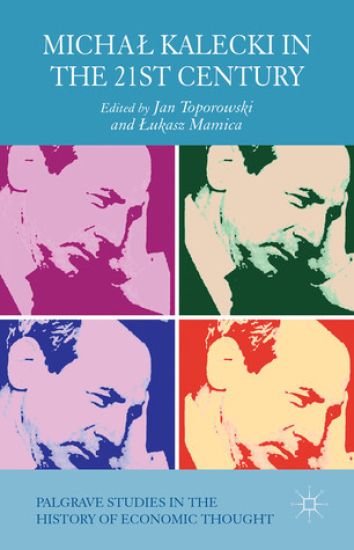
Michal Kalecki in the 21st Century
Leading experts on Kalecki have contributed special essays on what economists in the 21st century have to learn from the theories of Kalecki. Authors include surviving students of Kalecki, such as Amit Bhaduri, Mario Nuti, Kazimierz Laski Jerzy Osiatynski, and Post-Keynesian economists such as Geoff Harcourt, Marc Lavoie, and Malcolm Sawyer.
Michal Kalecki: An Intellectual Biography

Michal Kalecki: An Intellectual Biography

J. Toporowski

Palgrave Macmillan
2013
nidottu
This volume of intellectual biography takes the Polish economist Micha Kalecki (1899-1970) from the shattering of his prosperous childhood, in Tsarist Lódz in the 1905 Revolution, to Cambridge and the failure of his co-operative research with John Maynard Keynes's supporters in Cambridge.
Michal Kalecki in the 21st Century
Leading experts on Kalecki have contributed special essays on what economists in the 21st century have to learn from the theories of Kalecki. Authors include surviving students of Kalecki, such as Amit Bhaduri, Mario Nuti, Kazimierz Laski Jerzy Osiatynski, and Post-Keynesian economists such as Geoff Harcourt, Marc Lavoie, and Malcolm Sawyer.