Kirjojen hintavertailu. Mukana 11 417 157 kirjaa ja 12 kauppaa.

Kirjahaku

Etsi kirjoja tekijän nimen, kirjan nimen tai ISBN:n perusteella.

1000 tulosta hakusanalla Mikhail Bragin

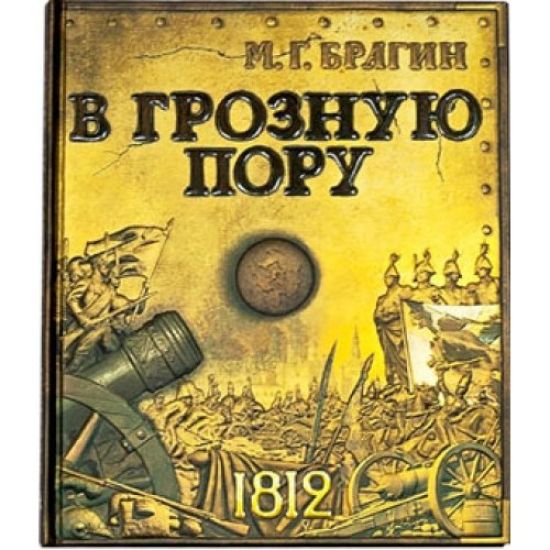
V groznuju poru. 1812 god

V groznuju poru. 1812 god

Mikhail Bragin

Detskaja i junosheskaja kniga
2023
sidottu
Kniga Mikhaila Bragina provodit junykh chitatelej cherez glavnye sobytija Otechestvennoj vojny 1812 goda, vyzyvaja soperezhivanie i iskrennij interes k nim. Kniga podojdjot dlja domashnego chtenija, a takzhe pomozhet uchiteljam nachalnykh klassov provesti interesnoe tematicheskoe zanjatie. Blagodarja unikalnomu metodicheskomu materialu, pomeschennomu v knigu, rabota s tekstami khudozhestvennykh proizvedenij stanet namnogo effektivnee. Rebjonok osvoit navyki smyslovogo chtenija, nauchitsja gramotno analizirovat tekst, zapominat detali, sjuzhet i kompozitsiju, glavnykh geroev, ikh kharaktery i motivy postupkov. Interesnoj formoj dejatelnosti stanet sostavlenie "klasterov", kotorye pomogut osmyslit i zapomnit glavnykh i vtorostepennykh personazhej, ustanovit suschestvujuschie mezhdu nimi svjazi. Takim obrazom, vy podgotovite rebjonka k chteniju i usvoeniju bolshikh obemov teksta v srednej i starshej shkole, a takzhe k svobodnomu pereskazu i napisaniju esse i sochinenij. Dlja mladshego shkolnogo vozrasta.Khudozhnik: Akishin Askold
V groznuju poru. 1812 god

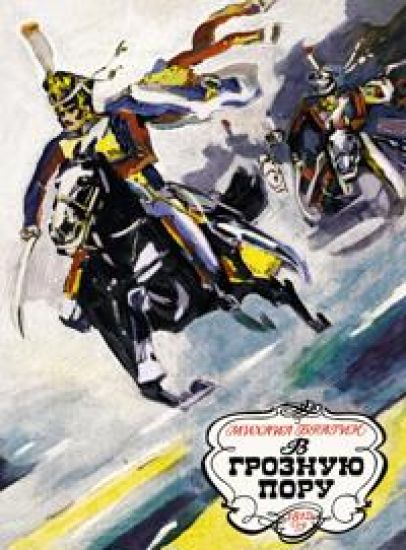
V groznuju poru. 1812 god

Mikhail Bragin

Makhaon
2023
sidottu
"V groznuju poru" - kniga, illjustrirujuschaja odnu iz samykh jarkikh, geroicheskikh stranits velikoj istorii Rossii, - Otechestvennuju vojnu 1812 goda. 1812 god... Na Rossiju shla nebyvalo ogromnaja armija pod komandovaniem Napoleona Bonaparta. K tomu vremeni imperator Frantsii podchinil sebe pochti vsju Evropu. Kazalos, eschjo nemnogo - i ego gospodstvo budet bezgranichnym. No na puti Napoleona stojala velikaja strana Rossija. Upojonnyj slavoj i uverennyj v moschi svoej armii, Napoleon predvkushal skoruju pobedu eschjo nad odnim gosudarstvom. No Rossija ne sdalas! Vsenarodnoe uchastie v vojne i geroizm soldat, obschenatsionalnyj podjom na zaschitu otechestva i polkovodcheskij talant glavnokomandujuschego russkoj armiej Kutuzova razrushili plany Napoleona i "istrebili vraga do poslednej cherty vozmozhnosti". Otechestvennaja vojna 1812 goda stala velikoj epokhoj v zhizni nashej strany, poistine groznoj poroj, a ejo geroi navsegda ostanutsja v istorii Rossii, pokazav nam vsem primer samootverzhennosti, ogromnoj ljubvi i predannosti Rodine. Kniga oformlena masterom russkoj grafiki, khudozhnikom s mirovym priznaniem Pavlom Buninym, sumevshim potrjasajusche emotsionalno, jarko vossozdat kartiny toj strashnoj, krovoprolitnoj Otechestvennoj vojny.
V groznuju poru

V groznuju poru

Mikhail Bragin

Labirint
2019
sidottu
V 1960-kh godakh istorik M. G. Bragin napisal knigu "V groznuju poru", i sovetskie malchishki zaboleli 1812 godom. Skolko armij bylo sozdano iz samykh neozhidannykh materialov, skolko razygrano srazhenij!Spustja pochti polveka eta kniga vozvraschaetsja k chitatelju, i vnov na ejo stranitsakh slyshen grokhot pushek, sverkajut kirasy i klubitsja porokhovoj dym. Otechestvennaja vojna ozhivaet zdes v melchajshikh podrobnostjakh: mozhno prochest perepisku generalov, razobratsja v skhemakh bojov, uvidet, chto nosil v rantse russkij soldat, zagljanut v ustav 1811 g., rassmotret uniformu i oruzhie, nauchitsja stroit ukreplenija, uznat, kak streljaet pushka, zachem sapjoru fartuk, mozhno li bylo vylechit Bagrationa, chto takoe okochurnik, kakaja statuja Napoleona mogla by stojat v Kremle i chto pogubilo Velikuju armiju.Dopolnitelnye materialy: originalnye obemnye konstruktsii, panoramnye stranitsy, klapany, knizhechki, karty, skhemy srazhenij, putevoditel po Borodinskomu polju, kartochki s portretami i biografijami velikikh polkovodtsev, istoricheskie dokumenty.Redaktor: Buntman Ekaterina, Kim Elena NikolaevnaKhudozhnik: Averjanov A., Alekhin P., Ezhov A., Belanov N., Loseva Irina, Muratova Olga Valerevna, Churkina Evgenija
Brain Metastases

Brain Metastases

Mikhail Dolgushin; Valery Kornienko; Igor Pronin

Springer International Publishing AG
2017
sidottu
This book describes the role of advanced neuroimaging techniques in characterizing the changes in tissue structure in patients with brain metastases. On a large number of newly recognized CT, MRI, and PET characteristics of brain metastases from different primary tumors are highlighted, thereby elucidating the potential differential diagnostic role of CT perfusion imaging, MR spectroscopy, MR diffusion-weighted imaging, MR susceptibility-weighted imaging, and PET with different radiopharmaceuticals. For example, the different manifestations of metastases of melanoma, renal cell carcinoma, and ovarian cancer on MRI and CT perfusion imaging are described, and the role of MR susceptibility-weighted imaging in the differential diagnosis of glioblastoma multiforme and metastatic tumors is clarified. Metastases of colon cancer have shown a special manifestation on T2 weighted images. The book also presents novel findings regarding pathogenesis and tumor biology and describes qualitative and quantitative changes in tumor tissue and alterations in brain white matter due to surrounding tumor growth. Neuroradiologists and others, including neurosurgeons, neurologists, and nuclear medicine physicians, will find that this book offers a fascinating insight into the ways in which newly available data on structural, hemodynamic, and metabolic changes are enriching the neuroimaging of brain metastases.
Brain Metastases

Brain Metastases

Mikhail Dolgushin; Valery Kornienko; Igor Pronin

Springer International Publishing AG
2018
nidottu
This book describes the role of advanced neuroimaging techniques in characterizing the changes in tissue structure in patients with brain metastases. On a large number of newly recognized CT, MRI, and PET characteristics of brain metastases from different primary tumors are highlighted, thereby elucidating the potential differential diagnostic role of CT perfusion imaging, MR spectroscopy, MR diffusion-weighted imaging, MR susceptibility-weighted imaging, and PET with different radiopharmaceuticals. For example, the different manifestations of metastases of melanoma, renal cell carcinoma, and ovarian cancer on MRI and CT perfusion imaging are described, and the role of MR susceptibility-weighted imaging in the differential diagnosis of glioblastoma multiforme and metastatic tumors is clarified. Metastases of colon cancer have shown a special manifestation on T2 weighted images. The book also presents novel findings regarding pathogenesis and tumor biology and describes qualitative and quantitative changes in tumor tissue and alterations in brain white matter due to surrounding tumor growth. Neuroradiologists and others, including neurosurgeons, neurologists, and nuclear medicine physicians, will find that this book offers a fascinating insight into the ways in which newly available data on structural, hemodynamic, and metabolic changes are enriching the neuroimaging of brain metastases.
Quantum Computing For The Brain

Quantum Computing For The Brain

Melanie Swan; Renato P Dos Santos; Mikhail A Lebedev; Frank Witte

World Scientific Europe Ltd
2022
sidottu
Quantum Computing for the Brain argues that the brain is the killer application for quantum computing. No other system is as complex, as multidimensional in time and space, as dynamic, as less well-understood, as of peak interest, and as in need of three-dimensional modeling as it functions in real-life, as the brain.Quantum computing has emerged as a platform suited to contemporary data processing needs, surpassing classical computing and supercomputing. This book shows how quantum computing's increased capacity to model classical data with quantum states and the ability to run more complex permutations of problems can be employed in neuroscience applications such as neural signaling and synaptic integration. State-of-the-art methods are discussed such as quantum machine learning, tensor networks, Born machines, quantum kernel learning, wavelet transforms, Rydberg atom arrays, ion traps, boson sampling, graph-theoretic models, quantum optical machine learning, neuromorphic architectures, spiking neural networks, quantum teleportation, and quantum walks.Quantum Computing for the Brain is a comprehensive one-stop resource for an improved understanding of the converging research frontiers of foundational physics, information theory, and neuroscience in the context of quantum computing.
Mikhail

Mikhail

Jonathan R P Taylor

Lulu.com
2023
pokkari
Mikhail is forced into the Russian Army by his homophobic father. He dreams of joining his only love, Maksim, in Paris. Separated by war he soon finds himself on the front in Ukraine fighting a war he does not believe in. Brutalised, he plans his escape, but as a deserter from the Wagner group, there is a huge price to pay... If you are seeking a novel that romanticises Russian culture and life or exudes the patriotic rhetoric of Vladimir Putin, then certainly you will be disappointed. Whilst Mikhail's narrative is fiction, the invasion of Ukraine is not. Tens of thousands have been killed in an unprecedented act of unwarranted Russian aggression. The author of this novel stands wholeheartedly with Ukraine. This is a book that warns its reader not to remain silent - Russian anti-LGBTQ+ hate speech has ultimately infected the Bulgarian psyche (an EU member) without a single shot being fired. There is no fear of invasion here for they've already arrived - years ago. Mikhail's resistance is his own existence, but for how long?
Mikhail Bakhtin

Mikhail Bakhtin

Ken Hirschkop

Oxford University Press
1999
nidottu
This book makes a radical break with earlier interpretations of Bakhtin's work. Using recent Russian scholarship, Ken Hirschkop explodes many of the myths which have surrounded Bakhtin and his work and lays the ground for a new, more historically acute sense of his achievement. Through a comprehensive reading of Bakhtin's work, Hirschkop demonstrates that his discussion of the philosophy of language, literary history, popular-festive culture, and the phenomenology of everyday life revolved around a lifelong search for a new kind of modern ethical culture. A detailed examination of the major works reveals the careful interweaving of philosophical and historical argument which makes Bakhtin at once so compelling and so frustrating a writer. Hirschkop treats Bakhtin not as a metaphysician or a philosopher for the ages, but as a writer inevitably drawn into the historical conflicts produced by a modernizing and democratizing Europe. As a consequence, Bakhtin becomes a more sober but also more original writer, with a striking contribution to make to the definition of the democratic project.
Mikhail Bakhtin

Mikhail Bakhtin

Ken Hirschkop

Oxford University Press
1999
sidottu
This book makes a radical break with earlier interpretations of Bakhtin's work. Using recent Russian scholarship, Ken Hirschkop explodes many of the myths which have surrounded Bakhtin and his work and lays the ground for a new, more historically acute sense of his achievement. Through a comprehensive reading of Bakhtin's work, Hirschkop demonstrates that his discussion of the philosophy of language, literary history, popularfestive culture, and the phenomenology of everyday life revolved around a lifelong search for a new kind of modern ethical culture. A detailed examination of the major works reveals the careful interweaving of philosophical and historical argument which makes Bakhtin at once so compelling and so frustrating a writer. Hirschkop treats Bakhtin not as a metaphysician or a philosopher for the ages, but as a writer inevitably drawn into the historical conflicts produced by a modernizing and democratizing Europe. As a consequence, Bakhtin becomes a more sober but also more original writer, with a striking contribution to make to the definition of the democratic project.
Mikhail Bakhtin and Walter Benjamin

Mikhail Bakhtin and Walter Benjamin

T. Beasley-Murray

Palgrave Macmillan
2007
sidottu
This first comparative study of the philosophers and literary critics, Walter Benjamin and Mikhail Bakhtin, focuses on the two thinkers' conceptions of experience and form, investigating parallels between Bakhtin's theories of responsibility, dialogue, and the novel, and Benjamin's theories of translation, montage, allegory, and the aura.
Mikhail Gorbachev: Memoirs

Mikhail Gorbachev: Memoirs

Mikhail Gorbachev

Doubleday
2007
pokkari
Mikhail Gorbachev is the man who changed everything. It was Gorbachev's initiative that raised the Iron Curtain; his actions that resulted in one of the era's most symbolic events, the demolition on the Berlin Wall; his reforms that set in train events leading to the fall of Communism.Twelve years ago, when Gorbachev came to power, the globe was still divided into two armed camps, one for each superpower - as it had been ever since 1945. The Cold War dominated international politics, from Angola to Afghanistan. The man who became leader of the Soviet Union in 1985 was much younger than his predecessors, yet there was little else to distinguish him from the stony-faced apparatchiks waving from the Kremlin. He seemed a model Communist, ideologically committed to socialism, raised wholly within the confines of the Party. Yet Gorbachev realized that the system could not continue. What was it about this man which enabled him to see so much more clearly than his colleagues?Like most who start a revolution, Gorbachev has been left behind. No longer in power, he has been forced to endure criticism from those wise after the event - most notably Boris Yeltsin, who became undisputed leader after the failed military coup that finally displaced Gorbachev from office. In these memoirs Gorbachev reveals his feelings about the sad state of his country today. He tells us of his childhood in the North Caucasus during the Second World War, of coming to Moscow as a student and meeting Raisa Maksimovna, of his glittering career as a Party functionary, eventually becoming one of the most powerful men in the world. This is a historical document of the first importance. It is also a fascinating human story, an insider's account of the events that we never dared believe could happen.
Mikhail Bakhtin

Mikhail Bakhtin

Alastair Renfrew

Routledge
2014
sidottu
Mikhail Bakhtin was one of the twentieth century’s most influential literary theorists. This accessible introduction to his thought begins with the questions ‘Why Bakhtin?’ and ‘Who was Bakhtin?’, before dealing in detail with his ideas on authorship and subjecthood, language, dialogism, heteroglossia and the novel, the chronotope, and the carnivalesque. True to their dialogic spirit, these ideas are presented not as a fixed body of knowledge, but rather as living and evolving entities, as ways of approaching not only the most persistent questions of language and literature, but also issues that are relevant across the full range of Humanities disciplines. Bakhtin emerges in the process as a key thinker for the Humanities in the twenty-first century.
Mikhail Bakhtin

Mikhail Bakhtin

Graham Pechey

Routledge
2007
nidottu
Mikhail Bakhtin is one of the most influential theorists of philosophy as well as literary studies. His work on dialogue and discourse has changed the way in which we read texts – both literary and cultural – and his practice of philosophy in literary refraction and philological exploration has made him a pioneering figure in the twentieth-century convergence of the two disciplines.In this book, Graham Pechey offers a commentary on Bakhtin’s texts in all their complex and allusive ‘textuality’, keeping a sense throughout of the historical setting in which they were written and of his own interpretation of and response to them. Examining Bakhtin’s relationship to Russian Formalism and Soviet Marxism, Pechey focuses on two major interests: the influence of Eastern Orthodox Christianity upon his thinking; and Bakhtin’s use of literary criticism and hermeneutics as ways of ‘doing philosophy by other means’.
Mikhail Bakhtin

Mikhail Bakhtin

Graham Pechey

Routledge
2007
sidottu
Mikhail Bakhtin is one of the most influential theorists of philosophy as well as literary studies. His work on dialogue and discourse has changed the way in which we read texts – both literary and cultural – and his practice of philosophy in literary refraction and philological exploration has made him a pioneering figure in the twentieth-century convergence of the two disciplines.In this book, Graham Pechey offers a commentary on Bakhtin’s texts in all their complex and allusive ‘textuality’, keeping a sense throughout of the historical setting in which they were written and of his own interpretation of and response to them. Examining Bakhtin’s relationship to Russian Formalism and Soviet Marxism, Pechey focuses on two major interests: the influence of Eastern Orthodox Christianity upon his thinking; and Bakhtin’s use of literary criticism and hermeneutics as ways of ‘doing philosophy by other means’.
Mikhail Zoshchenko

Mikhail Zoshchenko

Scatton Linda Hart

Cambridge University Press
2009
pokkari
Mikhail Zoshchenko was a household name in the Soviet Union from the 1920s until the crackdown on the arts after World War II. This is a full-length study in English of his career, and of his critical and political reception in a society where the purpose of art was service to the state. It places his longer works and the events leading up to his literary assassination in 1946 in the context of the short, riotous works that won him mass readership and a devoted following among contemporary writers who agreed with each other on little else. Dr Scatton identifies stylistic and thematic unities in his prose, and argues that Zoshchenko's later works were natural outgrowths of his earlier experiments and not, as is often stated, aberrations or expressions of subservience to the regime. Both as a master of Russian prose and a victim of Stalinist literary politics, Zoshchenko has been the object of critical rediscovery and reassessment over the last 15 years. This book describes that process.
Mikhail Bulgakov

Mikhail Bulgakov

Lesley Milne

Cambridge University Press
2009
nidottu
When it was published this was the full, post-glasnost critical biography of Mikhail Bulgakov (1891-1940), a great comic writer whose works are regarded as modern classics. This account of Bulgakov's career as playwright and prose-writer examines all his works in the context of the changing demands put upon artists in the Soviet Union of the 1920s and 1930s, who were faced with the choice of integrity at the price of silence, or publication and production at the price of conformty with the totalitarian state. Lesley Milne traces through Bulgakov's career an ethical concept of the writer's role, his response to his time, and his search for an audience in and beyond that time.
Mikhail Bakhtin

Mikhail Bakhtin

Michael F. Bernard-Donals

Cambridge University Press
1995
pokkari
The language theory of Mikhail Bakhtin does not fall neatly under any single rubric - ‘dialogism,’ ‘marxism,’ ‘prosaics,’ ‘authorship’ - because the philosophic foundation of his writing rests ambivalently between phenomenology and Marxism. The theoretical tension of these positions creates philosophical impasses in Bakhtin’s work, which have been neglected or ignored partly because these impasses are themselves mirrored by the problems of antifoundationalist and materialist tendencies in literary scholarship. In Mikhail Bakhtin: Between Phenomenology and Marxism Michael Bernard-Donals examines various incarnations of phenomenological and materialist theory - including the work of Jauss, Fish, Rorty, Althusser, and Pecheux - and places them beside Bakhtin’s work, providing a contextualised study of Bakhtin, a critique of the problems of contemporary critics, and an original contribution to literary theory.