Kirjojen hintavertailu. Mukana 11 699 587 kirjaa ja 12 kauppaa.

Kirjahaku

Etsi kirjoja tekijän nimen, kirjan nimen tai ISBN:n perusteella.

1000 tulosta hakusanalla Mikhail Tukhachevskij

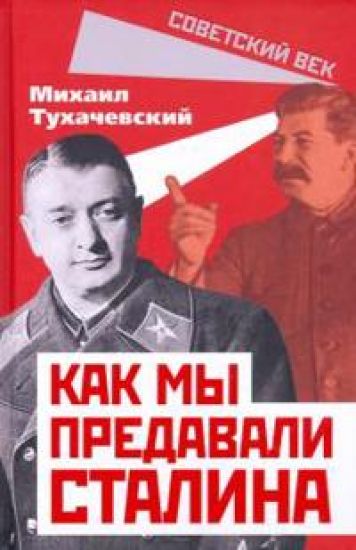
Kak my predavali Stalina

Kak my predavali Stalina

Mikhail Tukhachevskij

Rodina
2021
sidottu
M.N. Tukhachevskij - odin iz pervykh marshalov Sovetskogo Sojuza - s I.V. Stalinym byl znakom esche s grazhdanskoj vojny. Neudachu Varshavskoj operatsii 1920 g. Tukhachevskij pripisyval imenno Stalinu. V dalnejshem M. Tukhachevskij naladil shirokie kontakty s nemetskim Generalnym shtabom i pytalsja s pomoschju nemtsev organizovat zagovor protiv Stalina v 1937 g. Posle raskrytija zagovora Tukhachevskij byl osuzhden i rasstreljan, odnako pri Khruscheve reabilitirovan kak nevinno osuzhdennyj. V knigu, predstavlennuju vashemu vnimaniju, voshli sobstvennye pokazanija Tukhachevskogo i ego souchastnikov na sledstvii i sude. Kharakter etikh pokazanij delaet nevozmozhnym ikh poluchenie v rezultate "nezakonnykh metodov sledstvija", kak utverzhdalos Khruschevym, - oni soderzhat unikalnye voenno-tekhnicheskie podrobnosti zagovora, a takzhe risujut ego kartinu s mnozhestvom detalej, izvestnykh lish samim zagovorschikam.
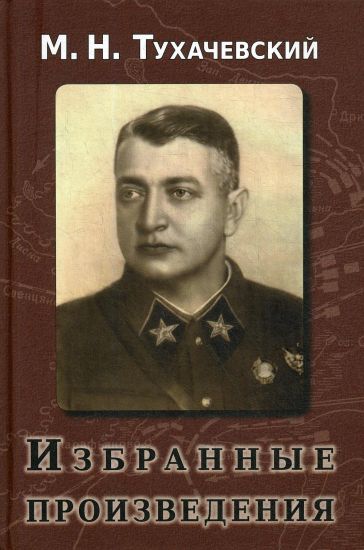
Izbrannye proizvedenija

Izbrannye proizvedenija

Mikhail Tukhachevskij

Russkij Shakhmatnyj Dom
2020
sidottu
V etoj knige sobrany naibolee interesnye raboty samogo molodogo i talantlivogo sovetskogo marshala Mikhaila Nikolaevicha Tukhachevskogo (1893-1937 gg.). Ego nazyvali "Krasnym Bonapartom" i tvortsom sovetskoj voennoj doktriny.Upor sdelan na raboty, predstavljajuschie interes ne tolko dlja voennykh spetsialistov, no prezhde vsego dlja shirokogo kruga ljubitelej istorii. Sredi predstavlennykh v knige rabot legendarnogo marshala: "Pervaja armija v 1918 godu", "Pokhod za Vislu", "Podgotovka novoj vojny protiv SSSR", "Voennye plany nyneshnej Germanii" i dr.
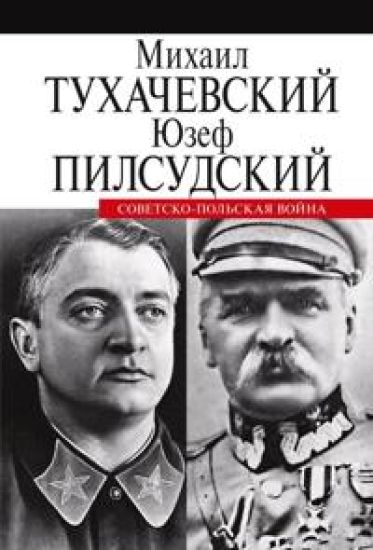
Sovetsko-polskaja vojna

Sovetsko-polskaja vojna

Mikhail Tukhachevskij; Ju. Pilsudskij

Prozaik
2020
sidottu
V knigu, posvjaschennuju sobytijam Sovetsko-polskoj vojny (1920-1921), voshli vospominanija dvukh voennykh i politicheskikh dejatelej, smotrevshikh drug na druga bukvalno cherez pritsel: glavnokomandujuschego polskoj armiej Juzefa Pilsudskogo i komandujuschego sovetskim Zapadnym frontom Mikhaila Tukhachevskogo. Ljudi raznogo vozrasta, kharaktera i sudby soshlis na pole bitvy s raznymi tseljami: Pilsudskij stremilsja vozrodit "velikuju Rech Pospolituju ot morja do morja", Tukhachevskij - "prodvinut mirovuju revoljutsiju v Evropu". Ni tomu ni drugomu ne udalos vypolnit zadumannoe. Sovetskaja Rossija etu vojnu proigrala i na bez malogo dvadtsat let lishilas zemel Zapadnoj Ukrainy i Belorussii. Polsha zhe stala vesomoj siloj v evropejskoj politike, no... na te zhe dvadtsat let. Ob istokakh, khode i rezultatakh vojny do sikh por vedutsja ozhestochennye spory sredi istorikov. Kniga adresovana chitatelju, zhelajuschemu uznat bolshe o maloizvestnykh sobytijakh nashej istorii i sostavit o nikh svoe mnenie.
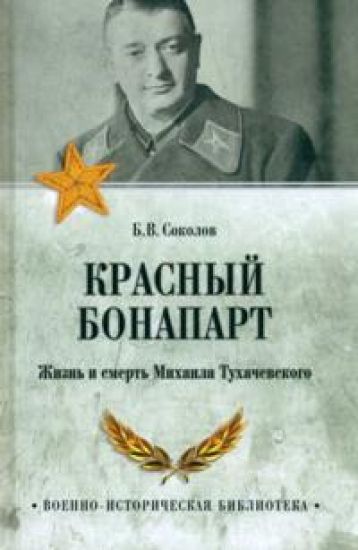
Krasnyj Bonapart. Zhizn i smert Mikhaila Tukhachevskogo
Pozhaluj, ni odin Marshal Sovetskogo Sojuza ne udostaivalsja kak pri zhizni, tak i posle smerti stol raznoobraznykh i protivorechivykh otsenok, kak M.N. Tukhachevskij. Ego blistatelnaja karera i tragicheskaja gibel porazhali voobrazhenie sovremennikov i prodolzhajut vyzyvat ustojchivyj interes i voprosy i v nashi dni. Otvetit na nikh pomozhet kniga izvestnogo istorika Borisa Sokolova.
Mikhail

Mikhail

Jonathan R P Taylor

Lulu.com
2023
pokkari
Mikhail is forced into the Russian Army by his homophobic father. He dreams of joining his only love, Maksim, in Paris. Separated by war he soon finds himself on the front in Ukraine fighting a war he does not believe in. Brutalised, he plans his escape, but as a deserter from the Wagner group, there is a huge price to pay... If you are seeking a novel that romanticises Russian culture and life or exudes the patriotic rhetoric of Vladimir Putin, then certainly you will be disappointed. Whilst Mikhail's narrative is fiction, the invasion of Ukraine is not. Tens of thousands have been killed in an unprecedented act of unwarranted Russian aggression. The author of this novel stands wholeheartedly with Ukraine. This is a book that warns its reader not to remain silent - Russian anti-LGBTQ+ hate speech has ultimately infected the Bulgarian psyche (an EU member) without a single shot being fired. There is no fear of invasion here for they've already arrived - years ago. Mikhail's resistance is his own existence, but for how long?
Mikhail Bakhtin

Mikhail Bakhtin

Ken Hirschkop

Oxford University Press
1999
nidottu
This book makes a radical break with earlier interpretations of Bakhtin's work. Using recent Russian scholarship, Ken Hirschkop explodes many of the myths which have surrounded Bakhtin and his work and lays the ground for a new, more historically acute sense of his achievement. Through a comprehensive reading of Bakhtin's work, Hirschkop demonstrates that his discussion of the philosophy of language, literary history, popular-festive culture, and the phenomenology of everyday life revolved around a lifelong search for a new kind of modern ethical culture. A detailed examination of the major works reveals the careful interweaving of philosophical and historical argument which makes Bakhtin at once so compelling and so frustrating a writer. Hirschkop treats Bakhtin not as a metaphysician or a philosopher for the ages, but as a writer inevitably drawn into the historical conflicts produced by a modernizing and democratizing Europe. As a consequence, Bakhtin becomes a more sober but also more original writer, with a striking contribution to make to the definition of the democratic project.
Mikhail Bakhtin

Mikhail Bakhtin

Ken Hirschkop

Oxford University Press
1999
sidottu
This book makes a radical break with earlier interpretations of Bakhtin's work. Using recent Russian scholarship, Ken Hirschkop explodes many of the myths which have surrounded Bakhtin and his work and lays the ground for a new, more historically acute sense of his achievement. Through a comprehensive reading of Bakhtin's work, Hirschkop demonstrates that his discussion of the philosophy of language, literary history, popularfestive culture, and the phenomenology of everyday life revolved around a lifelong search for a new kind of modern ethical culture. A detailed examination of the major works reveals the careful interweaving of philosophical and historical argument which makes Bakhtin at once so compelling and so frustrating a writer. Hirschkop treats Bakhtin not as a metaphysician or a philosopher for the ages, but as a writer inevitably drawn into the historical conflicts produced by a modernizing and democratizing Europe. As a consequence, Bakhtin becomes a more sober but also more original writer, with a striking contribution to make to the definition of the democratic project.
Mikhail Bakhtin and Walter Benjamin

Mikhail Bakhtin and Walter Benjamin

T. Beasley-Murray

Palgrave Macmillan
2007
sidottu
This first comparative study of the philosophers and literary critics, Walter Benjamin and Mikhail Bakhtin, focuses on the two thinkers' conceptions of experience and form, investigating parallels between Bakhtin's theories of responsibility, dialogue, and the novel, and Benjamin's theories of translation, montage, allegory, and the aura.
Mikhail Gorbachev: Memoirs

Mikhail Gorbachev: Memoirs

Mikhail Gorbachev

Doubleday
2007
pokkari
Mikhail Gorbachev is the man who changed everything. It was Gorbachev's initiative that raised the Iron Curtain; his actions that resulted in one of the era's most symbolic events, the demolition on the Berlin Wall; his reforms that set in train events leading to the fall of Communism.Twelve years ago, when Gorbachev came to power, the globe was still divided into two armed camps, one for each superpower - as it had been ever since 1945. The Cold War dominated international politics, from Angola to Afghanistan. The man who became leader of the Soviet Union in 1985 was much younger than his predecessors, yet there was little else to distinguish him from the stony-faced apparatchiks waving from the Kremlin. He seemed a model Communist, ideologically committed to socialism, raised wholly within the confines of the Party. Yet Gorbachev realized that the system could not continue. What was it about this man which enabled him to see so much more clearly than his colleagues?Like most who start a revolution, Gorbachev has been left behind. No longer in power, he has been forced to endure criticism from those wise after the event - most notably Boris Yeltsin, who became undisputed leader after the failed military coup that finally displaced Gorbachev from office. In these memoirs Gorbachev reveals his feelings about the sad state of his country today. He tells us of his childhood in the North Caucasus during the Second World War, of coming to Moscow as a student and meeting Raisa Maksimovna, of his glittering career as a Party functionary, eventually becoming one of the most powerful men in the world. This is a historical document of the first importance. It is also a fascinating human story, an insider's account of the events that we never dared believe could happen.
Mikhail Bakhtin

Mikhail Bakhtin

Alastair Renfrew

Routledge
2014
sidottu
Mikhail Bakhtin was one of the twentieth century’s most influential literary theorists. This accessible introduction to his thought begins with the questions ‘Why Bakhtin?’ and ‘Who was Bakhtin?’, before dealing in detail with his ideas on authorship and subjecthood, language, dialogism, heteroglossia and the novel, the chronotope, and the carnivalesque. True to their dialogic spirit, these ideas are presented not as a fixed body of knowledge, but rather as living and evolving entities, as ways of approaching not only the most persistent questions of language and literature, but also issues that are relevant across the full range of Humanities disciplines. Bakhtin emerges in the process as a key thinker for the Humanities in the twenty-first century.
Mikhail Bakhtin

Mikhail Bakhtin

Graham Pechey

Routledge
2007
nidottu
Mikhail Bakhtin is one of the most influential theorists of philosophy as well as literary studies. His work on dialogue and discourse has changed the way in which we read texts – both literary and cultural – and his practice of philosophy in literary refraction and philological exploration has made him a pioneering figure in the twentieth-century convergence of the two disciplines.In this book, Graham Pechey offers a commentary on Bakhtin’s texts in all their complex and allusive ‘textuality’, keeping a sense throughout of the historical setting in which they were written and of his own interpretation of and response to them. Examining Bakhtin’s relationship to Russian Formalism and Soviet Marxism, Pechey focuses on two major interests: the influence of Eastern Orthodox Christianity upon his thinking; and Bakhtin’s use of literary criticism and hermeneutics as ways of ‘doing philosophy by other means’.
Mikhail Bakhtin

Mikhail Bakhtin

Graham Pechey

Routledge
2007
sidottu
Mikhail Bakhtin is one of the most influential theorists of philosophy as well as literary studies. His work on dialogue and discourse has changed the way in which we read texts – both literary and cultural – and his practice of philosophy in literary refraction and philological exploration has made him a pioneering figure in the twentieth-century convergence of the two disciplines.In this book, Graham Pechey offers a commentary on Bakhtin’s texts in all their complex and allusive ‘textuality’, keeping a sense throughout of the historical setting in which they were written and of his own interpretation of and response to them. Examining Bakhtin’s relationship to Russian Formalism and Soviet Marxism, Pechey focuses on two major interests: the influence of Eastern Orthodox Christianity upon his thinking; and Bakhtin’s use of literary criticism and hermeneutics as ways of ‘doing philosophy by other means’.
Mikhail Zoshchenko

Mikhail Zoshchenko

Scatton Linda Hart

Cambridge University Press
2009
pokkari
Mikhail Zoshchenko was a household name in the Soviet Union from the 1920s until the crackdown on the arts after World War II. This is a full-length study in English of his career, and of his critical and political reception in a society where the purpose of art was service to the state. It places his longer works and the events leading up to his literary assassination in 1946 in the context of the short, riotous works that won him mass readership and a devoted following among contemporary writers who agreed with each other on little else. Dr Scatton identifies stylistic and thematic unities in his prose, and argues that Zoshchenko's later works were natural outgrowths of his earlier experiments and not, as is often stated, aberrations or expressions of subservience to the regime. Both as a master of Russian prose and a victim of Stalinist literary politics, Zoshchenko has been the object of critical rediscovery and reassessment over the last 15 years. This book describes that process.
Mikhail Bulgakov

Mikhail Bulgakov

Lesley Milne

Cambridge University Press
2009
nidottu
When it was published this was the full, post-glasnost critical biography of Mikhail Bulgakov (1891-1940), a great comic writer whose works are regarded as modern classics. This account of Bulgakov's career as playwright and prose-writer examines all his works in the context of the changing demands put upon artists in the Soviet Union of the 1920s and 1930s, who were faced with the choice of integrity at the price of silence, or publication and production at the price of conformty with the totalitarian state. Lesley Milne traces through Bulgakov's career an ethical concept of the writer's role, his response to his time, and his search for an audience in and beyond that time.
Mikhail Bakhtin

Mikhail Bakhtin

Michael F. Bernard-Donals

Cambridge University Press
1995
pokkari
The language theory of Mikhail Bakhtin does not fall neatly under any single rubric - ‘dialogism,’ ‘marxism,’ ‘prosaics,’ ‘authorship’ - because the philosophic foundation of his writing rests ambivalently between phenomenology and Marxism. The theoretical tension of these positions creates philosophical impasses in Bakhtin’s work, which have been neglected or ignored partly because these impasses are themselves mirrored by the problems of antifoundationalist and materialist tendencies in literary scholarship. In Mikhail Bakhtin: Between Phenomenology and Marxism Michael Bernard-Donals examines various incarnations of phenomenological and materialist theory - including the work of Jauss, Fish, Rorty, Althusser, and Pecheux - and places them beside Bakhtin’s work, providing a contextualised study of Bakhtin, a critique of the problems of contemporary critics, and an original contribution to literary theory.
Mikhail: A Tale of Pelythia

Mikhail: A Tale of Pelythia

J. A. Knight

Knight Publishing Company
2020
nidottu
One day a strange woman comes to court, claiming Prince Mikhail is fated to be her husband. Who is she and what does she really want from the royal family? Mikhail is inexplicably drawn to her but his past haunts him and he has to decide between doing what he wants and what is right for his country.