Kirjojen hintavertailu. Mukana 11 244 527 kirjaa ja 12 kauppaa.

Kirjahaku

Etsi kirjoja tekijän nimen, kirjan nimen tai ISBN:n perusteella.

1000 tulosta hakusanalla Milan Kundera

Milan Kundera

Milan Kundera

Jørn Boisen

Gyldendal Trade 140
2001
nidottu
Veloplagt og engageret introduktion til Milan Kunderas forfatterskab og dermed til nogle af de seneste årtiers vægtigste romaner. Kronologisk samt tekst- og værknært giver han et indblik i romaner som En spøg, Livet er et andet sted, Tilværelsens ulidelige lethed, Udødeligheden og Uvidenheden, som udkommer på dansk november 2001. Bogen dækker således hele forfatterskabet fra debuten i 1967 og frem til nu.
Milan Kundera and Feminist Criticism

Milan Kundera and Feminist Criticism

J. O'Brien

Palgrave Macmillan
1995
sidottu
'Eliot to Derrida is a book which should be read by all students contemplating enrolment for a university course in modern English or European literary studies.' - Times Higher Educational Supplement This study offers the first extensive critique of the problematic representation of women in the fiction of Milan Kundera, in particular the apparent reliance on simplistic binary oppositions in the representation of women (beauty/ugliness, Madonna/whore, free will/fate, and others). Without waving away these concerns, this study goes on to show that a feminist criticism attentive to poststructural theoretical perspectives is able to engage Kundera's work most fully. While remaining ambivalent about a number of Kundera's representational strategies, this consideration of Kundera suggest that Kundera exposes the very narrative practices and representational strategies that he seems to proliferate himself on the misogynist surface of these expansive novels. Using an eclectic perspective that draws on the insights and methodology of feminist criticism, poststructuralism, and deconstruction, O'Brien argues that the character of Sabina herself offers the most effective paradigm for reading Kundera's work. Suggesting a dual vision of surface/depth, this understanding of Kundera accounts for the simplistic surfaces and ambiguous depths, both of which pose serious problems for the feminist reader.
Milan Kundera's Fiction

Milan Kundera's Fiction

Karen von Kunes

Lexington Books
2019
sidottu
Milan Kundera is one of the few Czech writers with worldwide readership. Often set within a political context, his novels have appealed to readers for their clarity and originality, intellectual flair, philosophical angles, and mythological metaphors. In Milan Kundera’s Fiction: A Critical Approach to Existential Betrayals, Karen von Kunes traces Kundera’s literary aspirations to a single episode in Czechoslovakia in the Stalinist era. This moment attracted international attention when a 1950 police report was released in 2008. Reporters rushed to judgment, accusing Kundera of denouncing a young man, Miroslav Dvorácek, to the police, resulting in Dvorácek’s immediate arrest and sentencing to hard labor. von Kunes debunks this shocking charge in a systematic and thorough fashion. She argues that Kundera reported a suitcase, not a man. Von Kunes further contends that two sentences in the report provide significant insight into Kundera’s novels and plays. She ties his dominant themes of sex, betrayal, and political denouncement to the suitcase, a fatal instrument that can lead to paradoxes and unforeseen and catastrophic coincidences for his characters.
Milan Kundera's Fiction

Milan Kundera's Fiction

Karen von Kunes

BLOOMSBURY PUBLISHING PLC
2022
nidottu
In Milan Kundera’s Fiction: A Critical Approach to Existential Betrayals, Karen von Kunes traces Kundera’s literary aspirations to a single episode in Czechoslovakia in the Stalinist era. This moment attracted international attention when a 1950 police report was released in 2008. Reporters rushed to judgment, accusing Kundera of denouncing Miroslav Dvorácek to the police, resulting in Dvorácek’s immediate arrest and sentencing to hard labor. von Kunes debunks this shocking charge in a systematic way and argues that Kundera reported a suitcase, not a man. She ties Kundera’s dominant themes of sex, betrayal, and political denouncement to the suitcase, a fatal instrument that can lead to paradoxes and unforeseen and catastrophic coincidences for his characters.

Translating Milan Kundera

Translating Milan Kundera

Michelle Woods

Multilingual Matters
2006
nidottu
Translating Milan Kundera uses new archival research to view the wider cultural scope of the translation issue involving the controversies surrounding Kundera’s translated novels. It focuses on the language of the novels, Kundera’s ‘lost’ works, writing as translation, interpretation, exile, censorship and the social responses to translated fiction in the Anglophone world.
A Study Guide for Milan Kundera's "Nobody Will Laugh"

A Study Guide for Milan Kundera's "Nobody Will Laugh"

Cengage Learning Gale

Gale, Study Guides
2018
pokkari
A Study Guide for Milan Kundera's "Nobody will Laugh," excerpted from Gale's acclaimed Short Stories for Students. This concise study guide includes plot summary; character analysis; author biography; study questions; historical context; suggestions for further reading; and much more. For any literature project, trust Short Stories for Students for all of your research needs.
The Book of Imitation and Desire: Reading Milan Kundera with Rene Girard
Trevor Cribben Merrill offers a bold reassessment of Milan Kundera’s place in the contemporary canon. Harold Bloom and others have dismissed the Franco-Czech author as a maker of “period pieces” that lost currency once the Berlin Wall fell. Merrill refutes this view, revealing a previously unexplored dimension of Kundera’s fiction. Building on theorist René Girard’s notion of “triangular desire,” he shows that modern classics such as The Unbearable Lightness of Being and The Book of Laughter and Forgetting display a counterintuitive—and bitterly funny—understanding of human attraction.Most works of fiction (and most movies, too) depict passionate feelings as deeply authentic and spontaneous. Kundera’s novels and short stories overturn this romantic dogma. A pounding heart and sweaty palms could mean that we have found “the One” at last—or they could attest to the influence of a model whose desires we are unconsciously borrowing: our amorous predilections may owe less to personal taste or physical chemistry than they do to imitative desire. At once a comprehensive survey of Kundera’s novels and a witty introduction to Girard’s mimetic theory, The Book of Imitation and Desire challenges our assumptions about human motive and renews our understanding of a major contemporary author.
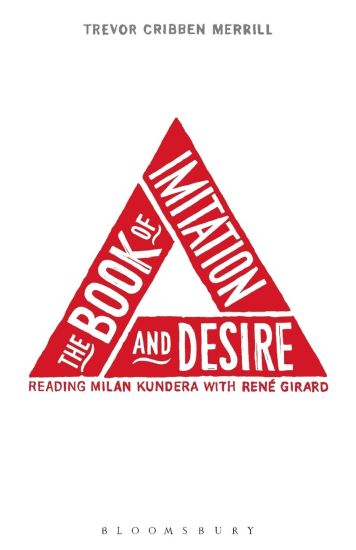
The Book of Imitation and Desire: Reading Milan Kundera with Rene Girard
Trevor Cribben Merrill offers a bold reassessment of Milan Kundera’s place in the contemporary canon. Harold Bloom and others have dismissed the Franco-Czech author as a maker of “period pieces” that lost currency once the Berlin Wall fell. Merrill refutes this view, revealing a previously unexplored dimension of Kundera’s fiction. Building on theorist René Girard’s notion of “triangular desire,” he shows that modern classics such as The Unbearable Lightness of Being and The Book of Laughter and Forgetting display a counterintuitive—and bitterly funny—understanding of human attraction.Most works of fiction (and most movies, too) depict passionate feelings as deeply authentic and spontaneous. Kundera’s novels and short stories overturn this romantic dogma. A pounding heart and sweaty palms could mean that we have found “the One” at last—or they could attest to the influence of a model whose desires we are unconsciously borrowing: our amorous predilections may owe less to personal taste or physical chemistry than they do to imitative desire. At once a comprehensive survey of Kundera’s novels and a witty introduction to Girard’s mimetic theory, The Book of Imitation and Desire challenges our assumptions about human motive and renews our understanding of a major contemporary author.