
Kirjahaku
Etsi kirjoja tekijän nimen, kirjan nimen tai ISBN:n perusteella.
240 tulosta hakusanalla Miltiades Varvounis


Miltiades - Ein Überblick über die komplizierten Zusammenhänge der Heldenbiographie des Marathonsiegers in der Forschung
Martin Meingast
Grin Verlag
2014
pokkari

Between Miltiades and Moltke: Early German Studies in Greek Military History
Roel Konijnendijk
BRILL
2022
nidottu
The authors of the first serious scholarly works on Greek warfare were not free to write their surveys as they wished. In the nineteenth-century German-speaking world, the supreme authority on all military history rested with the Great General Staff, the intellectual nerve centre of the Prussian army. Officers rejected the ability of historians to understand warfare and imposed their pragmatic perspective on any attempt to study past wars. How did classicists and historians respond to this challenge? This book explores how the scope and method of the first handbooks on Greek warfare were shaped by their environment; it questions the ancient wisdom that practical expertise is the best guide to writing military history.
The Lives of Miltiades, Cimon, Pausanias, and Aristides
Cornelius Nepos; John T. (EDT) White; D. D. (EDT) Oxon
Kessinger Pub
2009
pokkari
The Lives Of Miltiades, Cimon, Pausanias, And Aristides (1872)
Cornelius Nepos
KESSINGER PUBLISHING, LLC
2010
sidottu
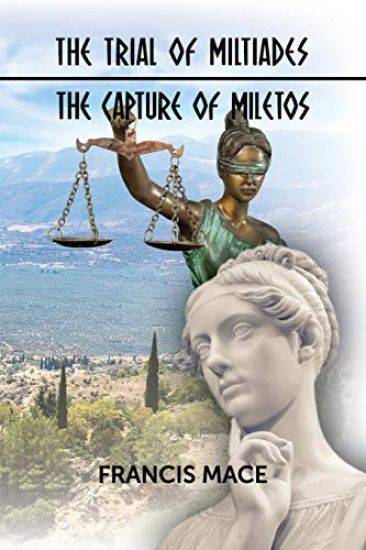
Of Miltiades' trial, it is too early to assess the repercussions. On his return to Athens (Spring 493BCE), he has been prosecuted on a charge of tyranny in the Chersonese, a former Athenian colony. His daughter Elpinike finds herself cast in roles both divine and semi-scandalous. Both she and her father are outsiders, if less so than their enemies imply. The prosecution's case is reasonable and specious. Meanwhile Miltiades seems an unlikely defender of the democratic city and her values. There's a kind of Tom and Viv (or Perikles-Aspasia) scenario, Elpinike having worked with her father on his speech. From a fevered city and international crisis, an olive grove near the Sacred Way provides a haven...at least for the younger daughter Kallidike. The drama 'On the Capture of Miletos', by Phrynichos son of Polyphrasmon, was produced in the same spring. The work provides insight into the psychological development, and genesis of an Athens that will be a paradigm, political and cultural, for future generations, and perhaps indeed (in accordance with the prophecy), 'an eagle in the clouds forever'. The present text represents an attempt to resuscitate this famous but lost (and banned) play.

Die Prozesse gegen Miltiades und deren Erkenntnisgehalt im Bezug auf eisangeliá in Athen vor den Reformen Ephialtes
Martin Meingast
Grin Publishing
2014
pokkari
The Lives of Titus Pomponius Atticus, Miltiades and Cimon
Cornelius Nepos; Richardson (TRN) Pack
Kessinger Pub
2009
pokkari
The Lives Of Titus Pomponius Atticus, Miltiades And Cimon (1735)
Cornelius Nepos
KESSINGER PUBLISHING, LLC
2010
sidottu

Die Schlacht bei Marathon. Welche Rolle spielte Miltiades bei dem Sieg der Griechen über die persische Großmacht?
Caroline Meinhardt
GRIN Verlag
2020
nidottu

There has long been a need for a systematic introduction to the modern pure theory of international trade that would take the student through a careful introduction to the tools of analysis and the main logical propositions into the application of the theory to practical problems of international economic policy. Trade theory should be part and parcel of price theory, distinguished only by the fact that other countries form part of the natural opportunities--and natural constraints--that a country confronts in its efforts to bend nature to its desire to produce utility-yielding goods and services; but its exposition is often confused by the attachment of its expositors to obsolete problems and backward analytical techniques.This book covers in detail classical, neoclassical, and modern theories of international trade, with special attention to problems of equilibrium, growth, and welfare, and discusses the work of all major contributors in this field from Ricardo and Mill through Meade, Heckscher, and Ohlin, to the growth models of Johnson, Solow, and Uzawa. All problems are clearly stated and the easiest and most convenient solutions are sought in each case, with the more technical topics in the field discussed in several chapters and appendixes that may be omitted for less advanced students without interrupting the continuity of the book.The book's coverage is complete and entirely up-to-date. It is written primarily for advanced undergraduate and graduate courses in international trade, but it will also serve as an important reference tool for professional economists working in this field and will be of considerable interest to students and practitioners dealing with problems of economic development and international business relationships more generally.



There has long been a need for a systematic introduction to the modern pure theory of international trade that would take the student through a careful introduction to the tools of analysis and the main logical propositions into the application of the theory to practical problems of international economic policy. Trade theory should be part and parcel of price theory, distinguished only by the fact that other countries form part of the natural opportunities--and natural constraints--that a country confronts in its efforts to bend nature to its desire to produce utility-yielding goods and services; but its exposition is often confused by the attachment of its expositors to obsolete problems and backward analytical techniques.This book covers in detail classical, neoclassical, and modern theories of international trade, with special attention to problems of equilibrium, growth, and welfare, and discusses the work of all major contributors in this field from Ricardo and Mill through Meade, Heckscher, and Ohlin, to the growth models of Johnson, Solow, and Uzawa. All problems are clearly stated and the easiest and most convenient solutions are sought in each case, with the more technical topics in the field discussed in several chapters and appendixes that may be omitted for less advanced students without interrupting the continuity of the book.The book's coverage is complete and entirely up-to-date. It is written primarily for advanced undergraduate and graduate courses in international trade, but it will also serve as an important reference tool for professional economists working in this field and will be of considerable interest to students and practitioners dealing with problems of economic development and international business relationships more generally.
Nearly two centuries have passed since K. O. Müller published the first "scientific" study "on the habitat, the origin and the early history of the Macedonian people". An ever growing number of publications appearing each year has rendered urgent a critical appraisal of this exuberant production, the more so that many aspects of ancient Macedonia remain controversial, if not problematic. Yet after seventy years of large-scale systematic excavations the activity of Greek archaeologists, as well as the labour of scholars from all over the world, have revealed a heretofore terra incognita and given a consistency to the people that Alexander led to the end of the known world. Now more than ever before we can tackle the "main problems" that have been contested without conclusion: Where exactly was Macedonia? Which were its limits? Where did the Macedonians come from? What language did they speak? What cults did they practice? Did they believe in an afterlife? What political and social institutions did they have? What was Alexander's role in his father's death? What were his aims? To what extent can we trust ancient historians? Alexander failed to provide a stable successor to the Achaemenid multiethnic empire, and the sands of Egypt have effaced even the traces of his last abode, yet if he returned to life, he could still boast in the words of Cavafy, a modern Alexandrian in every sense, “a new Hellenic world, a great one, came to be ... with the extended dominions, with the various attempts at judicious adaptations. And the Greek koine language all the way to outer Bactria we carried it, to the peoples of India”.

While many of the heroes of Greek literature of the pre and post-war era are caught up in the guiding national narrative and its myths, Dimitri is a person with more than one home. His story is a story of the Greek diaspora, one of curiosity, awakening, humorous observation, and the broadening of horizons. The second volume in Miltiades Hatzopoulos' trilogy has Dimitri arriving in Paris in 1956, a stranger in a foreign land, bewildered and bemused, but soon swept up in the reality of a country he has so far learned about only through his reading of French medieval literature. A sophisticated French family welcome him into their confusingly shabby upper-class home, where he lodges together with a colourful cast of characters on the sixth floor. Now permanently exiled from Cyprus, Dimitri is committed to his adoptive country. Grateful for the opportunities that the French Republic has so generously bestowed upon him, he becomes a French citizen and volunteers for military service just as the political unrest of the 60s hits the streets of Paris. In counterpoint to his own inner turmoil, the French colonial war in Algeria, the Arab-Israeli War and the military coup in Greece all take place while he is in France, and meanwhile the tragedy of Cyprus continues to unfold. Dimitri's humorous observation of life in the army is one of the many glories of this book, along with the fine descriptions of character, Paris and the provinces, the niceties of French society, the complexity of personal relations, and a vivid introduction to the politics of the time from a first-hand perspective. Historically enlightening and vivid, the book takes us along Dimitri's own personal journey, which is defined and dictated by the events going on around him, as he grapples with a world that sweeps him along, amused, confused and enchanted.