Kirjahaku
Etsi kirjoja tekijän nimen, kirjan nimen tai ISBN:n perusteella.
1000 tulosta hakusanalla Mithra Venkatraj



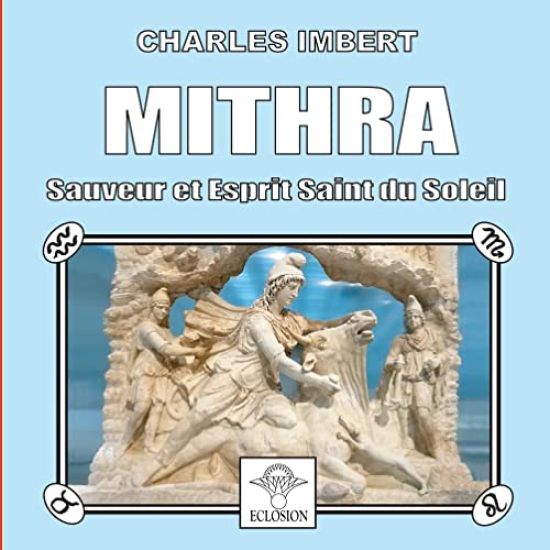
Mithra
Eclosion
2021
nidottu

mithra
Greenbooks
2024
pokkari
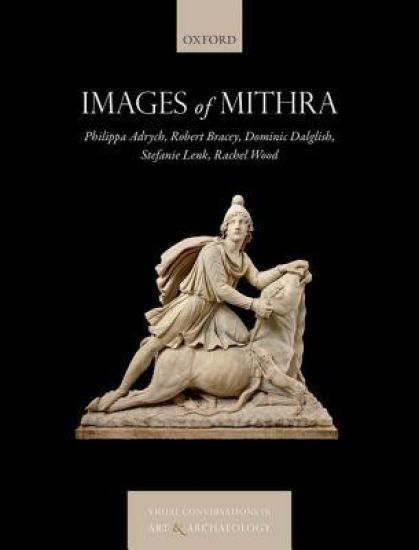
Images of Mithra
Philippa Adrych; Robert Bracey; Dominic Dalglish; Stefanie Lenk; Rachel Wood
Oxford University Press
2017
sidottu
With a history of use extending back to Vedic texts of the second millennium BC, derivations of the name Mithra appear in the Roman Empire, across Sasanian Persia, and in the Kushan Empire of southern Afghanistan and northern India during the first millennium AD. Even today, this name has a place in Yazidi and Zoroastrian religion. But what connection have Mihr in Persia, Miiro in Kushan Bactria, and Mithras in the Roman Empire to one another? Over the course of the volume, specialists in the material culture of these diverse regions explore appearances of the name Mithra from six distinct locations in antiquity. In a subversion of the usual historical process, the authors begin not from an assessment of texts, but by placing images of Mithra at the heart of their analysis. Careful consideration of each example's own context, situating it in the broader scheme of religious traditions and on-going cultural interactions, is key to this discussion. Such an approach opens up a host of potential comparisons and interpretations that are often side-lined in historical accounts. What Images of Mithra offers is a fresh approach to the ways in which gods were labelled and depicted in the ancient world. Through an emphasis on material culture, a more nuanced understanding of the processes of religious formation is proposed in what is but the first part of the Visual Conversations series.
The Avestan Hymn to Mithra
Cambridge University Press
2007
pokkari
The Avestan Hymn to Mithra, written in the fifth century BC, is the one extensive, ancient literary record of the attributes, companions and cult of the Iranian god whose worship spread, five or six centuries later, as far as Britain. Dr Gershevitch here reproduces Geldner's text and critical apparatus of the Hymn, adding his own introduction, translation and commentary. The introduction offers an orientation on the main problems concerning Mithra: how the god came to be included in the Zoroastrian religious system, his relation to Zarathustra's god Ahura Mazdah, his functions, his development from the stage at which the Indian Mitra is found in the Rig Veda, and the extent to which the Western Mithras has preserved the characteristics of the Avestan Mithra. The text is faced by the English translation, and is followed by Dr Gershevitch's exhaustive commentary.

This work has been selected by scholars as being culturally important and is part of the knowledge base of civilization as we know it.This work is in the public domain in the United States of America, and possibly other nations. Within the United States, you may freely copy and distribute this work, as no entity (individual or corporate) has a copyright on the body of the work.Scholars believe, and we concur, that this work is important enough to be preserved, reproduced, and made generally available to the public. To ensure a quality reading experience, this work has been proofread and republished using a format that seamlessly blends the original graphical elements with text in an easy-to-read typeface.We appreciate your support of the preservation process, and thank you for being an important part of keeping this knowledge alive and relevant.
This work has been selected by scholars as being culturally important and is part of the knowledge base of civilization as we know it.This work is in the public domain in the United States of America, and possibly other nations. Within the United States, you may freely copy and distribute this work, as no entity (individual or corporate) has a copyright on the body of the work.Scholars believe, and we concur, that this work is important enough to be preserved, reproduced, and made generally available to the public. To ensure a quality reading experience, this work has been proofread and republished using a format that seamlessly blends the original graphical elements with text in an easy-to-read typeface.We appreciate your support of the preservation process, and thank you for being an important part of keeping this knowledge alive and relevant.
First published in 1956, this seminal study, by the great Belgian scholar Franz Cumont, remains the definitive coverage of a great ideological struggle between the West and the Orient in the first centuries of the Christian era. Mithraism, a mystery religion originating in Persia, spread rapidly through the Roman Empire, and achieved such strength that Europe almost became Mithraic. Dr. Cumont, the world’s’ greatest authority on aspects of classical religions, here discusses the origins of this colourful oriental religion, and its association with the Roman army. Then utilizing fragmentary monuments and texts, in one of the greatest feats of scholarly detection, he reconstructs the mystery teachings and secret doctrines, the hidden organization and cult of Mithra. This volume includes 70 illustrations.
First published in 1956, this seminal study, by the great Belgian scholar Franz Cumont, remains the definitive coverage of a great ideological struggle between the West and the Orient in the first centuries of the Christian era. Mithraism, a mystery religion originating in Persia, spread rapidly through the Roman Empire, and achieved such strength that Europe almost became Mithraic. Dr. Cumont, the world’s’ greatest authority on aspects of classical religions, here discusses the origins of this colourful oriental religion, and its association with the Roman army. Then utilizing fragmentary monuments and texts, in one of the greatest feats of scholarly detection, he reconstructs the mystery teachings and secret doctrines, the hidden organization and cult of Mithra. This volume includes 70 illustrations.
Franz-Val ry-Marie Cumont (Aalst, Belgium, 3 January 1868 - Brussels, 25 August 1947) was a Belgian archaeologist and historian, a philologist and student of epigraphy, who brought these often isolated specialties to bear on the syncretic mystery religions of Late Antiquity, notably Mithraism. Cumont was a graduate of the University of Ghent (PhD, 1887). After receiving royal travelling fellowships, he undertook archaeology in Pontus and Armenia (published in 1906) and in Syria, but he is best known for his studies on the impact of Eastern mystery religions, particularly Mithraism, on the Roman Empire. Cumont's international credentials were brilliant, but his public circumspection was not enough. In 1910, Baron Edouard Descamps, the Catholic Minister of Sciences and Arts at the University of Ghent, refused to approve the faculty's unanimous recommendation of Cumont for the chair in Roman History, Cumont having been a professor there since 1906. There was a vigorous press campaign and student agitation in Cumont's favor, because the refusal was seen as blatant religious interference in the University's life. When another candidate was named, in 1912, Cumont resigned his positions at the University and at the Royal Museum in Brussels, left Belgium and henceforth divided his time between Paris and Rome. He contributed to many standard encyclopedias, published voluminously and in 1922, under stressful political conditions, conducted digs on the shore of the Euphrates at the previously unknown site of Dura-Europos; he published his research there in 1926. He was a member of most of the European academies. In 1936 Franz Cumont was awarded the Francqui Prize on Human Sciences. In 1947, Franz Cumont donated his library and papers to the Academia Belgica in Rome, where they are accessible to researchers. His works include * Texts and Illustrated Monuments Relating to the Mysteries of Mithra (1894-1900, with an English translation in 1903) is the study that made his international reputation, by its originality and massive documentation. * Les religions orientales dans le paganisme romain (1906, widely translated) * After-Life in Roman Paganism, lectures delivered at Yale University, published in 1922, was cautiously expressed, but it corrected many false impressions of pagan rite that Christian apologists had made. * Astrology and Religion Among the Greeks and Romans After his death, critics of his interpretation of Mithras as the descendant of the Iranian deity Mithra began to be heard, and surfaced at the First International Congress of Mithraic Studies in Manchester England, 1971. Modern interpretation of Mithras as the astronomical bull-slayer have continued to move away from Cumont's interpretations, though his documentation remains valuable. In 1997 the Royal Library, Brussels, observed the fiftieth anniversary of Cumont's death appropriately, with a colloquium on syncretism in the Mediterranean world of Antiquity.