Kirjojen hintavertailu. Mukana 12 390 323 kirjaa ja 12 kauppaa.

Kirjahaku

Etsi kirjoja tekijän nimen, kirjan nimen tai ISBN:n perusteella.

1000 tulosta hakusanalla Mohamed F. El-Amin

Numerical Modeling of Nanoparticle Transport in Porous Media

Numerical Modeling of Nanoparticle Transport in Porous Media

Mohamed F. El-Amin

Elsevier - Health Sciences Division
2023
nidottu
Numerical Modeling of Nanoparticle Transport in Porous Media: MATLAB/PYTHON Approach focuses on modeling and numerical aspects of nanoparticle transport within single- and two-phase flow in porous media. The book discusses modeling development, dimensional analysis, numerical solutions and convergence analysis. Actual types of porous media have been considered, including heterogeneous, fractured, and anisotropic. Moreover, different interactions with nanoparticles are studied, such as magnetic nanoparticles, ferrofluids and polymers. Finally, several machine learning techniques are implemented to predict nanoparticle transport in porous media. This book provides a complete full reference in mathematical modeling and numerical aspects of nanoparticle transport in porous media. It is an important reference source for engineers, mathematicians, and materials scientists who are looking to increase their understanding of modeling, simulation, and analysis at the nanoscale.
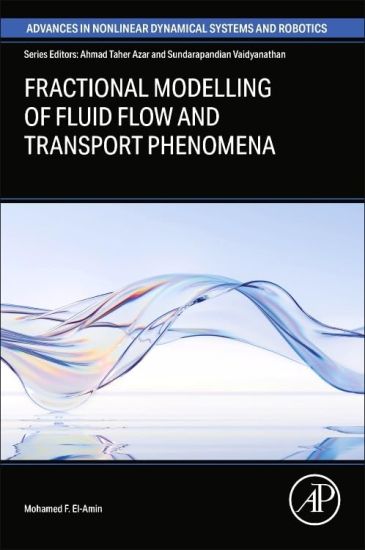
Fractional Modeling of Fluid Flow and Transport  Phenomena

Fractional Modeling of Fluid Flow and Transport Phenomena

Mohamed F. El-Amin

ELSEVIER SCIENCE PUBLISHING CO INC
2025
nidottu
Fractional Modeling of Fluid Flow and Transport Phenomena focuses on mathematical and numerical aspects of fractional-order modeling in fluid flow and transport phenomena. The book covers fundamental concepts, advancements, and practical applications, including modeling developments, numerical solutions, and convergence analysis for both time and space fractional order models. Various types of flows are explored, such as single- and multi-phase flows in porous media, involving different fluid types like Newtonian, non-Newtonian, nanofluids, and ferrofluids. This book serves as a comprehensive reference on fractional-order modeling of fluid flow and transport phenomena, offering a single resource that is currently unavailable. Fractional-order modeling has gained traction in engineering and science, particularly in fluid dynamics and transport phenomena. However, its mathematical and numerical advancements have progressed relatively slowly compared to other aspects. Therefore, this book emphasizes the fractional-order modeling of fluid flow and transport phenomena to bridge this gap. Each chapter in the book delves into a specific topic closely related to the others, ensuring a cohesive and self-contained structure.
Introduction to The Quantum Theory of Matter and Radiation: Ethereal Universe

Introduction to The Quantum Theory of Matter and Radiation: Ethereal Universe

Mohamed F. El-Hewie

Createspace Independent Publishing Platform
2011
nidottu
This revised edition narrates the brief history of the people, the events, and the ideas that advanced mankind into the electrical, nuclear, and space ages. The book describes the basic concepts of Quantum Mechanics and the efforts made to decipher the secrets of the structure of atoms, molecules, crystals and elementary nuclear particles. The author emphasizes the inherent limitations of classical mechanics that led to paradoxical outcome of the special theory of relativity, which in turn infected Dirac's attempts to rehabilitate the Schrodinger's Quantum Wave Equations. During the hundred and ten odd years of its existence, Quantum Mechanics has passed through three distinct stages of development. The first stage began by Planck's quanta and ended de Broglie's matter waves. It could be properly described as the stage of structuring the electronic shells of the atom. The second stage in the development of Quantum Mechanics began with de Broglie's discovery of matter waves, in 1924 and ended with the end of WWII. It could be properly described as the stage of deciphering the nuclear forces of the atomic core. The theory of the nucleus of the atom was created and new elementary particles were discovered that revealed some of the secrets of the nuclear forces. The third period began after World War II with the invention of nuclear reactors, radiospectrometers, and high altitude flights. This stage could be properly described as the phase of high energy exploration of the nuclear elementary particles. During this stage, Quantum Mechanics come up against ever greater difficulties, setbacks and failures. The newly discovered behaviors of elementary particles and their interactions shook the foundation of the old laws upon which Quantum Mechanics was erected. CHAPTER 1: THE ROAD TO THE ATOM: 1792-1900 The Creation from Nothing The Road to Conservation Newton Laws of Conservation Beginning of the Steam Age The French Revolution Birth of Electricity Nobel's Incentive Landmarks of the Nineteenth Century Ethereal Space Light Spectrum of Elements Discovery of the Electron Thomson Model of the Atom Lorentz Transformation Discovery of X-rays Discovery of Radioactivity Classical Senses and Cannons Birth of Quantum Mechanics Thermal Radiation Black Body Radiation Boltzmann-Wien Laws Rayleigh-Jeans Law CHAPTER 2: THE BIRTH OF THE QUANTA Thermal Radiation at High Frequencies The Quanta Photons and Corpuscles Discovery of Photons Dual Nature of Light Rutherford Atom Model Bohr Atom Model Privileged Atomic Quantum Orbits Emission and Absorption of Radiation Brightness and Spin of Emitted Radiation de Broglie Matter Waves Dual Properties of Electrons Electron Diffraction Quantum Wave Theory Probability Wave Function Uncertainty Relation Tunnel Effect Schr dinger Equation Harmonic Oscillator Pauli's Exclusion Principle The Spin Electronic Architecture of the Atom Periodic Table of Elements Atomic Spectrum CHAPTER 3: MOLECULES AND SOLIDS Molecules Ionic molecule Covalent molecules. Quantum Mechanics of Solids Compound crystals Metallic crystals Stark Effect Molecular Levels of Energy Insulators Conduction in Metal Superconductivity Semiconductors CHAPTER 4: THE INTERIOR OF THE NUCLEUS Radioactivity The Nucleus of the Atom The Neutron Nuclear Forces Discovery of the Meson Nuclear Stability and Abundance Alpha Particle Decay Nuclear Energy Levels Gamma Ray Decay Nuclear Fission Beta Particles Decay The Discovery of the Neutrino Electron Capture CHAPTER 5: ELEMENTARY NUCLEAR PARTICLES Relativistic Quantum Mechanics Dirac's Quantum Wave Equations Discovery of Anti-matter Action at a Distance Field and Matter Decay of Subatomic Particles Deduction of Coulomb's Law Classification of Elementary Particles Decay of Elementary Particles CHAPTER 6: CRITIQUE ON QUANTUM MECHANICS Critique on the Special Theory of Relativity Critique on the Theory of Matter Waves CHAPTER 7: CONTRIBUTION BY NATIONS OF SCIENTISTS CHAPTER 8: MAIN FACTS
Atomic Physics: Personal Study Notes: Atomic, Molecular, And Nuclear Physics

Atomic Physics: Personal Study Notes: Atomic, Molecular, And Nuclear Physics

Mohamed F. El-Hewie

Createspace Independent Publishing Platform
2012
nidottu
This volume encompasses eight chapters from my personal study notes which cover all courses and notes in my study of Nuclear Engineering, from high school throughout my post-doctorate associateship. Great emphasis is added on the two theories of relativity where the author posed many critical questions regarding the optical definition of relative simultaneity which Einstein used to equate matter with energy through the relation E = mc . TABLE OF CONTENTS CHAPTER 1: ELECTRIC DISCHARGE THROUGH GASES 1.1. Electric Discharge under normal gas pressure Ionization Ionization by collision Disruptive discharge Sparking potential and pressure of gas Sparking potential and distance between electrodes Paschen's law Nature of discharge: Brush, spark and corona discharges Mobility of ions Mobility and Nature of the ions Mobility and Ionic Mass Mobility and Gas Pressure Mobility and Temperature Decay of the ions-Recombination 1.2. Electric Discharge under Low Gas Pressure Behavior of emission of radiation in discharge tube Discoveries of the cathode tube Cathode rays Positive rays X-rays Geissler tube Sodium vapor lamp Mercury vapor lamp Fluorescent lamps CHAPTER 2: THE ELECTRON . CHARGE TO MASS RATIO (e/m) Thomson's Method CHARGE OF THE ELECTRON Methods using the Cloud Chamber Wilson Cloud Chamber Thomson's cloud chamber experiment H.A. Wilson's experiment Millikan's oil drop method MASS OF THE ELECTRON RADIUS OF THE ELECTRON CHAPTER 3: THE ELECTRON THEORY ELECTRICAL CONDUCTION IN METALS THERMAL CONDUCTIVITY THERMOELECTRIC EFFECTS Seebeck effect Peltier effect Thomson effect MAGNETIC PROPERTIES OF MATERIALS Methods of measuring magnetic susceptibility Faraday method Curie magnetic balance Gouy method Rowland method Diamagnetism Paramagnetism Ferromagnetisms Variation of magnetization with field Magnetic properties of alloys Heusler alloys Magneto-striction Magneto-thermal effects THEORETICAL INVESTIGATIONS Langevin's theory of diamagnetism Langevin's theory of paramagnetism Weiss molecular field theory of paramagnetism Weiss theory of ferromagnetism ZEEMAN EFFECT CRITICISM OF THE ELECTRON THEORY MAJOR APPLICATIONS OF ELECTRON EMISSION THERMIONIC EMISSION The Schottky effect Cold emission The shot effect 3.8.2. PHOTOELECTRIC EMISSION 3.8.3. PRACTICAL APPLIANCES OF ELECTRON BEAMS 3.8.3. I. THERMIONIC VALVES CHAPTER 4: POSITIVE RAYS POSITIVE RAYS THOMSON'S PARABOLA METHOD OF POSITIVE RAY ANALYSIS ASTON'S MASS SPECTROGRAPH DEMPSTER'S MASS SPECTROGPAPH BAINBRIDGE'S MASS SPECTROGRAPH NIER'S MASS SPECTROGRAPH BAINBRIDGE AND JORDAN DOUBLE-FOCUSING MASS SPECTROGRAPH THE ISOTOPIC CONSTITUTION OF ELEMENTS CHAPTER 5: X-Rays X-Rays PRODUCTION AND DETECTION OF X-RAYS The betatron The ionizing power of X-rays WAVE NATURE OF X-RAYS EXPERIMENT OF LAUE, FRIEDRICH AND KNIPPING EXPERIMENTAL METHODS OF MEASURING FOR X-RAYS CRYSTAL X-RAY SPECTROMETER RULED GRATING X-RAY SPECTROGRAPH ELECTROMAGNETIC THEORY OF X-RAYS THE STRUCTURE OF CRYSTALS CHAPTER 6: RADIOACTIVITY RADIOACTIVITY DISCOVERY OF RADIOACTIVITY INITIAL RESEARCHES ON RADIOACTIVITY FUNDAMENTAL LAWS OF RADIOACTIVITY MEASUREMENT OF THE CONSTANTS OF RADIOACTIVE DISINTEGRATION RADIOACTIVE TIME SCALES ALPHA RAYS BETA-RAYS BECQUEREL'S EXPERIMENT KAUFMANN'S EXPERIMENT BUCHERER'S EXPERIMENT EXPERIMENT OF GUYE AND LAVANCHY GAMMA-RAYS WAVELENGTHS OF THE GAMMA-RAYS USES OF RADIOACTIVITY CHAPTER 7: THE THEORY OF RELATIVITY THE THEORY OF RELATIVITY ORIGIN OF THE THEORY OF RELATIVITY MICHELSON-MORLEY EXPERIMENT TROUTON-NOBLE EXPERIMENT EINSTEIN'S THEORY OF RELATIVITY SPECIAL THEORY OF RELATIVITY IMPORTANT CONCLUSIONS OF THE SPECIAL THEORY OF RELATIVITY GENERAL THEORY OF RELATIVITY CHAPTER 8: THE QUANTUM THEORY OF RADIATION THE QUANTUM THEORY OF RADIATION The classical electromagnetic wave theory QUANTUM THEORY OF RADIATION QUANTA OR PHOTONS The photoelectric effect MILLIKAN'S EXPERIMENT EXPERIMENT OF MAURICE DE BROGLIE The Compton effect CRITICISM OF THE QUANTUM THEORY OF RADIA
Molecular Physics: Personal Study Notes: Atomic, Molecular, And Nuclear Physics

Molecular Physics: Personal Study Notes: Atomic, Molecular, And Nuclear Physics

Mohamed F. El-Hewie

Createspace Independent Publishing Platform
2011
nidottu
This volume encompasses five chapters from my personal study notes which covers all courses and notes in my study of Nuclear Engineering, from high school throughout my post-doctorate associateship. CHAPTER 9: The Wave Nature of Matter The Wave Nature of Matter DE BROGLIE'S CONCEPT OF MATTER WAVES EXPERIMENTAL STUDY OF MATTER WAVES EXPERIMENTS OF DAVISSON AND GERMER EXPERIMENTS OF G. P. THOMSON THEORETICAL STUDY OF MATTER WAVES QUANTUM MECHANICS Matrices Algebra 1. THE CORPUSCULAR CONCEPT OF MATTER 2. THE TRANSFORMATION THEORY WAVE MECHANICS PHYSICAL SIGNIFICANCE OF the wave function PRINCIPLE OF INDETERMINACY CRITICISM OF THE THEORY OF MATTER WAVES CHAPTER 10: Quantum Statistics Principles of statistical mechanics Calculus of probabilities and its laws CLASSICAL STATISTICS APPLICATIONS OF THE QUANTUM STATISTICS A. Bose-Einstein statistics 1. Black body radiation 2. Gas degeneration B. Fermi-Dirac statistics 1. Electron theory of metals 2. Thermal and electrical conductivities 3. Thermoelectricity 4. Thermionic effect 5. Photoelectric effect 6. Contact potential difference (Volta effect) 7. Paramagnetism of the alkali metals CRITICISM OF THE QUANTUM STATISTICS CHAPTER 11: The Atom SPECIAL UNITS USED IN ATOMIC PHYSICS The Electronic Structure of the Atom The Atom Models THOMSON ATOM MODEL RUTHERFORD NUCLEAR ATOM MODEL EXPERIMENTS ON THE SCATTERING OF ALPHA PARTICLES BOHR ATOM MODEL ELECTRONIC STRUCTURE ORIGIN OF SPECTRAL LINES Bohr's theory of the origin of spectral lines 1. Spectrum of the singly ionized helium 2. Determination of the ratio of the mass of the electron to that of the proton: m/MH 3. The discovery deuterium or heavy hydrogen of mass number two APPLICATIONS OF BOHR'S THEORY EXCITATION AND IONIZATION OF ATOMS Methods of excitation of atoms EXPERIMENT OF DAVIS AND GOUCHER X-RAY SPECTRA SOME PECULIARITIES OF THE CHARACTERISTIC X-RAY SPECTRA X-RAY ABSORPTION SPECTRA THE SOMMERFELD RELATIVISTIC ATOM MODEL VECTOR ATOM MODEL QUANTUM NUMBERS ASSOCIATED WITH THE VECTOR MODEL OF THE ATOM MAGNETIC MOMENT DUE TO ORBITAL MOTION BOHR MAGNETON MAGNETIC MOMENT DUE TO ELECTRON SPIN ELECTRONIC STRUCTURE IN ATOMS ELECTRON CONFIGURATIONS WITH THEIR MODERN SYMBOLIC REPRESENTATIONS Semiconductors and transistors FINE STRUCTURE OF SPECTRAL LINES OPTICAL SPECTRA Fine structure FINE STRUCTURE OF THE SODIUM D-LINE FINE STRUCTURE OF THE H-alpha LINE X-RAY SPECTRA ZEEMAN EFFECT DEBYE'S EXPLANATION OF THE NORMAL ZEEMAN EFFECT EXPLANATION OF THE ANOMALOUS ZEEMAN EFFECT PASCHEN-BACK EFFECT STARK EFFECT THE STARK PATTERN OF THE H-a LINE FORBIDDEN LINES IN ATOMIC SPECTRA Forbidden lines in nebular and auroral spectra EXPERIMENTAL CONFIRMATION OF THE VECTOR MODEL STERN AND GERLACH EXPERIMENT GYROMAGNETIC EFFECT THE WAVE MECHANICAL ATOM MODEL SOLUTION OF SCHR DINGER'S EQUATION FOR THE ONE-ELECTRON ATOM SOME APPLICATIONS OF THE WAVE MECHANICAL THEORY 1. HYDROGEN AND HELIUM ATOMS 2. MAGNETIC PROPERTIES OF MATERIALS CHAPTER 12: Molecular Spectra Van der Waals type of binding Molecular Spectra Van der Waals type of binding Metallic binding Electric moments of molecules Size and shape of molecules Dissociation of molecules: heat of dissociation Franck-Condon principle MOLECULAR SPECTRA Theory of the rotation-vibration spectra Theory of the electronic band spectra PECULIARITIES OF CERTAIN BAND SPECTRA ISOTOPIC EFFECT IN MOLECULAR SPECTRA RAMAN EFFECT APPLICATIONS OF THE RAMAN EFFECT IN PHYSICS APPLICATIONS OF THE RAMAN EFFECT IN CHEMISTRY SOLID STATE SPECTROSCOPY Chapter 13: Modern Problems of Radioactivity Modern Problems of Radioactivity The Nucleus of the Atom RADIATIONS FROM NATURAL RADIOELEMENTS Alpha disintegration Beta disintegration Gamma-ray emission SPECTRA OF THE RADIATIONS FROM NATURAL RADIOELEMENTS GAMMA RAY SPECTRA Nuclear energy levels ALPHA RAY SPECTRA BETA RAY SPECTRA The cloud chamber method Theoretical interpretation of the beta-ray continuum