
Kirjahaku
Etsi kirjoja tekijän nimen, kirjan nimen tai ISBN:n perusteella.
1000 tulosta hakusanalla Mohamed Moctar Abdourahamane
Suivi de communautés ego-centrées dans les réseaux sociaux dynamiques
Ahmed Ould Mohamed Moctar; Idrissa Sarr
ÉDITIONS UNIVERSITAIRES EUROPÉENNES
2019
nidottu
Les contrats préparatoires à la cession d'entreprise
Mohamed El Moctar Touré
ÉDITIONS UNIVERSITAIRES EUROPÉENNES
2016
nidottu
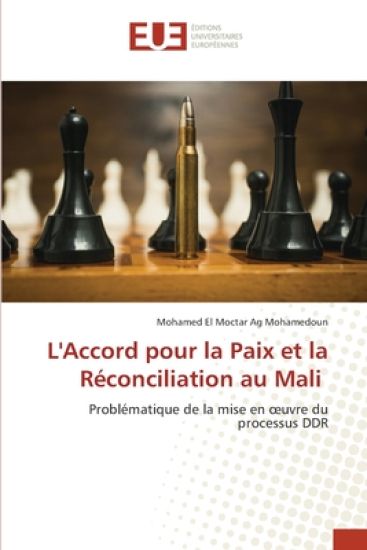
L'Accord pour la Paix et la Réconciliation au Mali
Mohamed El Moctar Ag Mohamedoun
Editions Universitaires Europeennes
2021
pokkari

Das Abkommen für Frieden und Versöhnung in Mali
Mohamed El Moctar Ag Mohamedoun
Verlag Unser Wissen
2021
nidottu
The Agreement for Peace and Reconciliation in Mali
Mohamed El Moctar Ag Mohamedoun
Our Knowledge Publishing
2021
nidottu

El Acuerdo de Paz y Reconciliación en Malí
Mohamed El Moctar Ag Mohamedoun
Ediciones Nuestro Conocimiento
2021
nidottu
L'accordo di pace e riconciliazione in Mali
Mohamed El Moctar Ag Mohamedoun
Edizioni Sapienza
2021
nidottu
O Acordo para a Paz e Reconciliação no Mali
Mohamed El Moctar Ag Mohamedoun
Edições Nosso Conhecimento
2021
nidottu
Soglashenie o mire i primirenii w Mali
Mohamed El Moctar Ag Mohamedoun
Sciencia Scripts
2021
nidottu
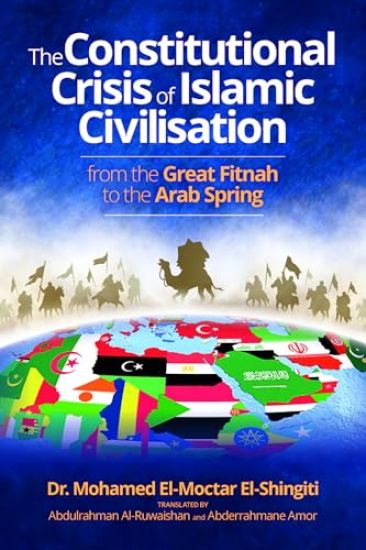
The Constitutional Crisis of Islamic Civilisation
Mohamed El-Moctar El-Shinqiti
Kube Publishing Ltd
2026
sidottu
At the heart of Islamic civilization is an unresolved crisis which dates from the battle of Siffin in 38 AH. Dr. Mohamed El-Moctar El-Shinqiti examines this issue in The Constitutional Crisis of Islamic Civilization. Dr. Shinqiti bases his work in Islamic scripture in order to uncover what was sometimes obscured by Islamic scholarship in the shadow of monarchic, non-consultative rule, arguing that Muslim scholars often had to deal with a reality in which they sacrificed some ideals to preserve the ummah’s unity, and that such a bargain led to many adverse consequences which we witness today. Dr Shinqiti aims to show that Islam does not exhibit any deficiency in political principles, but instead provides a complete, just, and humane system of politics—and that there were historical and cultural factors that caused the divergence between principle and reality which, being understood, might be reversed. The work is ultimately, as Sheikh Rachid Ghannouchi mentions in his foreword, a book of rare combination, scope, and insight—one deeply rooted in Islamic and Arab history and tradition while also connected to other major traditions from around the world and cognizant of the present challenges that face the Muslim Ummah.

Le premier objectif de mon travail est de g n raliser le th or me de Paley-Wiener classique et le th or me d' chantillonnage de Whittaker-Shannon-Kotelnokov au cas de la q-transformation de Fourier Rubin. Mon attention s'est port e essentiellement sur la q-transformation Fourier Rubin, ce qui m'a amen d montrer deux types de th or mes de Paley-Wiener: le premier est le th or me de Paley Wiener pour l'espace L2. Le second th or me est pour les fonctions dans le q-espace de Schwartz. Dans la deuxi me partie, j'ai introduit et tudi la q-transformation de Mellin modifi e laquelle j'ai donn une formule de Plancherel. En utilisant la formule de Plancherel et le th or me d'interpolation de Reitz-Thorine, j'ai d montr une in galit de type Hausdorff-Yong. Dans le m me cadre, j'ai d montr le th or me de Paley-Wiener pour la q-transformation de Mellin modifi e. Dans la troisi me partie je introduits les espaces de Sobolev associ s l'op rateur б, et j'ai d montr certaines propri t s (analogues des in galit s de Sobolev et des quivalences de Normes).

Théorème de Paley-Wiener Réels pour certaines transformations
Mohamed Moktar Chaffar
Editions Universitaires Europeennes
2018
pokkari
Le premier objectif de mon travail est de g n raliser le th or me de Paley-Wiener classique et le th or me d' chantillonnage de Whittaker-Shannon-Kotelnokov au cas de la q-transformation de Fourier Rubin. Mon attention s'est port e essentiellement sur la q-transformation Fourier Rubin, ce qui m'a amen d montrer deux types de th or mes de Paley-Wiener: le premier est le th or me de Paley Wiener pour l'espace L2. Le second th or me est pour les fonctions dans le q-espace de Schwartz. Dans la deuxi me partie, j'ai introduit et tudi la q-transformation de Mellin modifi e laquelle j'ai donn une formule de Plancherel. En utilisant la formule de Plancherel et le th or me d'interpolation de Reitz-Thorine, j'ai d montr une in galit de type Hausdorff-Yong. Dans le m me cadre, j'ai d montr le th or me de Paley-Wiener pour la q-transformation de Mellin modifi e.Dans la troisi me partie je introduits les espaces de Sobolev associ s l'op rateur (б), et j'ai d montr certaines propri t s (analogues des in galit s de Sobolev et des quivalences de Normes).

Rol' fMRT w razlichenii unipolqrnoj i bipolqrnoj depressii
Mohamed Mohtar Jejd; Sami Sajed; Mustafa Otman
Sciencia Scripts
2022
nidottu

DEVELOPMENT OF A MORTAR BASED ON COAL MACHEFERS POWDER
Redouane Mghaiouini; Mohamed Monkade; Abdeslam El Bouari
Our Knowledge Publishing
2022
nidottu
Effect of high temperatures on some properties of geopolymer mortar
Mohammed Shaker; Nada Mahdi Fawzi
Lap Lambert Academic Publishing
2022
nidottu
Improving Concrete and Mortar using Modified Ash and Slag Cements
Leonid Dvorkin; Vadim Zhitkovsky; Mohammed Sonebi; Vitaliy Marchuk; Yurii Stepasiuk
CRC Press
2020
sidottu
The use of concrete and mortar containing coal fly ash, blast furnace slag, and other dispersed technogenic materials is one of the major areas of potential resource savings and improving the environmental efficiency and sustainability of construction. Improving Concrete and Mortar using Modified Ash and Slag Cements presents the results of a study of high-tech concrete on composite Portland cement and slag Portland cement. It explains the possibility of significantly improving the properties of cements and concrete with the introduction of superplasticizers and hardening activators.Features: Describes how additives can reduce costs and lead to more environmentally sustainable production Explains the possibility of obtaining high-tech concrete with a high content of ash, slag, and clinker kiln dust Presents the possibility of significant reductions of the most energy-intensive component of cements Examines the calculated dependences for predicting the technical properties of concrete saturated with dispersed technogenic products Explains the methods of calculating the composition of concrete with specified properties of low-clinker cements Suitable for civil and structural engineers as well as for specialists working in the field of concrete technology, students of civil engineering, and researchers of new construction technologies, this book allows readers to understand new and sustainable ways to improve the properties of concrete and mortar by utilizing additives.

This book provides a significant history of Italy's brutal occupation of Libya. Using the lens of the life of the iconic resistance fighter Mohamed Fekini, it tells the story of Libya under Ottoman and Italian rule from the point of view of the colonized.
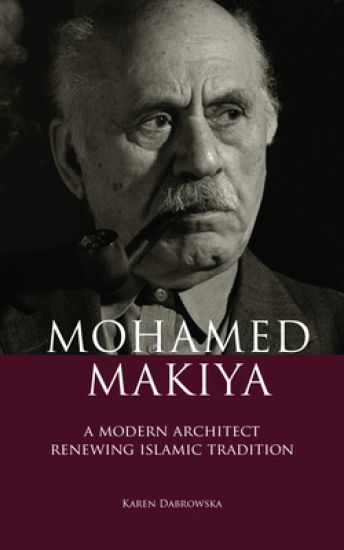
'Makiya was Baghdad and Baghdad was Makiya.' These words sum up the life of one of the Middle East's most famous architects. Mohamed Makiya's career spanned seven decades and included projects in more than ten countries. He was a master of incorporating traditional and classical styles into modern architecture. For Makiya, the continuity of tradition as a 'living dimension' was the justification for his work. Makiya was revered as a teacher of architecture in Iraq, where he set up the first Department of Architecture at Baghdad University in 1959. Makiya was also a promoter of Iraqi art, which he displayed at his Kufa Gallery in London that was set up to build a bridge between the East and the West. This compelling biography reveals the life of a visionary who achieved remarkable feats in Iraq and whose philosophy and humanity crossed all borders and cultures.