

Kirjahaku
Etsi kirjoja tekijän nimen, kirjan nimen tai ISBN:n perusteella.
1000 tulosta hakusanalla Nancy C Lee


Nancy C. Lee surveys what we can know of the history of lament in ancient Israel and its environment as well as the eclipse of the lament form in early Christianity. Lyrics of Lament also explores the surprising employment of lament forms in the contemporary world; In situations of distress, injustice, and despair, and commands specific practices for recovering lamentation as a resource for faith today.


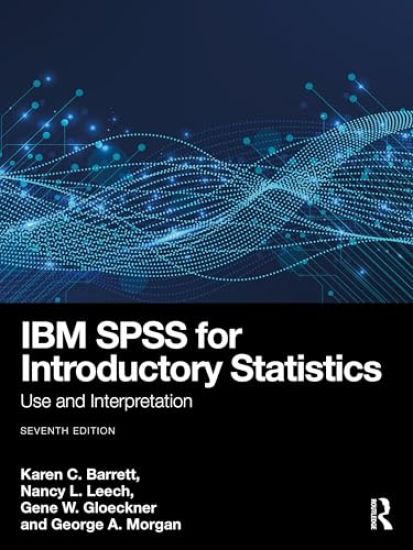
IBM SPSS for Introductory Statistics
Karen C. Barrett; Nancy L. Leech; Gene W. Gloeckner; George A. Morgan
TAYLOR FRANCIS LTD
2025
nidottu
IBM SPSS for Introductory Statistics is designed to help students learn how to analyze and interpret research. In easy-to-understand language, the authors show readers how to choose the appropriate statistic based on the design, and to interpret outputs appropriately. There is such a wide variety of options and statistics in SPSS that knowing which ones to use and how to interpret the outputs can be difficult. This book assists students with these challenges.Comprehensive and user-friendly, this book prepares readers for each step in the research process: design, entering and checking data, testing assumptions, assessing reliability and validity, computing descriptive and inferential parametric and nonparametric statistics, and writing about results. Dialog windows and SPSS syntax, along with the output, are provided. Several realistic data sets are used to solve the chapter problems and are available as an online resource.This edition includes:• Updated chapters and screenshots• Additional SPSS work problems• Callout boxes for each chapter, indicating crucial elements of APA style and referencing outputs.IBM SPSS for Introductory Statistics is an invaluable supplemental (or lab text) book for students. In addition, this book and its companion, IBM SPSS for Intermediate Statistics, are useful as guides/reminders to faculty and professionals regarding the specific steps to take to use SPSS and/or how to use and interpret parts of SPSS with which they are unfamiliar.
IBM SPSS for Introductory Statistics
Karen C. Barrett; Nancy L. Leech; Gene W. Gloeckner; George A. Morgan
TAYLOR FRANCIS LTD
2025
sidottu
IBM SPSS for Introductory Statistics is designed to help students learn how to analyze and interpret research. In easy-to-understand language, the authors show readers how to choose the appropriate statistic based on the design, and to interpret outputs appropriately. There is such a wide variety of options and statistics in SPSS that knowing which ones to use and how to interpret the outputs can be difficult. This book assists students with these challenges.Comprehensive and user-friendly, this book prepares readers for each step in the research process: design, entering and checking data, testing assumptions, assessing reliability and validity, computing descriptive and inferential parametric and nonparametric statistics, and writing about results. Dialog windows and SPSS syntax, along with the output, are provided. Several realistic data sets are used to solve the chapter problems and are available as an online resource.This edition includes:• Updated chapters and screenshots• Additional SPSS work problems• Callout boxes for each chapter, indicating crucial elements of APA style and referencing outputs.IBM SPSS for Introductory Statistics is an invaluable supplemental (or lab text) book for students. In addition, this book and its companion, IBM SPSS for Intermediate Statistics, are useful as guides/reminders to faculty and professionals regarding the specific steps to take to use SPSS and/or how to use and interpret parts of SPSS with which they are unfamiliar.
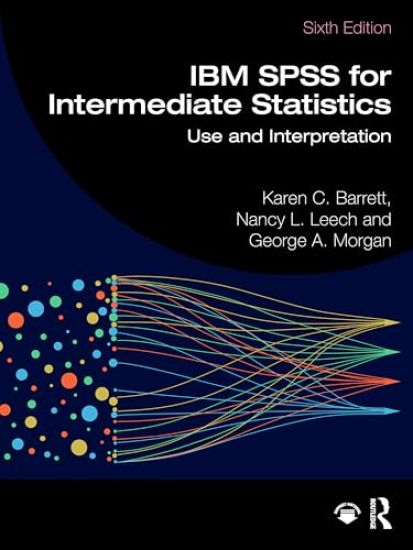
IBM SPSS for Intermediate Statistics
Karen C. Barrett; Nancy L. Leech; George A. Morgan
TAYLOR FRANCIS LTD
2025
nidottu
IBM SPSS for Intermediate Statistics, sixth edition, is designed to help readers analyze and interpret research data using IBM SPSS.This user-friendly book shows readers how to choose the appropriate statistic based on the design; perform intermediate statistics, including multivariate statistics; interpret output; and write about the results. The book reviews research designs and how to assess the accuracy and reliability of data; how to determine whether data meet the assumptions of statistical tests; how to calculate and interpret effect sizes for intermediate statistics; how to compute and interpret post-hoc power; and an overview of basic statistics for those who need a review. Unique chapters on multilevel linear modeling; multivariate analysis of variance (MANOVA); assessing reliability of data; multiple imputation; mediation, moderation, and canonical correlation; discriminant analyses; logistic regression; and factor analysis are provided. SPSS syntax is included for those who prefer this format. Pedagogical features include call-out boxes to highlight key points, interpretation sections and questions, realistic data sets for practice, and information on how to get started with SPSS, as well as appendices reviewing basic statistics, discussing how to write research questions, providing answers to the odd numbered interpretation questions, and providing references for further reading.An ideal supplement for courses in either intermediate/advanced statistics or research methods taught in departments of psychology, education, and other social and health sciences, this book is also appreciated by researchers in these areas looking for a handy reference for SPSS commands and how to interpret SPSS outputs.The new edition features: Updated for IBM SPSS version 29, but the book can be used with most other versionsMore information on how to get started in SPSS (Ch. 1)Updated discussion of which effect sizes can be calculated for various programs in SPSSUpdated information on multiple regression methods (Ch. 7)Updated chapter on how use a variable as a mediator or a moderator, using only SPSS (Ch. 8)All chapters updated to include effect sizes that are availableUpdated screens and outputsUpdated web resources for instructors, including PowerPoint slides, interpretation question and extra SPSS problem answers; and for students, data sets, and chapter outlines and study guides.
IBM SPSS for Intermediate Statistics
Karen C. Barrett; Nancy L. Leech; George A. Morgan
TAYLOR FRANCIS LTD
2025
sidottu
IBM SPSS for Intermediate Statistics, sixth edition, is designed to help readers analyze and interpret research data using IBM SPSS.This user-friendly book shows readers how to choose the appropriate statistic based on the design; perform intermediate statistics, including multivariate statistics; interpret output; and write about the results. The book reviews research designs and how to assess the accuracy and reliability of data; how to determine whether data meet the assumptions of statistical tests; how to calculate and interpret effect sizes for intermediate statistics; how to compute and interpret post-hoc power; and an overview of basic statistics for those who need a review. Unique chapters on multilevel linear modeling; multivariate analysis of variance (MANOVA); assessing reliability of data; multiple imputation; mediation, moderation, and canonical correlation; discriminant analyses; logistic regression; and factor analysis are provided. SPSS syntax is included for those who prefer this format. Pedagogical features include call-out boxes to highlight key points, interpretation sections and questions, realistic data sets for practice, and information on how to get started with SPSS, as well as appendices reviewing basic statistics, discussing how to write research questions, providing answers to the odd numbered interpretation questions, and providing references for further reading.An ideal supplement for courses in either intermediate/advanced statistics or research methods taught in departments of psychology, education, and other social and health sciences, this book is also appreciated by researchers in these areas looking for a handy reference for SPSS commands and how to interpret SPSS outputs.The new edition features: Updated for IBM SPSS version 29, but the book can be used with most other versionsMore information on how to get started in SPSS (Ch. 1)Updated discussion of which effect sizes can be calculated for various programs in SPSSUpdated information on multiple regression methods (Ch. 7)Updated chapter on how use a variable as a mediator or a moderator, using only SPSS (Ch. 8)All chapters updated to include effect sizes that are availableUpdated screens and outputsUpdated web resources for instructors, including PowerPoint slides, interpretation question and extra SPSS problem answers; and for students, data sets, and chapter outlines and study guides.
IBM SPSS for Intermediate Statistics
Karen C. Barrett; Nancy L. Leech; George A. Morgan
Routledge
2014
sidottu
Designed to help readers analyze and interpret research data using IBM SPSS, this user-friendly book shows readers how to choose the appropriate statistic based on the design; perform intermediate statistics, including multivariate statistics; interpret output; and write about the results. The book reviews research designs and how to assess the accuracy and reliability of data; how to determine whether data meet the assumptions of statistical tests; how to calculate and interpret effect sizes for intermediate statistics, including odds ratios for logistic analysis; how to compute and interpret post-hoc power; and an overview of basic statistics for those who need a review. Unique chapters on multilevel linear modeling; multivariate analysis of variance (MANOVA); assessing reliability of data; multiple imputation; mediation, moderation, and canonical correlation; and factor analysis are provided. SPSS syntax with output is included for those who prefer this format. The new edition features: • IBM SPSS version 22; although the book can be used with most older and newer versions • New discusiion of intraclass correlations (Ch. 3)• Expanded discussion of effect sizes that includes confidence intervals of effect sizes (ch.5) • New information on part and partial correlations and how they are interpreted and a new discussion on backward elimination, another useful multiple regression method (Ch. 6) • New chapter on how to use a variable as a mediator or a moderator (ch. 7)• Revised chapter on multilevel and hierarchical linear modeling (ch. 12) • A new chapter (ch. 13) on multiple imputation that demonstrates how to deal with missing data • Updated web resources for instructors including PowerPoint slides and answers to interpretation questions and extra problems and for students, data sets, chapter outlines, and study guides. IBM SPSS for Intermediate Statistics, Fifth Edition provides helpful teaching tools: • all of the key SPSS windows needed to perform the analyses • outputs with call-out boxes to highlight key points • interpretation sections and questions to help students better understand and interpret the output • extra problems with realistic data sets for practice using intermediate statistics • Appendices on how to get started with SPSS, write research questions, and basic statistics. An ideal supplement for courses in either intermediate/advanced statistics or research methods taught in departments of psychology, education, and other social, behavioral, and health sciences. This book is also appreciated by researchers in these areas looking for a handy reference for SPSS
IBM SPSS for Intermediate Statistics
Karen C. Barrett; Nancy L. Leech; George A. Morgan
Routledge
2014
nidottu
Designed to help readers analyze and interpret research data using IBM SPSS, this user-friendly book shows readers how to choose the appropriate statistic based on the design; perform intermediate statistics, including multivariate statistics; interpret output; and write about the results. The book reviews research designs and how to assess the accuracy and reliability of data; how to determine whether data meet the assumptions of statistical tests; how to calculate and interpret effect sizes for intermediate statistics, including odds ratios for logistic analysis; how to compute and interpret post-hoc power; and an overview of basic statistics for those who need a review. Unique chapters on multilevel linear modeling; multivariate analysis of variance (MANOVA); assessing reliability of data; multiple imputation; mediation, moderation, and canonical correlation; and factor analysis are provided. SPSS syntax with output is included for those who prefer this format. The new edition features: • IBM SPSS version 22; although the book can be used with most older and newer versions • New discusiion of intraclass correlations (Ch. 3)• Expanded discussion of effect sizes that includes confidence intervals of effect sizes (ch.5) • New information on part and partial correlations and how they are interpreted and a new discussion on backward elimination, another useful multiple regression method (Ch. 6) • New chapter on how to use a variable as a mediator or a moderator (ch. 7)• Revised chapter on multilevel and hierarchical linear modeling (ch. 12) • A new chapter (ch. 13) on multiple imputation that demonstrates how to deal with missing data • Updated web resources for instructors including PowerPoint slides and answers to interpretation questions and extra problems and for students, data sets, chapter outlines, and study guides. IBM SPSS for Intermediate Statistics, Fifth Edition provides helpful teaching tools: • all of the key SPSS windows needed to perform the analyses • outputs with call-out boxes to highlight key points • interpretation sections and questions to help students better understand and interpret the output • extra problems with realistic data sets for practice using intermediate statistics • Appendices on how to get started with SPSS, write research questions, and basic statistics. An ideal supplement for courses in either intermediate/advanced statistics or research methods taught in departments of psychology, education, and other social, behavioral, and health sciences. This book is also appreciated by researchers in these areas looking for a handy reference for SPSS
IBM SPSS for Introductory Statistics
George A. Morgan; Karen C. Barrett; Nancy L. Leech; Gene W. Gloeckner
Routledge
2019
nidottu
IBM SPSS for Introductory Statistics is designed to help students learn how to analyze and interpret research. In easy-to-understand language, the authors show readers how to choose the appropriate statistic based on the design, and to interpret outputs appropriately. There is such a wide variety of options and statistics in SPSS, that knowing which ones to use and how to interpret the outputs can be difficult. This book assists students with these challenges. Comprehensive and user-friendly, the book prepares readers for each step in the research process: design, entering and checking data, testing assumptions, assessing reliability and validity, computing descriptive and inferential parametric and nonparametric statistics, and writing about results. Dialog windows and SPSS syntax, along with the output, are provided. Several realistic data sets, available online, are used to solve the chapter problems. This new edition includes updated screenshots and instructions for IBM SPSS 25, as well as updated pedagogy, such as callout boxes for each chapter indicating crucial elements of APA style and referencing outputs.IBM SPSS for Introductory Statistics is an invaluable supplemental (or lab text) book for students. In addition, this book and its companion, IBM SPSS for Intermediate Statistics, are useful as guides/reminders to faculty and professionals regarding the specific steps to take to use SPSS and/or how to use and interpret parts of SPSS with which they are unfamiliar.
IBM SPSS for Introductory Statistics
George A. Morgan; Karen C. Barrett; Nancy L. Leech; Gene W. Gloeckner
Routledge
2019
sidottu
IBM SPSS for Introductory Statistics is designed to help students learn how to analyze and interpret research. In easy-to-understand language, the authors show readers how to choose the appropriate statistic based on the design, and to interpret outputs appropriately. There is such a wide variety of options and statistics in SPSS, that knowing which ones to use and how to interpret the outputs can be difficult. This book assists students with these challenges. Comprehensive and user-friendly, the book prepares readers for each step in the research process: design, entering and checking data, testing assumptions, assessing reliability and validity, computing descriptive and inferential parametric and nonparametric statistics, and writing about results. Dialog windows and SPSS syntax, along with the output, are provided. Several realistic data sets, available online, are used to solve the chapter problems. This new edition includes updated screenshots and instructions for IBM SPSS 25, as well as updated pedagogy, such as callout boxes for each chapter indicating crucial elements of APA style and referencing outputs.IBM SPSS for Introductory Statistics is an invaluable supplemental (or lab text) book for students. In addition, this book and its companion, IBM SPSS for Intermediate Statistics, are useful as guides/reminders to faculty and professionals regarding the specific steps to take to use SPSS and/or how to use and interpret parts of SPSS with which they are unfamiliar.

Correspondence Analysis and West Mexico Archaeology
C. Roger Nance; Jan de Leeuw; Phil C. Weigand
University of New Mexico Press
2013
sidottu
Because the archaeology of West Mexico has received little attention from researchers, large segments of the region’s prehistoric ceramic sequences have long remained incomplete. This book goes far toward filling that gap by analysing a collection of potsherds excavated in the 1960s and housed since then, though heretofore unanalysed, at UCLA. The authors employ the rarely used statistical technique known as correspondence analysis to sequence the Long-Glassow collection of artifacts. The book explains how correspondence analysis works and how it can be applied in archaeology. In addition to describing the archaeological sites in north central Jalisco where the collection comes from, the authors provide an ethnohistorical overview including information on the earliest Spanish explorers to reach the sites. They sequence more than seventy ceramic types and derive a master sequence from more than ten thousand potsherds. In addition to Mesoamerican archaeologists, the audience will also include other archaeologists concerned with ceramic analysis or the application of statistics to archaeology.

Therapy in the Real World
Nancy Boyd-Franklin; Elizabeth N. Cleek; Matt Wofsy; Brian Mundy
Guilford Press
2013
sidottu
Helping beginning and experienced therapists cope with the myriad challenges of working in agencies, clinics, hospitals, and private practice, this book distills the leading theories and best practices in the field. The authors provide a clear approach to engaging diverse clients and building rapport; interweaving evidence-based techniques to meet therapeutic goals; and intervening effectively with individuals, families, groups, and larger systems. Practitioners will find tools for addressing the needs of their clients while caring for themselves and avoiding burnout; students will find a clear-headed framework for making use of the variety of approaches available in mental health practice.

Therapy in the Real World
Nancy Boyd-Franklin; Elizabeth N. Cleek; Matt Wofsy; Brian Mundy
Guilford Press
2016
nidottu
Helping beginning and experienced therapists cope with the myriad challenges of working in agencies, clinics, hospitals, and private practice, this book distills the leading theories and best practices in the field. The authors provide a clear approach to engaging diverse clients and building rapport; interweaving evidence-based techniques to meet therapeutic goals; and intervening effectively with individuals, families, groups, and larger systems. Practitioners will find tools for addressing the needs of their clients while caring for themselves and avoiding burnout; students will find a clear-headed framework for making use of the variety of approaches available in mental health practice.

Brave New Brain is a travel guide to the future. Scientists are presently mapping both the terrain of the brain and the geography of the genome. Psychiatry has joined them on a quest to conquer mental illnesses - those illnesses that strike the most human part of our bodies, our brains and minds. Brave New Brain is designed as a resource book for following this voyage of discovery. It explains the nature of mental illness and genome and brain mapping. using clear simple language, interesting case histories, and extensive illustrations. Scientists today know more about the brain than ever before. Andreasen gives us an engaging and readable description of how it all works, from the billions of neurons to the tiny thalamus to the moral monitor in our prefrontal cortex. She also shows the progress made in mapping the human genome, whose 30,000-40,000 genes are almost all active in the brain.
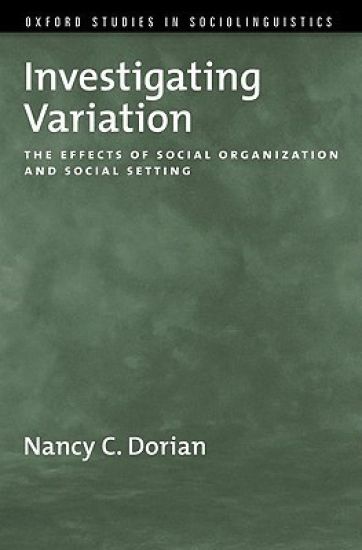
Linguistic variation has most commonly been studied in communities that have the dominant social organization of our time: occupational and ethnic diversity, socioeconomic stratification, and a population size that precludes community-wide face-to-face interaction. In such communities literacy introduces overarching, extra-community linguistic norms, and linguistic variation correlates with socioeconomic class. Investigating Variation explores a different kind of social organization: small size, enclavement, common occupation, absence of social stratification, bilingualism with extremely weak extra-community norming for the local minority language, which shows a very high level of individual variation. Nancy C. Dorian's examination of the fisherfolk Gaelic spoken in a Highland Scottish village offers a number of explanations for delayed recognition of linguistic variation unrelated to social class or other social sub-groups. Reports of similar variation phenomena in locations with similar social-setting and social organization features (contemporary minority-language pockets in Ireland, Russia, Norway, Canada, and Cameroon) make it possible to recognize a particular set of factors that contribute to the emergence and persistence of socially neutral inter-speaker and intra-speaker variation. The documented existence of still other forms of social organization, rare now but once more widespread, suggests that additional forms of linguistic variation, as well as other facets of language use related to social organization, remain unexamined, calling for attention before the few communities that represent them disappear altogether.

Linguistic variation has most commonlu been studied in communities that have the dominant social organization of our time: occupation and ethnic diversity, socioeconomic stratification, and a population size that precludes community-wide face-to-face interaction. In such communities literacy introduces overarching, extra-community linguistic norms, and linguistic variation correlates with socioeconomic class. Investigating Variation explores a different kind of social organization: small size, enclavement, common occupation, absence of social stratification, bilingualism with extremely weak extra-community norming for the local minority language, which shows a very high level of individual variation. Nancy C. Dorian's examination of the fisherfolk Gaelic spoken in a Highland Scottish village offers a number of explanations for delayed recognition of linguistic variation unrelated to social class or other social sub-groups. Reports of similar variation phenomena in locations with similar social-setting and social-organization features (contemporary minority-language pockets in Ireland, Russia, Norway, Canada, and Cameroon) make it possible to recognize a particular set of factors that contribute to the emergence and persistence of socially neutral inter-speaker and intra speaker variation. The documented existence of still other forms of social organization, rare now but once more widespread, suggests that additional forms of linguistic variation, as well as other facets of language use related to social organization, remain unexamined, calling for attention before the few communities that represent them disappear altogether.

From pre-Columbian times to the environmental justice movements of the present, women and men frequently responded to the environment and environmental issues in profoundly different ways. Although both environmental history and women's history are flourishing, explorations of the synergy produced by the interplay between environment and sex, sexuality, and gender are just beginning. Offering more than "great women in environmental history," this book examines the intersections that shaped women's unique environmental concerns and activism, and that framed the way the larger culture responded. Women discussed include Native Americans, colonists, enslaved field workers, pioneers, homemakers, municipal housekeepers, immigrants, hunters, nature writers, soil conservationists, scientists, migrant laborers, lesbians, nuclear protestors, and environmental justice activists. As women, they fared, thought, and acted in ways complicated by social, political, and economic norms, as well as issues of sexuality and childbearing. The housekeeping role assigned to women has long been recognized as important in environmental history. But that emphasis ignores the vast range of their influence and experiences. Enslaved women, left to do the fieldwork in disproportionate numbers, used their environmental knowledge to subtly undermine their masters, hastening the coming of the Civil War. Many pregnant women, faced with childbirth on the western trails, eyed frontier environments with considerable apprehension. In more recent times, lesbians have created alternative environments to resist homophobia and, in many economically disadvantaged communities, women have been at the forefront of the fight against environmental racism. Women are not always the heroes in this story, as when the popularity of hats lavishly decorated with feathers brought some bird species to near extinction. For better, and sometimes for worse, women have played a unique role in the shaping of the American environment. Their stories feature vibrant characters and shine a light on an underappreciated, often inspiring, and always complex history.