Kirjojen hintavertailu. Mukana 11 244 527 kirjaa ja 12 kauppaa.

Kirjahaku

Etsi kirjoja tekijän nimen, kirjan nimen tai ISBN:n perusteella.

1000 tulosta hakusanalla Neil Kenny

The Palace of Secrets

The Palace of Secrets

Neil Kenny

Clarendon Press
1991
sidottu
During the Renaissance, very divergent conceptions of knowledge were debated. Dominant among these was encyclopedism, which treated knowledge as an ordered and unified circle of learning in which branches were logically related to each other. By contrast, writers like Montaigne saw human knowledge as an inherently unsystematic and subjective flux. The Palace of Secrets explores the tension between these two views by examining specific areas such as theories of knowledge, uses of genre, and the role of fiction in philosophical texts. Examples are drawn from numerous sixteenth- and seventeenth-century texts but focus particularly on the polymath Béroalde de Verville, whose work graphically illustrates these two competing conceptions of knowledge, since he gradually abandoned encyclopedism. Hitherto Béroalde has been mainly known for the extraordinary and notorious Moyen de parvenir; this is the first detailed study of the whole range of his work, both fictional and learned. The book straddles literary and intellectual history, and indeed it demonstrates that the division between the two has little meaning in Renaissance terms. The intellectual conflicts which it explores have significance for the history of thought right up to the Enlightenment.
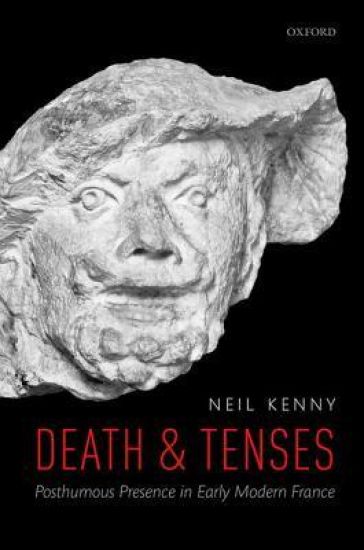
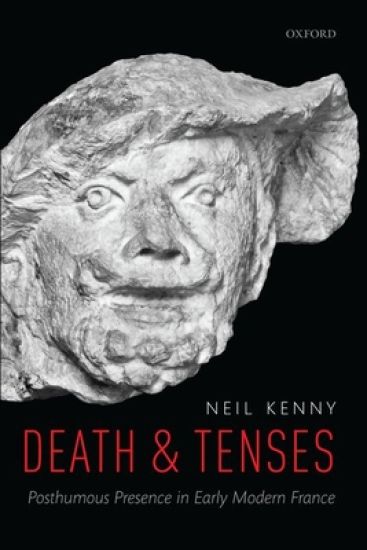
Death and Tenses

Death and Tenses

Neil Kenny

Oxford University Press
2015
sidottu
In what tense should we refer to the dead? The question has long been asked, from Cicero to Julian Barnes. Answering it is partly a matter of grammar and stylistic convention. But the hesitation, annoyance, even distress that can be caused by the 'wrong' tense suggests that more may be at stake--our very relation to the dead. This book, the first to test that hypothesis, investigates how tenses were used in sixteenth- and early seventeenth-century France (especially in French but also in Latin) to refer to dead friends, lovers, family members, enemies, colleagues, writers, officials, kings and queens of recent times, but also to those who had died long before, whether Christ, the saints, or the ancient Greeks and Romans who posthumously filled the minds of Renaissance humanists. Did tenses refer to the dead in ways that contributed to granting them differing degrees of presence (and absence)? Did tenses communicate dimensions of posthumous presence (and absence) that partly eluded more concept-based affirmations? The investigation ranges from funerary and devotional writing to Eucharistic theology, from poetry to humanist paratexts, from Rabelais's prose fiction to Montaigne's Essais. Primarily a work of literary and cultural history, it also draws on early modern grammatical thought and on modern linguistics (with its concept of aspect and its questioning of 'tense'), while arguing that neither can fully explain the phenomena studied. The book briefly compares early modern usage with tendencies in modern French and English in the West, asking whether changes in belief about posthumous survival have been accompanied by changes in tense-use.
Death and Tenses

Death and Tenses

Neil Kenny

Oxford University Press
2020
nidottu
In what tense should we refer to the dead? The question has long been asked, from Cicero to Julian Barnes. Answering it is partly a matter of grammar and stylistic convention. But the hesitation, annoyance, and even distress that can be caused by the "wrong" tense suggests that more may be at stake--our very relation to the dead. This book, the first to test that hypothesis, investigates how tenses were used in sixteenth and early seventeenth-century France (especially in French but also in Latin) to refer to dead friends, lovers, family members, enemies, colleagues, writers, officials, kings and queens of recent times, and also to those who had died long before, whether Christ, the saints, or the ancient Greeks and Romans who posthumously filled the minds of Renaissance humanists. Did tenses refer to the dead in ways that contributed to granting them differing degrees of presence (and absence)? Did tenses communicate dimensions of posthumous presence (and absence) that partly eluded more concept-based affirmations? The investigation ranges from funerary and devotional writing to Eucharistic theology, from poetry to humanist paratexts, from Rabelais's prose fiction to Montaigne's Essais. Primarily a work of literary and cultural history, it also draws on early modern grammatical thought and on modern linguistics (with its concept of aspect and its questioning of "tense"), while arguing that neither can fully explain the phenomena studied. The book briefly compares early modern usage with tendencies in modern French and English in the West, asking whether changes in belief about posthumous survival have been accompanied by changes in tense-use.
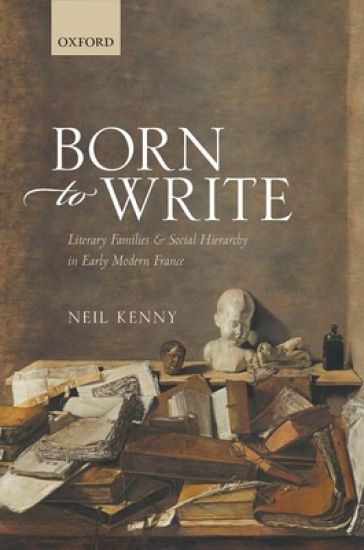
Born to Write

Born to Write

Neil Kenny

Oxford University Press
2020
sidottu
It is easy to forget how deeply embedded in social hierarchy was the literature and learning that has come down to us from the early modern European world. From fiction to philosophy, from poetry to history, works of all kinds emerged from and through the social hierarchy that was a fundamental fact of everyday life. Paying attention to it changes how we might understand and interpret the works themselves, whether canonical and familiar or largely forgotten. But a second, related fact is much overlooked too: works also often emanated from families, not just from individuals. Families were driving forces in the production--that is, in the composing, editing, translating, or publishing--of countless works. Relatives collaborated with each other, edited each other, or continued the unfinished works of deceased family members; some imitated or were inspired by the works of long-dead relatives. The reason why this second fact (about families) is connected to the first (about social hierarchy) is that families were in the period a basic social medium through which social status was claimed, maintained, threatened, or lost. So producing literary works was one of the many ways in which families claimed their place in the social world. The process was however often fraught, difficult, or disappointing. If families created works as a form of socio-cultural legacy that might continue to benefit their future members, not all members benefited equally; women sometimes produced or claimed the legacy for themselves, but they were often sidelined from it. Relatives sometimes disagreed bitterly about family history, identity (not least religious), and so about the picture of themselves and their family that they wished to project more widely in society through their written works, whether printed or manuscript. So although family was a fundamental social medium out of which so many works emerged, that process could be conflictual as well as harmonious. The intertwined role of family and social hierarchy within literary production is explored in this book through the case of France, from the late fifteenth to the mid-seventeenth century. Some families are studied here in detail, such as that of the most widely read French poet of the age, Clément Marot. But the extent of this phenomenon is quantified too: some two hundred families are identified as each containing more than one literary producer, and in the case of one family an extraordinary twenty-seven.
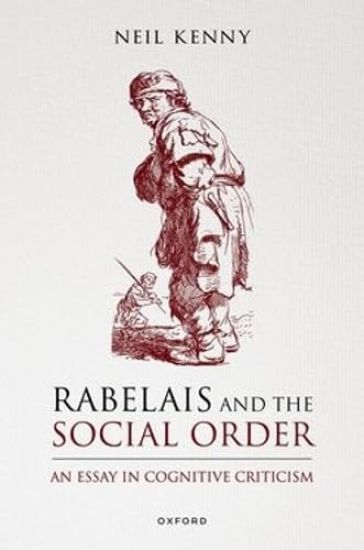
Rabelais and the Social Order

Rabelais and the Social Order

Neil Kenny

Oxford University Press
2026
sidottu
This book asks two questions. The first question concerns one of the greatest figures of world literature: François Rabelais. What do his sixteenth-century fictions communicate about the power relations that shape what social groups do (or refrain from doing) to each other--killing, wounding, dismembering, having sex with, feeding, depriving of food, protecting, healing, commanding, obeying, ruling, serving, honouring, swallowing, humiliating, scaring, and so on? The second question is more general: how does a literary writer communicate to readers (whether about relations between social groups or anything else), even to readers who are separated from the writer by vast swaths of time and place? By considering afresh the first question, the book contributes to recent cognitively inflected answers to the second. Part I provides a reading of the social order across all five books of the Rabelaisian fictional chronicles. They communicate a profound preoccupation both with the need for a rank-based, hierarchical, social order and yet also with the comic and disquieting vulnerabilities or impossibilities of that social order-or rather of social orders in the plural, since the narrative lurches from the warring kingdoms of the early books (Pantagruel and Gargantua) to the strangely organized island societies of the fourth and fifth books. In the middle (third) book, an extravagant character (Panurge) plans to insert himself, by becoming a paterfamilias, in the whole system of renewing the social order through legitimate procreation and inheritance. Part II changes gear: it analyses readings of the social order in Rabelais's fiction that have been offered over the past millennium and that often introduce rather different terms (such as 'class' or 'revolution'). The journey takes in Aldous Huxley, Gustave Flaubert, Ernest Renan, Primo Levi, and many more. Have these remarkably varied and often conflicting readings been produced by certain core communicative processes? And did those processes also produce, with different results, the reading offered in Part I? A cognitive approach helps readers understand how literature can afford rich and embodied thinking which is, by definition, constant re-thinking--both from one reader to the next, and from one page to the next.
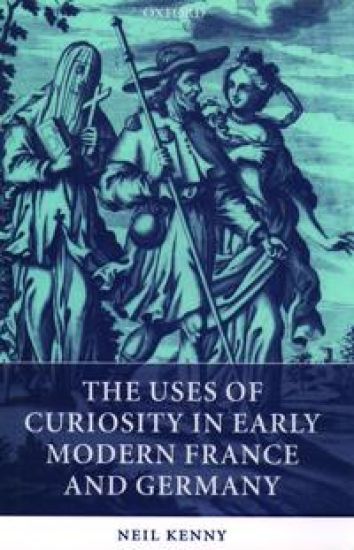
The Uses of Curiosity in Early Modern France and Germany
Why did people argue about curiosity in France, Germany, and elsewhere in Europe between the sixteenth and the eighteenth centuries, so much more than today? Why was curiosity a fashionable topic in early modern conduct manuals, university dissertations, scientific treatises, sermons, newspapers, novellas, plays, operas, ballets, poems, from Corneille to Diderot, from Johann Valentin Andreae to Gottlieb Spizel? Universities, churches, and other institutions invoked curiosity in order to regulate knowledge or behaviour, to establish who should try to know or do what, and under what circumstances. As well as investigating a crucial episode in the history of knowledge, this study makes a distinctive contribution to historiographical debates about the nature of 'concepts'. Curiosity was constantly reshaped by the uses of it. And yet, strangely, however much people contested what curiosity was, they often agreed that what they were disagreeing about was one and the same thing.
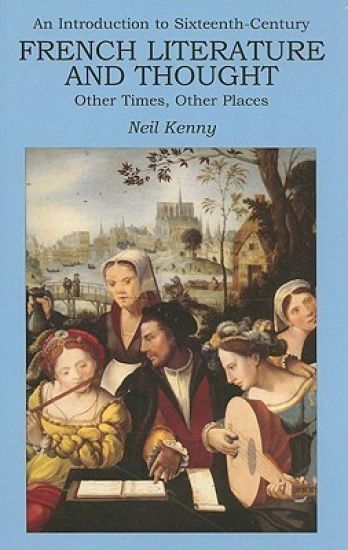
An Introduction to 16th-century French Literature and Thought
The age of Shakespeare, Cervantes, Erasmus, Luther, and Machiavelli produced in France too some of Europe's greatest ever literature and thought: Montaigne's "Essays", Rabelais' comic fictions, Ronsard's poetry, Calvin's theology. These and numerous other extraordinary writings emerged from and contributed to cultural upheavals: the movement usually known as the Renaissance, which sought to revive ancient Greek and Roman culture for present-day purposes; religious reform, including the previously unthinkable rejection of Catholicism by many in the Reformation, culminating in decades of civil war in France; the French language's transformation into an instrument for advanced abstract thought. This book introduces this vibrant literature and thought via an apparent paradox. Most writers were profoundly concerned to improve life in the here-and-now - socially, politically, morally, spiritually. Yet they often tried to do so by making detours, in their writing, to other times and places: antiquity; heaven and hell; the hidden recesses of Nature, the cosmos, or the future; the remote location of an absent loved one; the newly 'discovered' Americas. The point was to show readers that the only way to live in the here-and-now was to connect it to larger realities - cosmic, spiritual, and historical.
Text, Knowledge, and Wonder in Early Modern France: Essays in Honour of Stephen Bamforth
Explores the entwinement of early modern text, knowledge and wonder, and their connections in FranceA triple nexus of text, knowledge, and wonder permeated much literary, learned, and ceremonial culture in sixteenth- and seventeenth-century France. There were endless variations on the combination, often with two of the three elements predominating. This volume tracks some of those variations as they appeared in collections of natural wonders, pedagogical situations, a family, an alchemical romance, a carnival festivity, a learned society, and poetry.Key FeaturesContent written in English and French.The contributors to this volume are leading specialists in early modern French studies, from France and the UK.Considers the development of natural wonders, monsters and mythical animals, alchemical symbols and concepts of friendship and rivalry.
Montaigne in Transit: Essays in Honour of Ian Maclean
This volume tracks a Montaigne 'in transit' all the way from the genesis and production of his Essais and travel journal in the 1570s-1590s to their diffusion and reception from the 1580s up till the present day, in France, England, Germany, and elsewhere. The contributors take those key terms - genesis, production, diffusion, reception - as their starting-point, but show that the boundaries between them are blurred. How does embodied thought move through space and time between the author and reader of the Essais? Can the role of the ancient writers whom Montaigne quotes be assessed without consideration of the differences he knew there would be between readers' capacities to recognise and contextualise those quotations? Where does Montaigne's punctuation end and that of his compositors, editors, and translators begin? This volume asks such questions by exploring transit as a critical concept cutting across different languages, places, and times. Its authors include leading specialists in early modern French and English studies. It is a tribute to Ian Maclean, whose own trailblazing work has moved through and across numerous fields of early modern learned culture.
Walking with the Celtic Saints

Walking with the Celtic Saints

Neil Kennedy-Jones; Gerlinde Kennedy-Jones; Andrew M. Seddon

Crossroad Publishing Co ,U.S.
2004
nidottu
This light and enjoyable book is a series of stories and reflections on the Celtic saints. Each of the 15 chapters begins with a semi-fictional story or event from the life of a saint, showing some characteristic quality for which he or she is known. This is followed by a reflection that combines history and inspiration. Then comes a short original poem, scripture, meditation, and a blessing. A website connected with the book will offer fully arranged original hymns to accompany the poems.
Pray Like a Son

Pray Like a Son

Neil Kennedy

IngramSpark
2022
pokkari
I wanted to name this book, Pray Like a Man. However, as I began to study, meditate, and ask the Holy Spirit what to write and convey on prayer, I felt strongly to look at the pattern of how Jesus prayed.Jesus prayed like no one before Him. He approached God, the Holy One of Israel, saying, "Father...."This approach to prayer was a radical shift in the concept of praying. So much so that the Pharisees accused Jesus of blasphemy. Who dared call YHWH Father?Most of us want our prayers to be heard, received, and returned in the affirmative. No one had a better grasp of having His prayers heard than Jesus. So, He is our model of prayer.This teaching is to help you position yourself in the identity of sonship so that you can pray to your Father and be heard. By the conclusion of this teaching, I hope you radically change your position to step up to sonship and pray like a son.
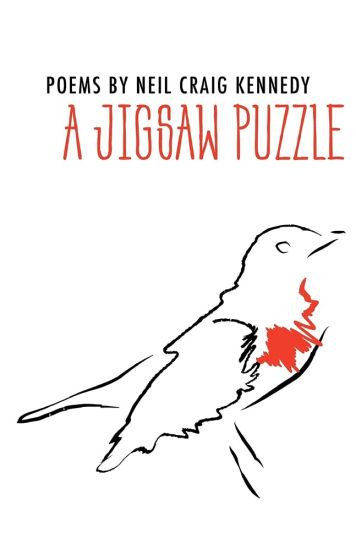
A Jigsaw Puzzle

A Jigsaw Puzzle

Neil Kennedy

Finishing Line Press
2021
pokkari
Neil Kennedy's new book, A Jigsaw Puzzle is like no other book of poetry I have ever read. From the very beginning-Flower on the floor./Somebody has lost their bloom./I am very careful.-Kennedy pulls you in, though really, as with any jigsaw puzzle, you can enter anywhere and find yourself unable to stop being enchanted by this world that gets put together one tercet at a time. Birds of all species, one chickadee setting up its home into two birdhouses, music from next door, problematic snow, little Jesus at the gas station, hourglasses, cats and dogs, timepieces and shoelaces, software malfunctions in the forgiveness machine, hammer and teacup going home together, hesitating clouds deciding whether to cast shadows or not, daffodils breaching their contract, card catalogue in the junkyard with one drawer open-this poignantly quiet rhythm and boldly observant eye unfold a landscape that is defined often by the spaces between places and moments in time. In one of the occasional breaks of the tercet form the poet writes "Behind one man's voice" and then then there's space and then "Another man's voice." In the poems to which we turn for insight and illumination we often sense poet and shadow self, the two voices talking to each other and including us in the conversation. Kennedy's A Jigsaw Puzzle, offers you a conversation to which you will want to return again and again.-Christopher Bursk, author of The Improbable Swervings of Atoms
Swing Trading Masterclass: Time-Proven Tactics, Tools and Profitable Strategies
Swing trading is known for its high profits and a very good risk/reward ratio. Yet, learning swing trading quite often becomes an expensive and frustrating experience. Read on if you're serious about swing trading and wish to study it from a professional swing trader...Swing Trading is truly one of the 'golden nuggets' of trading. It combines the best of both worlds - the slow pace of investing and the rapid potential gains of day trading. Based on the bulletproof trading principle of 'riding the wave of the current market trend', it's the ideal strategy to learn if you want a low risk / low involvement income source. Unfortunately, studying swing trading on your own often ends up being a frustrating experience. Most of the guides out there offer either an over-simplified approach or get overly academic, relying too much on technical jargon. And if you want a tailor-made course - you really have to get ready for a 4-figure price "Swing Trading Masterclass" has been written by Kenneth O'Neil to fill this gap. Backed by 10+ years of swing trading experience, he developed a straight-to-the point, detailed and practical guide to mastering swing trading. And rest assured - the book has been created with both beginners and experienced traders in mind Here is what you're going to learn by following the masterclass: A real trader's POV on swing trading and its stronger/weaker sides vs. other trading strategiesWhy swing trading is such a good match for so many traders and how to take full advantage of its unique benefitsHow to start with swing trading - building the right foundational investment strategyWhat's the right money management approach for a successful swing traderThe winning swing trading strategies - what are they and how can novices and experienced traders utilize them effectivelyCharting basics and advanced analysis tools (with specific examples and graphics)From theory to reality: how to correctly apply the knowledge in order to trade successfullyThe future outlook: establishing your master trading plans to maximize profitabilityA handy glossary of swing trading terms and so much more So, if you're serious about learning swing trading - do not wait any longer. Follow "Swing Trading Masterclass" and you will master one of the most rewarding trading strategies in the market today Ready to Get Started?Scroll to the top of the page and select the 'buy' button.