Kirjojen hintavertailu. Mukana 11 244 527 kirjaa ja 12 kauppaa.

Kirjahaku

Etsi kirjoja tekijän nimen, kirjan nimen tai ISBN:n perusteella.

725 tulosta hakusanalla Niall Ferguson

The House of Rothschild

The House of Rothschild

Niall Ferguson

Penguin Books Ltd
1999
pokkari
In his rich and nuanced portrait of the remarkable, elusive Rothschild family, Oxford scholar and bestselling author Niall Ferguson uncovers the secrets behind the family's phenomenal economic success. He reveals for the first time the details of the family's vast political network, which gave it access to and influence over many of the greatest statesmen of the age. And he tells a family saga, tracing the importance of unity and the profound role of Judaism in the lives of a dynasty that rose from the confines of the Frankfurt ghetto and later used its influence to assist oppressed Jews throughout Europe. A definitive work of impeccable scholarship with a thoroughly engaging narrative, 'The House of Rothschild' is a biography of the rarest kind, in which mysterious and fascinating historical figures finally spring to life.
The Pity of War

The Pity of War

Niall Ferguson

Penguin Books Ltd
2009
pokkari
The First World War killed around eight million men and bled Europe dry. In this provocative book Niall Ferguson asks: was the sacrifice worth it? Was it all really an inevitable cataclysm and were the Germans a genuine threat? Was the war, as is often asserted, greeted with popular enthusiasm? Why did men keep on fighting when conditions were so wretched? Was there in fact a death wish abroad, driving soldiers to their own destruction? The war, he argues, was a disaster - but not for the reasons we think. Far worse than a tragedy, it was the greatest error of modern history.'The most challenging and provocative analysis of the First World War to date' Ian Kershaw 'Must take a permanent place at the top of the War's historiography. It is one of the very few books whose own scale matches that of the events it describes' Alan Clark, Daily Telegraph'Possibly the most important book to appear in years both on the origins of the First World War ... Ferguson can confidently claim to have inherited A. J. P. Taylor's mantle' Paul Kennedy, New York Review of Books'At one massive stroke, Niall Ferguson has transformed the intellectual landscape' Economist
The House of Rothschild

The House of Rothschild

Niall Ferguson

Penguin Books Ltd
2000
pokkari
This second volume of Niall Ferguson's acclaimed, landmark history of the legendary Rothschild banking dynasty concludes his myth-breaking portrait of one of the most powerful and fascinating families of modern times. With all the depth, clarity and drama with which he traced the Rothschild's ascent, Ferguson shows how their power waned as conflicts from Crimea to the Second World War repeatedly threatened the stability of their worldwide empire, and how their failure to establish themselves successfully in the United States would prove fateful. At once a classic family saga and a major work of economic, social and political history, this is the definitive biography of some of the most powerful financiers of recent times.
The Cash Nexus

The Cash Nexus

Niall Ferguson

Penguin Books Ltd
2002
pokkari
Modern history shows that a nation's success largely depends on the way it manages its money. But where do money and politics meet? From 1700 to the present day, Niall Ferguson offers a bold and original analysis of the evolution of today's economic and political landscape. Far from being driven by the profit motive alone, our recent history, as Ferguson makes brilliantly clear, has also been made by potent and often conflicting human impulses - sex, violence and the desire for power. In this dazzling, powerful and controversial explanation of modern world history and the fundamental force that lurks behind it all, Niall Ferguson answers the big questions about finance and its crucial place in bringing happiness and despair, warfare and welfare, boom and crash to nations buffeted by the onward march of history. 'A marvellous combination of persuasion and provocation ... The Cash Nexus has enough ideas for a dozen books' Martin Daunton, History Today 'The Cash Nexus is ... packed with intriguing arguments and controversial propositions ... [an] outstanding book' Frank McLynn, Independent 'Ferguson is one of the most technically accomplished historians writing today ... The Cash Nexus offers an important corrective to the naïve story of economic growth' Robert Skidelsky, New York Review of Books
The War of the World

The War of the World

Niall Ferguson

Penguin Books Ltd
2009
pokkari
The beginning of the twentieth century saw human civilization at its most enlightened, well-educated, globalized and wealthy. What turned it into a bloodbath?Niall Ferguson re-tells the story of history's most savage century as a continual war that raged for 100 years. From the plains of Poland to the killing fields of Cambodia, he reveals how economic boom-and-bust, decaying empires and, above all, poisonous ideas of race led men to treat each other as aliens. It was an age of hatred that ended with the twilight, not the triumph, of the West. And, he shows, it could happen all over again.'A heartbreaking, serious and thoughtful survey of human evil that is utterly fascinating and dramatic' Simon Sebag Montefiore, The New York Times'Unputdownable, controversial, compelling' Independent on Sunday'The grenade lobbed into the cosy tea party of received wisdom' Max Hastings'A big, bold and brilliantly belligerent book' Sunday Telegraph'History at its most controversial ... no one can afford to overlook it' Allan Mallinson'Hums with energy, quotable insights and pithy summaries' Observer'Gripping' Tristram Hunt
Colossus

Colossus

Niall Ferguson

Penguin Books Ltd
2009
pokkari
Is America the new world empire? Presidents from Lincoln to Bush may have denied it but, as Niall Ferguson's brilliant and provocative book shows, the US is in many ways the greatest imperial power of all time. What's more, it always has been an empire, expanding westwards throughout the nineteenth century and rising to global dominance in the twentieth. But is today's American colossus really equipped to play Atlas, bearing the weight of the world on its shoulders? The United States, Ferguson reveals, is an empire running on empty, weakened by chronic defecits of money, manpower and political will. When the New Rome falls, he warns, its collapse may come from within.'One of the timeliest and most topical books to have appeared in recent years' Literary Review'Yet another tour de force from a writer who displays all his usual gifts of forceful polemic, unconventional intelligence and elegant prose ... guaranteed to spark fierce debate' Irish Times'A bravura exploration of why Americans are not cut out to be imperialists but nonetheless have an empire. Vigorous, substantive, and worrying' Timothy Garton Ash
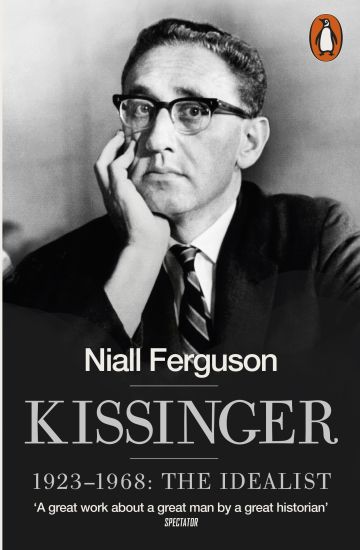
Kissinger

Kissinger

Niall Ferguson

Penguin
2016
pokkari
No American statesman has been as revered and as reviled as Henry Kissinger. Hailed by some as the "indispensable man", whose advice has been sought by every president from John F. Kennedy to George W. Bush, Kissinger has also attracted immense hostility from critics who have cast him as an amoral Machiavellian - the ultimate cold-blooded "realist".In this remarkable new book, the first of two volumes, Niall Ferguson has created an extraordinary panorama of Kissinger's world, and a paradigm-shifting reappraisal of the man. Only through knowledge of Kissinger's early life (as a Jew in Hitler's Germany, a poor immigrant in New York, a GI at the Battle of the Bulge, an interrogator of Nazis, and a student of history at Harvard) can we understand his debt to the philosophy of idealism.And only by tracing his rise, fall and revival as an adviser to Kennedy, Nelson Rockefeller and, finally, Richard Nixon can we appreciate the magnitude of his contribution to the theory of diplomacy, grand strategy and nuclear deterrence.Drawing not only on Kissinger's hitherto closed private papers but also on documents from more than a hundred archives around the world, this biography is Niall Ferguson's masterpiece. Like his classic two-volume history of the House of Rothschild, Kissinger sheds dazzling new light on an entire era.
High Financier

High Financier

Niall Ferguson

Penguin Books Ltd
2011
pokkari
This is the extraordinary story of Siegmund Warburg: the refugee from Nazi Germany who restored the Blitz-shattered City of London as the world's preeminent international financial centre. In recounting how this brilliant, scholarly man brought wit, passion and, above all, high ethical standards to the world of finance, Niall Ferguson shows how his meticulous methods were the antithesis of the debt-fuelled, speculative banking of our times. 'A fascinating portrait ... Beautifully paced, dramatically subtle and psychologically shrewd ... Warburg is an emblem of money as it ought to be, and now isn't' Bryan Appleyard, New Statesman'Extensively researched and beautifully written' Peter Stormonth Darling, Spectator'Ferguson's account of Warburg's life not only reveals a prophet of European unification and, later, globalization, but a banker from a more responsible (and civilised) era' Peter Mandelson, Daily Telegraph, Books of the Year'A timely, original and engaging biography' Sathnam Sanghera, The Times 'Financially literate, extremely thorough, deploying dazzling breadth of cultural reference ... Ferguson has produced a fine historical biography. He has also reminded us, regrettably, that Warburg has no peer in the financial world today' Simon Shaw, Mail on Sunday
Great Degeneration

Great Degeneration

Niall Ferguson

Penguin
2014
pokkari
The decline of the West is something that has long been prophesied. Symptoms of decline are all around us today: slowing growth, crushing debts, ageing populations. But what exactly is amiss with Western civilization? The author argues that the institutions that were once the four pillars of Western society - representative government, and more.
The Square and the Tower

The Square and the Tower

Niall Ferguson

Penguin Books Ltd
2018
pokkari
THE NEW YORK TIMES BESTSELLER'Silicon Valley needed a history lesson and Ferguson has provided it' Eric SchmidtMost history is about the people at the top of the towers of power. But what if the real action is in the social networks down below, in the town squares? Niall Ferguson, the international bestselling author of Empire, The Ascent of Money and Civilization, brilliantly recasts past and present as an unending contest between hierarchies and networks.'Provocative, snappy, a rare book ... fasten your seatbelts' Peter Frankopan, Daily Telegraph'Immensely stimulating, absorbing, illuminating ... sends ideas blazing all over the place ... one of the best popular historians of our time' David Goodhart, Prospect'Powerful, fast-paced ... a pull-yourself-together warning to the present by way of arresting historical precedent' Andrew Anthony, Guardian'Captivating and compelling' Jonathan A. Knee, The New York Times
Empire

Empire

Niall Ferguson

Penguin Books Ltd
2018
pokkari
Niall Ferguson's acclaimed bestseller on the highs and lows of Britain's empireOnce vast swathes of the globe were coloured imperial red and Britannia ruled not just the waves, but the prairies of America, the plains of Asia, the jungles of Africa and the deserts of Arabia. Just how did a small, rainy island in the North Atlantic achieve all this? And why did the empire on which the sun literally never set finally decline and fall? Niall Ferguson's acclaimed Empire brilliantly unfolds the imperial story in all its splendours and its miseries, showing how a gang of buccaneers and gold-diggers planted the seed of the biggest empire in all history - and set the world on the road to modernity.'The most brilliant British historian of his generation ... Ferguson examines the roles of "pirates, planters, missionaries, mandarins, bankers and bankrupts" in the creation of history's largest empire ... he writes with splendid panache ... and a seemingly effortless, debonair wit' Andrew Roberts 'Dazzling ... wonderfully readable' New York Review of Books'A remarkably readable précis of the whole British imperial story - triumphs, deceits, decencies, kindnesses, cruelties and all' Jan Morris 'Empire is a pleasure to read and brims with insights and intelligence' Sunday Times
Civilization

Civilization

Niall Ferguson

Penguin Books Ltd
2018
pokkari
Winner of the Estoril Global Issues Distinguished Book Prize 2013In 1412, Europe was a miserable backwater ravaged by plague, bad sanitation and incessant war, while the Orient was home to dazzling civilizations. Yet, somehow, the West came to dominate the Rest for most of the next half millennium.In this vital, brilliant book, Niall Ferguson reveals the six 'killer applications' that the Rest lacked: competition, science, property rights, medicine, consumerism and the work ethic. And he asks: do we still have these winning tools? Or is this the end of Western ascendancy?'Brilliantly written, full of wit and virtuosity, stuffed with memorable lines and gorgeous bits of information. A great read' The Times'A dazzling history of Western ideas ... epic' Economist'Vivid and fascinating' Daily Telegraph'Superb ... brings history alive ... dazzling' Independent'This is sharp. It feels urgent. Ferguson ... twists his knife with great literary brio' Andrew Marr, Financial Times
The Ascent of Money

The Ascent of Money

Niall Ferguson

Penguin Books Ltd
2019
pokkari
Bread, cash, dosh, dough, loot. Call if what you like, it matters now more than ever. In The Ascent of Money, Niall Ferguson shows that financial history is the back-story to all history.From the banking dynasty who funded the Italian Renaissance to the stock market bubble that caused the French Revolution, this is the story of booms and busts as it's never been told before.With the world in the grip of the biggest financial crisis since the Great Depression, there's never been a better time to understand the ascent - and descent - of money.'Beautifully written ... Breathtakingly clever' Sunday Telegraph'A lucid and racy account of financial history' New Statesman 'A fine, readable and entertaining history' Dominic Sandbrook, Daily Telegraph, Books of the Year 'The tales he tells of boom and bust, of triumph and disaster, of bubbles that inflate ... are the very essence of financial history' Bill Emmott, Financial Times'An often enlightening and enjoyable tour through the underside of great events, a lesson in how the most successful great powers have always been underpinned by smart money' Robert Skidelsky, New York Review of Books
Doom: The Politics of Catastrophe

Doom: The Politics of Catastrophe

Niall Ferguson

PENGUIN BOOKS LTD
2022
pokkari
'Magisterial ... Immensely readable' Douglas Alexander, Financial Times'Insightful, productively provocative and downright brilliant' New York Times A compelling history of catastrophes and their consequences, from 'the most brilliant British historian of his generation' (The Times) Disasters are inherently hard to predict. But when catastrophe strikes, we ought to be better prepared than the Romans were when Vesuvius erupted or medieval Italians when the Black Death struck. We have science on our side, after all. Yet the responses of many developed countries to a new pathogen from China were badly bungled. Why? While populist rulers certainly performed poorly in the face of the pandemic, Niall Ferguson argues that more profound pathologies were at work - pathologies already visible in our responses to earlier disasters. Drawing from multiple disciplines, including economics and network science, Doom: The Politics of Catastrophe offers not just a history but a general theory of disaster. As Ferguson shows, governments must learn to become less bureaucratic if we are to avoid the impending doom of irreversible decline. 'Stimulating, thought-provoking ... Readers will find much to relish' Martin Bentham, Evening Standard
Kissinger: 1923-1968: The Idealist

Kissinger: 1923-1968: The Idealist

Niall Ferguson

PENGUIN BOOKS
2016
nidottu
From the bestselling author of The Ascent of Money and The Square and the Tower, the definitive biography of Henry Kissinger, based on unprecedented access to his private papers. Winner of the Council on Foreign Relations Arthur Ross Book Award No American statesman has been as revered or as reviled as Henry Kissinger. Once hailed as "Super K"--the "indispensable man" whose advice has been sought by every president from Kennedy to Obama--he has also been hounded by conspiracy theorists, scouring his every "telcon" for evidence of Machiavellian malfeasance. Yet as Niall Ferguson shows in this magisterial two-volume biography, drawing not only on Kissinger's hitherto closed private papers but also on documents from more than a hundred archives around the world, the idea of Kissinger as the ruthless arch-realist is based on a profound misunderstanding. The first half of Kissinger's life is usually skimmed over as a quintessential tale of American ascent: the Jewish refugee from Hitler's Germany who made it to the White House. But in this first of two volumes, Ferguson shows that what Kissinger achieved before his appointment as Richard Nixon's national security adviser was astonishing in its own right. Toiling as a teenager in a New York factory, he studied indefatigably at night. He was drafted into the U.S. infantry and saw action at the Battle of the Bulge--as well as the liberation of a concentration camp--but ended his army career interrogating Nazis. It was at Harvard that Kissinger found his vocation. Having immersed himself in the philosophy of Kant and the diplomacy of Metternich, he shot to celebrity by arguing for "limited nuclear war." Nelson Rockefeller hired him. Kennedy called him to Camelot. Yet Kissinger's rise was anything but irresistible. Dogged by press gaffes and disappointed by "Rocky," Kissinger seemed stuck--until a trip to Vietnam changed everything. The Idealist is the story of one of the most important strategic thinkers America has ever produced. It is also a political Bildungsroman, explaining how "Dr. Strangelove" ended up as consigliere to a politician he had always abhorred. Like Ferguson's classic two-volume history of the House of Rothschild, Kissinger sheds dazzling new light on an entire era. The essential account of an extraordinary life, it recasts the Cold War world.
The War of the World: Twentieth-Century Conflict and the Descent of the West
From the bestselling author of The Ascent of Money and The Square and the Tower "Even those who have read widely in 20th-century history will find fresh, surprising details." --The Boston Globe "A fascinating read, thanks to Ferguson's gifts as a writer of clear, energetic narrative history." --The Washington Post Astonishing in its scope and erudition, this is the magnum opus that Niall Ferguson's numerous acclaimed works have been leading up to. In it, he grapples with perhaps the most challenging questions of modern history: Why was the twentieth century history's bloodiest by far? Why did unprecedented material progress go hand in hand with total war and genocide? His quest for new answers takes him from the walls of Nanjing to the bloody beaches of Normandy, from the economics of ethnic cleansing to the politics of imperial decline and fall. The result, as brilliantly written as it is vital, is a great historian's masterwork.
The Ascent of Money: A Financial History of the World: 10th Anniversary Edition
The 10th anniversary edition, with new chapters on the crash, Chimerica, and cryptocurrency " An] excellent, just in time guide to the history of finance and financial crisis." --The Washington Post"Fascinating." --Fareed Zakaria, NewsweekIn this updated edition, Niall Ferguson brings his classic financial history of the world up to the present day, tackling the populist backlash that followed the 2008 crisis, the descent of "Chimerica" into a trade war, and the advent of cryptocurrencies, such as Bitcoin, with his signature clarity and expert lens. The Ascent of Money reveals finance as the backbone of history, casting a new light on familiar events: the Renaissance enabled by Italian foreign exchange dealers, the French Revolution traced back to a stock market bubble, the 2008 crisis traced from America's bankruptcy capital, Memphis, to China's boomtown, Chongqing. We may resent the plutocrats of Wall Street but, as Ferguson argues, the evolution of finance has rivaled the importance of any technological innovation in the rise of civilization. Indeed, to study the ascent and descent of money is to study the rise and fall of Western power itself.
High Financier: The Lives and Time of Siegmund Warburg
From the bestselling author of The Ascent of Money and The Square and the Tower "Prodigiously researched but also splendidly written-clear and vivid and precise." --The Wall Street Journal Drawing on more than ten thousand hitherto unavailable letters and diary entries, bestselling author Niall Ferguson tells the story of Siegmund Warburg, a complex man who was as much a psychologist, a politician, and an actor-manager as a banker. An obsessive perfectionist with an aversion to excessive risk, Warburg-and the S. G. Warburg firm-adopted a financial philosophy that was the antithesis of the debt-fueled, algorithm-driven banking of our time. In High Financier, Niall Ferguson recaptures the meticulous business methods and strict ethical code that set Warburg apart from the mere speculators and traders who inhabit today's financial world.
Civilization: The West and the Rest

Civilization: The West and the Rest

Niall Ferguson

PENGUIN BOOKS
2012
nidottu
From the bestselling author of The Ascent of Money and The Square and the Tower "A dazzling history of Western ideas." --The Economist "Mr. Ferguson tells his story with characteristic verve and an eye for the felicitous phrase." --Wall Street Journal " W]ritten with vitality and verve . . . a tour de force." --Boston Globe Western civilization's rise to global dominance is the single most important historical phenomenon of the past five centuries. How did the West overtake its Eastern rivals? And has the zenith of Western power now passed? Acclaimed historian Niall Ferguson argues that beginning in the fifteenth century, the West developed six powerful new concepts, or "killer applications"--competition, science, the rule of law, modern medicine, consumerism, and the work ethic--that the Rest lacked, allowing it to surge past all other competitors. Yet now, Ferguson shows how the Rest have downloaded the killer apps the West once monopolized, while the West has literally lost faith in itself. Chronicling the rise and fall of empires alongside clashes (and fusions) of civilizations, Civilization: The West and the Rest recasts world history with force and wit. Boldly argued and teeming with memorable characters, this is Ferguson at his very best.