Kirjojen hintavertailu. Mukana 11 244 527 kirjaa ja 12 kauppaa.

Kirjahaku

Etsi kirjoja tekijän nimen, kirjan nimen tai ISBN:n perusteella.

1000 tulosta hakusanalla Nicholas J Saunders

Ancient Americas

Ancient Americas

Nicholas J Saunders

The History Press Ltd
2004
sidottu
In AD 1492, Christopher Columbus stumbled across the Americas while searching for a route to the spice rich Orient. This was a unique moment in world history, akin to an encounter with alien species in our own time. What Columbus, and his successors encountered was an unsuspected continent, a New World, full of civilisations strangely different from European societies in their languages, appearances, institutions, religions, architecture and ideas of life and death.From the great empires of the Aztecs in Mexico and the Incas in Peru, to their innumerable prehistoric ancestors, and the mosaic of tribes living in highland valleys and tropical rainforests, the evidence pointed to a phenomenon of human culture which had developed in isolation from the rest of the world for at least 20,000 years. Pre-Columbian America represents a singular example of the human genius for creating civilisation.Through a stimulating account of the major civilisations in Mesoamerica and the Andes, this book aims not only to give state-of-the-art syntheses of each culture, but also to build a living picture of the fundamentally different nature of indigenous Amerindian societies.
Killing Time

Killing Time

Nicholas J Saunders

Sutton Publishing Ltd
2007
sidottu
At the dawn of the twenty-first century, the Great War stands at the furthest edge of living memory. There are a handful of men alive who fought in the trenches of the Somme and Flanders. Within their own lifetimes, their memories have become epic history. Hardly a month passes without some dramatic and sometimes tragic discovery being made along the killing fields of the Western Front. Poignant remains of British soldiers buried during battle and then forgotten - lying in rows arm in arm, or found crouching at the entrance to a dugout. Whole 'underground cities' of trenches, dugouts, and shelters, preserved in the mud of Flanders - with newspapers and blankets scattered where they were left. There are field hospitals carved out of the chalk country of the Somme, tunnels marked with graffiti by long dead hands, and tons of volatile bombs and gas canisters waiting to explode. Yet, while there are innumerable books on the history of the war, there is not a single book on its archaeology. Nicholas J. Saunders' new book is therefore unique. In an authoritative and accessible way, it would bring together widely scattered discoveries, and offer fresh insights into the human dimension of the war.
Killing Time

Killing Time

Nicholas J Saunders

The History Press Ltd
2010
nidottu
The Great War of 1914-1918 now stands at the furthest edge of living memory. And yet, hardly a month passes without some dramatic and sometimes tragic discovery being made along the old killing fields of the Western Front. Graves of British soldiers buried during battle – still lying in rows seemingly arm in arm or found crouching at the entrance to a dugout; whole ‘underground cities’ of trenches, dugouts and shelters have been preserved in the mud; field hospitals carved out of the chalk country of the Somme marked with graffiti; unexploded bombs and gas canisters – all of these are the poignant and sometimes deadly legacies of a war we can never forget. Killing Time digs beneath the surface of war to uncover the living reality left behind. Nicholas J. Saunders brings together a wealth of discoveries to offer fresh insights into the human and often barbaric aspect of warfare. He uses discoveries in the trenches, family photographs, diaries and souvenirs to give the dead a voice. You cannot fail to be fascinated and moved by what he unearths.
Modern Conflict Archaeology and the First World War
Over recent years, there has been an explosion of interest in the multidisciplinary archaeology and anthropology of modern conflict. Yet whilst students from a variety of backgrounds are increasingly inspired by an anthropological approach to this new type of archaeology whose subject matter has shaped the modern world, few books have actively addressed the subject from this perspective. As such, this volume provides both a welcome overview of the opportunities afforded scholars by the integration of anthropology and history, as well as a specific investigation into how such an approach can reinvigorate our understanding of the First World War. Gathering together twelve discipline-defining journal articles and chapters published by Nicholas Saunders since 2000, together with two entirely new chapters and a substantial introduction and conclusion, the volume demonstrates the huge potential of an anthropological approach to the archaeology of 20th and 21st century conflict through the lens of the First World War. From trench art to aerial photography, spirituality to the material culture of landscapes, the book draws upon a rich variety of topics and approaches often overlooked by traditional histories, but which can tell us much about the conduct and legacy of modern conflict.
Modern Conflict Archaeology and the First World War
Over recent years, there has been an explosion of interest in the multidisciplinary archaeology and anthropology of modern conflict. Yet whilst students from a variety of backgrounds are increasingly inspired by an anthropological approach to this new type of archaeology whose subject matter has shaped the modern world, few books have actively addressed the subject from this perspective. As such, this volume provides both a welcome overview of the opportunities afforded scholars by the integration of anthropology and history, as well as a specific investigation into how such an approach can reinvigorate our understanding of the First World War. Gathering together twelve discipline-defining journal articles and chapters published by Nicholas Saunders since 2000, together with two entirely new chapters and a substantial introduction and conclusion, the volume demonstrates the huge potential of an anthropological approach to the archaeology of 20th and 21st century conflict through the lens of the First World War. From trench art to aerial photography, spirituality to the material culture of landscapes, the book draws upon a rich variety of topics and approaches often overlooked by traditional histories, but which can tell us much about the conduct and legacy of modern conflict.
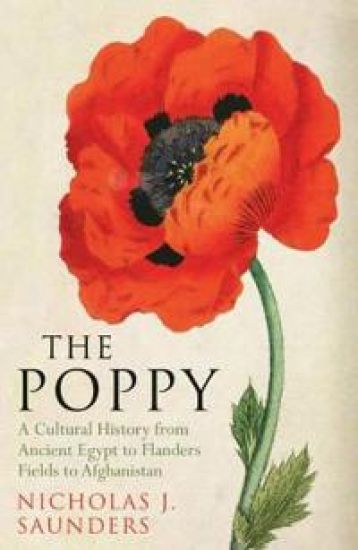
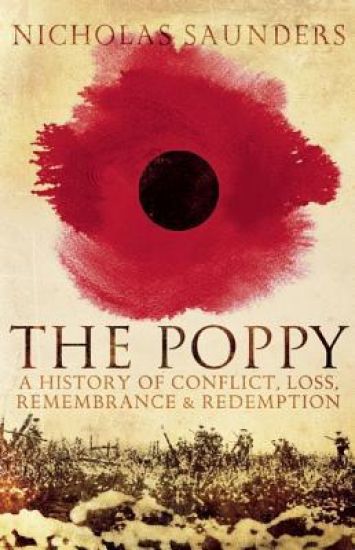
The Poppy

The Poppy

Saunders Nicholas J.

Oneworld Publications
2013
sidottu
In the aftermath of the horrific trench warfare of the First World War, the poppy – sprouting across the killing fields of France and Belgium, then immortalised in John McCrae’s moving poem – became a worldwide icon. Yet the poppy has a longer history, as the tell-tale sign of human cultivation of the land, of the ravages of war and of the desire to escape the earthly realm through inspired Romantic opium dreams or the grim reality of morphine drips. This is a story spanning three thousand years, from the ancient Egyptian fights over prized medicinal potions to the addicted veterans returning home from the American Civil War, from the British political machinations during the Opium Wars with China to the struggle to end Afghanistan’s tribal narcotics trade. Through it all, there stands the transformative poppy. Nicholas J. Saunders brings us the definitive history of this ever-enduring but humble flower of the fields, a story that is at turns tragic, eye-opening and, most essentially, life-affirming – a gift to us all.
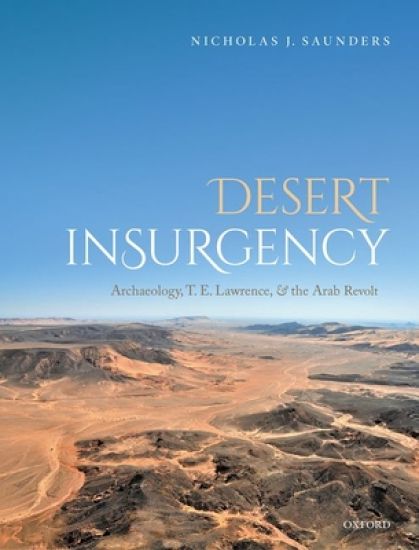
Desert Insurgency

Desert Insurgency

Nicholas J. Saunders

Oxford University Press
2020
sidottu
In the desert sands of southern Jordan lies a once-hidden conflict landscape along the Hejaz Railway. Built at the beginning of the twentieth-century, this narrow-gauge 1,320 km track stretched from Damascus to Medina and served to facilitate participation in the annual Muslim Hajj to Mecca. The discovery and archaeological investigation of an unknown landscape of insurgency and counter-insurgency along this route tells a different story of the origins of modern guerrilla warfare, the exploits of T. E. Lawrence, Emir Feisal, and Bedouin warriors, and the dramatic events of the Arab Revolt of 1916-18. Ten years of research in this prehistoric terrain has revealed sites lost for almost 100 years: vast campsites occupied by railway builders; Ottoman Turkish machine-gun redoubts; Rolls Royce Armoured Car raiding camps; an ephemeral Royal Air Force desert aerodrome; as well as the actual site of the Hallat Ammar railway ambush. This unique and richly illustrated account from Nicholas Saunders tells, in intimate detail, the story of a seminal episode of the First World War and the reshaping of the Middle East that followed.
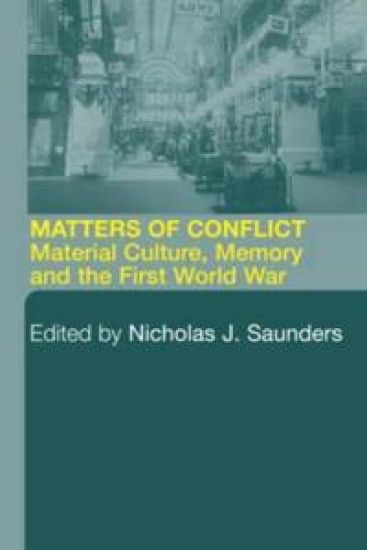
Matters of Conflict

Matters of Conflict

Nicholas J. Saunders

Routledge
2004
sidottu
Matters of Conflict looks at the definitive invention of the twentieth century - industrialised war - and its vast and varied material legacy. From trench art and postcards through avant-garde art, museum collections and prosthetic limbs to battlefield landscapes, the book examines the First World War and its significance through the things it left behind. The contributions come from a multidisciplinary perspective, uniting previously compartmentalized disciplines such as anthropology, archaeology, cultural history, museology and art history in their focus on material culture. This innovative, hybrid approach investigates the 'social life' of objects in order to understand them as they move through time and space and intersect the lives of all who came in contact with them.The resulting survey sets a new agenda for study of the First World War, and ultimately of all twentieth-century conflict.
Matters of Conflict

Matters of Conflict

Nicholas J. Saunders

Routledge
2004
nidottu
Matters of Conflict looks at the definitive invention of the twentieth century - industrialised war - and its vast and varied material legacy. From trench art and postcards through avant-garde art, museum collections and prosthetic limbs to battlefield landscapes, the book examines the First World War and its significance through the things it left behind. The contributions come from a multidisciplinary perspective, uniting previously compartmentalized disciplines such as anthropology, archaeology, cultural history, museology and art history in their focus on material culture. This innovative, hybrid approach investigates the 'social life' of objects in order to understand them as they move through time and space and intersect the lives of all who came in contact with them.The resulting survey sets a new agenda for study of the First World War, and ultimately of all twentieth-century conflict.
The Poppy

The Poppy

Nicholas J. Saunders

Oneworld Publications
2014
pokkari
The definitive history of the ever-enduring icon In the aftermath of the horrific trench warfare of the First World War, the poppy – sprouting across the killing fields of France and Belgium, then immortalized in John McCrae’s moving poem – became a worldwide icon. Yet the poppy has a longer history, as the tell-tale sign of human cultivation of the land, of the ravages of war, and of the desire to escape the earthly realm through opium dreams or morphine drips. From the ancient Egyptian fights over prized potions to the addicts of the American Civil War, to the British entanglements in the Opium Wars with China and the struggle to end Afghanistan’s tribal narcotics trade, there is the poppy.
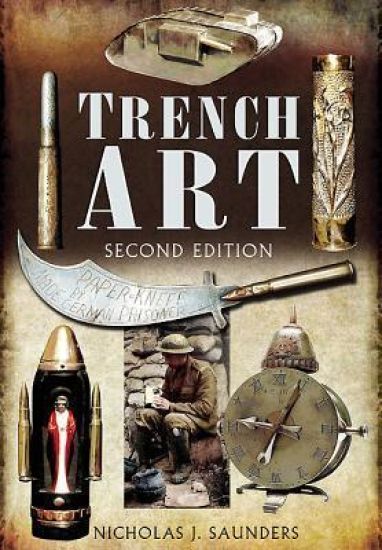
Trench Art

Trench Art

Nicholas J. Saunders

Pen Sword Military
2012
nidottu
Engraved shell-cases, bullet-crucifixes, letter openers and cigarette lighters made of shrapnel and cartridges, miniature aeroplanes and tanks, talismanic jewellery, embroidery, objects carved from stone, bone and wood - all of these things are trench art, the misleading name given to the dazzling array of objects made from the waste of war, in particular the Great War of 1914-1918 and the inter-war years. And they are the subject of Nicholas Saunders's pioneering study which is now republished in a revised edition in paperback. He reveals the lost world of trench art, for every piece relates to the story of the momentous experience of its maker - whether front-line soldier, prisoner of war, or civilian refugee. The objects resonate with the alternating terror and boredom of war, and those created by the prisoners symbolize their struggle for survival in the camps. Many of these items were poignant souvenirs bought by battlefield pilgrims between 1919 and 1939 and kept brightly polished on mantelpieces, often for a lifetime. Nicholas Saunders investigates their origins and how they were made, exploring their personal meaning and cultural significance. He also offers an important categorization of types which will be a useful guide for collectors.
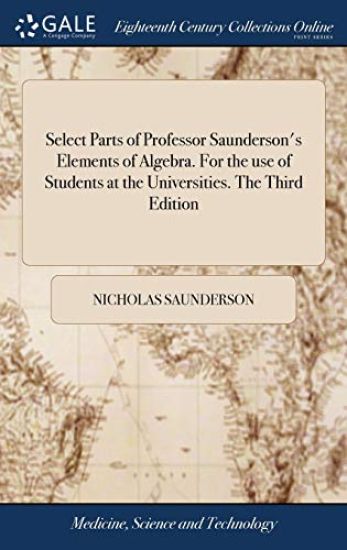
Memoirs of the Life and Character of Dr. Nicholas Saunderson, Late Lucasian Professor of the Mathematics in the University of Cambridge
The 18th century was a wealth of knowledge, exploration and rapidly growing technology and expanding record-keeping made possible by advances in the printing press. In its determination to preserve the century of revolution, Gale initiated a revolution of its own: digitization of epic proportions to preserve these invaluable works in the largest archive of its kind. Now for the first time these high-quality digital copies of original 18th century manuscripts are available in print, making them highly accessible to libraries, undergraduate students, and independent scholars.Rich in titles on English life and social history, this collection spans the world as it was known to eighteenth-century historians and explorers. Titles include a wealth of travel accounts and diaries, histories of nations from throughout the world, and maps and charts of a world that was still being discovered. Students of the War of American Independence will find fascinating accounts from the British side of conflict. ++++The below data was compiled from various identification fields in the bibliographic record of this title. This data is provided as an additional tool in helping to insure edition identification: ++++Cambridge University LibraryT221806Cambridge: printed at the University-Press, 1741. 2], xxvip.; 4
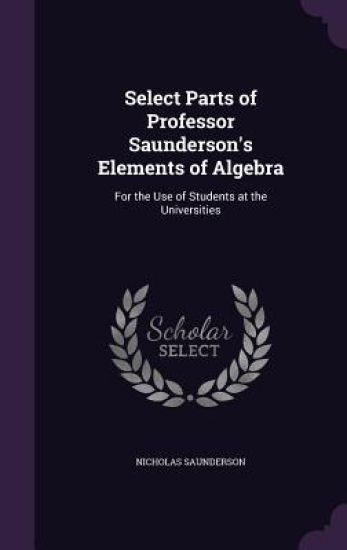
Select Parts of Professor Saunderson's Elements of Algebra. For the use of Students at the Universities. The Third Edition
The 18th century was a wealth of knowledge, exploration and rapidly growing technology and expanding record-keeping made possible by advances in the printing press. In its determination to preserve the century of revolution, Gale initiated a revolution of its own: digitization of epic proportions to preserve these invaluable works in the largest archive of its kind. Now for the first time these high-quality digital copies of original 18th century manuscripts are available in print, making them highly accessible to libraries, undergraduate students, and independent scholars.Medical theory and practice of the 1700s developed rapidly, as is evidenced by the extensive collection, which includes descriptions of diseases, their conditions, and treatments. Books on science and technology, agriculture, military technology, natural philosophy, even cookbooks, are all contained here.++++The below data was compiled from various identification fields in the bibliographic record of this title. This data is provided as an additional tool in helping to insure edition identification: ++++British LibraryT155295London: printed for J. Whiston, W. Bowyer and J. Nichols, J. and F. Rivington, L. Davis, S. Bladon; and J. Woodyer, at Cambridge, 1771. 4],412p., II plates; 8
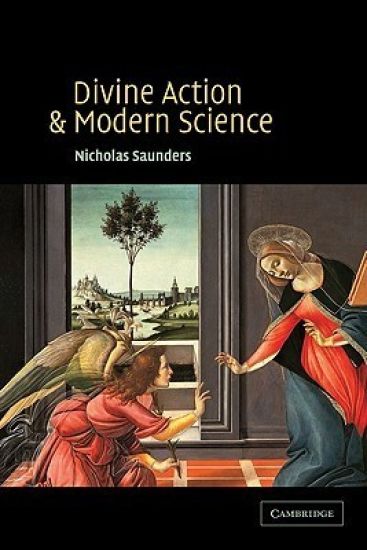
Divine Action and Modern Science

Divine Action and Modern Science

Nicholas Saunders

Cambridge University Press
2002
pokkari
Divine Action and Modern Science considers the relationship between the natural sciences and the concept of God acting in the world. Nicholas Saunders examines the Biblical motivations for asserting a continuing notion of divine action and identifies several different theological approaches to the problem. He considers their theoretical relationships with the laws of nature, indeterminism, and probabilistic causation. His book then embarks on a radical critique of current attempts to reconcile special divine action with quantum theory, chaos theory and quantum chaos. As well as considering the implications of these problems for common interpretations of divine action, Saunders also surveys and codifies the many different theological, philosophical and scientific responses to divine action. The conclusion reached is that we are still far from a satisfactory account of how God might act in a manner that is consonant with modern science despite the copious recent scholarship in this area.