Kirjojen hintavertailu. Mukana 11 244 527 kirjaa ja 12 kauppaa.

Kirjahaku

Etsi kirjoja tekijän nimen, kirjan nimen tai ISBN:n perusteella.

1000 tulosta hakusanalla Nico Stehr; Dustin Voss

Money

Money

Nico Stehr; Dustin Voss

Routledge
2019
sidottu
Since the publication of Georg Simmel’s Philosophy of Money more than a century ago, social science has primarily considered money a medium of exchange. This new book treats money as a more inclusive social concept that has profoundly influenced the emergence of modern society. Money is also a moral and political category. It communicates prices and thus embodies innumerable evaluations and judgments of objects and services, of social relationships and associations.At the same time, modern societies are undergoing fundamental transformations in which money assumes an ever-important role, while banking and financial services constitute the new primary sector of modern service economies. In this book, the authors trace the transformational scope of monetarization and financialization along the four classical productive forces—land, capital, labor, and knowledge—and evaluate the consequences of an irrepressible urge to quantify and monetarize almost everything social. What happens to a society in which the tangible products of the real economy lose their preeminent status, and everything is judged purely according to its economic value? The authors identify an increasing disconnect between market prices and social values with serious social, political, economic, and environmental consequences.

Money

Money

Nico Stehr; Dustin Voss

Routledge
2019
nidottu
Since the publication of Georg Simmel’s Philosophy of Money more than a century ago, social science has primarily considered money a medium of exchange. This new book treats money as a more inclusive social concept that has profoundly influenced the emergence of modern society. Money is also a moral and political category. It communicates prices and thus embodies innumerable evaluations and judgments of objects and services, of social relationships and associations.At the same time, modern societies are undergoing fundamental transformations in which money assumes an ever-important role, while banking and financial services constitute the new primary sector of modern service economies. In this book, the authors trace the transformational scope of monetarization and financialization along the four classical productive forces—land, capital, labor, and knowledge—and evaluate the consequences of an irrepressible urge to quantify and monetarize almost everything social. What happens to a society in which the tangible products of the real economy lose their preeminent status, and everything is judged purely according to its economic value? The authors identify an increasing disconnect between market prices and social values with serious social, political, economic, and environmental consequences.
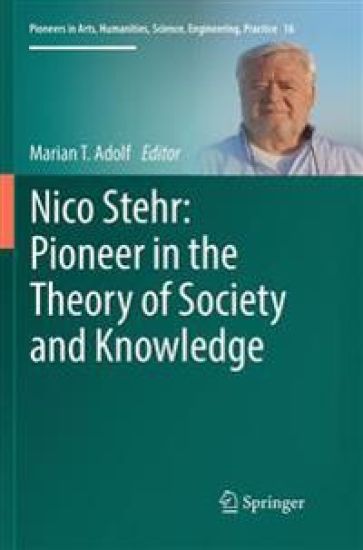
Nico Stehr: Pioneer in the Theory of Society and Knowledge
This unique volume brings together a selection of the most important texts of Nico Stehr for the first time and puts them in dialogue with original research that draws on his prolific work. Covering five decades of pioneering sociological research on the theory of society and knowledge, the book introduces the reader to Stehr’s seminal inquiries into the economic, political and social role of knowledge. Original concepts, such as his groundbreaking studies on the Knowledge Society, are introduced as the volume traces Stehr’s pursuit of social scientific research as a source of practical knowledge for modern society.The book comprises three parts devoted to the many facets and the remarkable range of Nico Stehr’s oeuvre. Part 1 provides an introduction to the significance of his pioneering work and career. Part 2 demonstrates the practical application of Nico Stehr’s research as seen through the eyes of eminent scholars. Part 3 presents a selection ofthe milestones of his publications.
Nico Stehr: Pioneer in the Theory of Society and Knowledge
This unique volume brings together a selection of the most important texts of Nico Stehr for the first time and puts them in dialogue with original research that draws on his prolific work. Covering five decades of pioneering sociological research on the theory of society and knowledge, the book introduces the reader to Stehr’s seminal inquiries into the economic, political and social role of knowledge. Original concepts, such as his groundbreaking studies on the Knowledge Society, are introduced as the volume traces Stehr’s pursuit of social scientific research as a source of practical knowledge for modern society.The book comprises three parts devoted to the many facets and the remarkable range of Nico Stehr’s oeuvre. Part 1 provides an introduction to the significance of his pioneering work and career. Part 2 demonstrates the practical application of Nico Stehr’s research as seen through the eyes of eminent scholars. Part 3 presents a selection ofthe milestones of his publications.
The Governance of Knowledge

The Governance of Knowledge

Nico Stehr

Transaction Publishers
2003
sidottu
Social surveillance and regulation of knowledge will be one of the most important issues in the near future, one that will give rise to unending controversy. In The Governance of Knowledge, Nico Stehr predicts that such concerns will create a new political field, namely, knowledge policy, which will entail regulating dissemination of the anticipated results of rapidly increasing knowledge. The number and range of institutionalized standards for monitoring new knowledge has hitherto been relatively small. Only in cases of technological applications has social control, in the form of political regulation, so far intervened. All modern societies today have complex regulations and extensive concerns with the registration, licensing, testing, and monitoring of pharmaceutical products. The increasingly important and extensive area of intellectual property legislation and administration is an example of social control in which certain measures selectively determine the use of scientific finds and technical knowledge. The Governance of Knowledge assembles a range of essays that attempt to explore the new field of knowledge politics for the first time. It is divided into four parts: The Emergence of Knowledge Politics: Origins, Context, and Consequences; Major Social Institutions and Knowledge Politics; Case Studies on the Governance of Knowledge; and Issues in Knowledge Politics as a New Political Field. Individual chapters concern the emergence of knowledge policy, the embeddedness of such regulations in major social institutions, and offer case studies of the governance of knowledge and discuss controversial issues that are bound to accompany efforts to regulate new knowledge. Professionals and graduate students in the fields of scoiology, political science, social science, and law, including policymakers and natural scientists, will find this book extremely informative.
Biotechnology

Biotechnology

Nico Stehr

Transaction Publishers
2004
sidottu
"While other books have addressed isolated aspects of recent developments in the biomedical sciences, Biotechnology: Between Commerce and Civil Society is the first book tgo engage with the full range of biotechnology's implications for social science and for society at large." -Professor Volker MejaNew scientific knowledge is no longer merely the key to unlocking the secrets of nature and society. It now represents the "becoming" of a new world. Scientific developments affect the ways in which we conduct our affairs, as well as how we comprehend the changes underway as the result of novel technical artefacts and scientific knowledge. The practical fruits of biotechnology are a case in point; they have grasped our imaginations, and generated worldwide debate and concern. Debates on biotechnology shift between images of utopia and dystopia. The social sciences deserve a voice in the debate, and can do so through sober examination of the economic, social, and cultural implications of biotechnology. Some economists even predict that the importance of biotechnology as the technology of the future will far exceed that of the information technologies, in particular the Internet. The contributors to this volume are drawn from a broad spectrum of the social sciences, and include Nico Stehr, Gene Rosa, Steve Fuller, Steve Best and Douglas Kellner, Nikolas Rose, Fred Buttel, Javier Lezaun, Anne Kerr, Susanna Hornig Priest and Toby Ten Eyck, Martin Schulte, Alexander Somek, Steven P. Vallas, Daniel Lee Kleinman, Abby Kinchy and Raul Necochea, Herbert Gottweis, J. Rogers Hollingsworth, Gysli Pblsson, Elizabeth Ettore, Richard Hindmarch and Reiner Grundmann. The impact of science on society is destined to be a fundamental concern in the new century. This volume illustrates the contributions anthropology, law, political science, and sociology can make to the ongoing discussions about the role of biotechnology in modern societies. Nico Stehr is senior research associate, Institut for Technikfolgenabschotzung, Forschungszentrum Karlsruhe and Institut for Kostenforschung, GKSS, Germany. He also is a fellow in the Center for Advanced Cultural Studies in Essen, Germany, editor of the Canadian Journal of Sociology, and a fellow of the Royal Society of Canada. Among his recent books are Werner Sombart: Economic Life in the Modern Age (with Reiner Grundmann, published by Transaction); The Fragility of Modern Societies: Knowledge and Risk in the Information Age; Knowledge and Economic Conduct: The Social Foundations of the Modern Economy; and Wissenspolitik: Die ?berwachung des Wissens.
Knowledge and Economic Conduct

Knowledge and Economic Conduct

Nico Stehr

University of Toronto Press
2002
pokkari
Examining the foundations of the modern capitalist economy from a broad social scientific perspective, this challenging work draws on economics, sociology, political science and geography. The author posits that changing economic circumstances - namely, an end to the primacy of labour and property as determinants of prosperity - have created a need for a new theoretical platform: one that transcends standard economic discourse. In Nico Stehr's view, knowledge is now the most significant source of economic growth - the 'prime productive factor'. This shift has ambiguous ramifications: Will it bring a more sustainable, less ecologically disruptive form of production, or escalating levels of unemployment? Questions of personal engagement are raised: What to be apprehensive about? Where are the possibilities for action in a context where such possibilities are being limited? This book will appeal to students and social scientists with an interest in technology, globalization and the changing economy. It is accessibly written and relevant to researchers and policy makers within the public and private sectors as well as an academic readership.
Knowledge Societies

Knowledge Societies

Nico Stehr

SAGE Publications Ltd
1994
sidottu
In this broad-ranging analysis of the central role that knowledge plays in our life, Nico Stehr critically examines the premises of existing social theory and explores the knowledge relations in advanced societies. The result is a significant new synthesis of social theory. The issues addressed in Knowledge Societies include: the process of scientization; the transformation of the political system by increasingly knowledgeable citizens; the rise of specific areas of expertise and changes in corresponding institutions based on the deployment of specialized knowledge; a shift in the nature of societal conflict from struggles about the allocation of income and property to claims and conflict about generalized human needs; and the emergence of fragility as a basic attribute of modern social organizations. Stehr's argument amply demonstrates that all social theories now need to take account of the changing nature of social relations around knowledge, and it defines the parameters within which this analysis should take place.
Knowledge Societies

Knowledge Societies

Nico Stehr

SAGE Publications Ltd
1994
nidottu
In this broad-ranging analysis of the central role that knowledge plays in our life, Nico Stehr critically examines the premises of existing social theory and explores the knowledge relations in advanced societies. The result is a significant new synthesis of social theory. The issues addressed in Knowledge Societies include: the process of scientization; the transformation of the political system by increasingly knowledgeable citizens; the rise of specific areas of expertise and changes in corresponding institutions based on the deployment of specialized knowledge; a shift in the nature of societal conflict from struggles about the allocation of income and property to claims and conflict about generalized human needs; and the emergence of fragility as a basic attribute of modern social organizations. Stehr's argument amply demonstrates that all social theories now need to take account of the changing nature of social relations around knowledge, and it defines the parameters within which this analysis should take place.
Knowledge Capitalism

Knowledge Capitalism

Nico Stehr

TAYLOR FRANCIS LTD
2022
nidottu
In his newest book, Stehr builds on his classic book Knowledge Societies (1994) to expand the concept toward one of knowledge capitalism for a now, much-changed era. It is not only because of the onset of the Covid-19 pandemic that we are living in a new epoch; it is the idea that modern societies increasingly constitute comprehensive knowledge societies under intensive capitalism, whereby the legal encoding of knowledge through national and international law is the lever that enables the transformation of the knowledge society into knowledge capitalism. The Trade Related Aspects of Intellectual Property Rights agreement, negotiated between 1986 and 1994 as part of the World Trade Organization, is the backbone of the modern society and marks a clear historical demarcation, and although knowledge capitalism is primarily an economic development, the digital giants who are in the driver’s seat have significant effects on the social structure and culture of modern society.
Knowledge Capitalism

Knowledge Capitalism

Nico Stehr

TAYLOR FRANCIS LTD
2022
sidottu
In his newest book, Stehr builds on his classic book Knowledge Societies (1994) to expand the concept toward one of knowledge capitalism for a now, much-changed era. It is not only because of the onset of the Covid-19 pandemic that we are living in a new epoch; it is the idea that modern societies increasingly constitute comprehensive knowledge societies under intensive capitalism, whereby the legal encoding of knowledge through national and international law is the lever that enables the transformation of the knowledge society into knowledge capitalism. The Trade Related Aspects of Intellectual Property Rights agreement, negotiated between 1986 and 1994 as part of the World Trade Organization, is the backbone of the modern society and marks a clear historical demarcation, and although knowledge capitalism is primarily an economic development, the digital giants who are in the driver’s seat have significant effects on the social structure and culture of modern society.
Society and Knowledge in a Turbulent Era

Society and Knowledge in a Turbulent Era

Nico Stehr

EDWARD ELGAR PUBLISHING LTD
2025
sidottu
Society and Knowledge in a Turbulent Era explores the pivotal role of knowledge in contemporary society. Nico Stehr emphasizes its importance in social theory, economic systems and global challenges, particularly in the context of the knowledge economy and knowledge capitalism.Adopting a diagnostic theoretical approach to analyze rapidly changing societal conditions, Stehr argues that knowledge is both a resource and a source of power, shaping social hierarchies and economic structures. He addresses key issues such as global knowledge distribution, social inequality, and the existential threat of climate change. The book bridges multiple disciplines, confronting distinct yet interrelated dimensions of knowledge in society. Chapters discuss the commodification of knowledge, intellectual property regimes, and the rise of artificial intelligence as drivers of economic and social inequality. Stehr showcases the tension between the long- and short-term, and recognizes the importance of looking ahead to tackle climate change and biodiversity loss.This book is especially important for academics and students of sociology, political science, and economics. Environmental and climate scientists, policy analysts, governance experts, and historians of capitalism and modernity will also benefit from its insights.
The World We Have Created

The World We Have Created

Nico Stehr

TAYLOR FRANCIS LTD
2026
nidottu
Addressing the complex interplay between climate change, democratic governance, and scientific knowledge in the Anthropocene era, this book focuses on how political systems respond to the global ecological crisis and to what extent they are structurally capable of doing so. The World We Have Created: Climate, Democracy, and Knowledge details how the de-democratization of ecological decision-making favors models of authoritarian governance, as democratic values such as transparency, participation, and accountability are continually undermined. Offering a robust account of the responses to the climate crisis and the necessary social and political changes posed by the scientific consensus, this book analyses the growing discrepancy between scientific knowledge about the causes and consequences of climate change and the lack of political and social willingness to implement necessary measures. Comprehensive social change is needed that focuses on social justice, intergenerational responsibility, and political participation, and it is only by strengthening democratic structures and integrating knowledge into responsible governance can we open paths to a resilient, just, and liveable future. This sharp, interdisciplinary intervention bridges sociological, political, and philosophical thinking to underline the necessity of hope and utopian social imagination together with concrete changes to the constitution that guarantees a safe environment for future generations.
The World We Have Created

The World We Have Created

Nico Stehr

TAYLOR FRANCIS LTD
2026
sidottu
Addressing the complex interplay between climate change, democratic governance, and scientific knowledge in the Anthropocene era, this book focuses on how political systems respond to the global ecological crisis and to what extent they are structurally capable of doing so. The World We Have Created: Climate, Democracy, and Knowledge details how the de-democratization of ecological decision-making favors models of authoritarian governance, as democratic values such as transparency, participation, and accountability are continually undermined. Offering a robust account of the responses to the climate crisis and the necessary social and political changes posed by the scientific consensus, this book analyses the growing discrepancy between scientific knowledge about the causes and consequences of climate change and the lack of political and social willingness to implement necessary measures. Comprehensive social change is needed that focuses on social justice, intergenerational responsibility, and political participation, and it is only by strengthening democratic structures and integrating knowledge into responsible governance can we open paths to a resilient, just, and liveable future. This sharp, interdisciplinary intervention bridges sociological, political, and philosophical thinking to underline the necessity of hope and utopian social imagination together with concrete changes to the constitution that guarantees a safe environment for future generations.
Information, Power, and Democracy

Information, Power, and Democracy

Nico Stehr

Cambridge University Press
2015
sidottu
The link between liberty and knowledge is neither static nor simple. Until recently the mutual support between knowledge, science, democracy and emancipation was presupposed. Recently, however, the close relationship between democracy and knowledge has been viewed with skepticism. The growing societal reliance on specialized knowledge often appears to actually undermine democracy. Is it that we do not know enough, but that we know too much? What are the implications for the freedom of societies and their citizens? Does knowledge help or heed them in unraveling the complexity of new challenges? This book systematically explores the shifting dynamics of knowledge production and the implications for the conditions and practices of freedom. It considers the growth of knowledge about knowledge and the impact of an evolving media. It argues for a revised understanding of the societal role of knowledge and presents the concept of 'knowledge societies' as a major resource for liberty.
Biotechnology

Biotechnology

Nico Stehr

Routledge
2017
nidottu
"While other books have addressed isolated aspects of recent developments in the biomedical sciences, Biotechnology: Between Commerce and Civil Society is the first book tgo engage with the full range of biotechnology's implications for social science and for society at large." -Professor Volker MejaNew scientific knowledge is no longer merely the key to unlocking the secrets of nature and society. It now represents the "becoming" of a new world. Scientific developments affect the ways in which we conduct our affairs, as well as how we comprehend the changes underway as the result of novel technical artefacts and scientific knowledge. The practical fruits of biotechnology are a case in point; they have grasped our imaginations, and generated worldwide debate and concern. Debates on biotechnology shift between images of utopia and dystopia. The social sciences deserve a voice in the debate, and can do so through sober examination of the economic, social, and cultural implications of biotechnology. Some economists even predict that the importance of biotechnology as the technology of the future will far exceed that of the information technologies, in particular the Internet. The contributors to this volume are drawn from a broad spectrum of the social sciences, and include Nico Stehr, Gene Rosa, Steve Fuller, Steve Best and Douglas Kellner, Nikolas Rose, Fred Buttel, Javier Lezaun, Anne Kerr, Susanna Hornig Priest and Toby Ten Eyck, Martin Schulte, Alexander Somek, Steven P. Vallas, Daniel Lee Kleinman, Abby Kinchy and Raul Necochea, Herbert Gottweis, J. Rogers Hollingsworth, Gysli Pblsson, Elizabeth Ettore, Richard Hindmarch and Reiner Grundmann. The impact of science on society is destined to be a fundamental concern in the new century. This volume illustrates the contributions anthropology, law, political science, and sociology can make to the ongoing discussions about the role of biotechnology in modern societies. Nico Stehr is senior research associate, Institut for Technikfolgenabschotzung, Forschungszentrum Karlsruhe and Institut for Kostenforschung, GKSS, Germany. He also is a fellow in the Center for Advanced Cultural Studies in Essen, Germany, editor of the Canadian Journal of Sociology, and a fellow of the Royal Society of Canada. Among his recent books are Werner Sombart: Economic Life in the Modern Age (with Reiner Grundmann, published by Transaction); The Fragility of Modern Societies: Knowledge and Risk in the Information Age; Knowledge and Economic Conduct: The Social Foundations of the Modern Economy; and Wissenspolitik: Die ?berwachung des Wissens.
Knowledge and Democracy

Knowledge and Democracy

Nico Stehr

Routledge
2017
nidottu
The relationship of knowledge and liberties in modern societies presents a multitude of fascinating issues that deserve to be explored more systematically. The production of knowledge is dynamic, and the conditions and practice of freedom is undergoing transformation. These changes ensure that the linkages between liberty and knowledge are always subject to changes. In the past, the connection between scientific knowledge, democracy, and emancipation seemed self-evident. More recently, the close linkage between democracy and knowledge has been viewed with skepticism.This volume explores the relationship between knowledge and democracy, Do they support each other, do they mutually depend on each other, or are they perhaps even in conflict with each other? Does knowledge increase the freedom to act? If additional knowledge contributes to individual and social well being, does it also enhance freedoms? Knowledge and Democracy focuses on the interpenetration of knowledge, freedom and democracy, and does so from various perspectives, theoretical as well as practical.Modern societies are transforming themselves into knowledge societies. This has a fundamental impact on political systems and the relationship of citizens to large social institutions. The contributors to this book systemically explore whether, and in what ways, these modern-day changes and developments are connected to expansion of the capacities of individual citizens to act. They focus on the interrelation of democracy and knowledge, and the role of democratic institutions, as well as on the knowledge and social conduct of actors within democratic institutions. In the process of investigation, they arrive at a new platform for future research and theory, one that is sensitive to present-day societal conflicts, cleavages, and transformations generated by new knowledge. In this way, this volume will attract the interest of political scientists, sociologists, economists and students within various disciplines.
Knowledge and Democracy

Knowledge and Democracy

Nico Stehr

AldineTransaction
2008
sidottu
The relationship of knowledge and liberties in modern societies presents a multitude of fascinating issues that deserve to be explored more systematically. The production of knowledge is dynamic, and the conditions and practice of freedom is undergoing transformation. These changes ensure that the linkages between liberty and knowledge are always subject to changes. In the past, the connection between scientific knowledge, democracy, and emancipation seemed self-evident. More recently, the close linkage between democracy and knowledge has been viewed with skepticism.This volume explores the relationship between knowledge and democracy, Do they support each other, do they mutually depend on each other, or are they perhaps even in conflict with each other? Does knowledge increase the freedom to act? If additional knowledge contributes to individual and social well being, does it also enhance freedoms? Knowledge and Democracy focuses on the interpenetration of knowledge, freedom and democracy, and does so from various perspectives, theoretical as well as practical.Modern societies are transforming themselves into knowledge societies. This has a fundamental impact on political systems and the relationship of citizens to large social institutions. The contributors to this book systemically explore whether, and in what ways, these modern-day changes and developments are connected to expansion of the capacities of individual citizens to act. They focus on the interrelation of democracy and knowledge, and the role of democratic institutions, as well as on the knowledge and social conduct of actors within democratic institutions. In the process of investigation, they arrive at a new platform for future research and theory, one that is sensitive to present-day societal conflicts, cleavages, and transformations generated by new knowledge. In this way, this volume will attract the interest of political scientists, sociologists, economists and students within various disciplines.
The Governance of Knowledge

The Governance of Knowledge

Nico Stehr

AldineTransaction
2017
nidottu
Social surveillance and regulation of knowledge will be one of the most important issues in the near future, one that will give rise to unending controversy. In The Governance of Knowledge, Nico Stehr predicts that such concerns will create a new political field, namely, knowledge policy, which will entail regulating dissemination of the anticipated results of rapidly increasing knowledge. The number and range of institutionalized standards for monitoring new knowledge has hitherto been relatively small. Only in cases of technological applications has social control, in the form of political regulation, so far intervened. All modern societies today have complex regulations and extensive concerns with the registration, licensing, testing, and monitoring of pharmaceutical products. The increasingly important and extensive area of intellectual property legislation and administration is an example of social control in which certain measures selectively determine the use of scientific finds and technical knowledge. The Governance of Knowledge assembles a range of essays that attempt to explore the new field of knowledge politics for the first time. It is divided into four parts: The Emergence of Knowledge Politics: Origins, Context, and Consequences; Major Social Institutions and Knowledge Politics; Case Studies on the Governance of Knowledge; and Issues in Knowledge Politics as a New Political Field. Individual chapters concern the emergence of knowledge policy, the embeddedness of such regulations in major social institutions, and offer case studies of the governance of knowledge and discuss controversial issues that are bound to accompany efforts to regulate new knowledge. Professionals and graduate students in the fields of scoiology, political science, social science, and law, including policymakers and natural scientists, will find this book extremely informative.
Knowledge Politics

Knowledge Politics

Nico Stehr

Paradigm
2005
sidottu
This book argues that new technologies and society's response to them have created a relatively new phenomenon, "knowledge politics." Nico Stehr describes Western society's response to a host of new technologies developed only since the 1970s, including genetic experiments, test-tube human conception, recombinant DNA, and embryonic stem cells; genetically engineered foods; neurogenetics and genetic engineering; and reproductive cloning and the reconstruction of the human ancestral genome. He looks also at the prospective fusion of nanotechnology, biotechnology, information technology, transgenic human engineering, and cognitive science whose products may, as its boosters claim, some day cure disease, slow the aging process, eliminate pollution, and generally enhance human performance. Knowledge Politics shows how human civilization has reached a new era of concern about the life-altering potentials of new technologies. Concerns about the societal consequences of an unfettered expansion of (natural) scientific knowledge are being raised more urgently and are moving to the center of disputes in society-- and thus to the top of the political agenda. Stehr explains the ramifications of knowledge politics and the approaches society could take to resolve difficult questions and conflicts over present and future scientific innovation.