Kirjojen hintavertailu. Mukana 11 517 516 kirjaa ja 12 kauppaa.

Kirjahaku

Etsi kirjoja tekijän nimen, kirjan nimen tai ISBN:n perusteella.

1000 tulosta hakusanalla Niklas Sundqvist

Lucy och andra noveller

Lucy och andra noveller

Niklas Sundqvist

Solentro
2017
nidottu
Ta vara på livet i Wayne City. Utelämna inget åt din fantasi när du beger dig till St:amy. Här kan allt hända. Precis som i den riktiga världen där du och jag lever. Här kan barn vara utan empati och vuxna kan vara påverkade av satan. Precis som din granne, vän eller kollega kan ha ett mörkt förhållande till livet. Och det får du bara veta den dagen du försöker ta reda på det...
Religionshistoria : en introduktion till teori och metod

Religionshistoria : en introduktion till teori och metod

Egil Asprem; Olof Sundqvist; Jenny Berglund; Niklas Foxeus; Peter Jackson Rova; Henrik Johnsén; Marja-Liisa Keinänen; Andreas Nordberg; Susanne Olsson; Willy Pfändtner

Studentlitteratur AB
2021
nidottu
I denna introduktion till religionshistoriens teori och metod beskrivs ämnets innehåll, karaktär och gränser: Vad är religionshistoria, vilka frågor ställer en religionshistoriker och hur skiljer ämnet sig från andra närliggande ämnen? I den första delen introduceras olika sätt att studera och synliggöra religion. Här presenteras jämförande, historiska, etnografiska, sociologiska, kognitionsvetenskapliga, genusvetenskapliga, postkoloniala, politiska och didaktiska perspektiv på religion. I bokens andra del behandlas centrala religionshistoriska begrepp och hur de kan användas i vetenskapliga sammanhang. Här ges pedagogiska beskrivningar av magi, gudar, myt, rit, symbol, asketism och sekularisering. Boken är avsedd för studenter på grundnivå i religionshistoria, men är även användbar i andra ämnen där studiet av religion utgör en viktig del. Den kan läsas av studenter och andra intresserade utan närmare förkunskaper, men också utgöra ett referensverk för de studenter som kommit längre i sina studier.
Kemiboken nivå 1

Kemiboken nivå 1

Anna Johansson; Cecilia Stenberg; Sten-Åke Sundkvist; Niklas Wästeby

Liber
2025
nidottu
Den pedagogiska tanken med Kemiboken nivå 1 enligt Gy25 är att elevernas inlärning ska underlättas genom 1) praktiska moment i böckerna i form av övningar, experiment och laborationer, 2) kapitelinledningar som ger eleverna överblick över vad de bör lära sig och vilka begrepp som är särskilt viktiga och 3) övningsuppgifter i slutet av kapitlen som bygger på kognitionsvetenskaplig forskning enligt principerna för ”goda frågor”. Svaren finns i slutet av boken, medan ett utförligt facit finns att ladda ner på liber.se Kemiboken nivå 1 innehåller 9 kapitel. Efter ett inledande kapitel om ämnen och reaktioner följer ett om kemins arbetsmetoder, där även riskbedömning, kemi och etik samt principerna för grön kemi ingår. Analytisk kemi har inget eget kapitel, utan metoderna tas upp i de olika kapitel där de hör hemma. Kemitekniska tillämpningar för hållbar utveckling tas främst upp i kapitlen om kolföreningar, energi respektive reduktion och oxidation. Till Kemiboken nivå 1 finns en lärarhandledning med fler laborationer, riskbedömningar av alla laborationer och experiment, arbetsövningar och fler övningsuppgifter. Det finns också ett kostnadsfritt, digitalt övningsmaterial med flervalsfrågor som hjälper eleverna att nöta in basfakta och begrepp. Det är lämpligt att eleverna tränar på detta hemma efter varje nytt moment, eller att läraren avsätter tid i slutet av lektionen. Forskningsresultat visar att detta ökar förmågan att skapa långtidsminnen – alltså att eleverna lär sig lättare. Kemiboken nivå 1 är utarbetat för elever som läser den första kursen i kemi på gymnasiet, komvux och naturvetenskapligt eller tekniskt basår. Språket är bearbetat för att passa alla elevkategorier.
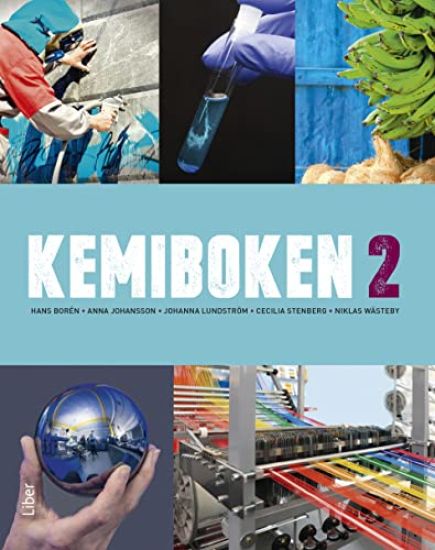
Kemiboken 2

Kemiboken 2

Hans Borén; Manfred Börner; Anna Johansson; Johanna Lundström; Maud Ragnarsson; Sten-Åke Sundkvist; Cecilia Stenberg; Niklas Wästeby

Liber
2020
nidottu
Med Kemibokens upplägg med experiment, vardagsanknytningar och ett lättillgängligt språk får alla gymnasieelever en god grund i kemi. Kemiboken 2 är skriven för kursen Kemi 2 på gymnasienivå. UppläggKapitlen inleds med kunskapskraven och de centrala begreppen, som sedan förklaras inne i kapitlet. Eleverna lotsas genom kemin med hjälp av lösta exempel, och testar sedan sig själva med de många uppgifterna, som är förmåge-taggade, och som syftar till att väcka intresse och få eleverna att fundera. InnehållI Kemiboken 2 ingår reaktionshastigheter, kemisk jämvikt, organisk kemi, analytisk kemi samt biokemi med tyngdpunkten på processer i människokroppen. I upplaga 6 har kapitlen om organisk kemi fokus på en tydlig systematik kring olika organiska ämnesklassers egenskaper, strukturer och funktionalitet. Kapitlet om organiska reaktionsmekanismer är förstärkt med nya exempel och uppgifter som ger förklaringsmodeller till hur organiska reaktioner sker. I kapitlet om analytisk kemi ingår beskrivningar av provberedning, och hantering av data och felkällor vid kemisk analys. Olika spektroskopiska analysmetoder beskrivs med exempel på hur man tolkar analysspektrum från MS, IR och NMR. I slutet av boken finns ett urval av laborationer.Facit som hämtningsbar pdf och Digitalt övningsmaterial-länk finns på www.liber.se.
Militära arbetsmetoder : En lärobok i krigsvetenskap

Militära arbetsmetoder : En lärobok i krigsvetenskap

Peter Thunholm; Jerker Widén; Niklas Wikström; Arne Baudin; Torsten Björkman; Anders Cedergren; Johan Elg; Håkan Gunneriusson; Ulf Högström; Stefan Lundqvist; Anders Palmgren

Roos Tegner
2018
kartonkisidos
Boken behandlar militära arbetsmetoder och syftet är att introducera och förklara de metoder som används för att förbereda, utföra och värdera militära operationer. Boken är även avsedd att fylla en lucka i befintlig militär metodlitteratur genom att ge en historisk förankring och forskningsanknytning till de militära arbetsmetoderna. Genom att beskriva den historiska utvecklingen av en arbetsmetod och koppla den till befintlig forskning ger boken en unik bakgrundsbeskrivning och problematiserande analys av de vanligaste militära arbetsmetoderna. Boken innehåller några övergripande teman. Det första är kopplat till officerens roll som chef och stabsmedlem. Inom detta tema beskrivs de metoder som används i den militära ledningsprocessen, det vill säga planering, genomförandeledning, uppföljning och utvärdering. Det andra är kopplat till officerens roll som utbildare och inom detta tema beskrivs de militära utbildnings- och arbetsmetoder som används för analys av strid i rummet eller terrängen, till exempel krigsspel, fältövningar och terränganalys. Ett tredje tema i boken är kopplingen mellan arbetsmetod och aktuell forskning.
Bild & Bubbla. 209

Bild & Bubbla. 209

Stef Gaines; Fredrik Strömberg; Ola Lundqvist; Claes Reimerthi; Patrik Schylström; Nikolas Krizan; Charlotta Borelius; Eugen Semitjov; Thomas Storn

Seriefrämjandet
2009
lehtivihko, moniste
Bild & Bubbla nummer 209 visar med sitt innehåll upp hela bredden av seriekonsten va idag, och igår. Numret innehåller till exempel intervjuer med serieskaparna och illustratörerna Gunnar Lundkvist (Klas Katt), Nina Höglund () och John Andersson (Sittplats nio på Kristallrepet) Tidskiften innehåller vidare en artikel om den klassiska barnserietidningen Tuff & Tuss, en intervju med förläggarna Per Myrhill (Plutonium Comics) och Ola Forssblad (Home Made Comics) samt en förhandstitt på Fabian Göransons kommande seriebok Martilo. Dessutom rapporter från jorden alla hörn av våra korrespondenter, recensioner av nyutkomna serieböcker, porträtt av redaktören Charlotta Borelius (Bamse) med mera.
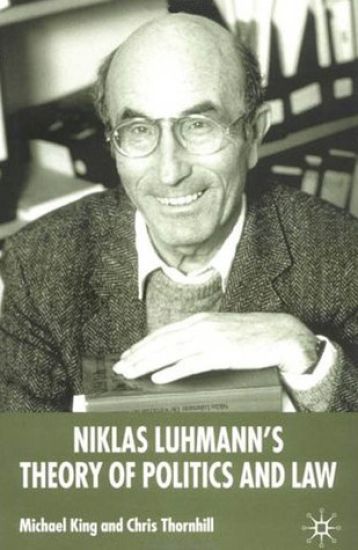
Niklas Luhmann's Theory of Politics and Law

Niklas Luhmann's Theory of Politics and Law

M. King; C. Thornhill

Palgrave Macmillan
2003
sidottu
Niklas Luhmann's social theory stands in direct opposition to the dominant 'anthropocentric' traditions of legal and political analysis. King and Thornhill now offer the first comprehensive, critical examination of Luhmann's highly original theory of the operations of the legal and political systems. They describe how from the perspective of his 'sociological enlightenment' Luhmann continually calls to account the certainties, the ambitions and rational foundations of The Enlightenment and the idealized versions of law and politics which they have produced.
Niklas Luhmann: Law, Justice, Society

Niklas Luhmann: Law, Justice, Society

Andreas Philippopoulos-Mihalopoulos

Routledge
2009
sidottu
Niklas Luhmann: Law, Justice, Society presents the work of sociologist Niklas Luhmann in a radical new light. Luhmann’s theory is here introduced both in terms of society at large and the legal system specifically, and for the first time, Luhmann’s texts are systematically read together with theoretical insights from post-structuralism, deconstruction, phenomenology, radical ethics, feminism and post-ecologism. In his far-reaching book, Andreas Philippopoulos-Mihalopoulos distances Luhmann’s theory from its misrepresentations as conservative, rigorously positivist and disconnected from empirical reality, and firmly locates it in a sphere of post-ideological jurisprudence.The book operates both as a detailed explanation of the theory’s concepts and as the locus of a critique which brings forth Luhmann’s radical credentials. The focal points are Luhmann’s concept of society and the law’s paradoxical connection to justice. However, these concepts are also transgressed in order to show how the law deals with the illusion of its identity, and more broadly how the theory itself deals with its limitations. This is illustrated by examples drawn from human rights, constitutional theory and ecological thinking. On the whole, Niklas Luhmann: Law, Justice, Society serves both as an introductory text and as a critical response to Luhmann’s theory, and is recommended reading for students and researchers in sociology, law, social sciences, politics and whoever is interested in seeing the influential work of Niklas Luhmann from a critical new perspective.
Niklas Luhmann

Niklas Luhmann

Christian Borch

Routledge
2011
sidottu
Niklas Luhmann offers an accessible introduction to one of the most important sociologists of our time. It presents the key concepts within Luhmann’s multifaceted theory of modern society, and compares them with the work of other key social theorists such as Jürgen Habermas, Michel Foucault, and Zygmunt Bauman.The book pays particular attention to introducing and discussing Luhmann’s original sociological systems theory. It presents a thorough investigation into the different phases of his oeuvre, through which both the shifting emphases as well as the continuities in his thinking are shown. The primary focus of this text is Luhmann’s theory of modern society as being differentiated into a plethora of ‘function systems’ – such as politics, law, and economy – which operate according to their own distinct logics and which cannot interfere with one another. For Luhmann, this functional differentiation works as a bulwark against totalitarian rule, and as such is a key foundation of modern democracy. Furthermore, the book critically examines the implications of this functional differentiation for inclusion and exclusion dynamics, as well as for the understanding of power and politics.This is a key text for both undergraduate and postgraduate students of areas including contemporary social theory, political sociology, and sociology.
Niklas Luhmann

Niklas Luhmann

Christian Borch

Routledge
2011
nidottu
Niklas Luhmann offers an accessible introduction to one of the most important sociologists of our time. It presents the key concepts within Luhmann’s multifaceted theory of modern society, and compares them with the work of other key social theorists such as Jürgen Habermas, Michel Foucault, and Zygmunt Bauman.The book pays particular attention to introducing and discussing Luhmann’s original sociological systems theory. It presents a thorough investigation into the different phases of his oeuvre, through which both the shifting emphases as well as the continuities in his thinking are shown. The primary focus of this text is Luhmann’s theory of modern society as being differentiated into a plethora of ‘function systems’ – such as politics, law, and economy – which operate according to their own distinct logics and which cannot interfere with one another. For Luhmann, this functional differentiation works as a bulwark against totalitarian rule, and as such is a key foundation of modern democracy. Furthermore, the book critically examines the implications of this functional differentiation for inclusion and exclusion dynamics, as well as for the understanding of power and politics.This is a key text for both undergraduate and postgraduate students of areas including contemporary social theory, political sociology, and sociology.
Niklas Luhmann: Law, Justice, Society

Niklas Luhmann: Law, Justice, Society

Andreas Philippopoulos-Mihalopoulos

Routledge
2011
nidottu
Niklas Luhmann: Law, Justice, Society presents the work of sociologist Niklas Luhmann in a radical new light. Luhmann’s theory is here introduced both in terms of society at large and the legal system specifically, and for the first time, Luhmann’s texts are systematically read together with theoretical insights from post-structuralism, deconstruction, phenomenology, radical ethics, feminism and post-ecologism. In his far-reaching book, Andreas Philippopoulos-Mihalopoulos distances Luhmann’s theory from its misrepresentations as conservative, rigorously positivist and disconnected from empirical reality, and firmly locates it in a sphere of post-ideological jurisprudence.The book operates both as a detailed explanation of the theory’s concepts and as the locus of a critique which brings forth Luhmann’s radical credentials. The focal points are Luhmann’s concept of society and the law’s paradoxical connection to justice. However, these concepts are also transgressed in order to show how the law deals with the illusion of its identity, and more broadly how the theory itself deals with its limitations. This is illustrated by examples drawn from human rights, constitutional theory and ecological thinking. On the whole, Niklas Luhmann: Law, Justice, Society serves both as an introductory text and as a critical response to Luhmann’s theory, and is recommended reading for students and researchers in sociology, law, social sciences, politics and whoever is interested in seeing the influential work of Niklas Luhmann from a critical new perspective.
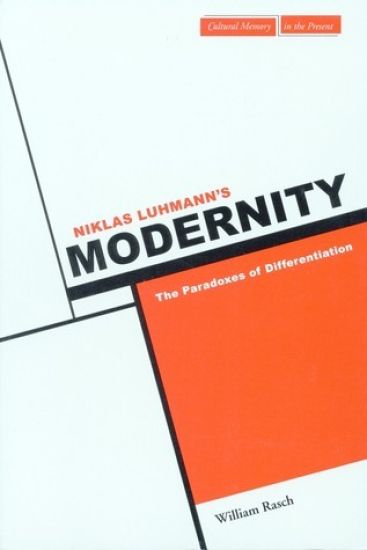
Niklas Luhmann's Modernity

Niklas Luhmann's Modernity

William W. Rasch

Stanford University Press
2000
sidottu
This book is an introduction to the nature of modernity as envisioned by Germany's leading social theorist of the late twentieth century, Niklas Luhmann. For Luhmann, modernity is neither an Enlightenment project nor a ludic rejection of that project, but rather the pre-condition of all our deliberations, the structure within which our semantics makes sense, even as we think we celebrate (or mourn) its passing. Rather than viewing modernity as a disease for which we seek a cure, Luhmann poses it as a question to which we continually devise incomplete and partial answers. When we grow impatient with the contingency and indeterminacy that is thus forced upon us and seek solace in community, religion (orthodox or civic), consensus, and a universal vision of the good life, we grow impatient with modernity itself. The book injects concepts derived from Luhmann's influential systems theory (complexity, contingency, and enforced selectivity; system differentiation, self-referential closure, and autopoiesis) into debates about modernity and postmodernity, constructivist and foundationalist epistemologies, the relationship between politics and ethics, and the possibilities of interdisciplinary work that spans the great divide between science and the humanities. Delighting in Luhmann's provocatively cool and dispassionate bursting of cherished balloons, the book stages challenging engagements with such thinkers as Jürgen Habermas, Jacques Derrida, Jean-François Lyotard, Drucilla Cornell, Judith Butler, Michel Serres, N. Katherine Hayles, and such political theorists as Chantal Mouffe and Carl Schmitt. The irrepressibility of paradox emerges as a stubborn feature of all of these confrontations. The book closes with two interviews: one a discussion with Luhmann and Hayles on epistemology, the other with Luhmann on the functional differentiation of modern society.
Niklas Luhmann's Modernity

Niklas Luhmann's Modernity

William W. Rasch

Stanford University Press
2000
pokkari
This book is an introduction to the nature of modernity as envisioned by Germany's leading social theorist of the late twentieth century, Niklas Luhmann. For Luhmann, modernity is neither an Enlightenment project nor a ludic rejection of that project, but rather the pre-condition of all our deliberations, the structure within which our semantics makes sense, even as we think we celebrate (or mourn) its passing. Rather than viewing modernity as a disease for which we seek a cure, Luhmann poses it as a question to which we continually devise incomplete and partial answers. When we grow impatient with the contingency and indeterminacy that is thus forced upon us and seek solace in community, religion (orthodox or civic), consensus, and a universal vision of the good life, we grow impatient with modernity itself. The book injects concepts derived from Luhmann's influential systems theory (complexity, contingency, and enforced selectivity; system differentiation, self-referential closure, and autopoiesis) into debates about modernity and postmodernity, constructivist and foundationalist epistemologies, the relationship between politics and ethics, and the possibilities of interdisciplinary work that spans the great divide between science and the humanities. Delighting in Luhmann's provocatively cool and dispassionate bursting of cherished balloons, the book stages challenging engagements with such thinkers as Jürgen Habermas, Jacques Derrida, Jean-François Lyotard, Drucilla Cornell, Judith Butler, Michel Serres, N. Katherine Hayles, and such political theorists as Chantal Mouffe and Carl Schmitt. The irrepressibility of paradox emerges as a stubborn feature of all of these confrontations. The book closes with two interviews: one a discussion with Luhmann and Hayles on epistemology, the other with Luhmann on the functional differentiation of modern society.
Niklas Luhmann's Theory of Politics and Law

Niklas Luhmann's Theory of Politics and Law

M. King; C. Thornhill

Palgrave Macmillan
2003
nidottu
Niklas Luhmann's social theory stands in direct opposition to the dominant 'anthropocentric' traditions of legal and political analysis. King and Thornhill now offer the first comprehensive, critical examination of Luhmann's highly original theory of the operations of the legal and political systems. They describe how from the perspective of his 'sociological enlightenment' Luhmann continually calls to account the certainties, the ambitions and rational foundations of The Enlightenment and the idealized versions of law and politics which they have produced.
Niklas Rogers

Niklas Rogers

Adamarie Dundon

AuthorHouse
2004
pokkari
Niklas Rogers, now 12, has always known that he was different from the other kids. Through a twist of events, some tragic, some bizarre and some mystical, he discovers that he posses a very special gift. In Niklas' own words, he tells a tale about his life and the days leading up to his magical discovery. His love for nature, takes on a whole new meaning.
Niklas Luhmann

Niklas Luhmann

Walter de Gruyter
2013
sidottu
Niklas Luhmanns "Soziale Systeme" (1984) bildet den Grundstein der von ihm ausgearbeiteten Systemtheorie; das Werk ist die Einleitung in seine "Theorie der Gesellschaft".Hier entfaltet er seine systemtheoretische Terminologie, wobei oft dieselben Begriffe wie in der traditionellen Terminologie auftauchen, von Luhmann in der eigenen Gesellschaftstheorie jedoch anders gef llt werden. Die Beitr ge des vorliegenden Bandes ebnen vor diesem Hintergrund den Zugang zur Luhmannschen Theorie und zeigen auf, dass sie wie jede Theorie ein Konstrukt ist, das uns hilft, die Realit t zu erfassen. Die Autorinnen und Autoren des kooperativen Kommentars zu Luhmanns Werk "Soziale Systeme" sind namhafte Theoretikerinnen und Theoretiker, die ihr Forschen in engem Zusammenhang mit der Luhmannschen Theorie betreiben. In den Beitr gen dieses Bandes werden die Leserinnen und Leser ber den Inhalt des Buchs von Luhmann informiert und dessen Kapitel, der Chronologie des Originalwerks folgend, f r ein besseres und erweitertes Verst ndnis aufgeschlossen. MIT BEITR GEN VON: Dirk Baecker, Cornelia Bohn, Marcus Emmerich, Elena Esposito, Dietmar Gensicke, Detlef Horster, Christina Huber, Maren Lehmann, Julian M ller, Armin Nassehi, Martin Petzke, William Rasch, Anna Schriefl, Michael Urban, Christine Weinbach und Niels Werber.
Niklas Luhmann

Niklas Luhmann

Claudio Baraldi; Giancarlo Corsi

Springer International Publishing AG
2016
nidottu
This book provides an insight into the ideas of one of the world’s greatest sociologists: Niklas Luhmann. It explains, in clear and concise language, the basic concepts of Social Systems Theory and their application to the specific case of the Education System, which was considered by Luhmann as a primary subsystem of modern society. It illustrates the complex and sophisticated thinking that characterises Luhmann’s work and explains that Luhmann’s theory has given an important and original contribution to the study of education from a sociological point of view. His contribution has some resonance in recent social constructionist and relational approaches to education, as well as in studies of educational interaction. In addition, research methodologies, in particular mixed methods strategies, draw heavily on epistemological issues. The book finally argues that educationists can appreciate the extent of Luhmann’s contribution to the field of education, although their perspective cannot be fully harmonised with, nor reduced to, the sociological one. This divergence of perspectives can stimulate pedagogy to call into question its conceptual framework as well its approach to social situations in the classroom.