Kirjahaku
Etsi kirjoja tekijän nimen, kirjan nimen tai ISBN:n perusteella.
1000 tulosta hakusanalla Oliver F. R. Haardt

The Philosophies of F. R. Tennant and John Dewey
J. Oliver Buswell Jr
Literary Licensing, LLC
2011
sidottu
The Philosophies of F. R. Tennant and John Dewey is a book written by J. Oliver Buswell Jr. that explores the philosophical ideas of two prominent thinkers of the early 20th century. The book provides an in-depth analysis of the ideas and arguments put forth by F. R. Tennant and John Dewey, examining their views on topics such as metaphysics, epistemology, ethics, and religion.Tennant was a British philosopher who believed in the importance of reason and empirical evidence in understanding the world. He argued that the universe was a rational and ordered system, and that humans could use their reason to uncover its secrets. Dewey, on the other hand, was an American philosopher who emphasized the importance of experience and practical knowledge in understanding the world. He believed that knowledge was not static, but rather constantly evolving through experimentation and observation.Buswell Jr. compares and contrasts the philosophies of Tennant and Dewey, highlighting their similarities and differences. He also explores the impact that their ideas had on the development of philosophy in the 20th century, and how their work continues to influence contemporary thought.Overall, The Philosophies of F. R. Tennant and John Dewey is a comprehensive and insightful examination of two important philosophical thinkers, and their contributions to the field of philosophy.This scarce antiquarian book is a facsimile reprint of the old original and may contain some imperfections such as library marks and notations. Because we believe this work is culturally important, we have made it available as part of our commitment for protecting, preserving, and promoting the world's literature in affordable, high quality, modern editions, that are true to their original work.
The Philosophies of F. R. Tennant and John Dewey
J. Oliver Buswell Jr
Literary Licensing, LLC
2011
nidottu
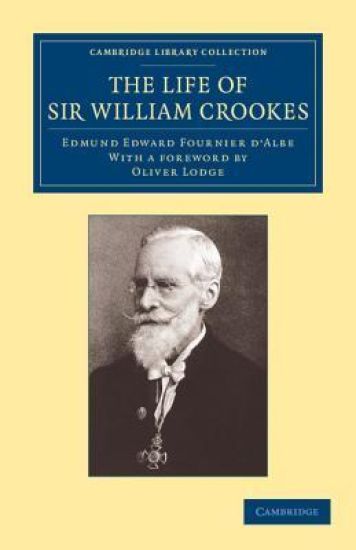
The Life of Sir William Crookes, O.M., F.R.S.
Edmund Edward Fournier d'Albe; Oliver Lodge
Cambridge University Press
2013
pokkari
In 1870, Sir William Crookes (1832–1919) travelled to Gibraltar to observe the solar eclipse. He kept a diary and produced beautiful accounts of the expedition - alongside altogether more specific observations, including the 656 steps down a local cliff face, and every item in his luggage. It is with the same meticulous approach and cheerful prose that he records, in letters, journal articles and reports, the successes and failures of the vast range of projects in which he was involved. Although initially trained as a chemist, Crookes worked across the spectrum of the sciences, from consulting on preventative measures against cattle plague through to investigating spiritualism. Opening with a foreword by the physicist Sir Oliver Lodge, this biography by Edmund Edward Fournier d'Albe (1868–1933), first published in 1923, explores a remarkable life of enquiry through a host of first-hand sources.
A Modern Aladdin; or, The Wonderful Adventures of Oliver Munier
R F Murray
Alpha Editions
2023
nidottu
Robert F. Murray (Author of the Scarlet Gown): His Poems; with a Memoir, a classical and rare book that has been considered essential throughout human history, so that this work is never forgotten, we at Alpha Editions have made efforts in its preservation by republishing this book in a modern format for present and future generations. This whole book has been reformatted, retyped and designed. These books are not made of scanned copies of their original work and hence the text is clear and readable.
A Nonacid Babcock Method for Determining Fat in Ice Cream
O. R. (Oliver Ralph) 1886-1 Overman; O. F. (Orlando Ford) 1901- Garrett
Hassell Street Press
2021
sidottu

A Nonacid Babcock Method for Determining Fat in Ice Cream
O. R. (Oliver Ralph) 1886-1 Overman; O. F. (Orlando Ford) 1901- Garrett
Hassell Street Press
2021
nidottu
This work has been selected by scholars as being culturally important and is part of the knowledge base of civilization as we know it.This work is in the public domain in the United States of America, and possibly other nations. Within the United States, you may freely copy and distribute this work, as no entity (individual or corporate) has a copyright on the body of the work.Scholars believe, and we concur, that this work is important enough to be preserved, reproduced, and made generally available to the public. To ensure a quality reading experience, this work has been proofread and republished using a format that seamlessly blends the original graphical elements with text in an easy-to-read typeface.We appreciate your support of the preservation process, and thank you for being an important part of keeping this knowledge alive and relevant.
The Energy Value of Milk as Related to Consumption: Formulas for the Computation of the Energy
O. R. (Oliver Ralph) 1886-1 Overman; F. P. (Frank Paul) 1895- Sanmann
Hassell Street Press
2021
nidottu
The business world is sometimes unfairly caricatured, as a world where everyone knows the price of everything and yet appreciates the value of nothing. It is our moral imagination that allows us to become sensitive to the dimensions of a situation that are likely to lead to the harming of human welfare. The essays gathered in The Moral Imagination: How Literature and Films Can Stimulate Ethical Reflection in the Business World show how, through literature, art, and film, society might learn to develop a sense of moral imagination. The premise of this collection is that the more interesting and prior question is Who are we? rather than What shall we do? Cultivating the imagination through art, literature, and film illuminates our understanding of what it means to be human and thus brings us closer to answering this fundamental question. By having a genuine sense of self, one can expand an impoverished moral vision and open the way for the greatness of heart that is needed to guide us through an ethical life in business. The focus on moral images in business ethics is credited, in part, to Aristotle. Some of these essays can be seen as arguing for a retrieval of the Aristotelian insight on ethics for the business ethics of our time. Ethics in this perspective is not primarily concerned with analyzing situations so that we can make correct decisions but rather with reflecting on what is constitutive of the good life. The fostering of this philosophical tradition can bring a crucial corrective to the way business ethics is practiced today.

Roughly half of all project managers have to lead customer projects as profit centers on contractor side with two big objectives: making the customer happy and bringing money home. Customer projects are a high-risk business on both sides, customers and contractors, but the dynamics of this business have so far been mostly ignored in literature. The book is intended to fill this gap. The book helps project managers better understand the dynamics of customer projects under contract from business development through handover and find solutions for common problems. A central aspect is international contract laws, an often underestimated factor in projects.
Over the last 30 years, corporate social responsibility (CSR) has become a household term, reflecting a combination of factors that we have come to associate with that most catch-all of terms "globalization," including the widespread popular concern with such social issues as the environment and international human rights. Corporate Social Responsibility examines the history of the idea of business ethics (which goes back at least to ancient Mesopotamia) before exploring the state of CSR today. This book argues that a wide-ranging understanding of the purpose of business is necessary to create value for a community of stakeholders which in turn can generate a sustainable future. The book suggests that corporations still have a long way to go, but remains optimistic. The book’s sanguine interpretation of the current state of corporate affairs and a recommended way forward, results not only from the authors analysis, but also his direct experience. This book presents the case that we are in the midst of a major paradigm shift in our understanding of the purpose of business and that this new understanding holds much promise for business being a significant force for a more just and peaceful world.This work provides a concise overview of CSR and an important examination of the present and future work of the UN Global Compact and will be of interest to students of international organizations, international business and corporate social responsibility.
Over the last 30 years, corporate social responsibility (CSR) has become a household term, reflecting a combination of factors that we have come to associate with that most catch-all of terms "globalization," including the widespread popular concern with such social issues as the environment and international human rights. Corporate Social Responsibility examines the history of the idea of business ethics (which goes back at least to ancient Mesopotamia) before exploring the state of CSR today. This book argues that a wide-ranging understanding of the purpose of business is necessary to create value for a community of stakeholders which in turn can generate a sustainable future. The book suggests that corporations still have a long way to go, but remains optimistic. The book’s sanguine interpretation of the current state of corporate affairs and a recommended way forward, results not only from the authors analysis, but also his direct experience. This book presents the case that we are in the midst of a major paradigm shift in our understanding of the purpose of business and that this new understanding holds much promise for business being a significant force for a more just and peaceful world.This work provides a concise overview of CSR and an important examination of the present and future work of the UN Global Compact and will be of interest to students of international organizations, international business and corporate social responsibility.

Catholic Social Teaching and the United States Economy
Oliver F. Williams; John W. Houck
University Press of America
1984
sidottu
The American Catholic Bishops, in preparing a pastoral on the American economy, sought the assistance of the Notre Dame Center for Ethics and Religious Values in Business. This book represents the resulting 15 research papers by business/labor leaders and theologians and is focused on four themes: employment generation, income for the poor and disadvantaged, U.S. trade with the Third World, and the possibilities for cooperation and planning in the U.S. economy.
The Common Good and U.S. Capitalism
Oliver F. Williams; John W. Houck
University Press of America
1987
sidottu
This volume explores whether the concept of the common good might be retrieved and become central in contemporary religious social thought. Contributors include: Charles C. West, John J. Collins, Ralph McInerny; J. Philip Wogaman, Charles E. Curran, Richard John Neuhaus, Dennis P. McCann, Ernest Bartell, Michael Novak, Charles K. Wilber, John W. Cooper, Gar Alperovitz, Richard T. DeGeorge, Gerald Cavanagh, William J. Cunningham, Peter Mann, Bette Jean Bullert and David Vogel. Co-published with the Notre Dame Center for Ethics and Religious Values in Business.

The Making of an Economic Vision
Oliver F. Williams; John W. Houck
University Press of America
1991
sidottu
How do we realize economic justice in our global society? What is economic justice? Are materialism, consumerism, and capitalism a threat or a promise to a peaceful earth? There is one voice that continues to offer a prophetic challenge both to Marxist collectivism and capitalism. Pope John Paul II has authored On Social Concern that has much to say to our times. Is the religious social teaching in this document in such contrast to the prevailing wisdom of political economy that it might properly be called countercultural? Does this teaching offer a new vision, a different way of interpreting economic events? The Notre Dame Center for Ethics and Religious Values in Business convened a symposium to address these issues, assembling business executives, labor leaders and scholars.

The Making of an Economic Vision
Oliver F. Williams; John W. Houck
University Press of America
1991
nidottu
How do we realize economic justice in our global society? What is economic justice? Are materialism, consumerism, and capitalism a threat or a promise to a peaceful earth? There is one voice that continues to offer a prophetic challenge both to Marxist collectivism and capitalism. Pope John Paul II has authored On Social Concern that has much to say to our times. Is the religious social teaching in this document in such contrast to the prevailing wisdom of political economy that it might properly be called countercultural? Does this teaching offer a new vision, a different way of interpreting economic events? The Notre Dame Center for Ethics and Religious Values in Business convened a symposium to address these issues, assembling business executives, labor leaders and scholars.

In this book, eleven distinguished contributors examine such recent cases as the Exxon Valdez crisis, Johnson and Johnson's Tylenol decisions, and Procter and Gamble's Rely product recall to assess the contribution of narrative theology and theories of virtue on the current discussion of the ethics of business management. Co-published with the Notre Dame Center for Ethics and Religious Values in Business.