
Kirjahaku
Etsi kirjoja tekijän nimen, kirjan nimen tai ISBN:n perusteella.
1000 tulosta hakusanalla Olivier Piot


"Olivier" par Fran ois Copp e. Fran ois Copp e tait un po te fran ais (1842-1908).

Olivier is an unexpected portrait of the twentieth century's greatest actor. His was a fairytale story - the clergyman's son who, on the strength of one season at the Old Vic, became a great Shakespearean actor and went on to conquer Hollywood - yet Olivier struggled with the dark side of his genius. Abandoning his first wife, he married Vivien Leigh; a manic depressive, she dominated his life for twenty years. When he finally wrenched himself away, he was plagued by a guilt that only incessant work could expiate. He married Joan Plowright, had a new young family, and was the founding director of the National Theatre - yet even the NT, he felt, ended in betrayal. Drawing on his unlimited and uncensored access to Olivier's personal papers, love letters and diaries, Terry Coleman has written a landmark biography.

Hollywood superstar; Oscar-winning director; greatest stage actor of the twentieth century. His era abounded in greats - Gielgud, Richardson, Guinness, Burton, O'Toole - but none could challenge Laurence Olivier's range and power. By the 1940s he had achieved international stardom. His affair with Vivien Leigh led to a marriage as glamorous and as tragic as any in Hollywood history. He was as accomplished a director as he was a leading man: his three Shakespearian adaptations are among the most memorable ever filmed. Off-stage, Olivier was the most extravagant of characters: generous, yet almost insanely jealous of those few contemporaries whom he deemed to be his rivals; charming but with a ferocious temper. With access to more than fifty hours of candid, unpublished interviews, Philip Ziegler ensures that Olivier's true character - at its most undisguised - shines through as never before.


The 20th century French composer Olivier Messiaen was a devout Roman Catholic and notably claimed that his music was an expression of his faith. Unsurprisingly, many performers and listeners consider Messiaen's strong religiosity central to their appreciation of the composer's music. Music scholars have devoted much energy to exploring how Messiaen's music was an extension of his religious beliefs. Yet, these works tend to discuss Messiaen's Catholicism solely in terms of personal religious identity and ignore the composer's broader connections to the cultural landscape of Roman Catholicism in France. In Olivier Messiaen: Texts, Contexts, and Intertexts (1937-1948) the late French literature scholar Richard Burton examines nine of Messiaen's works in the context of the broader French Catholic intellectual tradition. Drawing on an expansive knowledge of the Catholic literature and the surrealist tradition, Burton reveals that Messiaen's middle-period compositions are filled with intertextual references to the Bible and other theological writings, which Messiaen, given his reputation for falsifying facts, may have gone to great lengths to obscure. As a Catholic, Messiaen is presented as somewhat removed from the ethos of his time and place, taking no part in the social side of Catholicism that found expression in the Pétainist litany of 'Patrie, Famille, Travail'. Rather, Messiaen regarded himself as having a 'vertical' relationship with God, which could make him seem unworldly and even uncaring. With insights into the artistic careers of Messiaen's notable contemporaries and historical perspectives on the breakdown of French politics during World War II, Burton creates a vivid picture of the previously unexamined spiritual and philosophical inspirations behind Messiaen's pivotal mid-century compositions.
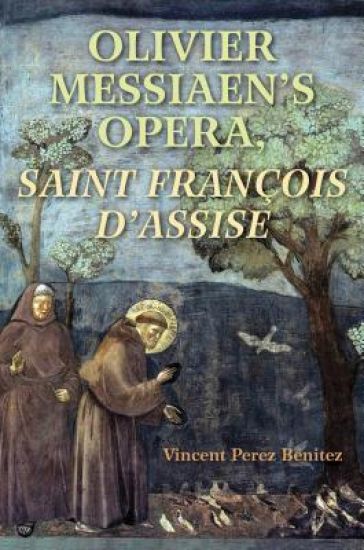
Olivier Messiaen's Opera, Saint Francois D'Assise
Vincent Perez Benitez
Indiana University Press
2019
sidottu
In this comprehensive study of Olivier Messiaen's magnum opus, Saint François d'Assise, Vincent Perez Benitez examines the opera from both theological and musical-analytical perspectives to ask how Messiaen expresses his Catholic theology through his work. Benitez combines a close reading of the opera score with accounts from Messiaen's associates, studies of Messiaen's birdsong notebooks and other primary documents, and an examination of the religious, musical, poetic, and visual arts literature with which the composer was familiar to explore how the opera's harmonic language and sound-color relationships motivate its musical meaning and expression. Through his analysis of these diverse sources and comparisons of Saint François d'Assise with other works such as Berg's Wozzeck and Wagner's Parsifal, Benitez places Messiaen's compositional practice within larger musical perspectives and historical contexts.
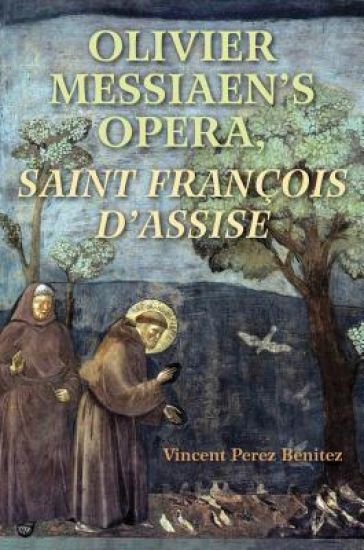
Olivier Messiaen's Opera, Saint Francois D'Assise
Vincent Perez Benitez
Indiana University Press
2019
pokkari
In this comprehensive study of Olivier Messiaen's magnum opus, Saint François d'Assise, Vincent Perez Benitez examines the opera from both theological and musical-analytical perspectives to ask how Messiaen expresses his Catholic theology through his work. Benitez combines a close reading of the opera score with accounts from Messiaen's associates, studies of Messiaen's birdsong notebooks and other primary documents, and an examination of the religious, musical, poetic, and visual arts literature with which the composer was familiar to explore how the opera's harmonic language and sound-color relationships motivate its musical meaning and expression. Through his analysis of these diverse sources and comparisons of Saint François d'Assise with other works such as Berg's Wozzeck and Wagner's Parsifal, Benitez places Messiaen's compositional practice within larger musical perspectives and historical contexts.

Following the second World War, Olivier Messiaen, previously known primarily for his religious music, composed three works inspired by the medieval love story of Tristan and Iseult: Harawi, Turangal^Dla-symphonie, and Cinq rechants. Though the song cycle, symphony, and choral work each consider their source story in a different way, the three compositions are tied closely together by theme and musical technique. This new study is the only full-length consideration of this most significant work, applying literary techniques of stylistic analysis and source study as well as musical analysis of Messiaen's aesthetics and form.As Audrey Ekdahl Davidson shows, Messiaen's work was informed by more than just the mythic tale at its center. The twelve songs in Harawi are indebted to Peruvian melodies, and rhythmically they reveal the influence of the Hindu musical theory that the composer encountered at the Paris Conservatory. Turangal^Dla-symphonie continues and expands the use of these complex rhythmic structures to create a form that expresses elements of the Tristan story as filtered through Wagner's famous operatic depiction. And in Cinq rechants, Messiaen produced a set of choral pieces that use surrealistic texts joined to music that is related structurally to the rechants of the sixteenth-century composer Claude le Jeune. Davidson's examination of these works reveals both their interrelatedness and their many layers of musical and textual meaning.
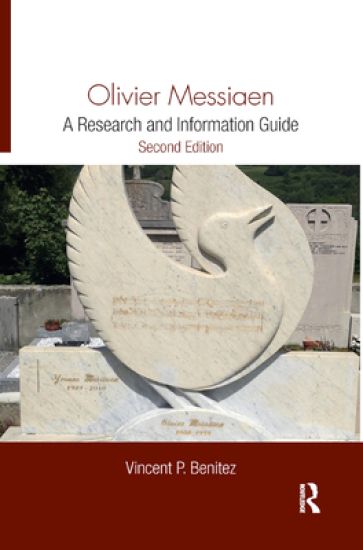
Olivier Messiaen: A Research and Information Guide, Second Edition presents researchers with the most significant and helpful resources on Olivier Messiaen, one of the twentieth century's greatest composers. With multiple indices, this annotated bibliography will serve as an excellent tool for librarians, researchers, and scholars sorting through the massive amount of material in the field. The second edition has been fully revised and updated.
Olivier Messiaen was one of the outstanding creative artists of his time. The strength of his appeal, to listeners as well as to composers, is a measure of the individuality of his music, which draws on a vast range of sources: rhythms of twentieth-century Europe and thirteenth-century India, ripe romantic harmony and brittle birdsong, the sounds of Indonesian percussion and modern electronic instruments. What binds all these together is, on one level, his unswerving devotion to praising God in his art, and on another, his independent view of how music is made. Messiaen's music offers a range of ways of experiencing time: time suspended in music of unparalleled changelessness, time racing in music of wild exuberance, time repeating itself in vast cycles of reiteration.In Olivier Messiaen and the Music of Time, leading writer and musicologist, Paul Griffiths, explores the problems of religious art, and includes searching analyses and discussions of all the major works, suggesting how they function as works of art and not only as theological symbols. This comprehensive and stimulating book covers the whole of Messiaen's output up to and including his opera, Saint Francoise d'Assise.

One of the foremost composers of the twentieth century, Olivier Messiaen wrote widely on his music and on his beliefs. This is the first edition of his early journalism and provides both the original French text and an English translation. The writing in this volume dates from the 1930s, before the composer gained the international reputation that he and his music now enjoy. The pieces he wrote range from reviews of individual performances to essays on particular works or composers and articles that discuss more general themes such as sincerity of expression in music. Many of the articles included in this collection are new to the Messiaen bibliography, and others are available here for the first time in English. A number are, as Broad describes them, 'quietly shocking' in that they force us to reappraise certain aspects of the composer such as his role in La Jeune France, and his wider participation in the debates of his time. This edition, therefore, represents a new source for understanding Messiaen and provides a fascinating glimpse of the composer in the early part of his career.

Olivier Messiaen: Music, Art and Literature
Christopher Dingle; Nigel Simeone
Ashgate Publishing Limited
2007
sidottu
When Olivier Messiaen died in 1992, the prevailing image was of a man apart; a deeply religious man whose only sources of inspiration were God and Nature and a composer whose music progressed along an entirely individual path, artistically impervious to contemporaneous events and the whims both of his contemporaries and the critics. Whilst such a view contains a large element of truth, the past ten years has seen an explosion of interest in the composer, and the work of a diverse range of scholars has painted a much richer, more complex picture of Messiaen. This volume presents some of the fruits of this research for the first time, concentrating on three broad, interrelated areas: Messiaen's relationship with fellow artists; key developments in the composer's musical language and technique; and his influences, both sacred and secular. The volume assesses Messiaen's position as a creative artist of the twentieth century in the light of the latest research. In the process, it identifies some of the key myths, confusions and exaggerations surrounding the composer which often mask equally remarkable truths. In attempting to reveal some of those truths, the essays elucidate a little of the mystery surrounding Messiaen as a man, an artist, a believer and a musician. Specifically, the volume covers Messiaen's attitudes and associations to Cocteau, Stravinsky's Les Noces, Dutilleux and Toesca, as well as exploring his teaching techniques, the Traité de rythme, de couleur et d'ornithologie, Messiaen's harmony, performing and transcription techniques, composing for Ondes Martenot, his association with ballet, Saint François d'Assise and the influence of his faith. Messiaen himself contributes directly in the form of a speech that he gave about the tapestry-maker Jean Lurçat, and the collection also includes the first literary translation of L'âme en bourgeon; the garland of poems written by Messiaen's mother, Cécile Sauvage, when she was expecting him. The composer described these poems as 'the only influence' in his life, making L'âme en bourgeon a fascinating centrepiece to a rich and rewarding collection of essays.
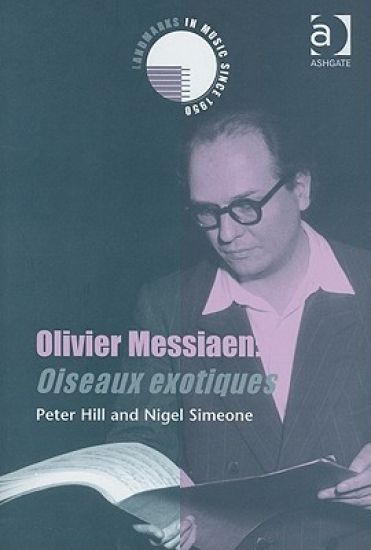
Olivier Messiaen: Oiseaux exotiques
Peter Hill; Nigel Simeone
Ashgate Publishing Limited
2007
sidottu
What makes Oiseaux exotiques so important is that it is arguably the first of Messiaen's major works to create a successful synthesis between his music and his passion for ornithology. The earliest composition to use birdsong to a significant extent was the Quatuor pour la fin du Temps (1940-41). A newspaper interview a few years later (France-Soir, 1948) demonstrates Messiaen's growing desire to move away from the stylization that had characterized the Quatuor towards a much greater realism, based on a close observation of birds in their natural habitat. At the same time, Messiaen continued to regard birdsong as music - and divinely inspired music at that - a belief that led for a time to an obsession with truth-to-nature. Against this background, Oiseaux exotiques proves to be a landmark, the work in which Messiaen the musician began to regain the upper hand over Messiaen the ornithologist. The introductory chapter (Chapter 1) outlines the background to Oiseaux exotiques, discussing Messiaen's relations with the 1950s avant garde - in particular with his former pupil Pierre Boulez - and his involvement with the concerts of the Domaine musical, for which Oiseaux exotiques was composed. In Chapter 2, access to Messiaen's sketches enables the authors to analyse his compositional methods in unprecedented detail; a generous number of music examples refer to birdsong recordings actually used by Messiaen (which can be heard on the accompanying CD), and trace step-by-step the evolution of musical ideas from first notation to finished score. Chapter 3 provides a commentary on the music, investigating issues of continuity and texture, and revealing the processes underlying the score's dazzling profusion. In two further chapters Peter Hill and Nigel Simeone recount the reception history of Oiseaux exotiques, and compare recorded interpretations, taking as their point of departure the historic premiere, included in full on the CD. Finally, the Conclusion considers
Andrew Shenton's groundbreaking cross-disciplinary approach to Messiaen's music presents a systematic and detailed examination of the compositional techniques of one of the most significant musicians of the twentieth century as they relate to his desire to express profound truths about Catholicism. It is widely accepted that music can have mystical and transformative powers, but because 'pure' music has no programme, Messiaen sought to refine his compositions to speak more clearly about the truths of the Catholic faith by developing a sophisticated semiotic system in which aspects of music become direct signs for words and concepts. Using interdisciplinary methodologies drawing on linguistics, cognition studies, theological studies and semiotics, Shenton traces the development of Messiaen's sign system using examples from many of Messiaen's works and concentrating in particular on the Méditations sur le mystère de la Sainte Trinité for organ, a suite which contains the most sophisticated and developed use of a sign system and represents a profound exegesis of Messiaen's understanding of the Catholic triune God. By working on issues of interpretation, Shenton endeavours to bridge the traditional gap between scholars and performers and to help people listen to Messiaen's music with spirit and understanding.
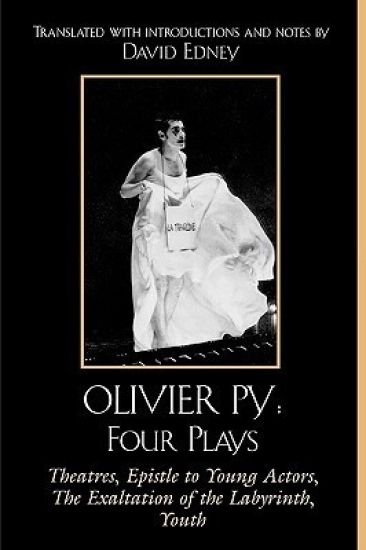
Olivier Py: Four Plays
University Press of America
2005
nidottu
This anthology of four plays is the first publication in English of the work of Olivier Py (born in 1965). Excess and a mixture of opposites characterize Py's dramatic universe, which presents the plight of young people today, searching for meaning in a world devoid of values and rife with violence. The dense poetic language is broken by contemporary colloquialisms, buffoonery punctures the characters' earnestness, and eroticism complements the preoccupation with spiritual matters. Presenting himself as a Catholic and a homosexual, Py flouts convention and challenges audiences, yet rewards their attention with striking theatricality and a resonance of significance that is unusual in modern theatre. The four works included in this anthology, Theatres, Epistle to Young Actors, The Exaltation of the Labyrinth, and Youth, are particularly suited to university and theatre schools, both for study and for production. Two of the plays were commissions for the French National Conservatory of Dramatic Art. The volume includes introductions, a bibliography and notes, and, as an appendix, an article by Barbara Mason and Susan Mason, reviewing one of Olivier Py's plays.