Kirjojen hintavertailu. Mukana 11 244 527 kirjaa ja 12 kauppaa.

Kirjahaku

Etsi kirjoja tekijän nimen, kirjan nimen tai ISBN:n perusteella.

290 tulosta hakusanalla Onora O'Neill

Reading Onora O'Neill
Onora O’Neill is one of the foremost moral philosophers writing today. Her work on ethics and bioethics, political philosophy and the philosophy of Kant is extremely influential. Her landmark Reith Lectures on trust did much to establish the subject not only on the philosophical and political agenda but in the world of media, business and law more widely.Reading Onora O’Neill is the first book to examine and critically appraise the work of this important thinker. It includes specially commissioned chapters by leading international philosophers in ethics, Kantian philosophy and political philosophy. The following aspects of O’Neill’s work are examined: global justiceKantthe ethics of the familybioethicsconsenttrust.Featuring a substantial reply to her critics at the end of the book, Reading Onora O’Neill is essential reading for students and scholars of ethics and political philosophy.
Constructions of Reason

Constructions of Reason

Onora O'Neill

Cambridge University Press
1990
sidottu
Two centuries after they were published, Kant's ethical writings are as much admired and imitated as they have ever been, yet serious and long-standing accusations of internal incoherence remain unresolved. Onora O'Neill traces the alleged incoherences to attempt to assimilate Kant's ethical writings to modern conceptions of rationality, action and rights. When the temptation to assimilate is resisted, a strikingly different and more cohesive account of reason and morality emerges. Kant offers a `constructivist' vindication of reason and a moral vision in which obligations are prior to rights and in which justice and virtue are linked. O'Neill begins by reconsidering Kant's conceptions of philosophical method, reason, freedom, automony and action. She then moves on to the more familiar terrain of interpretation of the Categorical Imperative, while in the last section she emphasises differences between Kant's ethics and recent 'Kantian' ethics, including the work of John Rawls and other contemporary liberal political philosophers. This reassessment will add significantly to the understanding of Kantian practical philosophy.
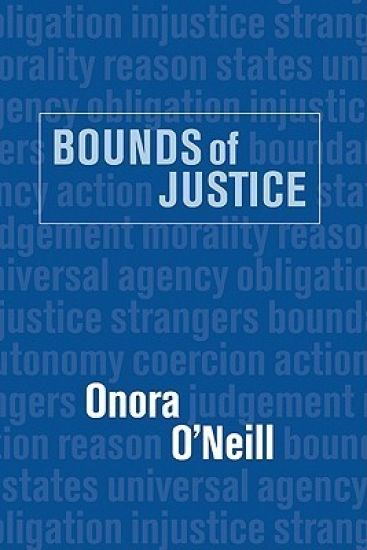
Bounds of Justice

Bounds of Justice

Onora O'Neill

Cambridge University Press
2000
sidottu
In this collection of essays Onora O'Neill explores and argues for an account of justice that is fundamentally cosmopolitan rather than civic, yet takes serious account of institutions and boundaries, and of human diversity and vulnerability. Starting from conceptions that are central to any account of justice - those of reason, action, judgement, coercion, obligations and rights - she discusses whether and how culturally or politically specific concepts and views, which limit the claims and scope of justice, can be avoided. She then examines the demands and scope of just institutions, arguing that there are good reasons for taking the claims of distant strangers seriously, but that doing so points not to a world without boundaries but to one of porous boundaries and dispersed power. Bounds of Justice will be of interest to a wide range of readers in philosophy, politics and international relations.
Bounds of Justice

Bounds of Justice

Onora O'Neill

Cambridge University Press
2000
pokkari
In this collection of essays Onora O’Neill explores and argues for an account of justice that is fundamentally cosmopolitan rather than civic, yet takes serious account of institutions and boundaries, and of human diversity and vulnerability. Starting from conceptions that are central to any account of justice - those of reason, action, judgement, coercion, obligations and rights - she discusses whether and how culturally or politically specific concepts and views, which limit the claims and scope of justice, can be avoided. She then examines the demands and scope of just institutions, arguing that there are good reasons for taking the claims of distant strangers seriously, but that doing so points not to a world without boundaries but to one of porous boundaries and dispersed power. Bounds of Justice will be of interest to a wide range of readers in philosophy, politics and international relations.
A Question of Trust

A Question of Trust

Onora O'Neill

Cambridge University Press
2002
pokkari
We say we can no longer trust our public services, institutions or the people who run them. The professionals we have to rely on - politicians, doctors, scientists, businessmen and many others - are treated with suspicion. Their word is doubted, their motives questioned. Whether real or perceived, this crisis of trust has a debilitating impact on society and democracy. Can trust be restored by making people and institutions more accountable? Or do complex systems of accountability and control themselves damage trust? Onora O'Neill challenges current approaches, investigates sources of deception in our society and re-examines questions of press freedom. 2002's Reith Lectures present a philosopher's view of trust and deception, and ask whether and how trust can be restored in a modern democracy.
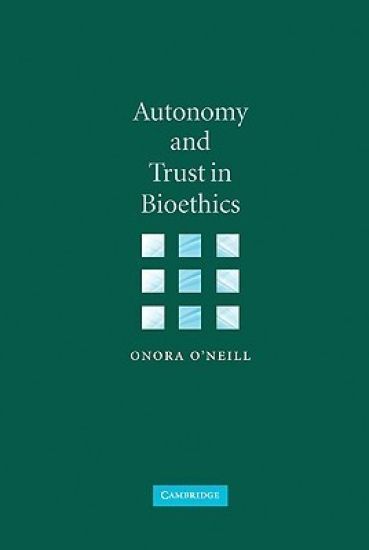
Autonomy and Trust in Bioethics

Autonomy and Trust in Bioethics

Onora O'Neill

Cambridge University Press
2002
sidottu
Why has autonomy been a leading idea in philosophical writing on bioethics, and why has trust been marginal? In this important book, Onora O'Neill suggests that the conceptions of individual autonomy so widely relied on in bioethics are philosophically and ethically inadequate, and that they undermine rather than support relations of trust. She shows how Kant's non-individualistic view of autonomy provides a stronger basis for an approach to medicine, science and biotechnology, and does not marginalize untrustworthiness, while also explaining why trustworthy individuals and institutions are often undeservingly mistrusted. Her arguments are illustrated with issues raised by practices such as the use of genetic information by the police or insurers, research using human tissues, uses of new reproductive technologies, and media practices for reporting on medicine, science and technology. Autonomy and Trust in Bioethics will appeal to a wide range of readers in ethics, bioethics and related disciplines.
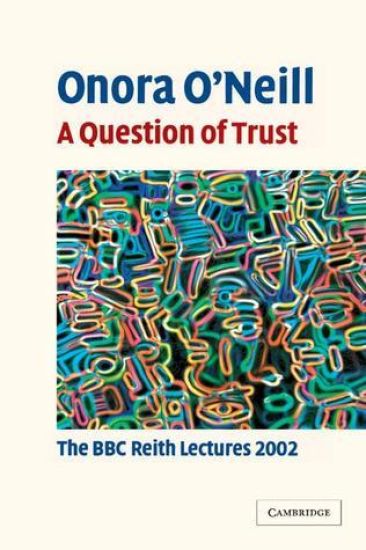
A Question of Trust

A Question of Trust

Onora O'Neill

Cambridge University Press
2002
sidottu
We say we can no longer trust our public services, institutions or the people who run them. The professionals we have to rely on - politicians, doctors, scientists, businessmen and many others - are treated with suspicion. Their word is doubted, their motives questioned. Whether real or perceived, this crisis of trust has a debilitating impact on society and democracy. Can trust be restored by making people and institutions more accountable? Or do complex systems of accountability and control themselves damage trust? Onora O'Neill challenges current approaches, investigates sources of deception in our society and re-examines questions of press freedom. 2002's Reith Lectures present a philosopher's view of trust and deception, and ask whether and how trust can be restored in a modern democracy.
Autonomy and Trust in Bioethics

Autonomy and Trust in Bioethics

Onora O'Neill

Cambridge University Press
2002
pokkari
Why has autonomy been a leading idea in philosophical writing on bioethics, and why has trust been marginal? In this important book, Onora O’Neill suggests that the conceptions of individual autonomy so widely relied on in bioethics are philosophically and ethically inadequate, and that they undermine rather than support relations of trust. She shows how Kant’s non-individualistic view of autonomy provides a stronger basis for an approach to medicine, science and biotechnology, and does not marginalize untrustworthiness, while also explaining why trustworthy individuals and institutions are often undeservingly mistrusted. Her arguments are illustrated with issues raised by practices such as the use of genetic information by the police or insurers, research using human tissues, uses of new reproductive technologies, and media practices for reporting on medicine, science and technology. Autonomy and Trust in Bioethics will appeal to a wide range of readers in ethics, bioethics and related disciplines.
Acting on Principle

Acting on Principle

Onora O'Neill

Cambridge University Press
2013
sidottu
'Two things', wrote Kant, 'fill the mind with ever new and increasing admiration and awe: the starry heavens above and the moral law within'. Many would argue that since Kant's day, the study of the starry heavens has advanced while ethics has stagnated, and in particular that Kant's ethics offers an empty formalism that tells us nothing about how we should live. In Acting on Principle Onora O'Neill shows that Kantian ethics has practical as well as philosophical importance. First published in 1975, the book is regarded as a classic account and defence of the Kantian ethical position. It addresses Kant's account of reasoning about action, in particular his controversial claim that the Categorical Imperative guides action and is basic to ethics and justice. This second edition offers a substantial new introduction and updated bibliography, and will be valuable for a wide readership in Kant studies and those studying ethics.
From Principles to Practice

From Principles to Practice

Onora O'Neill

Cambridge University Press
2018
sidottu
Knowledge aims to fit the world, and action to change it. In this collection of essays, Onora O'Neill explores the relationship between these concepts and shows that principles are not enough for ethical thought or action: we also need to understand how practical judgement identifies ways of enacting them and of changing the way things are. Both ethical and technical judgement are supported, she contends, by bringing to bear multiple considerations, ranging from ethical principles to real-world constraints, and while we will never find practical algorithms - let alone ethical algorithms - that resolve moral and political issues, good practical judgement can bring abstract principles to bear in situations that call for action. Her essays thus challenge claims that all inquiry must use either the empirical methods of scientific inquiry or the interpretive methods of the humanities. They will appeal to a range of readers in moral and political philosophy.
Justice across Boundaries

Justice across Boundaries

Onora O'Neill

Cambridge University Press
2016
sidottu
Who ought to do what, and for whom, if global justice is to progress? In this collection of essays on justice beyond borders, Onora O'Neill criticises theoretical approaches that concentrate on rights, yet ignore both the obligations that must be met to realise those rights, and the capacities needed by those who shoulder these obligations. She notes that states are profoundly anti-cosmopolitan institutions, and that even those committed to justice and universal rights often lack the competence and the will to secure them, let alone to secure them beyond their borders. She argues for a wider conception of global justice, in which obligations may be held either by states or by competent non-state actors, and in which borders themselves must meet standards of justice. This rich and wide-ranging collection will appeal to a broad array of academic researchers and advanced students of political philosophy, political theory, international relations and philosophy of law.
Constructing Authorities

Constructing Authorities

Onora O'Neill

Cambridge University Press
2016
sidottu
This collection of essays brings together the central lines of thought in Onora O'Neill's work on Kant's philosophy, developed over many years. Challenging the claim that Kant's attempt to provide a critique of reason fails because it collapses into a dogmatic argument from authority, O'Neill shows why Kant held that we must construct, rather than assume, the authority of reason, and how this can be done by ensuring that anything we offer as reasons can be followed by others, including others with whom we disagree. She argues that this constructivist view of reasoning is the clue to Kant's claims about knowledge, ethics and politics, as well as to his distinctive accounts of autonomy, the social contract, cosmopolitan justice and scriptural interpretation. Her essays are a distinctive and illuminating commentary on Kant's fundamental philosophical strategy and its implications, and will be a vital resource for scholars of Kant, ethics and philosophy of law.
From Principles to Practice

From Principles to Practice

Onora O'Neill

Cambridge University Press
2018
pokkari
Knowledge aims to fit the world, and action to change it. In this collection of essays, Onora O'Neill explores the relationship between these concepts and shows that principles are not enough for ethical thought or action: we also need to understand how practical judgement identifies ways of enacting them and of changing the way things are. Both ethical and technical judgement are supported, she contends, by bringing to bear multiple considerations, ranging from ethical principles to real-world constraints, and while we will never find practical algorithms - let alone ethical algorithms - that resolve moral and political issues, good practical judgement can bring abstract principles to bear in situations that call for action. Her essays thus challenge claims that all inquiry must use either the empirical methods of scientific inquiry or the interpretive methods of the humanities. They will appeal to a range of readers in moral and political philosophy.

Justice across Boundaries

Justice across Boundaries

Onora O'Neill

Cambridge University Press
2016
pokkari
Who ought to do what, and for whom, if global justice is to progress? In this collection of essays on justice beyond borders, Onora O'Neill criticises theoretical approaches that concentrate on rights, yet ignore both the obligations that must be met to realise those rights, and the capacities needed by those who shoulder these obligations. She notes that states are profoundly anti-cosmopolitan institutions, and that even those committed to justice and universal rights often lack the competence and the will to secure them, let alone to secure them beyond their borders. She argues for a wider conception of global justice, in which obligations may be held either by states or by competent non-state actors, and in which borders themselves must meet standards of justice. This rich and wide-ranging collection will appeal to a broad array of academic researchers and advanced students of political philosophy, political theory, international relations and philosophy of law.
Constructing Authorities

Constructing Authorities

Onora O'Neill

Cambridge University Press
2015
pokkari
This collection of essays brings together the central lines of thought in Onora O'Neill's work on Kant's philosophy, developed over many years. Challenging the claim that Kant's attempt to provide a critique of reason fails because it collapses into a dogmatic argument from authority, O'Neill shows why Kant held that we must construct, rather than assume, the authority of reason, and how this can be done by ensuring that anything we offer as reasons can be followed by others, including others with whom we disagree. She argues that this constructivist view of reasoning is the clue to Kant's claims about knowledge, ethics and politics, as well as to his distinctive accounts of autonomy, the social contract, cosmopolitan justice and scriptural interpretation. Her essays are a distinctive and illuminating commentary on Kant's fundamental philosophical strategy and its implications, and will be a vital resource for scholars of Kant, ethics and philosophy of law.
A Philosopher Looks at Digital Communication

A Philosopher Looks at Digital Communication

Onora O'Neill

Cambridge University Press
2022
pokkari
Communication is complicated, and so is the ethics of communication. We communicate about innumerable topics, to varied audiences, using a gamut of technologies. The ethics of communication, therefore, has to address a wide range of technical, ethical and epistemic requirements. In this book, Onora O'Neill shows how digital technologies have made communication more demanding: they can support communication with huge numbers of distant and dispersed recipients; they can amplify or suppress selected content; and they can target or ignore selected audiences. Often this is done anonymously, making it harder for readers and listeners, viewers and browsers, to assess which claims are true or false, reliable or misleading, flaky or fake. So how can we empower users to assess and evaluate digital communication, so that they can tell which standards it meets and which it flouts? That is the challenge which this book explores.
Rethinking Informed Consent in Bioethics

Rethinking Informed Consent in Bioethics

Neil C. Manson; Onora O'Neill

Cambridge University Press
2007
sidottu
Informed consent is a central topic in contemporary biomedical ethics. Yet attempts to set defensible and feasible standards for consenting have led to persistent difficulties. In Rethinking Informed Consent in Bioethics, first published in 2007, Neil Manson and Onora O'Neill set debates about informed consent in medicine and research in a fresh light. They show why informed consent cannot be fully specific or fully explicit, and why more specific consent is not always ethically better. They argue that consent needs distinctive communicative transactions, by which other obligations, prohibitions, and rights can be waived or set aside in controlled and specific ways. Their book offers a coherent, wide-ranging and practical account of the role of consent in biomedicine which will be valuable to readers working in a range of areas in bioethics, medicine and law.
Humanities in the World

Humanities in the World

Rens Bod; Stefan Collini; Onora O'Neill

U Press
2020
pokkari
Tre nye essays af de internationalt anerkendte humanister Onora O'Neill, Stefan Collini og Rens Bod viser en anden side af humaniora, som dels er uadskillelig fra andre videnskaber, dels viser sig at have været selve forudsætningen for en del af vor tids mest avancerede teknologi. Opfordringen er klar fra bogens danske redaktør, professor Anders Engberg-Pedersen: "We need a better account of what the humanities are."INDHOLD Introduction:The Humanities in the WorldAnders Engberg-Pedersen, Mikkel Bille og Karen Gram-SkjoldagerOn Not 'justifying' the Humanities Stefan ColliniThe Humanities beyond InterpretationOnora O'NeillHow the Humanities have Changed the WorldRens Bod
Constructions of Reason

Constructions of Reason

O'Neill Onora

Cambridge University Press
1990
pokkari
Two centuries after they were published, Kant’s ethical writings are as much admired and imitated as they have ever been, yet serious and long-standing accusations of internal incoherence remain unresolved. Onora O’Neill traces the alleged incoherences to attempt to assimilate Kant’s ethical writings to modern conceptions of rationality, action and rights. When the temptation to assimilate is resisted, a strikingly different and more cohesive account of reason and morality emerges. Kant offers a `constructivist’ vindication of reason and a moral vision in which obligations are prior to rights and in which justice and virtue are linked. O’Neill begins by reconsidering Kant’s conceptions of philosophical method, reason, freedom, automony and action. She then moves on to the more familiar terrain of interpretation of the Categorical Imperative, while in the last section she emphasises differences between Kant’s ethics and recent ‘Kantian’ ethics, including the work of John Rawls and other contemporary liberal political philosophers. This reassessment will add significantly to the understanding of Kantian practical philosophy.
Towards Justice and Virtue

Towards Justice and Virtue

O'Neill Onora

Cambridge University Press
1996
pokkari
Towards Justice and Virtue challenges the rivalry between those who advocate only abstract, universal principles of justice and those who commend only the particularities of virtuous lives. Onora O’Neill traces this impasse to defects in underlying conceptions of reasoning about action. She proposes and vindicates a modest account of ethical reasoning and a reasoned way of answering the question ‘who counts?’, then uses these to construct linked accounts of principles by which we can move towards just institutions and virtuous lives.