Kirjojen hintavertailu. Mukana 12 390 323 kirjaa ja 12 kauppaa.

Kirjahaku

Etsi kirjoja tekijän nimen, kirjan nimen tai ISBN:n perusteella.

1000 tulosta hakusanalla P Gérard

Du Partage Des Biens Des Pauvres À La Suite de Démembrements de Communes
Du Partage des biens des pauvres a la suite de demembrements de communes, par P. Gerard, ...Date de l'edition originale: 1883Ce livre est la reproduction fidele d'une oeuvre publiee avant 1920 et fait partie d'une collection de livres reimprimes a la demande editee par Hachette Livre, dans le cadre d'un partenariat avec la Bibliotheque nationale de France, offrant l'opportunite d'acceder a des ouvrages anciens et souvent rares issus des fonds patrimoniaux de la BnF.Les oeuvres faisant partie de cette collection ont ete numerisees par la BnF et sont presentes sur Gallica, sa bibliotheque numerique.En entreprenant de redonner vie a ces ouvrages au travers d'une collection de livres reimprimes a la demande, nous leur donnons la possibilite de rencontrer un public elargi et participons a la transmission de connaissances et de savoirs parfois difficilement accessibles.Nous avons cherche a concilier la reproduction fidele d'un livre ancien a partir de sa version numerisee avec le souci d'un confort de lecture optimal. Nous esperons que les ouvrages de cette nouvelle collection vous apporteront entiere satisfaction.Pour plus d'informations, rendez-vous sur www.hachettebnf.fr

Trois ans en Judée

Trois ans en Judée

P Gérardy Saintine

Anatiposi Verlag
2023
pokkari
R impression inchang e de l' dition originale de 1860. La maison d' dition Anatiposi publie des livres historiques en r impression. En raison de leur ge, ces livres peuvent pr senter des pages manquantes ou une qualit moindre. Notre objectif est de pr server ces livres et de les rendre accessibles au public afin qu'ils ne se perdent pas.
Trois ans en Judée

Trois ans en Judée

P Gérardy Saintine

Anatiposi Verlag
2023
sidottu
R impression inchang e de l' dition originale de 1860. La maison d' dition Anatiposi publie des livres historiques en r impression. En raison de leur ge, ces livres peuvent pr senter des pages manquantes ou une qualit moindre. Notre objectif est de pr server ces livres et de les rendre accessibles au public afin qu'ils ne se perdent pas.
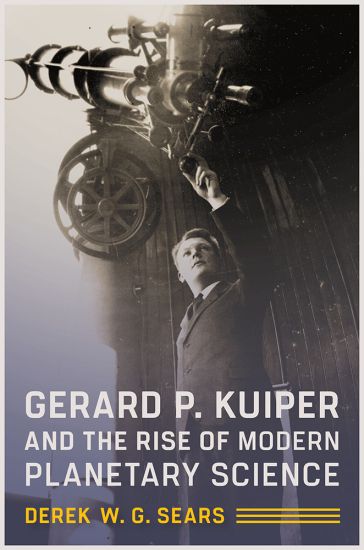
Gerard P. Kuiper and the Rise of Modern Planetary Science

Gerard P. Kuiper and the Rise of Modern Planetary Science

Derek W. G. Sears

University of Arizona Press
2019
sidottu
Astronomer Gerard P. Kuiper ignored the traditional boundaries of his subject. Using telescopes and the laboratory, he made the solar system a familiar, intriguing place. “It is not astronomy,” complained his colleagues, and they were right. Kuiper had created a new discipline we now call planetary science. Kuiper was an acclaimed astronomer of binary stars and white dwarfs when he accidentally discovered that Titan, the massive moon of Saturn, had an atmosphere. This turned our understanding of planetary atmospheres on its head, and it set Kuiper on a path of staggering discoveries: Pluto was not a planet, planets around other stars were common, some asteroids were primary while some were just fragments of bigger asteroids, some moons were primary and some were captured asteroids or comets, the atmosphere of Mars was carbon dioxide, and there were two new moons in the sky, one orbiting Uranus and one orbiting Neptune.He produced a monumental photographic atlas of the Moon at a time when men were landing on our nearest neighbor, and he played an important part in that effort. He also created some of the world's major observatories in Hawai‘i and Chile. However, most remarkable was that the keys to his success sprang from his wartime activities, which led him to new techniques. This would change everything.Sears shows a brilliant but at times unpopular man who attracted as much dislike as acclaim. This in-depth history includes some of the twentieth century's most intriguing scientists, from Harold Urey to Carl Sagan, who worked with—and sometimes against—the father of modern planetary science. Now, as NASA and other space agencies explore the solar system, they take with them many of the ideas and concepts first described by Gerard P. Kuiper.
Gerard P. Kuiper and the Rise of Modern Planetary Science

Gerard P. Kuiper and the Rise of Modern Planetary Science

Derek W. G. Sears

University of Arizona Press
2024
nidottu
Astronomer Gerard P. Kuiper ignored the traditional boundaries of his subject. Using telescopes and the laboratory, he made the solar system a familiar, intriguing place. “It is not astronomy,” complained his colleagues, and they were right. Kuiper had created a new discipline we now call planetary science. Kuiper was an acclaimed astronomer of binary stars and white dwarfs when he accidentally discovered that Titan, the massive moon of Saturn, had an atmosphere. This turned our understanding of planetary atmospheres on its head, and it set Kuiper on a path of staggering discoveries: Pluto was not a planet, planets around other stars were common, some asteroids were primary while some were just fragments of bigger asteroids, some moons were primary and some were captured asteroids or comets, the atmosphere of Mars was carbon dioxide, and there were two new moons in the sky, one orbiting Uranus and one orbiting Neptune. He produced a monumental photographic atlas of the Moon at a time when men were landing on our nearest neighbor, and he played an important part in that effort. He also created some of the world’s major observatories in Hawai‘i and Chile. However, most remarkable was that the keys to his success sprang from his wartime activities, which led him to new techniques. This would change everything. Sears shows a brilliant but at times unpopular man who attracted as much dislike as acclaim. This in-depth history includes some of the twentieth century’s most intriguing scientists, from Harold Urey to Carl Sagan, who worked with—and sometimes against—the father of modern planetary science. Now, as NASA and other space agencies explore the solar system, they take with them many of the ideas and concepts first described by Gerard P. Kuiper.
Dictionary of Plant Toxins

Dictionary of Plant Toxins

Gerard P. Moss

John Wiley Sons Inc
1996
sidottu
Phytotoxins are poisonous substances produced by plants, mostly for reasons of protection and compound transport. The study of these substances has yielded many new medicinal products both for humans and other animals. This book provides a concise and comprehensive source of information on plant toxins.
Medical Issues in Boxing, An Issue of Clinics in Sports Medicine

Medical Issues in Boxing, An Issue of Clinics in Sports Medicine

Gerard P. Varlotta; Barry D. Jordan

W B Saunders Co Ltd
2009
sidottu
For this issue on the medical aspects of the increasingly-popular sport of boxing, Dr. Barry Jordan, Director of the Brain Injury Program and Memory Evaluation and Treatment Service at the Burke Rehabilitation Hospital in New York, has teamed up with Dr. Gerard Varlotta, Professor and specialist in pain management and injury prevention for NYU's departments of Joint Diseases and Rehabilitation Medicine. The Guest Editors have gathered a panel of leading experts on the subject, to cover topics such as medical safety in boxing, the role of the ringside physician, doping and drug use in boxing, facial and hand injuries in boxing, infectious disease in boxing, and more.
The Ultra-Short: Fourteenth Annual Ultra--Short Competition
Winning entries from the Fourteenth Annual International Ultra-Short Competition.Prize WinnersDebra Kirouac - A Day in the Life (Humor)Clare Marsh - Trompe L'oeil (Poetry)Christy Stofko - Summer Love (Prose)George Newcastle - Almost Valhalla (Slice of Life)Honorable MentionsDanny P. Barbare - The Janitor's BroomMichele Baron - post-euhemerismSally Basmajian - BoundMara Buck - The GeeseSarah Carleton - Memory: Tower of London, WWI Centennial, 2014Michelle Chen - The Iowa River as My Self-Diagnosed Marfan SyndromeSally Clark - The Dairy QueenKathleen Clauson - For GoodCharlie Coleman - Grand TheftRobert M. Craig - Gentlemen's AgreementBarry Dearborn - Decision TimeAnthony DeGregorio - In a RestaurantLiz Dolan - ObsessionEunice-Grace M. Domingo - Grandfather ClockChristina Woś Donnelly - DanceJennifer L. Freed - The LesserJoyce Frohn - I Know About PigsJoe Giordano - Everyone Dies AloneMiranda Divett Gonz lez - Dying Would Be CheaperTracy L. Grimaldi - Anna's SongDebbie Okun Hill - TaxingMichael Jewell - Obituary For LazarusBarbara S. Johnson - All Too OftenKayssie K. - MommaStanley Korn - UncertaintyLaurie Merritt Larkin - The BunkerDoug Mathewson - TrafficCaroline Michalicki - Last HarvestDouglas W. Milliken - InternEllen Birkett Morris - Broken VesselsBeki Muchow - The PaintingJames B. Nicola - Condolences 2Christopher Owen - The DrowningsAshley Parker Owens - Salt Lick, February 26, 1940Adrian S. Potter - Secondhand InspirationAndrea Reeves - Missed CallRachel Rodman - A Dream of RomeShannon Schuren - Her Train DerailedSage - GhostwriterMaureen Sherbondy - The Denouement of Mr. Potato HeadDiane Smith - The Silliness of LoveJenna Pashley Smith - BeauticeuticalsMatthew J. Spireng - ChangeErik Svehaug - What Can I Say?R.M. Trenkler-Thomson - The Old HouseCaroline Todd - Sharon at Her WorstDonna Turello - War of the RosesReLynn Vaughn - She Marched
Who Am I? Who Is She?

Who Am I? Who Is She?

Gerard P. Montague

De Gruyter
2012
sidottu
Are ‘persons’ physical things, members of the species homo sapiens which exist solely in materialist form, continuous in structure with other living things? Or is the issue a more complex one: are there more dimensions to being a person than mere physical, biological existence? These are matters of interest and discussion in many fields of study in this age of individuality. In this wide-ranging essay, the author addresses various aspects of the issue, including the history of self and identity. The ancient tradition of dualism is rejected in favour of a straightforward holistic and naturalistic account of selfhood; it is argued that the mind arises in an emergent sense from the body and personal identity is best expressed in terms of a self-reflective and meaningful narrative. The approach is principally from an analytic philosophy point of view but also takes on–board psychological and sociological aspects of self and identity.