Kirjojen hintavertailu. Mukana 11 627 630 kirjaa ja 12 kauppaa.

Kirjahaku

Etsi kirjoja tekijän nimen, kirjan nimen tai ISBN:n perusteella.

1000 tulosta hakusanalla P Métais

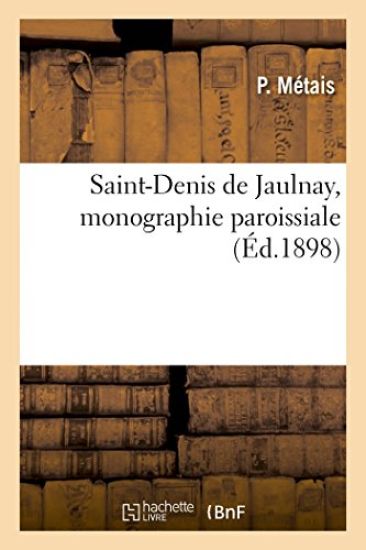
Saint-Denis de Jaulnay, Monographie Paroissiale
Saint-Denis de Jaulnay, monographie paroissialeDate de l'edition originale: 1898Sujet de l'ouvrage: Jaulnay (France)Ce livre est la reproduction fidele d'une oeuvre publiee avant 1920 et fait partie d'une collection de livres reimprimes a la demande editee par Hachette Livre, dans le cadre d'un partenariat avec la Bibliotheque nationale de France, offrant l'opportunite d'acceder a des ouvrages anciens et souvent rares issus des fonds patrimoniaux de la BnF.Les oeuvres faisant partie de cette collection ont ete numerisees par la BnF et sont presentes sur Gallica, sa bibliotheque numerique.En entreprenant de redonner vie a ces ouvrages au travers d'une collection de livres reimprimes a la demande, nous leur donnons la possibilite de rencontrer un public elargi et participons a la transmission de connaissances et de savoirs parfois difficilement accessibles.Nous avons cherche a concilier la reproduction fidele d'un livre ancien a partir de sa version numerisee avec le souci d'un confort de lecture optimal. Nous esperons que les ouvrages de cette nouvelle collection vous apporteront entiere satisfaction.Pour plus d'informations, rendez-vous sur www.hachettebnf.fr
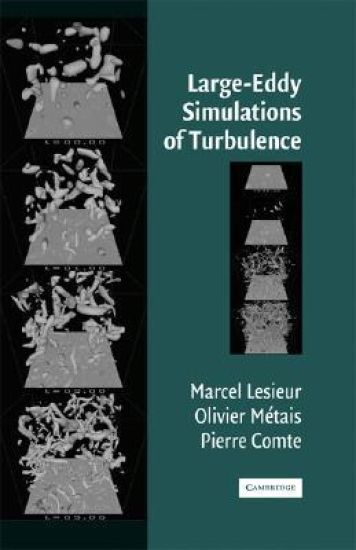
Large-Eddy Simulations of Turbulence

Large-Eddy Simulations of Turbulence

M. Lesieur; O. Métais; P. Comte

Cambridge University Press
2005
sidottu
Large-Eddy Simulations of Turbulence is an ideal introduction for people new to LES [large-eddy simulation], direct numerical simulation and Reynolds-averaged Navier-Stokes simulation, and as a reference for researchers. Of particular interest in the text are the detailed discussion, in Chapter 2, of vorticity, pressure, and the velocity gradient tensor, quantities useful for probing the results of a simulation, particularly when looking for coherent vortices and coherent structures. Chapters 4 and 5 feature an in-depth discussion of spectral subgrid-scale modeling. Although physical-space models are generally more readily applied, spectral models give insight into the requirements and limitations in subgrid-scale modeling and backscattering. A third special feature is the detailed discussion in Chapter 7, of large-eddy simulation of compressible flows previously only available in articles scattered throughout the literature. This will be of interest to those dealing with supersonic flows, combustion, astrophysics, and other related topics.
Activated Metals in Organic Synthesis
Activated Metals in Organic Synthesis discusses fundamental principles of the generation of activated, highly reactive metals, and their applications in organic synthesis. Following an introductory chapter on basic forms of metals the chapters in Part 1 are devoted to common strategies utilized for the preparation of active metals. These strategies include vaporization and subsequent co-condensation of metal atoms, in addition to depassivating methods employed commonly in laboratory syntheses. Chapters in Part 2 discuss relevant organic transformations in which metal activation plays a crucial role. Specific topics covered include metal-induced reductive methods; pinacolic, Reformatsky-, and Barbier-type reactions; McMurry ketone-olefin coupling; and the Bernet-Vasella reaction. Each chapter is followed by literature citations ranging from specific references to significant reviews. Many structural formulas are provided, making it easy to follow each synthesis. The book will be an important reference for students, organic chemists, and researchers in all areas of organometallic chemistry.
Superconductivity Of Metals And Alloys
Drawn from the author's introductory course at the University of Orsay, Superconductivity of Metals and Alloys is intended to explain the basic knowledge of superconductivity for both experimentalists and theoreticians. These notes begin with an elementary discussion of magnetic properties of Type I and Type II superconductors. The microscopic theory is then built up in the Bogolubov language of self-consistent fields. This text provides the classic, fundamental basis for any work in the field of superconductivity.
Metals in Biochemistry

Metals in Biochemistry

P. Harrison

Chapman and Hall
1980
nidottu
In this book we present a largely biochemical look at the metals of life and their functions, which we hope will be of interest to chemists and biologists as well as biochemists. The field of 'inorganic bio­ chemistry' is one of rapid change. Recent developments in our know­ ledge of the activity of calcium, and of the iron-sulphur proteins, are two examples, and increasing attention is being paid to non-metals as well [3]. For reasons of space, we shall restrict ourselves to the normal biological activities of metals. We must ignore, on the one hand, the gross physiological effects of metal deficiency or toxicity, and on the other, the many model studies which have been stimulated by the unusual properties of metals in biological systems. Usually the synthesis of model metal compounds follows rather than anticipates the dis­ covery of novel biological configurations. However, such studies give us a firm basis for an understanding of the biological systems, and sometimes answer questions that cannot be tackled any other way (for instance, what is the net charge on an iron-sulphur cluster?). As a result, we can refer to new and interesting information on the metals oflife at a chemical level. We gratefully acknowledge the help of Professor P. Banks and Dr D. Fenton who have read and criticized the manuscript, though any errors or misconceptions remain our own responsibility. We thank Mr P. Elliot for preparing Fig. 5.2.
Superconductivity Of Metals And Alloys

Superconductivity Of Metals And Alloys

P. G. De Gennes

Westview Press Inc
1999
nidottu
Drawn from the author's introductory course at the University of Orsay, Superconductivity of Metals and Alloys is intended to explain the basic knowledge of superconductivity for both experimentalists and theoreticians. These notes begin with an elementary discussion of magnetic properties of Type I and Type II superconductors. The microscopic theory is then built up in the Bogolubov language of self-consistent fields. This text provides the classic, fundamental basis for any work in the field of superconductivity.
Trace Metals in Aquatic Systems

Trace Metals in Aquatic Systems

Robert P. Mason

Wiley-Blackwell (an imprint of John Wiley Sons Ltd)
2013
sidottu
This book provides a detailed examination of the concentration, form and cycling of trace metals and metalloids through the aquatic biosphere, and has sections dealing with the atmosphere, the ocean, lakes and rivers. It discusses exchanges at the water interface (air/water and sediment/water) and the major drivers of the cycling, concentration and form of trace metals in aquatic systems. The initial chapters focus on the fundamental principles and modelling approaches needed to understand metal concentration, speciation and fate in the aquatic environment, while the later chapters focus on specific environments, with case studies and research highlights. Specific examples deal with metals that are of particular scientific interest, such as mercury, iron, arsenic and zinc, and the book deals with both pollutant and required (nutrient) metals and metalloids. The underlying chemical principles controlling toxicity and bioavailability of these elements to microorganisms and to the aquatic food chain are also discussed. Readership: Graduate students studying environmental chemistry and related topics, as well as scientists and managers interested in the cycling of trace substances in aqueous systems Additional resources for this book can be found at: www.wiley.com/go/mason/tracemetals.
The Chemistry of the Non-Metals

The Chemistry of the Non-Metals

P. Powell

Chapman and Hall
1974
nidottu
This book is a new attempt to interrelate the chemistry of the non-metals. In the early chapters, simple compounds of the non-metals with the halogens, hydrogen, and oxygen are surveyed, permitting a large area of chemistry to be discussed without the burden of too many facts. The structural relationships in the elemental forms of the non-metals are then used as an introduction to the catenated compounds, including the boron hydrides. In the concluding chapter, selected heteronuclear chain, ring, and cage compounds are con­ sidered. In some chapters, we have thought it useful to outline important features of a topic in relation to chemical theory, before giving a more detailed ac count of the chemistry of individual elements. The book is certainly not comprehensive and the bias in the material selected probably reflects our interest in volatile, covalent non-metal compounds. Suggestions for furt her reading are presented in two ways. A selected bibliography lists general textbooks which relate to much of our subject matter. References in the text point to review articles and to a few original papers which we consider to be of special interest. Although there are few difficult concepts in the text, the treatment may be appreciated most by students with some previous exposure to a Group by Group approach to non-metal chemistry. We have assumed an elementary knowledge of chemical periodicity, bonding theory, thermodynamics, and spectroscopic methods of structure determination.
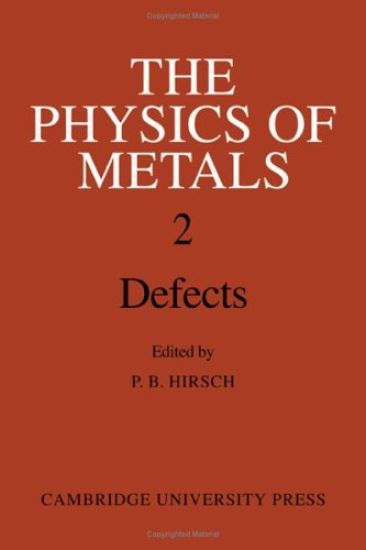
The Physics of Metals

The Physics of Metals

P. B. Hirsch

Cambridge University Press
1976
sidottu
The Physics of Metals is an advanced treatise written by a team of experts. It presents an authoritative account of selected topics in a major field of modern physics and will prove indispensable to both experimental and theoretical solid state physicists and metallurgists seeking a clear explanation of the state of knowledge of the physical phenomena occurring in metals, without recourse to elaborate mathematics. The whole work was inspired by the desire to honour Sir Nevill Mott by writing an account of some of the topics treated in Mott and Jones's classic work The Theory of the Properties of Metals and Alloys.
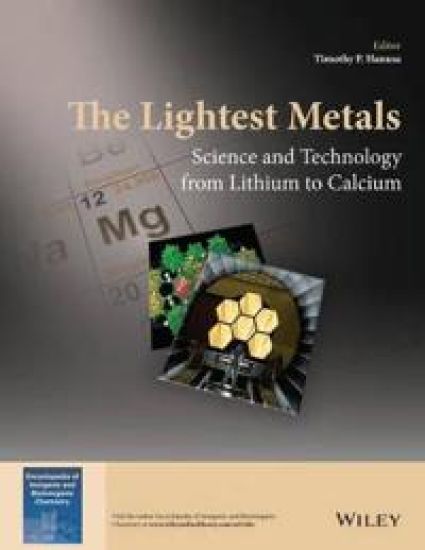
The Lightest Metals

The Lightest Metals

Timothy P. Hanusa

John Wiley Sons Inc
2015
sidottu
The first seven metals in the periodic table are lithium, beryllium, sodium, magnesium, aluminium, potassium and calcium, known collectively as the “lightest metals”. The growing uses of these seven elements are enmeshing them ever more firmly into critical areas of 21st century technology, including energy storage, catalysis, and various applications of nanoscience. This volume provides comprehensive coverage of the fundamentals and recent advances in the science and technology of the lightest metals. Opening chapters of the book describe major physical and chemical properties of the metals, their occurrence and issues of long-term availability. The book goes on to disucss a broad range of chemical features, including low oxidation state chemistry, organometallics, metal-centered NMR spectroscopy, and cation-p interactions. Current and emerging applications of the metals are presented, including lithium-ion battery technology, hydrogen storage chemistry, superconductor materials, transparent ceramics, nano-enhanced catalysis, and research into photosynthesis and photoelectrochemical cells.The content from this book will be added online to the Encyclopedia of Inorganic and Bioinorganic Chemistry: http://www.wileyonlinelibrary.com/ref/eibc
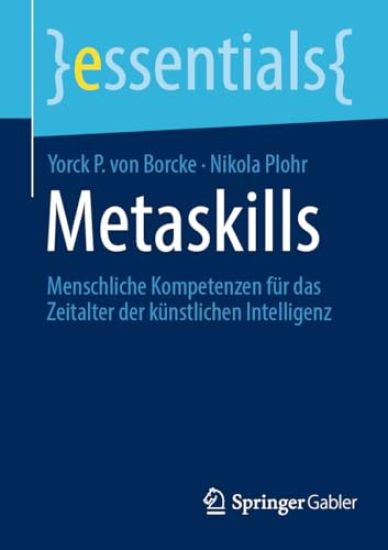
Metaskills

Metaskills

Yorck P. von Borcke; Nikola Plohr

Springer-Verlag Berlin and Heidelberg GmbH Co. KG
2024
nidottu
?Das beginnende Zeitalter der künstlichen Intelligenz braucht menschliche Kompetenzen, wenn es erfolgreich gelingen soll. Anhand von aktuellen KI-basierten Beispielen beleuchtet das esssential den Zusammenhang von technologischer Entwicklung und menschlichen Kompetenzen, die sich nicht an die KI delegieren lassen: den Metaskills.Die Autoren beschreiben ausgewählte Metaskills, die einen reflektierten Umgang mit KI auf individueller, unternehmerischer und globaler Ebene ermöglichen und benennen jeweils konkrete Anwendungsfälle. Zudem erläutern sie zentrale Prinzipien, die nötig sind, um KI-Technologien menschengerecht zu entwickeln.