Kirjojen hintavertailu. Mukana 11 244 527 kirjaa ja 12 kauppaa.

Kirjahaku

Etsi kirjoja tekijän nimen, kirjan nimen tai ISBN:n perusteella.

1000 tulosta hakusanalla Pamela Colman Smith

Pamela Colman Smith

Pamela Colman Smith

Stuart R. Kaplan; Mary K. Greer

U.S. Games
2018
sidottu
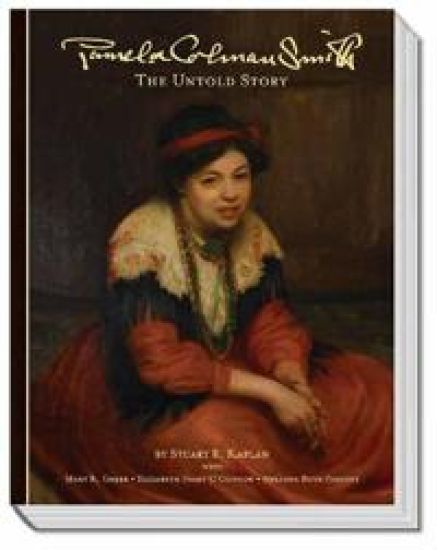
Pamela Colman Smith: The Untold Story brings together the work of four distinguished scholars who have devoted years of research to uncover the life and artistic accomplishments of Pamela Colman Smith. Known to millions as the creator of the Rider-Waite Tarotƒƒ‚‚ƒ‚‚ deck, Pamela Colman Smith (1878ƒ‚‚"ƒ‚‚€ƒ‚‚"1951) was also a stage and costume designer, folklorist, poet, author, illustrator of ballads and folktales, suffragette, and publisher of books and broadsheets. This collaborative work presents: a richly illustrated biography of Pamela's life with essays on the events and people that influenced her including Jack Yeats, Ellen Terry, Alfred Stieglitz, Bram Stoker and William Gillette. There is also a chronological survey of her folktales, art and poetry and an exploration of her lasting legacy. Over 400 color images of Pamela's non-tarot art have been curated from her publications including A Broad Sheet, The Green Sheaf, Blue Beard, Annancy stories, Russian ballet, costumes, stage designs, Iri
Pamela Colman Smith

Pamela Colman Smith

Elizabeth Foley O'Connor

LIVERPOOL UNIVERSITY PRESS
2024
nidottu
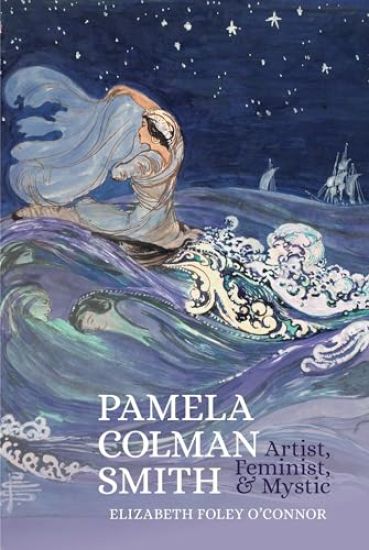
Pamela Colman Smith’s illustrations for the Rider Waite tarot deck are known to millions worldwide, but her work took her from art galleries in New York and Europe to salons with luminaries of the English suffrage movement, the Irish literary revival, and friendships with Bram Stoker, W. B. Yeats, and G. K. Chesterton. A feminist artist, poet, folklorist, editor, publisher, and stage designer who was active from 1896 through the 1920s, Colman Smith became popular for her live performances of Jamaican folktales in both England and the U.S., using the creole of the island to capture the dramatic power of these tales while driving speculation about her purposefully indeterminate racial and sexual identity. She also travelled in - and was expelled from – occult circles, and her ability to take on and cast aside a wide range of identities was central to her life’s work. Colman Smith illustrated more than 20 books and well over a hundred magazine articles, wrote two collections of Jamaican folktales, and edited two magazines. Her paintings were exhibited in galleries in the U.S. and Europe.
Pamela Colman Smith Commemorative Set
Celebrating the 100th Anniversary of the Rider-Waite Deck, the Pamela Colman Smith Commemorative set will be cherished by all tarot collectors and art lovers. The deluxe set includes the Smith-Waite Centennial Tarot Deck and two books; The Artwork and Times of Pamela Colman Smith and The Pictorial Key to the Tarot.
Pamela Colman Smith, Tarot Artist

Pamela Colman Smith, Tarot Artist

Dawn Robinson

Fonthill Media
2020
nidottu
Pamela Colman Smith is the mysterious artist behind the most renowned tarot deck in the world, for many years forgotten. In a revival of interest in esoteric artists and accessible tarot, curiosity about Pamela is now on the ascendant, but there are still many unanswered questions, especially concerning her later life. Born in London to American parents, Pamela was a prolific illustrator and artist who mixed with the great and good of art and theatre, among them W. B. Yeats and Bram Stoker. ‘Adopted’ by actress Ellen Terry, she spent some years with the Lyceum Theatre crowd, also working as an exotic storyteller, known as Gelukiezanger, in bohemian London. People have questioned her sexuality, her ethnic origins and alleged synaesthesia, assuming her to be biracial and lesbian. These are discussed but the biggest mystery of all is why she converted from mysticism to Catholicism in 1911, removing herself from vibrant London to the isolated Lizard in the west of Cornwall. There, living in relative obscurity, she evangelised Catholicism in a heavily non-conformist area, before moving to Bude in her sixties.
Pamela Colman Smith and Madge Gill

Pamela Colman Smith and Madge Gill

Andrea J Miles

Green Magic Publishing
2023
nidottu
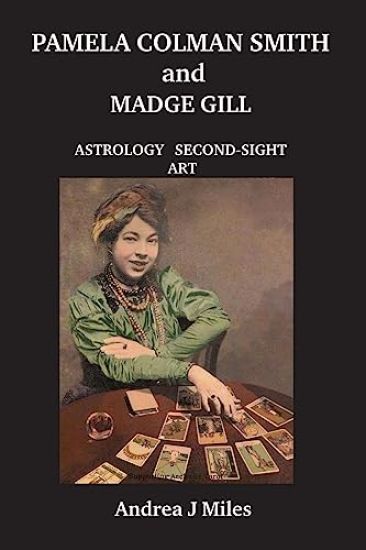
Welcome to the lives of Pamela Colman Smith (‘Pixie’) and Madge Gill. Two very different women from contrasting backgrounds who were born during the reign of Queen Victoria. Both are remembered now for the interesting and unique individuals they were. Celebrated and finding fame posthumously, Colman Smith is known principally for her illustrations of the Rider-Waite Tarot deck and Gill for her art, spiritual beliefs and second-sight. What binds them together, aside from their being artists and unconventional for their time, is how their lives were touched by the areas of astrology, magic, psychic abilities and spiritualism. This book looks at their lives and uses an astrological narrative to help better understand what drove them and how they managed their challenges and successes. Illustrated with photographs and images.
Pamela Colman Smith, Tarot Artist

Pamela Colman Smith, Tarot Artist

Dawn Robinson-Walsh

PEN SWORD BOOKS LTD
2026
sidottu
Pamela Colman Smith (1878–1951) is the artist behind the most renowned tarot deck in the world, the Rider-Waite Tarot. She is a woman whose life is as mysterious and alluring as the strange, beautiful figures she was famous for painting. Born in London to American parents, Smith was a prolific artist and illustrator and outspoken suffragette who mixed with the great and good of the London art world, as well as the highest tier of the city’s acting and literary circles. She was ‘adopted’ by actress Ellen Terry and spent several years among the Lyceum Theatre crowd. Friends like W. B. Yeats and Bram Stoker were doubtless intrigued by her work as an exotic storyteller known as Gelukiezanger in bohemian London. Smith always inspired curiosity, and questions regarding her sexuality, ethnic origins and alleged synaesthesia attracted extraordinary interest during her lifetime. The biggest mystery of all, however, is why she converted from mysticism to Catholicism in 1911, removing herself from vibrant London to the isolated Lizard in the west of Cornwall. There, living in relative obscurity, she evangelised Catholicism in a heavily non-conformist area before moving to Bude in her sixties.
Smith-Waite® Centennial Tarot Deck In A Tin
The Smith-Waite Centennial Tarot Deck in a Tin is a faithful reproduction of the original deck created by Pamela Colman Smith in 1909 under the direction of Arthur E. Waite. This classic tarot deck features full pictorial scenes in the muted colors chosen by “Pixie” herself. The deck was first issued in 2009 by U.S. Games Systems as part of the Pamela Colman Smith Commemorative Set. The 80-card deck includes the standard 78 tarot cards plus 2 samples of Pixie’s non-tarot artwork. Cards in this pocket-sized deck measure 2.25? x 3.75?.
Smith-Waite(r) Tarot Borderless Edition

Smith-Waite(r) Tarot Borderless Edition

Pamela Colman Smith

U.S. Games Systems, Inc.
2017
muu
Pamela Colman Smith's beloved tarot artwork, created in 1909 under the direction of Arthur E. Waite, is now presented in a borderless format for a more immersive reading experience. This 84-card deck includes four extra cards with reproduction samples of Pixie's non-tarot artwork, including two watercolor paintings "Catch Me" and "Duet"; the Lovers illustration from the play Deirdre; and an illustration from the sheet music for "Christmas Carol." The deck comes with an instruction booklet.
Pocket Rider-Waite® Tarot

Pocket Rider-Waite® Tarot

Pamela Colman Smith

U.S. GAMES
2002
muu
With full pictorial scenes on every card of the Major and Minor Arcana, Rider-Waite Tarot set the standard for hundreds of other tarot decks around the world. First created in 1909 by Pamela Colman Smith, under the direction of Arthur Edward Waite, the vibrant drawings of Rider-Waite Tarot hold timeless appeal. The deck’s enduring popularity stems from the universality of the symbolism captured in every card of the 78-card deck. Pocket Rider-Waite Tarot includes an instruction booklet with upright and reversed meanings, keywords, and an introduction by tarot expert, Stuart R. Kaplan. This is a deck that is beloved by tarot beginners and experienced readers alike. Rider-Waite Tarot belongs in every tarot collection.
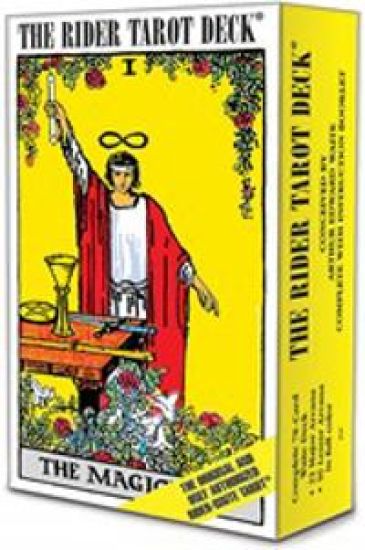
The Rider Tarot Deck®

The Rider Tarot Deck®

Pamela Colman Smith

U.S. GAMES
2002
muu
The cards were drawn in 1909 by Pamela Colman Smith under the direction of Arthur Edward Waite. Smith's vibrant drawings transformed the standard tarot deck."A unique feature of the Rider-Waite deck, and one of the of the principal reasons for its enduring popularity, is that all of the cards, including the Minor Arcana, depict full scenes with figures and symbols. Prior to the Rider-Waite Tarot, the pip cards of almost all tarot decks were marked only with the arrangement of the suit signs -- swords, wands, cups, and coins, or pentacles. The pictorial images on all the cards allow interpretations without the need to repeatedly consult explanatory text. The innovative Minor Arcana, and Pamela Colman Smith's ability to capture the subtleties of emotion and experience have made the Rider-Waite Tarot a model for the designs of many tarot packs." -- (from The Encyclopedia of Tarot, Volume III)Rider-Waite Tarot was named one of the Top Ten Tarot Decks of All Time by Aeclectic Tarot.Pamela Colman SmithBorn February 16, 1878, in Middlesex, England to American parents, Smith's childhood years were spent between London, New York, and Kingston, Jamaica. During her teens, she traveled throughout England with the theatre company of Ellen Terry and Henry Irving. Thereafter, she began formal art training at Pratt Institute of Brooklyn, graduating in 1897.Smith returned to England, where she became a theatrical designer for miniature theatre, and an illustrator -- mainly of books, pamphlets and posters. Around 1903, she joined the Order of the Golden Dawn. In 1909, under the guidance of Arthur Edward Waite, she undertook a series of seventy-eight allegorical paintings described by Waite as a rectified tarot pack. The designs, published in the same year by William Rider and Son, exemplify the mysticism, ritual, imagination, fantasy, and deep emotions of the artist.Arthur Edward WaiteBorn in America in 1857, Waite was raised and educated as a Catholic in England. Beginning at the age of 21, Waite pursued research and writing on psychical and esoteric matters. Soon after joining the Hermetic Order of the Golden Dawn, he became the Grand Master, and redirected the focus of the order from magic to mysticism. The Golden Order, whose structural hierarchy was based on the Kabbalah, is considered the single greatest 20th century influence on the occult. Waite was a prolific author of occult texts, works on the Holy Grail, and the body of mystical knowledge, which comprises the basis of modern Tarot. He is best known as the co-creator of the Rider-Waite Tarot deck and author of its companion volume The Pictorial Key to the Tarot, first published in 1910.
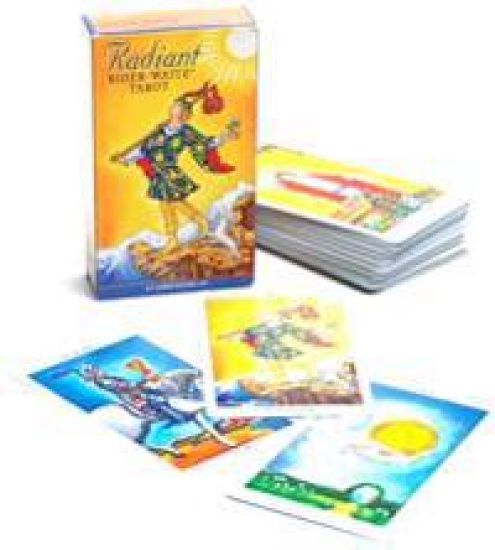
Radiant Rider-Waite(r) Tarot

Radiant Rider-Waite(r) Tarot

Pamela Colman Smith

U.S. Games Systems, Inc.
2003
sidottu
Virginijus Poshkus has successfully undertaken the task of re-colorizing an iconic tarot deck and enhancing the beloved artwork created by Pamela Colman Smith. His carefully chosen palette of vibrant color brings new energy and radiance to the 78 cards of the Rider-Waite Tarot. The updated look replaces Smith's thick, black outlines with subtle shading that gives depth to the familiar scenes. Radiant Rider-Waite's enhanced brightness highlights the traditional symbolism that readers rely on for insightful readings. The card backs have also been given the fresh new look of a star-filled deep, blue sky. Radiant Rider-Waite Tarot includes an instruction booklet with an Introduction by Stuart R. Kaplan.
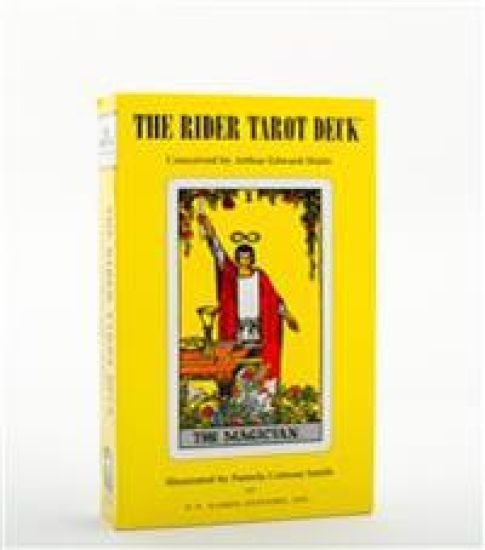
Rider-Waite(r) Tarot Premier Edition

Rider-Waite(r) Tarot Premier Edition

Pamela Colman Smith

U.S. Games Systems, Inc.
2005
muu
Once considered revolutionary, the Rider-Waite deck has become the most popular tarot deck in the world, and has set the standard for hundreds of other tarot decks. The cards were drawn in 1909 by Pamela Colman Smith under the direction of Arthur Edward Waite. Smith's vibrant drawings transformed the standard tarot deck."A unique feature of the Rider-Waite deck, and one of the of the principal reasons for its enduring popularity, is that all of the cards, including the Minor Arcana, depict full scenes with figures and symbols. Prior to the Rider-Waite Tarot, the pip cards of almost all tarot decks were marked only with the arrangement of the suit signs -- swords, wands, cups, and coins, or pentacles. The pictorial images on all the cards allow interpretations without the need to repeatedly consult explanatory text. The innovative Minor Arcana, and Pamela Colman Smith's ability to capture the subtleties of emotion and experience have made the Rider-Waite Tarot a model for the designs of many tarot packs." -- (from The Encyclopedia of Tarot, Volume III)Rider-Waite Tarot was named one of the Top Ten Tarot Decks of All Time by Aeclectic Tarot.See all other Rider-Waite decks
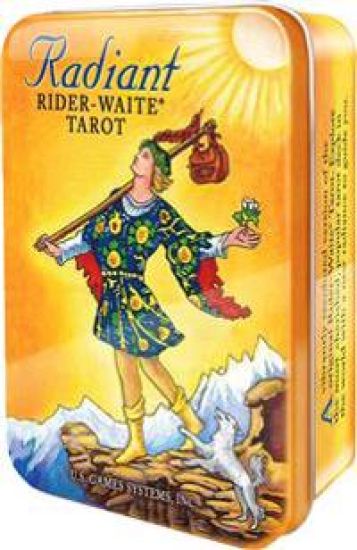
Radiant Rider-Waite Tarot in a Tin

Radiant Rider-Waite Tarot in a Tin

Pamela Colman Smith

U.S. GAMES
2015
muu
The brilliantly colored tarot deck that has been popular for decades is now presented in a charming keepsake tin. For Radiant Rider-Waite, the artwork of Pamela Colman Smith has been updated and enhanced with a vibrant palette of colors, bringing new energy and radiance to the familiar scenes of 78 cards. Radiant Rider-Waite’s brightness and subtle shading highlight the traditional symbolism that readers rely on for insightful readings. The card backs feature a star-filled deep, blue sky. Radiant Rider-Waite® Tarot includes an instruction booklet with an Introduction by Stuart R. Kaplan. 10x14 See also Radiant Rider-Waite TarotSize 2” x 3.5”
The 100% Plastic Rider Tarot Deck

The 100% Plastic Rider Tarot Deck

Pamela Colman Smith

U.S. Games Systems, Inc.
2020
muu
100% plastic tarot cards are durable, resistant to bending, easy to shuffle and can last up to 50 times longer than paper cards.The original and only authorized edition of the famous 78-card Tarot Deck designed by Pamela Colman Smith under the direction of Arthur Edward Waite.Complete with instruction booklet by Arthur Edward Waite with foreword by Stuart R. Kaplan.
Rider Waite Playing Card Deck

Rider Waite Playing Card Deck

Pamela Colman Smith

U.S. Games Systems, Inc.
2021
muu
This unique 78-card poker deck features Rider-Waite Tarot images. The deck includes 22 Major Arcana, 52 Minor Arcana combined with their matching playing card indices and four Knights, which may be used as Jokers. The deck also includes a 56-page booklet featuring instructions for two tarot games and traditional card meanings from the Rider-Waite Tarot.
A.E. Waite Tarot Standard Premium Edition

A.E. Waite Tarot Standard Premium Edition

Pamela Colman Smith

Cartamundi/AGM-Urania Königsfurt-Urania Verlag GmbH
2017
muu
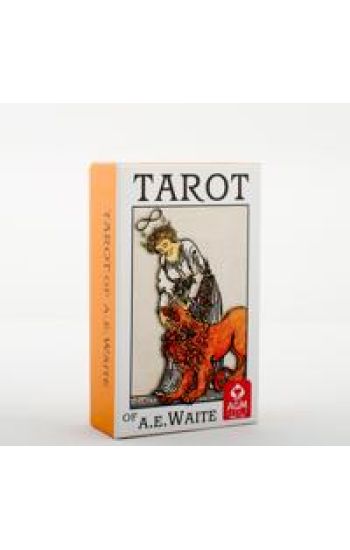
Colors and backside of the cards according to the first edition from 1909. The frontsides of the cards offer the same beautiful reprint of the colors of the historic cards as the blue edition. The back of the cards shows the famous brown pebble back that was the very backside of the first printing. This edition consists of a sturdy bottom lid box with a detailed instruction booklet of 96 pages various language editions and in three different card sizes:Deluxe = 99 x 169 mm; English Standard = 70 x 120 mm; English, Spanish, Portuguese & French Pocket = 57 x 89 mm; English, Spanish & Portuguese The cards were drawn in 1909 by Pamela Colman Smith under the direction of Arthur Edward Waite. Smith's vibrant drawings transformed the standard tarot deck. Pamela Colman Smith was born February 16, 1878, in Middlesex, England to American parents, Smith's childhood years were spent between London, New York, and Kingston, Jamaica. During her teens, she traveled throughout England with the theatre company of Ellen Terry and Henry Irving. Thereafter, she began formal art training at Pratt Institute of Brooklyn, graduating in 1897. Around 1903, she joined the Order of the Golden Dawn. In 1909, under the guidance of Arthur Edward Waite, she undertook a series of seventy-eight allegorical paintings described by Waite as a rectified tarot pack. The designs, published in the same year by William Rider and Son, exemplify the mysticism, ritual, imagination, fantasy, and deep emotions of the artist. Arthur Edward Waite was born in America in 1857, raised and educated as a Catholic in England. Beginning at the age of 21, Waite pursued research and writing on psychical and esoteric matters. Soon after joining the Hermetic Order of the Golden Dawn, he became the Grand Master, and redirected the focus of the order from magic to mysticism. The Golden Order, whose structural hierarchy was based on the Kabbalah, is considered the single greatest 20th century influence on the occult. Waite was a prolific author of occult texts, works on the Holy Grail, and the body of mystical knowledge, which comprises the basis of modern Tarot.
A.E. Waite Tarot Pocket Premium Edition

A.E. Waite Tarot Pocket Premium Edition

Pamela Colman Smith

Cartamundi/AGM-Urania Königsfurt-Urania Verlag GmbH
2017
muu
Colors and backside of the cards according to the first edition from 1909. The frontsides of the cards offer the same beautiful reprint of the colors of the historic cards as the blue edition. The back of the cards shows the famous brown pebble back that was the very backside of the first printing. This edition consists of a sturdy bottom lid box with a detailed instruction booklet of 96 pages various language editions and in three different card sizes:Deluxe = 99 x 169 mm; English Standard = 70 x 120 mm; English, Spanish, Portuguese & French Pocket = 57 x 89 mm; English, Spanish & Portuguese The cards were drawn in 1909 by Pamela Colman Smith under the direction of Arthur Edward Waite. Smith's vibrant drawings transformed the standard tarot deck. Pamela Colman Smith was born February 16, 1878, in Middlesex, England to American parents, Smith's childhood years were spent between London, New York, and Kingston, Jamaica. During her teens, she traveled throughout England with the theatre company of Ellen Terry and Henry Irving. Thereafter, she began formal art training at Pratt Institute of Brooklyn, graduating in 1897. Around 1903, she joined the Order of the Golden Dawn. In 1909, under the guidance of Arthur Edward Waite, she undertook a series of seventy-eight allegorical paintings described by Waite as a rectified tarot pack. The designs, published in the same year by William Rider and Son, exemplify the mysticism, ritual, imagination, fantasy, and deep emotions of the artist. Arthur Edward Waite was born in America in 1857, raised and educated as a Catholic in England. Beginning at the age of 21, Waite pursued research and writing on psychical and esoteric matters. Soon after joining the Hermetic Order of the Golden Dawn, he became the Grand Master, and redirected the focus of the order from magic to mysticism. The Golden Order, whose structural hierarchy was based on the Kabbalah, is considered the single greatest 20th century influence on the occult. Waite was a prolific author of occult texts, works on the Holy Grail, and the body of mystical knowledge, which comprises the basis of modern Tarot.