Inspired and birthed from author Felix B. Duckworth, Sr. 's irrational personal decisions and their unexpected outcomes, The Struggle is Real helps broken people rebuild the broken walls of their lives. Duckworth tells that instead of allowing his destructive actions to redefine who he was or to permanently pervert his self-image, he seized the journey as a golden opportunity to rediscover himself, allowing God to re-mold and fashion him into whom he is meant to be. Through a variety of scriptures and personal testimony, Duckworth encourages you to thank God for the Holy Ghost as a compass to help you navigate life's journey. The Struggle is Real shows you how to utilize the fallout of your misguided decisions and reckless choices as building blocks to redesign and restructure your life and revamp your image. It helps you take stock of your life, get off the merry-go-round, slow your thoughts, and get your balance.
Inspired and birthed from author Felix B. Duckworth, Sr. 's irrational personal decisions and their unexpected outcomes, The Struggle is Real helps broken people rebuild the broken walls of their lives. Duckworth tells that instead of allowing his destructive actions to redefine who he was or to permanently pervert his self-image, he seized the journey as a golden opportunity to rediscover himself, allowing God to re-mold and fashion him into whom he is meant to be. Through a variety of scriptures and personal testimony, Duckworth encourages you to thank God for the Holy Ghost as a compass to help you navigate life's journey. The Struggle is Real shows you how to utilize the fallout of your misguided decisions and reckless choices as building blocks to redesign and restructure your life and revamp your image. It helps you take stock of your life, get off the merry-go-round, slow your thoughts, and get your balance.
Start pulling the strings of your IT infrastructure effectively with Puppet - learn how to configure, customize and manage your systems more intelligently in an enterprise deployment. About This Book * Step-by-step instructions to jump start your Puppet deployment and automate your IT configurations * Design, implement, and deploy Puppet in your infrastructure and tackle everyday IT infrastructure challenges * Gain expert understanding of Puppet's latest and most advanced features Who This Book Is For If you're an experienced IT professional and a new Puppet user, this course will provide you with all you need to know to go from installation to advanced automation. What You Will Learn * Write and employ individual Puppet manifests * Understand how Puppet implements system abstraction * Use Puppet to manage network, cloud, and virtualization devices * Manage and test the Puppet code workflow * Tweak, hack, and adapt the Puppet extension points * Use exported resources to orchestrate change between machines * Debug a puppetserver using Java techniques In Detail Puppet is a configuration management tool that allows you to automate all your IT configurations, giving you control. It was written for and by system administrators to manage large numbers of systems efficiently and prevent configuration drifts. Puppet gives you control of what you do to each node, when you do it, and how you do it.This Learning Path will take you from the basics of Puppet to extending it and then mastering it. We will start off with a primer on Puppet, its installation and get a sneak peek under its hood. We will then move on to designing and deploying your Puppet architecture, learning best practices for writing reusable and maintainable code, and executing, testing, and deploying Puppet across your systems. Finally, we will deal with problems of scale and exceptions in your code, automate workflows, and support multiple developers working simultaneously.This course is based on the following books: 1. Puppet 4 Essentials - Second Edition 2. Extending Puppet - Second Edition 3. Mastering Puppet - Second Edition Style and approach This learning path follows a practical approach, starting from the basic commands to advanced aspects. Through a series of examples you will learn the most important skills essential to manage your IT infrastructure effectively.
Rui Diogo; Josep M. Potau; Juan F. Pastor; Felix J. de Paz; Mercedes Barbosa; Eva M. Ferrero; Gaëlle Bello; Mohammed Ashraf Aziz; Julia Arias-Martorell; Bernard Wood
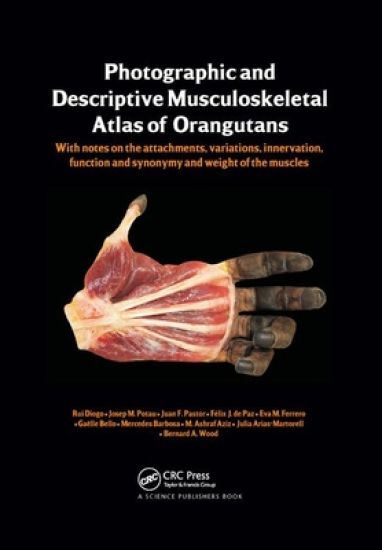
Orangutans, together with chimpanzees and gorillas, are our closest living relatives. Photographic and Descriptive Musculoskeletal Atlas of Orangutans, the first photographic and descriptive musculoskeletal atlas of the genus Pongo, adopts the same format as the photographic atlases of Gorilla, Pan and Hylobates previously published by the same authors. These four books are part of a series of monographs that will set out the comparative and phylogenetic context of the gross anatomy and evolutionary history of the soft tissue morphology of modern humans and their closest relatives. The present atlas, which includes detailed high-quality photographs of musculoskeletal structures from most anatomical regions of the body as well as textual information about the attachments, innervation, function and weight of the respective muscles, is based on dissections of five orangutans and on an extensive review of the literature. It provides an updated review of the anatomical variations within orangutans as well as an extensive list of the synonyms used in the literature to designate the structures we discuss. It will be of interest to students, teachers and researchers studying primatology, comparative anatomy, functional morphology, zoology, and physical anthropology and to medical students, doctors and researchers who are curious about the origin, evolution, homology and variations of the musculoskeletal structures of modern humans.
Rui Diogo; Josep M. Potau; Juan F. Pastor; Felix J. dePaz; Eva M. Ferrero; Gaelle Bello; Mercedes Barbosa; M. Ashraf Aziz; Anne M. Burrows; Julia Arias-Martorell; Bernard A. Wood
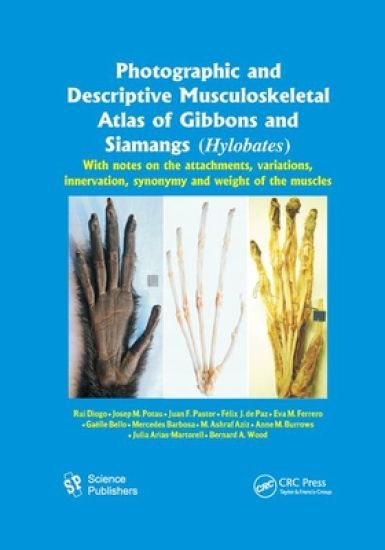
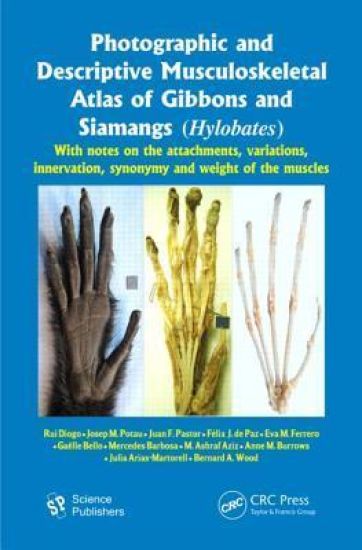
This book is the first photographic and descriptive musculoskeletal atlas of Hylobates, and adopts the same format as the photographic atlas of Gorilla published by the same authors in 2010. These two books are part of a series of monographs that will set out the comparative and phylogenetic context of the gross anatomy and evolutionary history of the soft tissue morphology of modern humans and their closest relatives. This atlas, which includes detailed high-quality photographs of musculoskeletal structures from most anatomical regions of the body as well as textual information about the attachments, innervation and weight of the respective muscles, is based on dissections and on an extensive review of the literature. It provides an updated review of the anatomical variations within hylobatids as well as an extensive list of the synonyms used in the literature to designate the structures we discuss. The atlas will be of interest to students, teachers and researchers studying primatology, comparative anatomy, functional morphology, zoology, and physical anthropology and to medical students, doctors and researchers who are curious about the origin, evolution, homology and variations of the musculoskeletal structures of modern humans.
In Chunhuhub, the Conquest is not a done deal. Unlike many small tropical towns, Chunhuhub in rural Quintana Roo, Mexico, has not been a helpless victim of international forces. Its people are descendants of heroic Mayans who stood off the Spanish invaders. People in Chunhuhub continue to live largely through subsistence farming of maize and vegetables, supplemented by commercial orchard, livestock, and field crop cultivation. They are, however, also self-consciously modernizing? by seeking better educational and economic opportunities. Political Ecology in a Yucatec Maya Community tells the story of Chunhuhub at the beginning of the twenty-first century, focusing on the resource management of plants and animals. E. N. Anderson and his Maya co-authors provide a detailed overview of Maya knowledge of and relationships with the environment, describing how these relationships have been maintained over the centuries and are being transformed by modernization. They show that the Quintana Roo Mayas have been working to find ways to continue ancient and sustainable methods of making a living while also introducing modern techniques that can improve that living. For instance, traditional subsistence agriculture is broadly sustainable at current population densities, but hunting is not, and modern mechanized agriculture has an uncertain future. Bringing the voice of contemporary Mayas to every page, the authors offer an encyclopedic overview of the region: history, environment, agriculture, medicine, social relations, and economy. Whether discussing the fine points of beekeeping or addressing the problem of deforestation, they provide a remarkably detailed account that immerses readers in the landscape. Mayas of the Yucatan Peninsula have had more than their share of successes, nd some failures as well, nd as a study in political and cultural ecology, Political Ecology in a Yucatec Maya Community has much to tell us about tropical development and about the human condition. Their experience tells us that if we wish to have not only farms but also mahogany, wildlife, and ecotourism, then further efforts are needed. As Anderson observes, traditional Maya management, with its immense knowledge base, remains the best?indeed, the onlyeffective system for making a living from the Yucatan's harsh landscape. Political Ecology in a Yucatec Maya Community is a compelling testament to the daily life practices of modern peasant farmers that can provide us with clues about more efficient management techniques for the conservation of biodiversity worldwide.
Rui Diogo; Josep M. Potau; Juan F. Pastor; Felix J. de Paz; Mercedes Barbosa; Eva M. Ferrero; Gaëlle Bello; Mohammed Ashraf Aziz; Julia Arias-Martorell; Bernard Wood
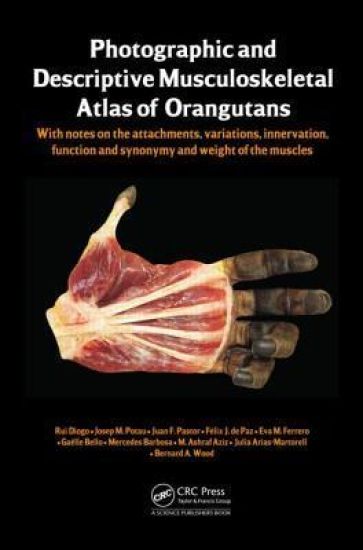
Orangutans, together with chimpanzees and gorillas, are our closest living relatives. Photographic and Descriptive Musculoskeletal Atlas of Orangutans, the first photographic and descriptive musculoskeletal atlas of the genus Pongo, adopts the same format as the photographic atlases of Gorilla, Pan and Hylobates previously published by the same authors. These four books are part of a series of monographs that will set out the comparative and phylogenetic context of the gross anatomy and evolutionary history of the soft tissue morphology of modern humans and their closest relatives. The present atlas, which includes detailed high-quality photographs of musculoskeletal structures from most anatomical regions of the body as well as textual information about the attachments, innervation, function and weight of the respective muscles, is based on dissections of five orangutans and on an extensive review of the literature. It provides an updated review of the anatomical variations within orangutans as well as an extensive list of the synonyms used in the literature to designate the structures we discuss. It will be of interest to students, teachers and researchers studying primatology, comparative anatomy, functional morphology, zoology, and physical anthropology and to medical students, doctors and researchers who are curious about the origin, evolution, homology and variations of the musculoskeletal structures of modern humans.
Rui Diogo; Josep M. Potau; Juan F. Pastor; Felix J. dePaz; Eva M. Ferrero; Gaelle Bello; Mercedes Barbosa; M. Ashraf Aziz; Anne M. Burrows; Julia Arias-Martorell; Bernard A. Wood
This book is the first photographic and descriptive musculoskeletal atlas of Hylobates, and adopts the same format as the photographic atlas of Gorilla published by the same authors in 2010. These two books are part of a series of monographs that will set out the comparative and phylogenetic context of the gross anatomy and evolutionary history of the soft tissue morphology of modern humans and their closest relatives. This atlas, which includes detailed high-quality photographs of musculoskeletal structures from most anatomical regions of the body as well as textual information about the attachments, innervation and weight of the respective muscles, is based on dissections and on an extensive review of the literature. It provides an updated review of the anatomical variations within hylobatids as well as an extensive list of the synonyms used in the literature to designate the structures we discuss. The atlas will be of interest to students, teachers and researchers studying primatology, comparative anatomy, functional morphology, zoology, and physical anthropology and to medical students, doctors and researchers who are curious about the origin, evolution, homology and variations of the musculoskeletal structures of modern humans.
Rui Diogo; Brian Shearer; Josep M. Potau; Juan F. Pastor; Felix J. de Paz; Julia Arias-Martorell; Cassandra Turcotte; Ashley Hammond; Evie Vereecke; Marie Vanhoof; Sandra Nauwelaerts; Bernard Wood
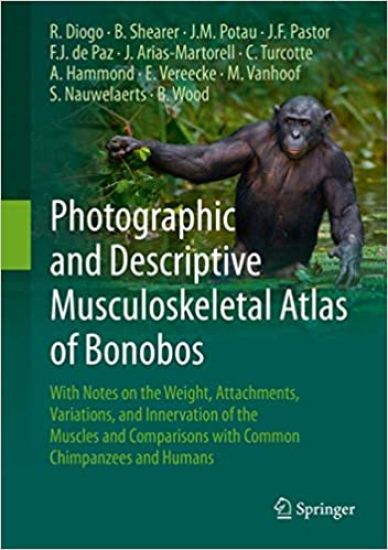
Chimpanzees, including bonobos and common chimpanzees, are our closest living relatives. However, surprisingly, the information about the soft tissues of bonobos is very scarce, making it difficult to discuss and understand human evolution. This book, which is the first photographic and descriptive musculoskeletal atlas of bonobos (Pan paniscus), adopts the same format as the photographic atlases of other apes previously published by the same authors. These books are part of a series of monographs that will set out the comparative and phylogenetic context of the gross anatomy and evolutionary history of the soft tissue morphology of modern humans and their closest relatives. The present atlas, which includes detailed high quality photographs of the musculoskeletal structures from most anatomical regions of the body as well as textual information about the attachments, innervation, function and weight of the respective muscles, is based ondissections of seven bonobos, including adults, adolescents, infants and fetuses, and males and females, and on an extensive review of the literature for comparisons with common chimpanzees. It therefore provides an updated review of the anatomical variations within chimpanzees as well as an extensive list of synonyms used in the literature to designate the structures covered here. Moreover, contrary to the previous photographic atlases of apes, it also provides details on neurovascular structures such as the brachial and lumbrosacral plexuses. The book will therefore be of interest to students, teachers and researchers focusing on primatology, comparative anatomy, functional morphology, zoology, and physical anthropology and to medical students, doctors and researchers who are curious about the origin, evolution, homology and variations of the musculoskeletal and neurovascular structures of modern humans.
Pastor: Unterrichtung, wie ein Pfarherr und Seelsorger in Lehr leben, und allem Wandel sich christlich verhalten soll ist ein unver nderter, hochwertiger Nachdruck der Originalausgabe aus dem Jahr 1565. Hansebooks ist Herausgeber von Literatur zu unterschiedlichen Themengebieten wie Forschung und Wissenschaft, Reisen und Expeditionen, Kochen und Ern hrung, Medizin und weiteren Genres. Der Schwerpunkt des Verlages liegt auf dem Erhalt historischer Literatur. Viele Werke historischer Schriftsteller und Wissenschaftler sind heute nur noch als Antiquit ten erh ltlich. Hansebooks verlegt diese B cher neu und tr gt damit zum Erhalt selten gewordener Literatur und historischem Wissen auch f r die Zukunft bei.
Pastor Tillich: The Justification of the Doubter tells the story of Paul Tillich's early theological development from his student days until the end of the First World War, set against the backdrop of church politics in Wilhelmine Germany and with particular reference to his early sermons. The majority of scholarship understands Tillich primarily as a philosophical theologian. But before and during the First World War, Tillich was Pastor Tillich, studying to become a pastor, leading a Christian student group, working periodically as a pastor in Berlin churches, and preaching to soldiers. Arriving in Berlin after the war, Tillich pursued religious socialism and a theology of culture through the 1920s. But the theological basis of these programmes was what Tillich considered his main concern in 1919: the theology of doubt. Using a wealth of untranslated German sources largely unknown to English-language scholarship, Pastor Tillich presents the stations of Tillich's theological development of the notion of the justification of the doubter up to 1919. Distinguishing between Tillich's later autobiographical statements and the witness of archival sources, a significantly original, contextualised account of Tillich's early life in Germany emerges. From his days as the conservative son of a conservative Lutheran pastor to the battle-worn chaplain who could even talk about 'faith without God', Tillich underwent considerable change. The book should therefore speak to any interested in the history of modern theology, as an example of how biography and theology are intertwined.