Kirjojen hintavertailu. Mukana 11 244 527 kirjaa ja 12 kauppaa.

Kirjahaku

Etsi kirjoja tekijän nimen, kirjan nimen tai ISBN:n perusteella.

1000 tulosta hakusanalla Patterson Annabel M.

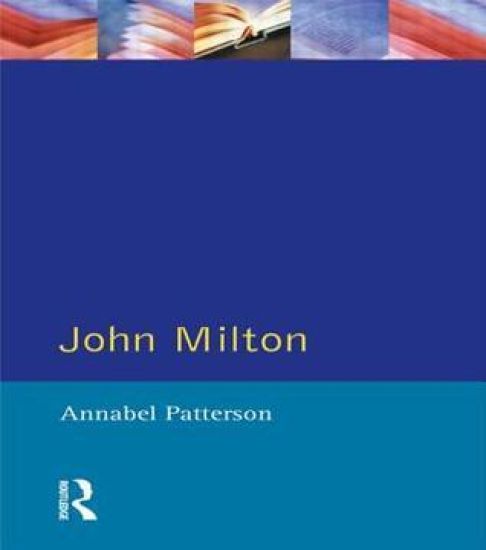
John Milton

John Milton

Patterson Annabel M.

Routledge
1992
nidottu
This collection of selected writings represents the best of recent critical work on Milton. The essays cover all stages of his career, from the early poems through to the later poems of the Restoration period, especially Paradise Lost. Professor Patterson includes British and American critics such as Michael Wilding, Victoria Kahn, James Grantham Turner and Mary Ann Radzinowicz and guides the reader through the varied ways Milton's achievement has been explored and debated by modern criticism.
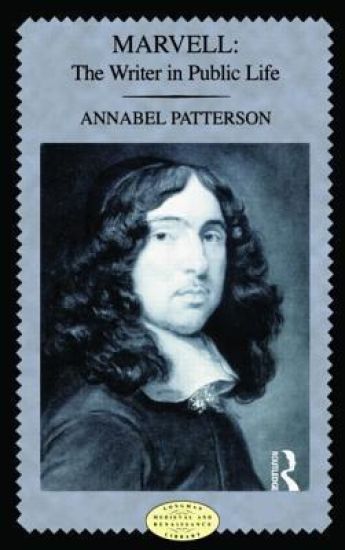
Marvell

Marvell

Annabel M. Patterson

Longman
1999
nidottu
Marvell: The Writer in Public Life is substantially revised from Professor Patterson's well received 1978 study, including a new introduction and new chapter on Marvell and secret history. This important study provides an up to date perspective on a writer still thought of merely as the author of lyric and pastoral poems. It looks at both Marvell's political poetry and his often neglected political prose, revealing Marvell's life long commitment to writing about the values and standards of public life and follows his often dangerous writerly activities on behalf of freedom of conscience and constitutional government.
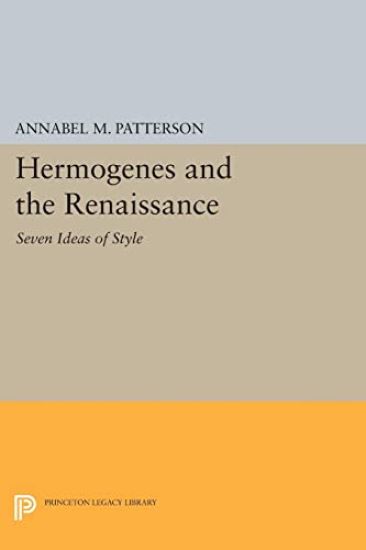
Hermogenes and the Renaissance

Hermogenes and the Renaissance

Annabel M. Patterson

Princeton University Press
2015
pokkari
Annabel M. Patterson offers here a reassessment of the place of Hermogenes, a Greek rhetorician of the second century A.D., in literary history. She shows that the literary men of the European Renaissance-scholars, critics, and poets-found Hermogenes' Concerning Ideas both important and extremely useful, and she finds that they vigorously applied his concepts to create "a lovely conformitie." The author first gives the history of this treatise on style and a detailed critical analysis of the Seven Ideas or categories of style. The book then demonstrates genre by genre how knowledge of the Seven Ideas can improve one's understanding of poetic development, especially in England, and reveals how the Ideas operate in the works of Tasso, Donne, Sidney, Shakespeare, Marvell, Jonson, Spenser, Milton , and many other poets and critics. Originally published in 1970. The Princeton Legacy Library uses the latest print-on-demand technology to again make available previously out-of-print books from the distinguished backlist of Princeton University Press. These editions preserve the original texts of these important books while presenting them in durable paperback and hardcover editions. The goal of the Princeton Legacy Library is to vastly increase access to the rich scholarly heritage found in the thousands of books published by Princeton University Press since its founding in 1905.
Hermogenes and the Renaissance

Hermogenes and the Renaissance

Annabel M. Patterson

Princeton University Press
2016
sidottu
Annabel M. Patterson offers here a reassessment of the place of Hermogenes, a Greek rhetorician of the second century A.D., in literary history. She shows that the literary men of the European Renaissance-scholars, critics, and poets-found Hermogenes' Concerning Ideas both important and extremely useful, and she finds that they vigorously applied his concepts to create "a lovely conformitie." The author first gives the history of this treatise on style and a detailed critical analysis of the Seven Ideas or categories of style. The book then demonstrates genre by genre how knowledge of the Seven Ideas can improve one's understanding of poetic development, especially in England, and reveals how the Ideas operate in the works of Tasso, Donne, Sidney, Shakespeare, Marvell, Jonson, Spenser, Milton , and many other poets and critics. Originally published in 1970. The Princeton Legacy Library uses the latest print-on-demand technology to again make available previously out-of-print books from the distinguished backlist of Princeton University Press. These editions preserve the original texts of these important books while presenting them in durable paperback and hardcover editions. The goal of the Princeton Legacy Library is to vastly increase access to the rich scholarly heritage found in the thousands of books published by Princeton University Press since its founding in 1905.
Marvell

Marvell

Annabel M. Patterson

Routledge
2017
sidottu
Marvell: The Writer in Public Life is substantially revised from Professor Patterson's well received 1978 study, including a new introduction and new chapter on Marvell and secret history. This important study provides an up to date perspective on a writer still thought of merely as the author of lyric and pastoral poems. It looks at both Marvell's political poetry and his often neglected political prose, revealing Marvell's life long commitment to writing about the values and standards of public life and follows his often dangerous writerly activities on behalf of freedom of conscience and constitutional government.
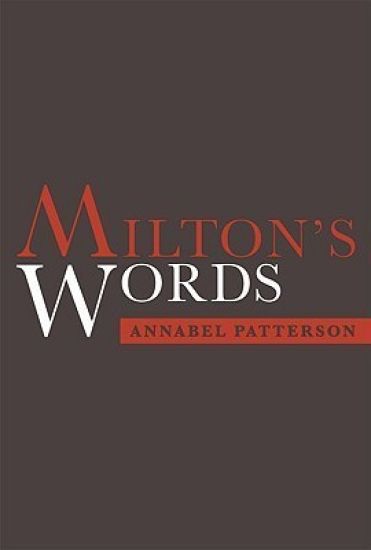
Milton's Words

Milton's Words

Annabel Patterson

Oxford University Press
2009
sidottu
Milton's Words approaches John Milton in both an old and a new way, focusing on his genius with words: keywords - the keys to a text or a theory; words of sexual avoidance and distress; words of abuse; words of privilege because 'Scripture'; big learned words; and cunning little words, easily overlooked. After a short account of Milton's life as a writer, Patterson guides us through most of the poetry and polemical prose, all too often kept in separate compartments. She shows how new challenges and crises required shifts in vocabulary, as well as changes in Milton's views. What do Milton's words look like when we acknowledge their freight of personal and political history; when we track them from text to text; when we consider not only the big, important, learned words but also the very small ones, such as 'perhaps', which Milton deployed with consummate skill at some crucial moments in both poetry and prose, or the phrase 'he who', which replicates the Latinate 'ille qui', but to which Milton gives a psychological twist; when we consider not only word frequency, but infrequency, uniqueness or near uniqueness, as a signal of Milton's interest in a word; when we tackle these issues in the Latin texts for which there is not, as yet, a concordance; when we consider the possibility that certain words gain or lose value for Milton as he proceeds through his writer's life, and that certain words become keywords to a particular text, as 'book' becomes to Areopagitica; when we reconsider the question of Milton's coinages not from the stern legalistic perspective as to whether he should have made them, but why he needed them? No one person could complete all these tasks, and nobody would wish to read a book that appeared to have completed them. Understanding Milton's words is, and should remain, a work in progress. But close attention to Milton's words is not all that this book offers. It tells a slightly different story about Milton himself than the ones we have been used to. Starting with an abbreviated 'writer's life', it explains the shape of Milton's writing career, the life-long tension between his literary ambitions and the pressure of exhilarating political circumstances. The Milton you will find here walked no straight path from his Cambridge degree to the epic he had been talking of writing when he was still at university, but instead cut his teeth as a writer in an entirely different field, political controversy. The effect on his vocabulary of his campaign to reform his country's church government and its divorce laws was galvanic, not least because he had to reconstitute his own image from that of a shy and bookish person to that of a crusader. He discovered that he enjoyed not only verbal conflict, but also mudslinging, and rude words became part of his arsenal in his very first prose tract. 'Marriage' and 'divorce', on the other hand, became loaded words for Milton for personal reasons, and he developed a new set of verbal resources, which Patterson calls 'words of avoidance', to help him tackle the subject. He never got over the experience of writing the divorce tracts. It was still on his mind when at the end of his life he revised his Latin treatise on theology, De Doctrina Christiana. Then, for about a decade, he was called upon to justify the Long Parliament's execution of Charles I, which forced him to come to terms with the political keywords of his generation, words such as 'king', 'liberty', 'tyranny', and 'the people'. When the republican experiment collapsed on the death of Oliver Cromwell, after one last brave salvo against the restoration of the monarchy Milton retired back into the role of private intellectual and poet.
Reading Holinshed's Chronicles

Reading Holinshed's Chronicles

Annabel Patterson

University of Chicago Press
1994
sidottu
This volume provides a study of the 16th-century Elizabethan text, Holinshed's "Chronicles" - a history of England, Scotland and Ireland which has traditionally been read as the source material for many of Shakespeare's plays or as an archaic form of history-writing. In this book, Annabel Patterson insists that the chronicles be read in their own right as an important and inventive cultural history. Although it is known by the name of Raphael Holinshed, editor and major compiler of the 1577 edition, the chronicles were the work of a group - a collaboration between antiquarians, clergymen, members of parliament, poets, publishers and booksellers. Through a detailed reading, Patterson argues that the chronicles convey insights into the way the Elizabethan middle-class understood their society. Responding to the crisis of disunity which resulted from the Reformation, the authors of the chronicles embodied and encouraged an ideal of justice, what we would now call liberalism, that extended beyond the writing of history into the realms of politics, law, economics, citizenship, class and gender. Also, since the second edition of 1587 was called in by the Privy Council and revised under supervision, the work constitutes an important test case for the history of early modern censorship.
Reading Holinshed's Chronicles

Reading Holinshed's Chronicles

Annabel Patterson

University of Chicago Press
1994
nidottu
This volume provides a study of the 16th-century Elizabethan text, Holinshed's "Chronicles" - a history of England, Scotland and Ireland which has traditionally been read as the source material for many of Shakespeare's plays or as an archaic form of history-writing. In this book, Annabel Patterson insists that the chronicles be read in their own right as an important and inventive cultural history. Although they are known by the name of Raphael Holinshed, editor and major compiler of the 1577 edition, the chronicles were the work of a group - a collaboration between antiquarians, clergymen, members of parliament, poets, publishers and booksellers. Through a detailed reading, Patterson argues that the chronicles convey insights into the way the Elizabethan middle-class understood their society. Responding to the crisis of disunity which resulted from the Reformation, the authors of the chronicles embodied and encouraged an ideal of justice, what we would now call liberalism, that extended beyond the writing of history into the realms of politics, law, economics, citizenship, class and gender. Also, since the second edition of 1587 was called in by the Privy Council and revised under supervision, the work constitutes an important test case for the history of early modern censorship.
Nobody’s Perfect

Nobody’s Perfect

Annabel Patterson

Yale University Press
2003
sidottu
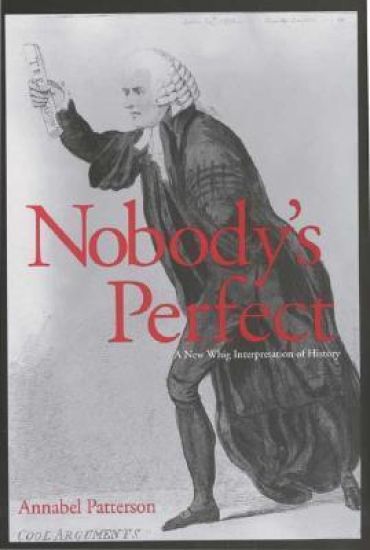
Is history driven more by principle or interest? Are ideas of historical progress obsolete? Is it unforgivable to change one’s mind or political allegiance? Did the eighteenth century really exchange the civilizing force of commercial advantage for political conflict? In this new account of liberal thought from its roots in seventeenth-century English thinking to the end of the eighteenth century, Annabel Patterson tackles these important historiographical questions. She rescues the term “whig” from the low regard attached to it; denies the primacy of self-interest in the political struggles of Georgian England; and argues that while Whigs may have strayed from liberal principles on occasion (nobody’s perfect), nevertheless many were true progressives.In a series of case studies, mainly from the reign of George III, Patterson examines or re-examines the careers of such prominent individuals as John Almon, Edmund Burke, Sir Joshua Reynolds, Thomas Erskine, and, at the end of the century, William Wordsworth. She also addresses a host of secondary characters, reshaping our thinking about both well-known and lesser figures of the time. Tracking a coherent, sustained, and adaptable liberalism throughout the eighteenth century, Patterson overturns common assumptions of political, cultural, and art historians. The author delivers fresh insights into the careers of those who called themselves Whigs, their place in British political thought, and the crucial ramifications of this thinking in the American political arena.
The Long Parliament of Charles II

The Long Parliament of Charles II

Annabel Patterson

Yale University Press
2008
sidottu
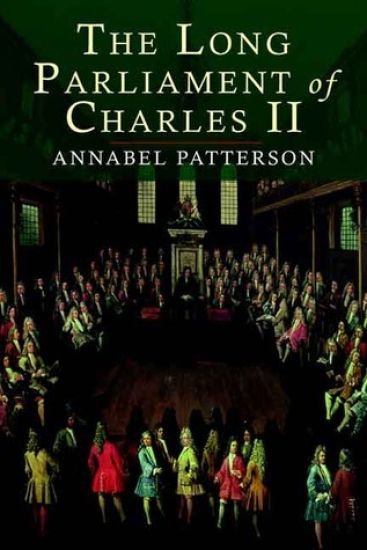
Charles II’s first and most important parliament sat for eighteen years without a general election, earning itself the sobriquet “Long.” In 1661 this parliament began in eager compliance with the new king. Gradually disillusioned by Charles’s maneuvers, however, its members came to demand more control of the economy, religion, and foreign policy, starting a struggle that led to the Exclusion crisis. This lively book is the first full study of this Restoration Parliament. Using parliamentary diaries, newsletters, memoirs, letters from members of parliament, scofflaw pamphlets, and the king’s own speeches, Annabel Patterson describes this second Long Parliament in an innovative and challenging way, stressing that how its records were kept and circulated is an important part of the story. Because the parliamentary debates of this age were jealously guarded from public knowledge, unofficial sources of information flourished. Often these are more candid or colorful than official records. Eighteenth-century historians, especially if Whiggish, recycled many of them for posterity. The book, therefore, not only recovers a crucial period of parliamentary history, one that helps to explain the Glorious Revolution, it also opens a discussion about historiographical method.
The International Novel

The International Novel

Annabel Patterson

Yale University Press
2014
pokkari
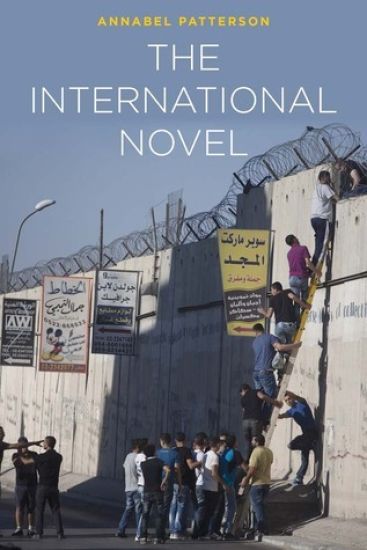
Annabel Patterson here turns her well-known concern with political history in early modern England into an engine for investigating our own era and a much wider terrain. The focus of this book is, broadly, nationalism and internationalism today, approached not theoretically but through the lens of fiction. Novels are uniquely capable of dealing with abstract problems by embodying them in the experience of persons, thereby rendering them more “real.” Patterson takes twelve novels from (almost) all over the world: India, Africa, Turkey, Crete, the Balkans, Palestine, Afghanistan, South America, and Mexico, novels which illustrate the dire effects of some of the following: imperialism, partition, annexation, ethnic and religious strife, boundaries redrawn by aggression, the virus of dictatorships, the vulnerability of small countries, and the meddling of the Great Powers. All are highly instructive, and excellent reads.
Reading Between the Lines

Reading Between the Lines

Annabel Patterson

Routledge
1993
sidottu
Annabel Patterson tackles the hottest topic in literary studies today - `the Great Books debate - providing a superbly formulated moderate stance between the Western canon's radical oppponents and its zealous protectors.
Reading Between the Lines

Reading Between the Lines

Annabel Patterson

Routledge
1993
nidottu
Annabel Patterson tackles the hottest topic in literary studies today - `the Great Books debate - providing a superbly formulated moderate stance between the Western canon's radical oppponents and its zealous protectors.
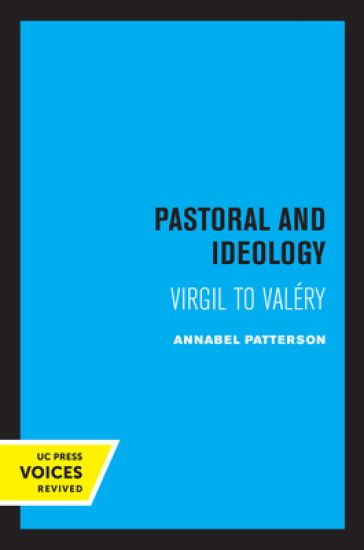
Pastoral and Ideology

Pastoral and Ideology

Annabel Patterson

University of California Press
2022
pokkari
Patterson follows the fortunes of Virgil’s Eclogues from the Middle Ages to our own century. She argues that Virgilian pastoral spoke to the intellectuals of each place and time of their own condition. The study reinspects our standard system of periodization in literary and art history and challenges some of the current premises of modernism. This title is part of UC Press's Voices Revived program, which commemorates University of California Press’s mission to seek out and cultivate the brightest minds and give them voice, reach, and impact. Drawing on a backlist dating to 1893, Voices Revived makes high-quality, peer-reviewed scholarship accessible once again using print-on-demand technology. This title was originally published in 1987.
Pastoral and Ideology

Pastoral and Ideology

Annabel Patterson

University of California Press
2022
sidottu
Patterson follows the fortunes of Virgil’s Eclogues from the Middle Ages to our own century. She argues that Virgilian pastoral spoke to the intellectuals of each place and time of their own condition. The study reinspects our standard system of periodization in literary and art history and challenges some of the current premises of modernism. This title is part of UC Press's Voices Revived program, which commemorates University of California Press’s mission to seek out and cultivate the brightest minds and give them voice, reach, and impact. Drawing on a backlist dating to 1893, Voices Revived makes high-quality, peer-reviewed scholarship accessible once again using print-on-demand technology. This title was originally published in 1987.
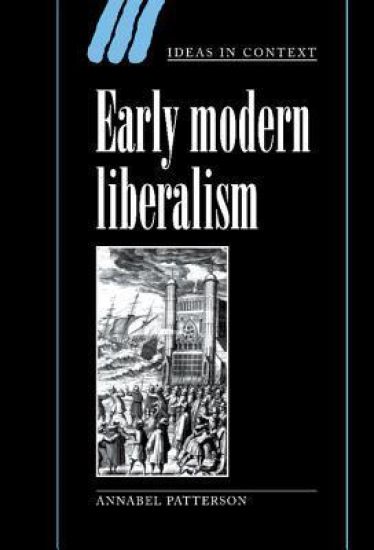
Early Modern Liberalism

Early Modern Liberalism

Annabel Patterson

Cambridge University Press
2006
pokkari
Early Modern Liberalism rediscovers an important phase in the development of liberal thought. Despite the fact that 'liberalism' as a term was not applied to political thought or political parties in England until late in the eighteenth century, Annabel Patterson argues that its central ideas were formulated by seventeenth-century English writers in defiance of their society's norms, and then transmitted to the American colonies. The author is particularly concerned with the means and agents of transmission, with those who ensured that the liberal canon would be preserved, expanded, republished and dispersed; for example, the eighteenth-century philanthropist Thomas Hollis, among whose heroes were Milton, Marvell, Locke and Algernon Sidney. Framed by chapters on Hollis and Adams, this book shows what early modern liberals had in common and reopens the transatlantic conversation that began in the seventeenth century.
Early Modern Liberalism

Early Modern Liberalism

Annabel Patterson

Cambridge University Press
1997
sidottu
Early Modern Liberalism rediscovers an important phase in the development of liberal thought. Despite the fact that 'liberalism' as a term was not applied to political thought or political parties in England until late in the eighteenth century, Annabel Patterson argues that its central ideas were formulated by seventeenth-century English writers in defiance of their society's norms, and then transmitted to the American colonies. The author is particularly concerned with the means and agents of transmission, with those who ensured that the liberal canon would be preserved, expanded, republished and dispersed; for example, the eighteenth-century philanthropist Thomas Hollis, among whose heroes were Milton, Marvell, Locke and Algernon Sidney. Framed by chapters on Hollis and Adams, this book shows what early modern liberals had in common and reopens the transatlantic conversation that began in the seventeenth century.
Shakespeare and Popular Voice

Shakespeare and Popular Voice

Annabel Patterson

Blackwell Publishers
1989
nidottu
In Shakespeare and the Popular Voice Annabel Patterson challenges as counter-intuitive the common opinion that Shakespeare was anti-democratic, contemptuous of the crowd and an unfailing supporter of Elizabethan social hierarchy.
Andrew Marvell

Andrew Marvell

Annabel Patterson

Liverpool University Press
1994
nidottu
This new study of Andrew Marvell offers a state-of-the-art guide to one of the most intriguing and elusive poets of the seventeenth century. Hero to the eighteenth century for his published defences of parliamentary government and religious toleration, Marvell was friend and defender of Milton, underground author of satires against the Restoration court, paradoxically, promoted by T.S. Eliot for a diametrically opposite set of qualities and achievements – poise, detachment, an ethos both world-excluding and hypercivilised, not to mention the most perfect poems we have on “the figure in the landscape”. Annabel Patterson, known for her ability to make serious scholarship engaging, explains how Marvell’s complex personality and beliefs produce these contradictory responses. The book provides comprehensive introductions to Marvell’s different self-representations, and places the most famous poems, such as The Garden and Horatian Ode, in the dialectic they lose when read only in anthologies.