

Kirjahaku
Etsi kirjoja tekijän nimen, kirjan nimen tai ISBN:n perusteella.
1000 tulosta hakusanalla Paul B Harsh
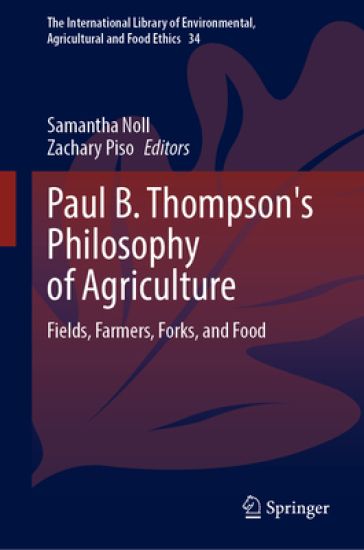
Paul B. Thompson's Philosophy of Agriculture
Springer International Publishing AG
2024
sidottu
??This book explores the philosophical thought and praxis of Paul B. Thompson, who planted some of the first seeds of philosophy of agriculture and whose work inspires interdisciplinary scholarship in food ethics, biotechnology, and environmental philosophy. Landmark texts such as The Spirit of the Soil, The Agrarian Vision, and From Field to Fork revealed the fertility of food systems for inspiring reflection on our relationships to technology, the land, and one another. Rooted in philosophical traditions ranging from pragmatism to post-phenomenology, Thompson’s work nourishes projects in ethics, epistemology, philosophy of science, and social and political theory, not only in academic philosophy departments but also in the social and natural sciences. This volume collects this diversity of thought in a tour of the many fields of food systems; from theorizing the sustainability of agroecological systems, to appreciating the quotidian practice of agrarian communities, to anticipating the impacts of emerging biotechnology, and to savoring the roles that food plays in forming our identities. Composed by an international crop of scholars working on the future of food ethics, the volume is a vital contribution to scholars and practitioners thinking through our relationships to the food systems that sustain us.


In African Forest and Jungle by Paul B. Du Chaillu: (full image Illustrated)
Paul Du Chaillu
Createspace Independent Publishing Platform
2015
nidottu
In African Forest and Jungle by Paul B. Du Chaillu: (full image Illustrated) Kindle Edition: - http: //www.amazon.com/dp/B013MCODSC Paperback Format: - https: //www.createspace.com/1517617472 Prepared by thaiperfect.com fiction, Adventure, Action, Forest, Jungle, African, Rogala CONTENTS A canoe-voyage to the country of Rotembo the Chief--A toilet of ceremony I propose to go into the forest to hunt--Rotembo promises me three gifts Preparations for departure--Off for forest and jungle The home of Rogala--His hunting-trophies We build a leopard trap--A night on the watch My hunters and I become great friends--Andekko and Ndova grow fond of me Fight between monkey tribes, nkagos and mondis--My gun puts both sides to flight Rogala's wife's parrot--I use it as a decoy We build a fortified camp in the depths of the forest--Structure of the camp I take a swim in a crystal pool--Driven out by a huge snake Another excursion--Footprints of gorillas (nginas) Ndova as a test of poisonous fruits and berries--He discovers a beehive Ndova's thoughtfulness--His winning and sportive ways Uneasiness of Rogala--He fears the new moon may see and bewitch him Rogala leaves the camp--Non-appearance of Shinshooko and Alapai We discover a pair of nshiego-nkengos--Description of them My reckoning lost--Rogala and I go to an island where I can see the heavens Appearance of the southern heavens at night--Homesickness We cross the river and hide our axes--Ndova's fright at a python Leave the island for our camp--Monkeys among the trees Plantain peelings to eat--Human footprints lead me to a village Alarm of my hunters at my absence--Rogala sets out to search for me Witchcraft proceedings of the Bakalais--Two of the class "bewitched" We come to the end of our provisions--Antelope skin boiled furnishes us a repast I find strange footprints on the banks of a rivulet--Rogala and I set off in pursuit Ndova falls sick--Stung by a scorpion or bitten by a centipede I go hunting in the forest with Andekko--Disappearance of the dog Our provisions fail--Attacked again by bashikouays Decide to break up our camp and return--Arrival at Rogala's home List of Illustrations I saw peeping through the leaves a black fierce face looking at us The meeting with Rotembo Facing Rogala and Andekko Ndova's mother tries to carry him away into the forest We raised our guns and aimed at the two biggest white-nosed ones and fired She looked at me in fear and trembling, and she and the children ran to hide The leopard was slowly crawling near We fired and brought him down Boiling water and hot ashes were thrown upon the ants and we put brands across their path Suddenly the bull made for the river Gun in hand, I watched for him to swim to the surface of the water He put his nose close to her face and moaned pitifully Soon I saw their heads peeping over the palisades Rogala and his idol The two nshiego-nkengos had their backs turned towards us, and were eating pineapples When the raft was ready Rogala, Ndova, and Andekko crossed to the island When I was ready to take observations, I seated myself cross-legged before the artificial horizon Rogala came out of the den holding two little live leopards by the neck Clearly this village belonged to a warlike tribe, whose people were always fighting When I saw him, I came towards him, and in an instant we were in each other's arms Suddenly Rogala uttered a terrific war-cry and ran towards the man He ate with us, and consequently had the same food Andekko had pinned the mandrill down and they were fighting savagely At the end of the day I had made a pair of skin trousers CHAPTER I. A CANOE-VOYAGE TO THE COUNTRY OF ROTEMBO THE CHIEF-A TOILET OF CEREMONY-ROTEMBO's GROTESQUE COSTUME-A FORMAL RECEPTION-SPEECHES OF ROTEMBO AND MYSELF-A DANCE IN MY HONOR-MY PRESENTS TO THE CHIEF-WE BECOME GOOD FRIENDS The canoe that took me from King Mombo to Rotembo the Chief was a dug-out made of a huge tree, and was of great length.

Louis A. Gentile et al., Appellants, V. Paul B. Altermatt et al. U.S. Supreme Court Transcript of Record with Supporting Pleadings
Harold J Geragosian; Ralph G Elliot; Carl R Ajello
Gale Ecco, U.S. Supreme Court Records
2011
pokkari

Comrade Paul's Socialist Bathroom Reader: Volume One
Paul B. Skousen
Createspace Independent Publishing Platform
2012
nidottu
Real socialists hate this book. It flushes all their utopian ideas down the crapper with rude and mocking hilarity. For the more studious and casual bathroom readers who seek pleasurable reading for hours on end, here is Part One of an astonishing treasure trove of socialist failures, slaughters, and collapses. It is written for the rising generation of forgetful citizenry who keep falling for all those free lunches that are routinely promised in the socialists' 5-year Porcelain Platform Plan (please be seated). For the first time ever, the hilarious, the shocking, the revealing, the numbing, the suspiciously conspiratorial if not blatantly declarative of socialism's darkest and most profoundly secretive platitudes inhale and take breath here], are all brought together in this first installment of Comrade Paul's Socialist Bathroom Reader. Organized for many gleeful months of raucous and riveting reading, the curious and disgusted proletarians may delve into: -Socialism's amazing world records -The anti-socialist themes in Hollywood movies -The truth about Hitler's socialistic agenda -The murder mystery of the most hated woman in America -The truth behind shoddy imports from socialist countries -The evil seven pillars of socialism designed to destroy natural rights -The U.S. presidents who furthered socialism in America -And an unending supply of socialist jokes freshly plucked from the impoverished oppressed who must live under socialism each and every day. This book need not be read from front to back in the usual fashion for this is not a typical bourgeois fashionable book. To the contrary, it is meant to be picked up and read from any page---that is, rudely arbitrarily, just like socialism. It is most important, on penalty of 10 years at the Retraining Camp, that severe attention be paid to the reading because in the end, there will be a quiz. Therefore, Dear Leader says, "Must read."

While politicians, entrepreneurs, and even school children could tell you that sustainability is an important and nearly universal value, many of them, and many of us, may struggle to define the term, let alone trace its history. What is sustainability? Is it always about the environment? What science do we need to fully grasp what it requires? What does sustainability mean for business? How can governments plan for a sustainable future? This short, accessible book written in the signature question-and-answer format of the What Everyone Needs to Know® series tackles these and numerous other questions. Sustainability is a porous topic, which has been adapted and reshaped for developing ecological models, improving corporate responsibility, setting environmental and land-use policies, organizing educational curricula, and reimagining the goals of governance and democracy. Where other treatments of this topic tend to focus on just one application of sustainability, this primer encompasses everything from global development and welfare to social justice and climate change. With chapters that discuss sustainability in the contexts of profitable businesses, environmental risks, scientific research, and the day-to-day business of local government, it gives readers a deep understanding of one of the most essential concepts of our time. Bringing to bear experience in natural resource conservation, agriculture, the food industry, and environmental ethics, authors Paul B. Thompson and Patricia E. Norris explain clearly what sustainability means, and why getting it right is so important for the future of our planet.
While politicians, entrepreneurs, and even school children could tell you that sustainability is an important and nearly universal value, many of them, and many of us, may struggle to define the term, let alone trace its history. What is sustainability? Is it always about the environment? What science do we need to fully grasp what it requires? What does sustainability mean for business? How can governments plan for a sustainable future? This short, accessible book written in the signature question-and-answer format of the What Everyone Needs to Know® series tackles these and numerous other questions. Sustainability is a porous topic, which has been adapted and reshaped for developing ecological models, improving corporate responsibility, setting environmental and land-use policies, organizing educational curricula, and reimagining the goals of governance and democracy. Where other treatments of this topic tend to focus on just one application of sustainability, this primer encompasses everything from global development and welfare to social justice and climate change. With chapters that discuss sustainability in the contexts of profitable businesses, environmental risks, scientific research, and the day-to-day business of local government, it gives readers a deep understanding of one of the most essential concepts of our time. Bringing to bear experience in natural resource conservation, agriculture, the food industry, and environmental ethics, authors Paul B. Thompson and Patricia E. Norris explain clearly what sustainability means, and why getting it right is so important for the future of our planet.

The Book of Revelation presents the reader with a frightening narrative world in which the people of God are tormented, threatened, and sometimes killed by various agents of Satan. Throughout the work, the Apocalyse points to Rome as the predominant demonic agent. Scholars have traditionally thought that Revelation was written in order to encourage believers to stand fast in the face of the Roman persecutation of the early Church. More recently, however, it has been argued that no such crisis existed at the time the book was written. In this study, Paul Duff offers a different viewpoint on the origin of the Book of Revelation is a rhetorically sophisticated response to an internal leadership crisis within the churches. In support of this argument Duff marshals evidence from the social and economic context of the time, and from literary and rhetorical analyses of the text. The result is a work that substantially advances the implication of the current consensus and sheds new light on this influential yet enigmatic text.

What Is Agriculture For? describes four contrasting rationales for technical and policy change in agriculture and food systems. Technological Modernization applies an ethic common to every sector in the industrial economy: production should seek greater efficiencies in order to lower consumer costs and secure adequate supply but should not do so in ways that harm third parties or the environment. The other views single out a feature of agriculture giving it unique moral significance. Sustainable Intensification emphasizes future challenges to the global food supply, and Rural Resilience places special value on the social role of farmers and other producers. Urban Agriculture highlights cities' growing vulnerability to rurally based supply chains. Each perspective leads to distinct policy goals and suggests different priorities for technical innovation. At the same time, the argument for any particular innovation may draw on two of more of these archetypal rationales. The book does greater justice to the complexity of food politics, providing tools for critical evaluation of implicit value commitments and greater understanding of opposing points of view.


Following the pattern of From Field to Fork (OUP, 2015) Paul B. Thompson provides a highly readable and up-to-date analysis of contemporary ethical issues connected with food. Thompson reinterprets Peter Singer's work on famine relief in light of the history of funding development assistance through food aid, defends locavore diets against philosophical critics, and analyzes the ethics of food labelling in light of J.S. Mill's On Liberty. Further exploring today's key ethical questions about food, Thompson compares anthropological and toxicological approaches to pollution and defends a revised notion of agricultural sustainability. These topics provide an entry point for a novel approach in practical ethics that blends pragmatist philosophy of language, historical interpretation of agrarian thought, and recent philosophical writings on race and structural racism.

Most people are familiar with the dodo and the dinosaur, but extinction has occurred throughout the history of life, with the result that nearly all the species that have ever existed are now extinct. Today, species are disappearing at an ever increasing rate, whilst past losses have occurred during several great crises. Issues such as habitat destruction, conservation, climate change, and, during major crises, volacanism and meteorite impact, can all contribute towards the demise of a group. In this Very Short Introduction, Paul B. Wignall looks at the causes and nature of extinctions, past and present, and the factors that can make a species vulnerable. Summarising what we know about all of the major and minor exctinction events, he examines some of the greatest debates in modern science, such as the relative role of climate and humans in the death of the Pleistocene megafauna, including mammoths and giant ground sloths, and the roles that global warming, ocean acidification, and deforestation are playing in present-day extinctions ABOUT THE SERIES: The Very Short Introductions series from Oxford University Press contains hundreds of titles in almost every subject area. These pocket-sized books are the perfect way to get ahead in a new subject quickly. Our expert authors combine facts, analysis, perspective, new ideas, and enthusiasm to make interesting and challenging topics highly readable.

After centuries of neglect, the ethics of food are back with a vengeance. Justice for food workers and small farmers has joined the rising tide of concern over the impact of industrial agriculture on food animals and the broader environment, all while a global epidemic of obesity-related diseases threatens to overwhelm modern health systems. An emerging worldwide social movement has turned to local and organic foods, and struggles to exploit widespread concern over the next wave of genetic engineering or nanotechnologies applied to food. Paul B. Thompson's book applies the rigor of philosophy to key topics in the first comprehensive study explore interconnections hidden deep within this welter of issues. Bringing more than thirty years of experience working closely with farmers, agricultural researchers and food system activists to the topic, he explores the eclipse of food ethics during the rise of nutritional science, and examines the reasons for its sudden re-emergence in the era of diet-based disease. Thompson discusses social injustice in the food systems of developed economies and shows how we have missed the key insights for understanding food ethics in the developing world. His discussions of animal production and the environmental impact of agriculture breaks new ground where most philosophers would least expect it. By emphasizing the integration of these issues, Thompson not only brings a comprehensive philosophical approach to moral issues in the production, processing, distribution, and consumption of food -- he introduces a fresh way to think about practical ethics that will have implications in other areas of applied philosophy.

After centuries of neglect, the ethics of food are back with a vengeance. Justice for food workers and small farmers has joined the rising tide of concern over the impact of industrial agriculture on food animals and the broader environment, all while a global epidemic of obesity-related diseases threatens to overwhelm modern health systems. An emerging worldwide social movement has turned to local and organic foods, and struggles to exploit widespread concern over the next wave of genetic engineering or nanotechnologies applied to food. Paul B. Thompson's book applies the rigor of philosophy to key topics in the first comprehensive study explore interconnections hidden deep within this welter of issues. Bringing more than thirty years of experience working closely with farmers, agricultural researchers and food system activists to the topic, he explores the eclipse of food ethics during the rise of nutritional science, and examines the reasons for its sudden re-emergence in the era of diet-based disease. Thompson discusses social injustice in the food systems of developed economies and shows how we have missed the key insights for understanding food ethics in the developing world. His discussions of animal production and the environmental impact of agriculture breaks new ground where most philosophers would least expect it. By emphasizing the integration of these issues, Thompson not only brings a comprehensive philosophical approach to moral issues in the production, processing, distribution, and consumption of food -- he introduces a fresh way to think about practical ethics that will have implications in other areas of applied philosophy.
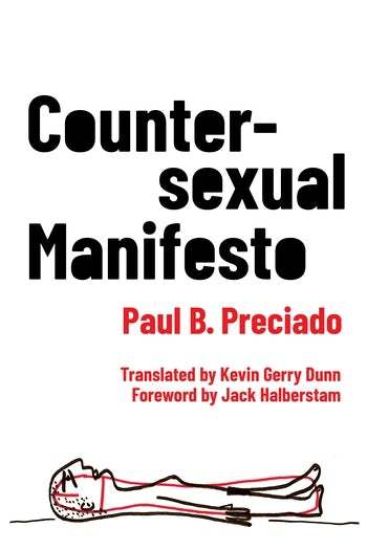
Countersexual Manifesto is an outrageous yet rigorous work of trans theory, a performative literary text, and an insistent call to action. Seeking to overthrow all constraints on what can be done with and to the body, Paul B. Preciado offers a provocative challenge to even the most radical claims about gender, sexuality, and desire.Preciado lays out mock constitutional principles for a countersexual revolution that will recognize genitalia as technological objects and offers step-by-step illustrated instructions for dismantling the heterocentric social contract. He calls theorists such as Derrida, Foucault, Butler, and Haraway to task for not going nearly far enough in their attempts to deconstruct the naturalization of normative identities and behaviors. Preciado’s claim that the dildo precedes the penis—that artifice, not nature, comes first in the history of sexuality—forms the basis of his demand for new practices of sexual emancipation. He calls for a world of sexual plasticity and fabrication, of bio-printers and “dildonics,” and he invokes countersexuality’s roots in the history of sex toys, pornography, and drag in order to rupture the supposedly biological foundations of the heterocentric regime. His claims are extreme, but supported through meticulous readings of philosophy and theory, as well as popular culture. The Manifesto is now available in English translation for its twentieth anniversary, with a new introduction by Preciado. Countersexual Manifesto will disrupt feminism and queer theory and scandalize us all with its hyperbolic but deadly serious defiance of everything we’ve been told about sex.

Countersexual Manifesto is an outrageous yet rigorous work of trans theory, a performative literary text, and an insistent call to action. Seeking to overthrow all constraints on what can be done with and to the body, Paul B. Preciado offers a provocative challenge to even the most radical claims about gender, sexuality, and desire.Preciado lays out mock constitutional principles for a countersexual revolution that will recognize genitalia as technological objects and offers step-by-step illustrated instructions for dismantling the heterocentric social contract. He calls theorists such as Derrida, Foucault, Butler, and Haraway to task for not going nearly far enough in their attempts to deconstruct the naturalization of normative identities and behaviors. Preciado’s claim that the dildo precedes the penis—that artifice, not nature, comes first in the history of sexuality—forms the basis of his demand for new practices of sexual emancipation. He calls for a world of sexual plasticity and fabrication, of bio-printers and “dildonics,” and he invokes countersexuality’s roots in the history of sex toys, pornography, and drag in order to rupture the supposedly biological foundations of the heterocentric regime. His claims are extreme, but supported through meticulous readings of philosophy and theory, as well as popular culture. The Manifesto is now available in English translation for its twentieth anniversary, with a new introduction by Preciado. Countersexual Manifesto will disrupt feminism and queer theory and scandalize us all with its hyperbolic but deadly serious defiance of everything we’ve been told about sex.

America finds itself in an acute predicament: The international order it has helped construct over many decades is under increasing stress from various quarters. As the world's predominant military power and principal guarantor of global peace and security, the United States must fulfill its many responsibilities without becoming entangled in costly conflicts that threaten its security, deplete its national power, and weaken its international standing. Preventive Engagement proposes a long-term strategy for how the United States can manage the risks of a more turbulent world in a way that lessens the demand for--and potential drain on--U.S. power. Its novel approach adapts the basic techniques used to prevent many societal problems, such as infectious diseases, violent crime, and drug trafficking. Preventive engagement has three complementary components: the promotion of policies known to lower the risk of violent conflict and political instability; the anticipation of crises most likely to precipitate major U.S. military engagement; and a concerted effort to mitigate if not resolve conflicts that erupt in the short term before escalating into a threat to U.S. interests. This comprehensive approach stresses early detection and foresight to actively manage sources of conflict. Using examples from Syria, Ukraine, and the South China Sea, Preventive Engagement shows its strategy in practice and illuminates the role that international actors, including NGOs, the United Nations, regional organizations, and private businesses, can play to further U.S. preventive goals.

The United States faces an increasingly turbulent world. The risk of violent conflict and other threats to international order presents a vexing dilemma: should the United States remain the principal guarantor of global peace and security with all its considerable commitments and potential pitfalls––not least new and costly military entanglements––that over time diminish its capacity and commitment to play this vital role or, alternatively, should it pull back from the world in the interests of conserving U.S. power, but at the possible cost of even greater threats emerging in the future?Paul B. Stares proposes an innovative and timely strategy—“preventive engagement”—to resolve America’s predicament. This approach entails pursuing three complementary courses of action: promoting policies known to lessen the risk of violent conflict over the long term; anticipating and averting those crises likely to lead to costly military commitments in the medium term; and managing ongoing conflicts in the short term before they escalate further and exert pressure on the United States to intervene. In each of these efforts, forging “preventive partnerships” with a variety of international actors, including the United Nations, regional organizations, nongovernmental organizations, and the business community, is essential. The need to think and act ahead that lies at the heart of a preventive engagement strategy requires the United States to become less shortsighted and reactive. Drawing on successful strategies in other areas, Preventive Engagement provides a detailed and comprehensive blueprint for the United States to shape the future and reduce the potential dangers ahead.