

Kirjahaku
Etsi kirjoja tekijän nimen, kirjan nimen tai ISBN:n perusteella.
1000 tulosta hakusanalla Paul B. McNulty


Genealogy of the Anglo-Norman Lynches: who settled in Galway
Paul B. McNulty
Createspace Independent Publishing Platform
2013
nidottu
The pedigrees of the Anglo-Norman Lynches who settled in Galway are mostly derived from the descendants of James and William, the sons of Thomas Lynch, the first Provost of Galway in 1274. The progression of the family in Ireland was emphasised by the appointment of more than eighty mayors of Galway named Lynch between 1485 and 1654. When James I bestowed a baronetcy on Henry Lynch, a rich merchant, in 1622 their elevated status was confirmed. However, political controversy intervened when Henry Lynch, 3rd Bt, was attainted of high treason following the defeat of James II at the Battle of the Boyne. Personal controversy followed with the liaison of Henry Lynch-Blosse, 7th Bt with the alluring Sibella Cottle which scandalized the community. The story has been outlined by the author in his historical novel, "Spellbound by Sibella." The Lynch-Blosses continued to serve in Ireland until the purchase of their estate of 18,566 acres by the Congested District's Board in 1909 for 154,000. Thereafter, the family settled in Wales and later in England. The current incumbent is Richard Hely Lynch-Blosse, 17th Bt, a general practitioner in Oxfordshire. The Anglo-Norman Lynches who settled in Galway have been connected to famous people and events including the Bodkin massacre, Che Guevara, James II, Richard 'Humanity Dick' Martin MP, Grace O'Malley, Patrick Sarsfield and Bram Stoker. These connections are illustrated in pedigree charts derived from a BrothersKeeper.com database of 2843 individuals. The database also includes members of the extended family of the author.
Letters to the Editor: Food & Food-Related Issues
Paul B. McNulty
Createspace Independent Publishing Platform
2016
nidottu
1798: A Rebel Romance: A Stage Play
Paul B. McNulty
Createspace Independent Publishing Platform
2016
nidottu
When Cecilia Lynch falls in love with John Moore, a United Irishman, she finds herself drawn into the web of revolution. The illegitimate daughter of the late Sir Harry Lynch-Blosse stands by her fianc when General Humbert routs the redcoats through Castlebar. Cecilia is jubilant when the Frenchman appoints Moore, formerly of Alicante and the Sorbonne, as President of Connaught within the declared Irish Republic. Their hopes for the future of a free and United Ireland are unrestrained.

A Girl Called May: (abridged)
Paul B. McNulty
Createspace Independent Publishing Platform
2018
nidottu
Margaret Mary 'May' McNulty was born on 5 November 1900 at 15 Warrington Place, Dublin 2, Ireland. There she lived for the rest of her life apart from the 1920s when she sojourned in Italy and Austria. I have studied May's career through the lens of a McNulty-Boylan picture postcard archive, an on-line search of her progress in Irish newspapers (as below) and archival research. According to family lore, May McNulty was a singer of sufficient talent to warrant further training in Milan commencing in 1921. She reputedly sang on Radio ireann but no such record has been found. Neither has her singing talent featured in any Irish newspaper following an on-line search. A further search was equally fruitless in relation to her singing although her career as an international bridge player was highlighted. May McNulty moved to Austria in 1924. She received a picture postcard from Ida Enfer in 1926. It was co-signed by Enfer's eight year-old daughter, Jeannie, later a distinguished writer who also translated the work of Irish authors into German. An April 1927 picture card reveals May's move from the provincial Wiener Neustadt to the metropolis of Vienna while remaining dependent on home finance. While there May have sought to promote her singing career as suggested in a picture postcard from the noted musicologist, Harold Sheldon, who promised to reply to her letter. Contact with the family of another musicologist, Hugo Botstiber, was evident from a card received from Nana Botstiber, who urged May to write her at Vienna. Dr Felzmann, writing from Croatia in 1928, reminds us of May's singing talent: I hope you are in good health and always busy in singing? Having returned to Ireland in 1932, with no apparent sign of a singing contract, May turns to the game of contract bridge destined to become her enduring passion. Now, in her early thirties, her postcard archive peters out and is replaced by newspaper reports. May quickly establishes herself in the world of contract bridge attracting attention as Honorary Secretary of Dublin's largest Bridge Club, the Regent, in 1937. She came to national prominence in 1938 when partnering Mrs Fitzgerald to win the Ladies' Championship. Her upward momentum continued when qualifying for the Free State of Ireland Team Panel in partnership with Mrs J O'Neill. Now an established international bridge player, May McNulty was included in a team of five to represent Ireland at the 1949 European Bridge Championships in Paris. In 1951, Ireland beat Wales in their third match for the Camrose Trophy by 50 match points over 100 boards at the Portmarnock Country Club. Mrs O Giddings and Miss M McNulty, in their first Camrose partnership, played exceedingly well and showed fine judgment in selecting the best game contract. In 1952, May McNulty must have revisited memories of her continental past when playing bridge against Austria whose team included Mrs H Breithner, likely to be the second wife of the famous Viennese Mayor and social democrat, Hugo Breitner. May McNulty passed away, a single woman, in 1966. S amus Dowling rated her as Ireland's greatest female bridge player, second only to the legendary Ruth Giddings, in Thank you, Partner: The History of Bridge in Ireland, 2009.
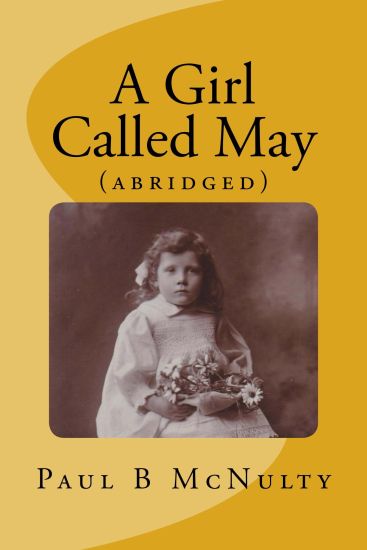
A Girl Called May: (with appendices)
Paul B. McNulty
Createspace Independent Publishing Platform
2018
nidottu
This edition includes Appendices I through V. Margaret Mary 'May' McNulty was born on 5 November 1900 at 15 Warrington Place, Dublin 2, Ireland. There she lived for the rest of her life apart from the 1920s when she sojourned in Italy and Austria. She was the daughter of Thomas McNulty BA BL, originally of Derry City, and Mary Boylan, originally of Dublin. They married in a Roman Catholic Chapel on 30 December 1891. Little is known of May's early years except that her father died when she was only three and she attended Muckross Park College, a private girls' secondary school, in Dublin. May McNulty was a singer of sufficient talent to warrant further training in Milan commencing in 1921. She reputedly sang on Radio ireann but no such record has been found. Neither has her singing talent featured in any Irish newspaper following an on-line search for Miss McNulty or variants thereof. A Google search was equally fruitless in relation to her singing although her career as an international bridge player was highlighted. While in Milan, she attracted the attention of some male admirers including the operatic singer, Davide Dorlini, a French Tahitian, who revealed his affection for her in a 1922 picture card: alla Signorina May McNulty con auguri (with best wishes.) His possible connection to the late Dag Drollett and the family of Marlon Brando is explored. May McNulty moved to Austria in 1924 after an opportunity to advance her singing career had apparently not emerged. Examination of picture postcards received from her many correspondents revealed that Frida Schad may have been a Holocaust victim; that J.McD in Donegal missed her singing; that M in St Mary's, Dublin may have been suicidal; that a teaching role for May was indicated in a card signed Your little pupil; that May was a child-minder for eight-year-old Jeannie Enfer destined to become a distinguished Austrian writer who also translated the work of Irish authors into German. An April 1927 picture card reveals May's move from the provincial Wiener Neustadt to the metropolis of Vienna while remaining dependent on family finance. While there she may have sought to promote her singing career by contact with noted musicologists, Harold Sheldon and Hugo Botstiber. Later that year, she received an intriguing card from Liesl Wanka inviting her to visit again at Vienna. Liesl is mentioned in a critique of Dr Paul Hasterlik by Helene K nig; in a letter by Hasterlik (later a Holocaust victim) to his son in 1935; and in the diary of Katharina Br mse who mentions Liesl's involvement in an unspecified project. Having returned to Ireland in 1932, with no apparent sign of a singing contract, May turned to the game of contract bridge destined to become her enduring passion. Now, in her early thirties, her postcard archive peters out and is replaced by newspaper reports. She quickly establishes herself in the world of contract bridge. Progress was reported after WW II when she captained a championship team of the Contract Bridge Association of Ireland that travelled to Belfast to play their counterparts representing the Northern Ireland Bridge Union. In 1946, she set up a new record in competitive bridge by winning for the third time in succession the National Team Championship and Kelburn Cup using only four other players to complete her teams. This was sufficient to prelude an appearance on Radio ireann, where she partnered Noel Peart in a discussion entitled Meet The Bridge Experts. In 1952, she must have revisited memories of her continental past when playing bridge against Austria whose team included Mrs H Breithner, likely to be the second wife of the famous Viennese Mayor and social democrat, Hugo Breitner. Torquay was May's final appearance as an international bridge player. Her declining health persuaded her not to participate in the 1960 Women's World Championship in Turin. May McNulty passed away, as a single woman, in 1966 but her memory lives on.
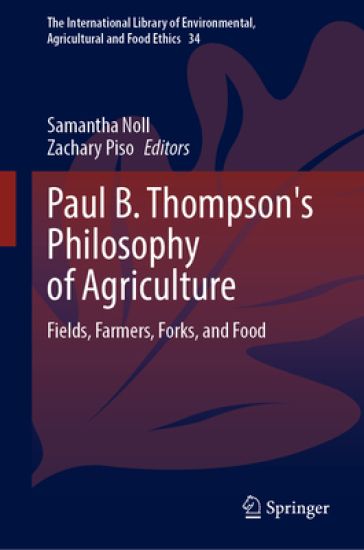
Paul B. Thompson's Philosophy of Agriculture
Springer International Publishing AG
2024
sidottu
??This book explores the philosophical thought and praxis of Paul B. Thompson, who planted some of the first seeds of philosophy of agriculture and whose work inspires interdisciplinary scholarship in food ethics, biotechnology, and environmental philosophy. Landmark texts such as The Spirit of the Soil, The Agrarian Vision, and From Field to Fork revealed the fertility of food systems for inspiring reflection on our relationships to technology, the land, and one another. Rooted in philosophical traditions ranging from pragmatism to post-phenomenology, Thompson’s work nourishes projects in ethics, epistemology, philosophy of science, and social and political theory, not only in academic philosophy departments but also in the social and natural sciences. This volume collects this diversity of thought in a tour of the many fields of food systems; from theorizing the sustainability of agroecological systems, to appreciating the quotidian practice of agrarian communities, to anticipating the impacts of emerging biotechnology, and to savoring the roles that food plays in forming our identities. Composed by an international crop of scholars working on the future of food ethics, the volume is a vital contribution to scholars and practitioners thinking through our relationships to the food systems that sustain us.

In African Forest and Jungle by Paul B. Du Chaillu: (full image Illustrated)
Paul Du Chaillu
Createspace Independent Publishing Platform
2015
nidottu
In African Forest and Jungle by Paul B. Du Chaillu: (full image Illustrated) Kindle Edition: - http: //www.amazon.com/dp/B013MCODSC Paperback Format: - https: //www.createspace.com/1517617472 Prepared by thaiperfect.com fiction, Adventure, Action, Forest, Jungle, African, Rogala CONTENTS A canoe-voyage to the country of Rotembo the Chief--A toilet of ceremony I propose to go into the forest to hunt--Rotembo promises me three gifts Preparations for departure--Off for forest and jungle The home of Rogala--His hunting-trophies We build a leopard trap--A night on the watch My hunters and I become great friends--Andekko and Ndova grow fond of me Fight between monkey tribes, nkagos and mondis--My gun puts both sides to flight Rogala's wife's parrot--I use it as a decoy We build a fortified camp in the depths of the forest--Structure of the camp I take a swim in a crystal pool--Driven out by a huge snake Another excursion--Footprints of gorillas (nginas) Ndova as a test of poisonous fruits and berries--He discovers a beehive Ndova's thoughtfulness--His winning and sportive ways Uneasiness of Rogala--He fears the new moon may see and bewitch him Rogala leaves the camp--Non-appearance of Shinshooko and Alapai We discover a pair of nshiego-nkengos--Description of them My reckoning lost--Rogala and I go to an island where I can see the heavens Appearance of the southern heavens at night--Homesickness We cross the river and hide our axes--Ndova's fright at a python Leave the island for our camp--Monkeys among the trees Plantain peelings to eat--Human footprints lead me to a village Alarm of my hunters at my absence--Rogala sets out to search for me Witchcraft proceedings of the Bakalais--Two of the class "bewitched" We come to the end of our provisions--Antelope skin boiled furnishes us a repast I find strange footprints on the banks of a rivulet--Rogala and I set off in pursuit Ndova falls sick--Stung by a scorpion or bitten by a centipede I go hunting in the forest with Andekko--Disappearance of the dog Our provisions fail--Attacked again by bashikouays Decide to break up our camp and return--Arrival at Rogala's home List of Illustrations I saw peeping through the leaves a black fierce face looking at us The meeting with Rotembo Facing Rogala and Andekko Ndova's mother tries to carry him away into the forest We raised our guns and aimed at the two biggest white-nosed ones and fired She looked at me in fear and trembling, and she and the children ran to hide The leopard was slowly crawling near We fired and brought him down Boiling water and hot ashes were thrown upon the ants and we put brands across their path Suddenly the bull made for the river Gun in hand, I watched for him to swim to the surface of the water He put his nose close to her face and moaned pitifully Soon I saw their heads peeping over the palisades Rogala and his idol The two nshiego-nkengos had their backs turned towards us, and were eating pineapples When the raft was ready Rogala, Ndova, and Andekko crossed to the island When I was ready to take observations, I seated myself cross-legged before the artificial horizon Rogala came out of the den holding two little live leopards by the neck Clearly this village belonged to a warlike tribe, whose people were always fighting When I saw him, I came towards him, and in an instant we were in each other's arms Suddenly Rogala uttered a terrific war-cry and ran towards the man He ate with us, and consequently had the same food Andekko had pinned the mandrill down and they were fighting savagely At the end of the day I had made a pair of skin trousers CHAPTER I. A CANOE-VOYAGE TO THE COUNTRY OF ROTEMBO THE CHIEF-A TOILET OF CEREMONY-ROTEMBO's GROTESQUE COSTUME-A FORMAL RECEPTION-SPEECHES OF ROTEMBO AND MYSELF-A DANCE IN MY HONOR-MY PRESENTS TO THE CHIEF-WE BECOME GOOD FRIENDS The canoe that took me from King Mombo to Rotembo the Chief was a dug-out made of a huge tree, and was of great length.

Louis A. Gentile et al., Appellants, V. Paul B. Altermatt et al. U.S. Supreme Court Transcript of Record with Supporting Pleadings
Harold J Geragosian; Ralph G Elliot; Carl R Ajello
Gale Ecco, U.S. Supreme Court Records
2011
pokkari
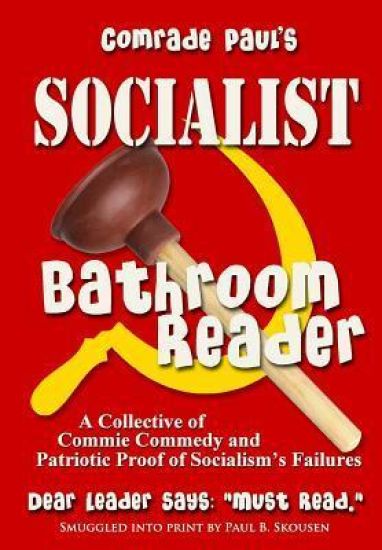
Comrade Paul's Socialist Bathroom Reader: Volume One
Paul B. Skousen
Createspace Independent Publishing Platform
2012
nidottu
Real socialists hate this book. It flushes all their utopian ideas down the crapper with rude and mocking hilarity. For the more studious and casual bathroom readers who seek pleasurable reading for hours on end, here is Part One of an astonishing treasure trove of socialist failures, slaughters, and collapses. It is written for the rising generation of forgetful citizenry who keep falling for all those free lunches that are routinely promised in the socialists' 5-year Porcelain Platform Plan (please be seated). For the first time ever, the hilarious, the shocking, the revealing, the numbing, the suspiciously conspiratorial if not blatantly declarative of socialism's darkest and most profoundly secretive platitudes inhale and take breath here], are all brought together in this first installment of Comrade Paul's Socialist Bathroom Reader. Organized for many gleeful months of raucous and riveting reading, the curious and disgusted proletarians may delve into: -Socialism's amazing world records -The anti-socialist themes in Hollywood movies -The truth about Hitler's socialistic agenda -The murder mystery of the most hated woman in America -The truth behind shoddy imports from socialist countries -The evil seven pillars of socialism designed to destroy natural rights -The U.S. presidents who furthered socialism in America -And an unending supply of socialist jokes freshly plucked from the impoverished oppressed who must live under socialism each and every day. This book need not be read from front to back in the usual fashion for this is not a typical bourgeois fashionable book. To the contrary, it is meant to be picked up and read from any page---that is, rudely arbitrarily, just like socialism. It is most important, on penalty of 10 years at the Retraining Camp, that severe attention be paid to the reading because in the end, there will be a quiz. Therefore, Dear Leader says, "Must read."

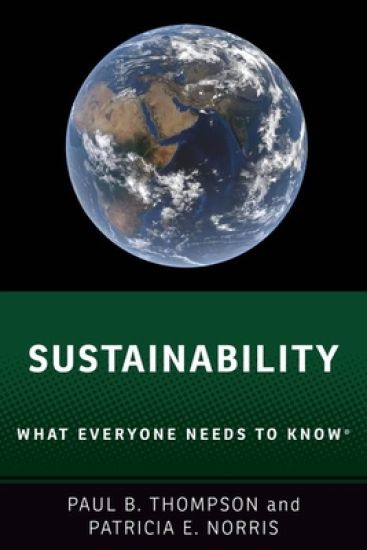
While politicians, entrepreneurs, and even school children could tell you that sustainability is an important and nearly universal value, many of them, and many of us, may struggle to define the term, let alone trace its history. What is sustainability? Is it always about the environment? What science do we need to fully grasp what it requires? What does sustainability mean for business? How can governments plan for a sustainable future? This short, accessible book written in the signature question-and-answer format of the What Everyone Needs to Know® series tackles these and numerous other questions. Sustainability is a porous topic, which has been adapted and reshaped for developing ecological models, improving corporate responsibility, setting environmental and land-use policies, organizing educational curricula, and reimagining the goals of governance and democracy. Where other treatments of this topic tend to focus on just one application of sustainability, this primer encompasses everything from global development and welfare to social justice and climate change. With chapters that discuss sustainability in the contexts of profitable businesses, environmental risks, scientific research, and the day-to-day business of local government, it gives readers a deep understanding of one of the most essential concepts of our time. Bringing to bear experience in natural resource conservation, agriculture, the food industry, and environmental ethics, authors Paul B. Thompson and Patricia E. Norris explain clearly what sustainability means, and why getting it right is so important for the future of our planet.
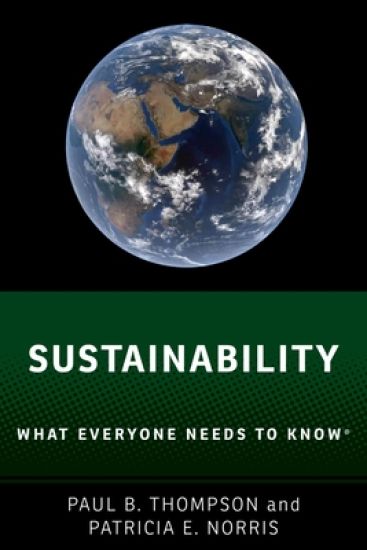
While politicians, entrepreneurs, and even school children could tell you that sustainability is an important and nearly universal value, many of them, and many of us, may struggle to define the term, let alone trace its history. What is sustainability? Is it always about the environment? What science do we need to fully grasp what it requires? What does sustainability mean for business? How can governments plan for a sustainable future? This short, accessible book written in the signature question-and-answer format of the What Everyone Needs to Know® series tackles these and numerous other questions. Sustainability is a porous topic, which has been adapted and reshaped for developing ecological models, improving corporate responsibility, setting environmental and land-use policies, organizing educational curricula, and reimagining the goals of governance and democracy. Where other treatments of this topic tend to focus on just one application of sustainability, this primer encompasses everything from global development and welfare to social justice and climate change. With chapters that discuss sustainability in the contexts of profitable businesses, environmental risks, scientific research, and the day-to-day business of local government, it gives readers a deep understanding of one of the most essential concepts of our time. Bringing to bear experience in natural resource conservation, agriculture, the food industry, and environmental ethics, authors Paul B. Thompson and Patricia E. Norris explain clearly what sustainability means, and why getting it right is so important for the future of our planet.
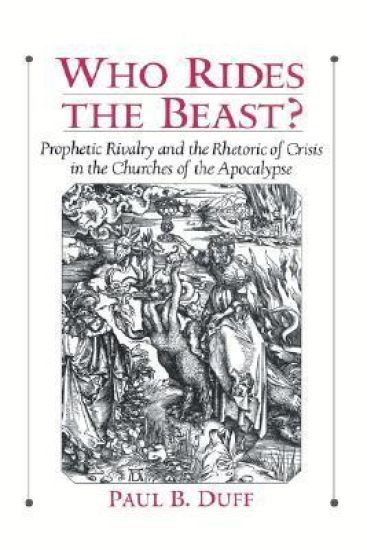
The Book of Revelation presents the reader with a frightening narrative world in which the people of God are tormented, threatened, and sometimes killed by various agents of Satan. Throughout the work, the Apocalyse points to Rome as the predominant demonic agent. Scholars have traditionally thought that Revelation was written in order to encourage believers to stand fast in the face of the Roman persecutation of the early Church. More recently, however, it has been argued that no such crisis existed at the time the book was written. In this study, Paul Duff offers a different viewpoint on the origin of the Book of Revelation is a rhetorically sophisticated response to an internal leadership crisis within the churches. In support of this argument Duff marshals evidence from the social and economic context of the time, and from literary and rhetorical analyses of the text. The result is a work that substantially advances the implication of the current consensus and sheds new light on this influential yet enigmatic text.

What Is Agriculture For? describes four contrasting rationales for technical and policy change in agriculture and food systems. Technological Modernization applies an ethic common to every sector in the industrial economy: production should seek greater efficiencies in order to lower consumer costs and secure adequate supply but should not do so in ways that harm third parties or the environment. The other views single out a feature of agriculture giving it unique moral significance. Sustainable Intensification emphasizes future challenges to the global food supply, and Rural Resilience places special value on the social role of farmers and other producers. Urban Agriculture highlights cities' growing vulnerability to rurally based supply chains. Each perspective leads to distinct policy goals and suggests different priorities for technical innovation. At the same time, the argument for any particular innovation may draw on two of more of these archetypal rationales. The book does greater justice to the complexity of food politics, providing tools for critical evaluation of implicit value commitments and greater understanding of opposing points of view.


Following the pattern of From Field to Fork (OUP, 2015) Paul B. Thompson provides a highly readable and up-to-date analysis of contemporary ethical issues connected with food. Thompson reinterprets Peter Singer's work on famine relief in light of the history of funding development assistance through food aid, defends locavore diets against philosophical critics, and analyzes the ethics of food labelling in light of J.S. Mill's On Liberty. Further exploring today's key ethical questions about food, Thompson compares anthropological and toxicological approaches to pollution and defends a revised notion of agricultural sustainability. These topics provide an entry point for a novel approach in practical ethics that blends pragmatist philosophy of language, historical interpretation of agrarian thought, and recent philosophical writings on race and structural racism.