Kirjojen hintavertailu. Mukana 11 463 618 kirjaa ja 12 kauppaa.

Kirjahaku

Etsi kirjoja tekijän nimen, kirjan nimen tai ISBN:n perusteella.

1000 tulosta hakusanalla Paul D. McNicholas

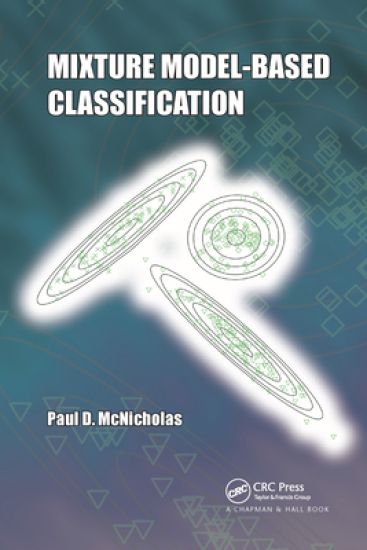
Mixture Model-Based Classification

Mixture Model-Based Classification

Paul D. McNicholas

CRC Press
2020
nidottu
"This is a great overview of the field of model-based clustering and classification by one of its leading developers. McNicholas provides a resource that I am certain will be used by researchers in statistics and related disciplines for quite some time. The discussion of mixtures with heavy tails and asymmetric distributions will place this text as the authoritative, modern reference in the mixture modeling literature." (Douglas Steinley, University of Missouri)Mixture Model-Based Classification is the first monograph devoted to mixture model-based approaches to clustering and classification. This is both a book for established researchers and newcomers to the field. A history of mixture models as a tool for classification is provided and Gaussian mixtures are considered extensively, including mixtures of factor analyzers and other approaches for high-dimensional data. Non-Gaussian mixtures are considered, from mixtures with components that parameterize skewness and/or concentration, right up to mixtures of multiple scaled distributions. Several other important topics are considered, including mixture approaches for clustering and classification of longitudinal data as well as discussion about how to define a clusterPaul D. McNicholas is the Canada Research Chair in Computational Statistics at McMaster University, where he is a Professor in the Department of Mathematics and Statistics. His research focuses on the use of mixture model-based approaches for classification, with particular attention to clustering applications, and he has published extensively within the field. He is an associate editor for several journals and has served as a guest editor for a number of special issues on mixture models.
Mixture Model-Based Classification

Mixture Model-Based Classification

Paul D. McNicholas

Apple Academic Press Inc.
2016
sidottu
"This is a great overview of the field of model-based clustering and classification by one of its leading developers. McNicholas provides a resource that I am certain will be used by researchers in statistics and related disciplines for quite some time. The discussion of mixtures with heavy tails and asymmetric distributions will place this text as the authoritative, modern reference in the mixture modeling literature." (Douglas Steinley, University of Missouri)Mixture Model-Based Classification is the first monograph devoted to mixture model-based approaches to clustering and classification. This is both a book for established researchers and newcomers to the field. A history of mixture models as a tool for classification is provided and Gaussian mixtures are considered extensively, including mixtures of factor analyzers and other approaches for high-dimensional data. Non-Gaussian mixtures are considered, from mixtures with components that parameterize skewness and/or concentration, right up to mixtures of multiple scaled distributions. Several other important topics are considered, including mixture approaches for clustering and classification of longitudinal data as well as discussion about how to define a clusterPaul D. McNicholas is the Canada Research Chair in Computational Statistics at McMaster University, where he is a Professor in the Department of Mathematics and Statistics. His research focuses on the use of mixture model-based approaches for classification, with particular attention to clustering applications, and he has published extensively within the field. He is an associate editor for several journals and has served as a guest editor for a number of special issues on mixture models.
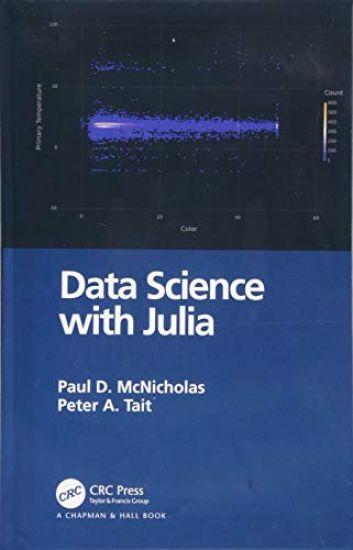
Data Science with Julia

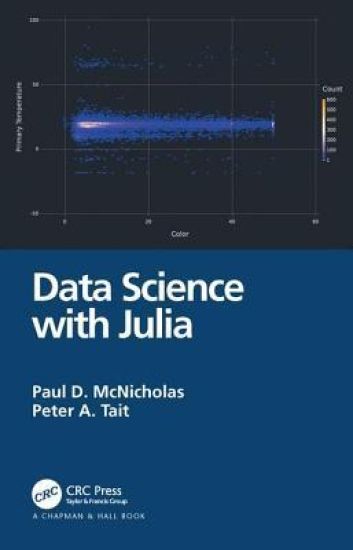
Data Science with Julia

Paul D. McNicholas; Peter Tait

CRC Press
2019
nidottu
"This book is a great way to both start learning data science through the promising Julia language and to become an efficient data scientist."- Professor Charles Bouveyron, INRIA Chair in Data Science, Université Côte d’Azur, Nice, FranceJulia, an open-source programming language, was created to be as easy to use as languages such as R and Python while also as fast as C and Fortran. An accessible, intuitive, and highly efficient base language with speed that exceeds R and Python, makes Julia a formidable language for data science. Using well known data science methods that will motivate the reader, Data Science with Julia will get readers up to speed on key features of the Julia language and illustrate its facilities for data science and machine learning work.Features: Covers the core components of Julia as well as packages relevant to the input, manipulation and representation of data. Discusses several important topics in data science including supervised and unsupervised learning. Reviews data visualization using the Gadfly package, which was designed to emulate the very popular ggplot2 package in R. Readers will learn how to make many common plots and how to visualize model results. Presents how to optimize Julia code for performance. Will be an ideal source for people who already know R and want to learn how to use Julia (though no previous knowledge of R or any other programming language is required). The advantages of Julia for data science cannot be understated. Besides speed and ease of use, there are already over 1,900 packages available and Julia can interface (either directly or through packages) with libraries written in R, Python, Matlab, C, C++ or Fortran. The book is for senior undergraduates, beginning graduate students, or practicing data scientists who want to learn how to use Julia for data science."This book is a great way to both start learning data science through the promising Julia language and to become an efficient data scientist."Professor Charles BouveyronINRIA Chair in Data ScienceUniversité Côte d’Azur, Nice, France
Data Science with Julia

Data Science with Julia

Paul D. McNicholas; Peter Tait

CRC Press
2018
sidottu
"This book is a great way to both start learning data science through the promising Julia language and to become an efficient data scientist."- Professor Charles Bouveyron, INRIA Chair in Data Science, Université Côte d’Azur, Nice, FranceJulia, an open-source programming language, was created to be as easy to use as languages such as R and Python while also as fast as C and Fortran. An accessible, intuitive, and highly efficient base language with speed that exceeds R and Python, makes Julia a formidable language for data science. Using well known data science methods that will motivate the reader, Data Science with Julia will get readers up to speed on key features of the Julia language and illustrate its facilities for data science and machine learning work.Features: Covers the core components of Julia as well as packages relevant to the input, manipulation and representation of data. Discusses several important topics in data science including supervised and unsupervised learning. Reviews data visualization using the Gadfly package, which was designed to emulate the very popular ggplot2 package in R. Readers will learn how to make many common plots and how to visualize model results. Presents how to optimize Julia code for performance. Will be an ideal source for people who already know R and want to learn how to use Julia (though no previous knowledge of R or any other programming language is required). The advantages of Julia for data science cannot be understated. Besides speed and ease of use, there are already over 1,900 packages available and Julia can interface (either directly or through packages) with libraries written in R, Python, Matlab, C, C++ or Fortran. The book is for senior undergraduates, beginning graduate students, or practicing data scientists who want to learn how to use Julia for data science."This book is a great way to both start learning data science through the promising Julia language and to become an efficient data scientist."Professor Charles BouveyronINRIA Chair in Data ScienceUniversité Côte d’Azur, Nice, France
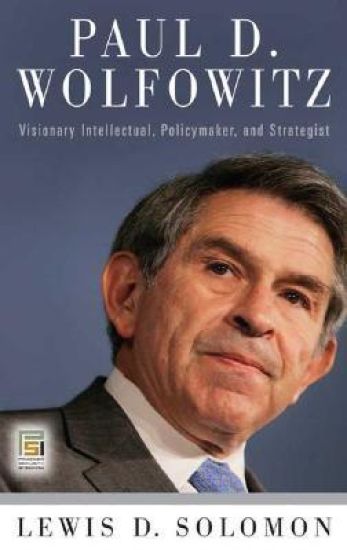
Paul D. Wolfowitz

Paul D. Wolfowitz

Lewis D. Solomon

Praeger Publishers Inc
2007
sidottu
With the announcement of his resignation from the World Bank, the ongoing saga of Paul Wolfowitz, played out in the front pages of the world's newspapers, came to a dramatic conclusion. Paul D. Wolfowitz, as columnist George F. Will wrote in the Washington Post (May 12, 2005), has never been elected to office or served in a president's cabinet, but he has mattered much more than most who have. A longtime State Department hand (Assistant Secretary of State for East Asian and Pacific Affairs, Ambassador to Indonesia), a leading scholar/intellectual (Dean of the Johns Hopkins School of Advanced International Studies), Deputy Secretary of Defense for four years, and one of the architects of the Bush Doctrine, Wolfowitz is a crucial figure in post-Cold War foreign and security policy. He most recently served as President of the World Bank. In each of these roles, he has stood out for his neoconservative and often uncompromising positions. It is no wonder that he is often vilified by the Left and lionized by the Right. In this first full-length biography of Wolfowitz, Solomon attempts to capture him not by delineating the quotidian details of his career, but by tracing his intellectual development and bureaucratic influence at key points along the road to Baghdad and beyond.
Chirurgie de Paul d'Égine

Chirurgie de Paul d'Égine

Paul d'Égine

Hachette Livre - BNF
2013
pokkari
Chirurgie de Paul d'Egine / texte grec... avec traduction francaise en regard, precede d'une Introduction par Rene Briau, ...Date de l'edition originale: 1855Ce livre est la reproduction fidele d'une oeuvre publiee avant 1920 et fait partie d'une collection de livres reimprimes a la demande editee par Hachette Livre, dans le cadre d'un partenariat avec la Bibliotheque nationale de France, offrant l'opportunite d'acceder a des ouvrages anciens et souvent rares issus des fonds patrimoniaux de la BnF.Les oeuvres faisant partie de cette collection ont ete numerisees par la BnF et sont presentes sur Gallica, sa bibliotheque numerique.En entreprenant de redonner vie a ces ouvrages au travers d'une collection de livres reimprimes a la demande, nous leur donnons la possibilite de rencontrer un public elargi et participons a la transmission de connaissances et de savoirs parfois difficilement accessibles.Nous avons cherche a concilier la reproduction fidele d'un livre ancien a partir de sa version numerisee avec le souci d'un confort de lecture optimal. Nous esperons que les ouvrages de cette nouvelle collection vous apporteront entiere satisfaction.Pour plus d'informations, rendez-vous sur www.hachettebnf.fr
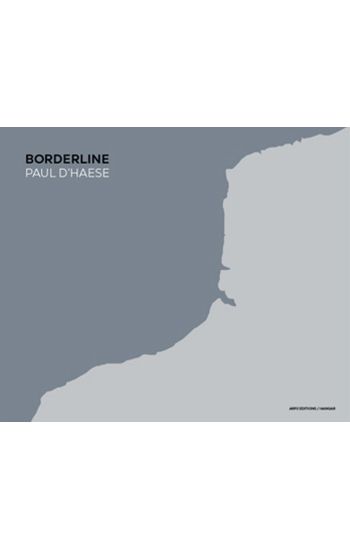
Borderline: Paul D’Haese

Borderline: Paul D’Haese

Paul D’Haese

STOCKMANS NV
2025
nidottu
With Borderline, the Belgian photographer Paul D’Haese explores the coastal strip from Bray-Dunes to Le Havre. His photographs of the chaotic built-up landscape with its blind walls, parapets and fences ironically depict this coastline as a new “Atlantic wall”. In this, they form a masterful visual fable about the desert that can become a country that closes itself off. The images question the forms of a heterogeneous building, the sediment of human activity. In particular it offers a beautiful metaphor for an approach that invites in-depth reading rather than surface contemplation. The project obtained ‘Le Prix de la Ministre de la Culture’ - May 2021 - Musée de la Photographie, Charleroi. Text in English and French.
Les Antiquités de Saint-Paul d'Orléans, d'Après Des Documents Inédits
Les antiquites de Saint-Paul d'Orleans, d'apres des documents inedits (plans et vue de l'ancienne eglise) / par Amicie de Foulques de Villaret, ...Date de l'edition originale: 1884Sujet de l'ouvrage: Eglises -- France -- Orleans (Loiret)OrleansCe livre est la reproduction fidele d'une oeuvre publiee avant 1920 et fait partie d'une collection de livres reimprimes a la demande editee par Hachette Livre, dans le cadre d'un partenariat avec la Bibliotheque nationale de France, offrant l'opportunite d'acceder a des ouvrages anciens et souvent rares issus des fonds patrimoniaux de la BnF.Les oeuvres faisant partie de cette collection ont ete numerisees par la BnF et sont presentes sur Gallica, sa bibliotheque numerique.En entreprenant de redonner vie a ces ouvrages au travers d'une collection de livres reimprimes a la demande, nous leur donnons la possibilite de rencontrer un public elargi et participons a la transmission de connaissances et de savoirs parfois difficilement accessibles.Nous avons cherche a concilier la reproduction fidele d'un livre ancien a partir de sa version numerisee avec le souci d'un confort de lecture optimal. Nous esperons que les ouvrages de cette nouvelle collection vous apporteront entiere satisfaction.Pour plus d'informations, rendez-vous sur www.hachettebnf.fr
The Reminiscences of Mr. Paul D. Richmond
During World War II, after graduating from the Naval Academy in 1941 and being commissioned as a Naval Reserve officer, Richmond was involved in the training of new recruits at the Great Lakes Naval Training Station north of Chicago. In 1942, with the influx of thousands of black sailors among the recruits, Richmond served as a battalion commander at the segregated Camp Robert Smalls. In early 1944, 16 black sailors reported to Great Lakes to undergo a two-and-a-half-month training program to become officers. Richmond devised the curriculum for the black men and supervised their training. They were commissioned in March 1944 and subsequently became known as the Golden Thirteen. After leaving Great Lakes in 1944, Richmond served on the staff of Rear Admiral John L. Hall during the 1945 invasion of Okinawa and later had shore duty in Hawaii and Japan. Following the war, Richmond returned to the Detroit area (where he had grown up) and worked as a stockbroker for 43 years.
The Reminiscences of Vice Adm. Paul D. Stroop, USN (Ret.)
After graduation and duty in the USS Arkansas (BB-33), Admiral Stroop competed in gymnastics in the Olympic Games of 1928. He then trained and was designated naval aviator. When Pearl Harbor was bombed, he served as staff officer for Commander Task Force II in the USS Lexington (CV-2), participating in battles in the Coral Sea until the Lexington was lost. He then became planning officer for Admiral Fitch in the South Pacific. In 1944 he was aviation plans officer for CNO, Admiral E.J. King, accompanying him to the Yalta Conference. Later duties included: CO of the escort carrier USS Croatan (CVE-25); Assistant Chief of Staff for Operations, CinCPac; CO of the USS Princeton (CV-37), patrolling the Korean coast in 1951; Commander, China Lake Naval Ordnance Test Station; Commander, Taiwan Patrol Force; and Commander, Naval Air Force, Pacific Fleet.
The Reminiscences of Vice Adm. Paul D. Stroop, USN (Ret.)
After graduation and duty in the USS Arkansas (BB-33), Admiral Stroop competed in gymnastics in the Olympic Games of 1928. He then trained and was designated naval aviator. When Pearl Harbor was bombed, he served as staff officer for Commander Task Force II in the USS Lexington (CV-2), participating in battles in the Coral Sea until the Lexington was lost. He then became planning officer for Admiral Fitch in the South Pacific. In 1944 he was aviation plans officer for CNO, Admiral E.J. King, accompanying him to the Yalta Conference. Later duties included: CO of the escort carrier USS Croatan (CVE-25); Assistant Chief of Staff for Operations, CinCPac; CO of the USS Princeton (CV-37), patrolling the Korean coast in 1951; Commander, China Lake Naval Ordnance Test Station; Commander, Taiwan Patrol Force; and Commander, Naval Air Force, Pacific Fleet.
Two Guys from Barnum, Iowa and How They Helped Save Basketball: a History of U.S. Patent 4,534,556 : Paul D. Estlund and Kenneth F. Estlund, Inventors
This is the true story of the making and marketing of an invention by two American brothers who grew up on a farm in Iowa, about two miles from where the author grew up. They are credited by many with helping to save the great game of basketball in the last decades of the 20th century, by making an invention for a break-away basketball goal and working to get it into widespread use. Francis B. Francois began his professional career in the U.S. Patent Office in 1956 as a Patent Examiner after graduating from Iowa State University with a degree in engineering. Shortly after moving to Washington, D.C., Frank began attending night law school at The George Washington University. He was the inventors' patent attorney, and in this book he reveals the fascinating story of how his friends the Estlunds helped save basketball.