Kirjojen hintavertailu. Mukana 11 342 296 kirjaa ja 12 kauppaa.

Kirjahaku

Etsi kirjoja tekijän nimen, kirjan nimen tai ISBN:n perusteella.

1000 tulosta hakusanalla Paul D. Numrich; Elfriede Wedam

Religion and Community in the New Urban America

Religion and Community in the New Urban America

Paul D. Numrich; Elfriede Wedam

Oxford University Press Inc
2015
sidottu
Religion and Community in the New Urban America examines the interrelated transformations of cities and urban congregations over the past several decades. The authors ask how the new metropolis affects local religious communities, and what the role of those local religious communities is in creating the new metropolis. Through an in-depth study of fifteen Chicago congregations--Catholic parishes, Protestant churches, Jewish synagogues, Muslim mosques, and a Hindu temple, city and suburban, neighborhood-based and commuter--this book describes the lives of their members and measures the influences of those congregations on urban environments. Paul D. Numrich and Elfriede Wedam challenge the view held by many urban studies scholars that religion plays a small role--if any--in shaping postindustrial cities and that religious communities merely adapt to urban structures in a passive fashion. Taking into account the spatial distribution of constituents, internal traits, and external actions, each congregation's urban impact is plotted on a continuum of weak, to moderate, to strong, thus providing a nuanced understanding of the significance of religion in the contemporary urban context. Providing a thoughtful analysis that includes several original maps illustrating such things as membership distribution for each congregation, the authors offer an insightful look into urban community life today, from congregations to the social-geographic places in which they are embedded.
Religion and Community in the New Urban America

Religion and Community in the New Urban America

Paul D. Numrich; Elfriede Wedam

Oxford University Press Inc
2015
nidottu
Religion and Community in the New Urban America examines the interrelated transformations of cities and urban congregations over the past several decades. The authors ask how the new metropolis affects local religious communities, and what the role of those local religious communities is in creating the new metropolis. Through an in-depth study of fifteen Chicago congregations--Catholic parishes, Protestant churches, Jewish synagogues, Muslim mosques, and a Hindu temple, city and suburban, neighborhood-based and commuter--this book describes the lives of their members and measures the influences of those congregations on urban environments. Paul D. Numrich and Elfriede Wedam challenge the view held by many urban studies scholars that religion plays a small role--if any--in shaping postindustrial cities and that religious communities merely adapt to urban structures in a passive fashion. Taking into account the spatial distribution of constituents, internal traits, and external actions, each congregation's urban impact is plotted on a continuum of weak, to moderate, to strong, thus providing a nuanced understanding of the significance of religion in the contemporary urban context. Providing a thoughtful analysis that includes several original maps illustrating such things as membership distribution for each congregation, the authors offer an insightful look into urban community life today, from congregations to the social-geographic places in which they are embedded.
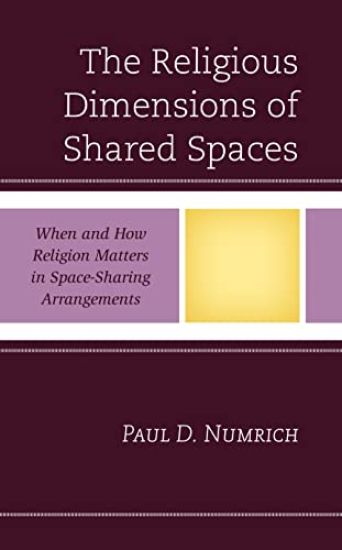
The Religious Dimensions of Shared Spaces

The Religious Dimensions of Shared Spaces

Paul D. Numrich

BLOOMSBURY PUBLISHING PLC
2023
sidottu
Space sharing by groups and organizations is widespread in the United States, from commercial partnerships, to government and private sector joint use agreements, to the use of public facilities and commons, and more. Drawing upon a variety of historical examples and contemporary cases, The Religious Dimensions of Shared Spaces offers a focused and systematic analysis of space sharing involving religious groups or organizations. All space-sharing arrangements are similar in most respects, so what difference does it make when religious groups or organizations are involved? How do they invest meaning in the spaces they use and share, including “sacred space”? When and why do they enter into space-sharing arrangements with other parties, religious and/or secular? How do religious space sharers structure and maintain their arrangements, including handling tensions that arise? What can secular space sharers learn from their religious counterparts, and vice versa? The book also teases out when religion does not matter in space sharing, even when religious groups or organizations are involved. Case studies include internal congregational groups that negotiate the use of shared facilities, arrangements between congregations and external groups or organizations, multifaith partnerships, and shared spaces in secular venues.
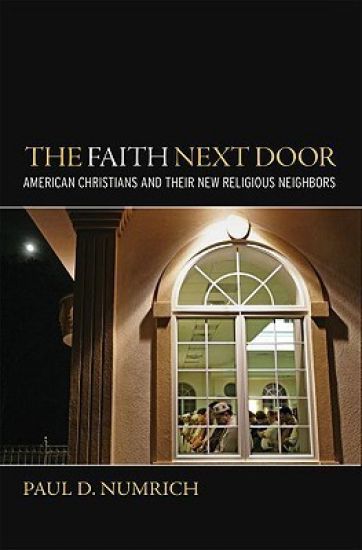
The Faith Next Door

The Faith Next Door

Paul D Numrich

Oxford University Press Inc
2009
sidottu
In 1993, 8000 representatives of the religions of the world gathered in Chicago, on the centennial of the historical 1893 World's Parliament of Religions. The objectives were to "promote understanding and cooperation among religious communities and institutions" and "encourage the spirit of harmony and celebrate, with openness and mutual respect, the rich diversity of religions.'" The Parliament also raised a pressing question: How do local Christians respond when they discover that the religions of the world now reside in their town? Most of the non-Christian representatives to the first Parliament came from outside the U.S. In 1993, however, when the organizers invited the religious communities of Chicago to form host committees for the event, more than half turned out to be non-Christian: Baha'i, Buddhist, Hindu, Jain, Jewish, Muslim, Sikh and Zoroastrian. In this book, Paul Numrich presents eleven case studies of local Chicago-area Christian responses to America's changing religious landscape. Offering a broad, balanced, and sympathetic sampling, he wants to enable readers to make informed decisions about their own attitudes and strategies regarding their non-Christian neighbors. Included are Protestant, Catholic, and Orthodox Christian cases, cases from immigrant and African-American communities, and perspectives ranging from conservative to liberal, from evangelical to pluralist. His study will be of great interest to scholars of American religious pluralism but is also designed to be usable by adult congregational study groups and church leaders at all points on the theological spectrum and from every denominational background.
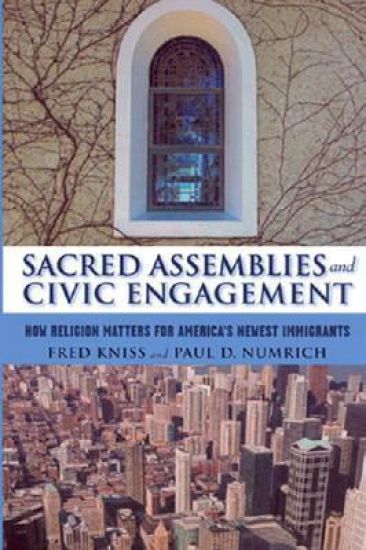
Sacred Assemblies and Civic Engagement

Sacred Assemblies and Civic Engagement

Paul D Numrich; Fred Kniss

Rutgers University Press
2007
nidottu
Immigration to the United States has been a major source of population growth and cultural change throughout much of America’s history. Currently, about 40 percent of the nation’s annual population growth comes from the influx of foreign-born individuals and their children. As these new voices enter America’s public conversations, they bring with them a new understanding of Buddhism, Hinduism, Islam, Judaism, and Christianity to a society that has been marked by religious variety.Sacred Assemblies and Civic Engagement takes an in-depth look at one particular urban area—the Chicago metropolitan region—and examines how religion affects the civic engagement of the nation’s newest residents. Chapters focus on important religious factors, including sectarianism, moral authority, and moral projects; on several areas of social life, including economics, education, marriage, and language, where religion impacts civic engagement; and on how notions of citizenship and community are influenced by sacred assemblies.
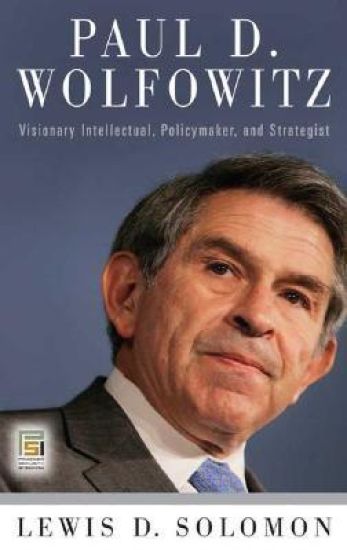
Paul D. Wolfowitz

Paul D. Wolfowitz

Lewis D. Solomon

Praeger Publishers Inc
2007
sidottu
With the announcement of his resignation from the World Bank, the ongoing saga of Paul Wolfowitz, played out in the front pages of the world's newspapers, came to a dramatic conclusion. Paul D. Wolfowitz, as columnist George F. Will wrote in the Washington Post (May 12, 2005), has never been elected to office or served in a president's cabinet, but he has mattered much more than most who have. A longtime State Department hand (Assistant Secretary of State for East Asian and Pacific Affairs, Ambassador to Indonesia), a leading scholar/intellectual (Dean of the Johns Hopkins School of Advanced International Studies), Deputy Secretary of Defense for four years, and one of the architects of the Bush Doctrine, Wolfowitz is a crucial figure in post-Cold War foreign and security policy. He most recently served as President of the World Bank. In each of these roles, he has stood out for his neoconservative and often uncompromising positions. It is no wonder that he is often vilified by the Left and lionized by the Right. In this first full-length biography of Wolfowitz, Solomon attempts to capture him not by delineating the quotidian details of his career, but by tracing his intellectual development and bureaucratic influence at key points along the road to Baghdad and beyond.
Chirurgie de Paul d'Égine

Chirurgie de Paul d'Égine

Paul d'Égine

Hachette Livre - BNF
2013
pokkari
Chirurgie de Paul d'Egine / texte grec... avec traduction francaise en regard, precede d'une Introduction par Rene Briau, ...Date de l'edition originale: 1855Ce livre est la reproduction fidele d'une oeuvre publiee avant 1920 et fait partie d'une collection de livres reimprimes a la demande editee par Hachette Livre, dans le cadre d'un partenariat avec la Bibliotheque nationale de France, offrant l'opportunite d'acceder a des ouvrages anciens et souvent rares issus des fonds patrimoniaux de la BnF.Les oeuvres faisant partie de cette collection ont ete numerisees par la BnF et sont presentes sur Gallica, sa bibliotheque numerique.En entreprenant de redonner vie a ces ouvrages au travers d'une collection de livres reimprimes a la demande, nous leur donnons la possibilite de rencontrer un public elargi et participons a la transmission de connaissances et de savoirs parfois difficilement accessibles.Nous avons cherche a concilier la reproduction fidele d'un livre ancien a partir de sa version numerisee avec le souci d'un confort de lecture optimal. Nous esperons que les ouvrages de cette nouvelle collection vous apporteront entiere satisfaction.Pour plus d'informations, rendez-vous sur www.hachettebnf.fr
Borderline: Paul D’Haese

Borderline: Paul D’Haese

Paul D’Haese

STOCKMANS NV
2025
nidottu
With Borderline, the Belgian photographer Paul D’Haese explores the coastal strip from Bray-Dunes to Le Havre. His photographs of the chaotic built-up landscape with its blind walls, parapets and fences ironically depict this coastline as a new “Atlantic wall”. In this, they form a masterful visual fable about the desert that can become a country that closes itself off. The images question the forms of a heterogeneous building, the sediment of human activity. In particular it offers a beautiful metaphor for an approach that invites in-depth reading rather than surface contemplation. The project obtained ‘Le Prix de la Ministre de la Culture’ - May 2021 - Musée de la Photographie, Charleroi. Text in English and French.
Les Antiquités de Saint-Paul d'Orléans, d'Après Des Documents Inédits
Les antiquites de Saint-Paul d'Orleans, d'apres des documents inedits (plans et vue de l'ancienne eglise) / par Amicie de Foulques de Villaret, ...Date de l'edition originale: 1884Sujet de l'ouvrage: Eglises -- France -- Orleans (Loiret)OrleansCe livre est la reproduction fidele d'une oeuvre publiee avant 1920 et fait partie d'une collection de livres reimprimes a la demande editee par Hachette Livre, dans le cadre d'un partenariat avec la Bibliotheque nationale de France, offrant l'opportunite d'acceder a des ouvrages anciens et souvent rares issus des fonds patrimoniaux de la BnF.Les oeuvres faisant partie de cette collection ont ete numerisees par la BnF et sont presentes sur Gallica, sa bibliotheque numerique.En entreprenant de redonner vie a ces ouvrages au travers d'une collection de livres reimprimes a la demande, nous leur donnons la possibilite de rencontrer un public elargi et participons a la transmission de connaissances et de savoirs parfois difficilement accessibles.Nous avons cherche a concilier la reproduction fidele d'un livre ancien a partir de sa version numerisee avec le souci d'un confort de lecture optimal. Nous esperons que les ouvrages de cette nouvelle collection vous apporteront entiere satisfaction.Pour plus d'informations, rendez-vous sur www.hachettebnf.fr
The Reminiscences of Mr. Paul D. Richmond
During World War II, after graduating from the Naval Academy in 1941 and being commissioned as a Naval Reserve officer, Richmond was involved in the training of new recruits at the Great Lakes Naval Training Station north of Chicago. In 1942, with the influx of thousands of black sailors among the recruits, Richmond served as a battalion commander at the segregated Camp Robert Smalls. In early 1944, 16 black sailors reported to Great Lakes to undergo a two-and-a-half-month training program to become officers. Richmond devised the curriculum for the black men and supervised their training. They were commissioned in March 1944 and subsequently became known as the Golden Thirteen. After leaving Great Lakes in 1944, Richmond served on the staff of Rear Admiral John L. Hall during the 1945 invasion of Okinawa and later had shore duty in Hawaii and Japan. Following the war, Richmond returned to the Detroit area (where he had grown up) and worked as a stockbroker for 43 years.
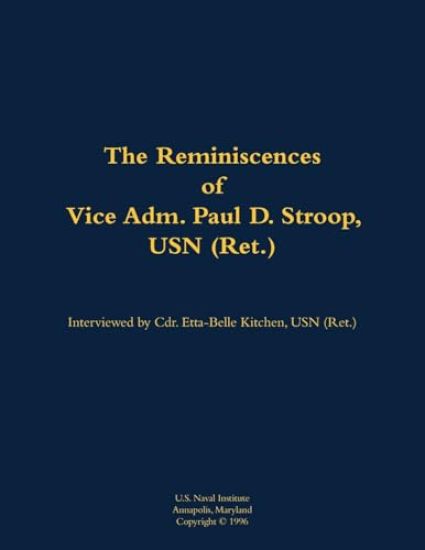
The Reminiscences of Vice Adm. Paul D. Stroop, USN (Ret.)
After graduation and duty in the USS Arkansas (BB-33), Admiral Stroop competed in gymnastics in the Olympic Games of 1928. He then trained and was designated naval aviator. When Pearl Harbor was bombed, he served as staff officer for Commander Task Force II in the USS Lexington (CV-2), participating in battles in the Coral Sea until the Lexington was lost. He then became planning officer for Admiral Fitch in the South Pacific. In 1944 he was aviation plans officer for CNO, Admiral E.J. King, accompanying him to the Yalta Conference. Later duties included: CO of the escort carrier USS Croatan (CVE-25); Assistant Chief of Staff for Operations, CinCPac; CO of the USS Princeton (CV-37), patrolling the Korean coast in 1951; Commander, China Lake Naval Ordnance Test Station; Commander, Taiwan Patrol Force; and Commander, Naval Air Force, Pacific Fleet.
The Reminiscences of Vice Adm. Paul D. Stroop, USN (Ret.)
After graduation and duty in the USS Arkansas (BB-33), Admiral Stroop competed in gymnastics in the Olympic Games of 1928. He then trained and was designated naval aviator. When Pearl Harbor was bombed, he served as staff officer for Commander Task Force II in the USS Lexington (CV-2), participating in battles in the Coral Sea until the Lexington was lost. He then became planning officer for Admiral Fitch in the South Pacific. In 1944 he was aviation plans officer for CNO, Admiral E.J. King, accompanying him to the Yalta Conference. Later duties included: CO of the escort carrier USS Croatan (CVE-25); Assistant Chief of Staff for Operations, CinCPac; CO of the USS Princeton (CV-37), patrolling the Korean coast in 1951; Commander, China Lake Naval Ordnance Test Station; Commander, Taiwan Patrol Force; and Commander, Naval Air Force, Pacific Fleet.