Kirjojen hintavertailu. Mukana 12 360 815 kirjaa ja 12 kauppaa.

Kirjahaku

Etsi kirjoja tekijän nimen, kirjan nimen tai ISBN:n perusteella.

1000 tulosta hakusanalla Paul Ernest 1901- Adolph

Health Shall Spring Forth

Health Shall Spring Forth

Paul Ernest 1901- Adolph

Hassell Street Press
2021
sidottu
This work has been selected by scholars as being culturally important and is part of the knowledge base of civilization as we know it.This work is in the public domain in the United States of America, and possibly other nations. Within the United States, you may freely copy and distribute this work, as no entity (individual or corporate) has a copyright on the body of the work.Scholars believe, and we concur, that this work is important enough to be preserved, reproduced, and made generally available to the public. To ensure a quality reading experience, this work has been proofread and republished using a format that seamlessly blends the original graphical elements with text in an easy-to-read typeface.We appreciate your support of the preservation process, and thank you for being an important part of keeping this knowledge alive and relevant.
Relatively and Philosophically Earnest Festschrift in honor of Paul Ernest's 65th Birthday
Paul Ernest’s name is synonymous with social constructivism as a philosophy of mathematics. His contributions to mathematics education have occurred at a very fundamental level and to a extent shaped theory development in this field. His research addresses fundamental questions about the nature of mathematics and how it relates to teaching, learning and society. For the last three decades Paul has been a prolific scholar who has published in a wide array of topics such as the relationship between the philosophy of mathematics and mathematics education, and more generally the philosophy of mathematics education, ethics and values in mathematics education, and the philosophy of research methodology.The title of this Festschrift is meant to be a pun to convey the sometimes relativistic dimension to mathematical certainty that Paul argued for in developing his philosophy, and also a play on words for the fact that absolute “earnestness” may perhaps be a Platonic construct, and not possible in the realm of language and human discourse! Paul Ernest’s scholarly evolution and life can best be summarized in the words of Walt Whitman “Do I contradict myself? Very well then I contradict myself” (I am large, I contain multitudes). Indeed his presence has been large and multitudinous and this Festschrift celebrates his 65th Birthday with numerous contributions coming from the mathematics, philosophy and mathematics education communities around the world.
Relatively and Philosophically Earnest Festschrift in Honor of Paul Ernest's 65th Birthday
Paul Ernest’s name is synonymous with social constructivism as a philosophy of mathematics. His contributions to mathematics education have occurred at a very fundamental level and to a extent shaped theory development in this field. His research addresses fundamental questions about the nature of mathematics and how it relates to teaching, learning and society. For the last three decades Paul has been a prolific scholar who has published in a wide array of topics such as the relationship between the philosophy of mathematics and mathematics education, and more generally the philosophy of mathematics education, ethics and values in mathematics education, and the philosophy of research methodology.The title of this Festschrift is meant to be a pun to convey the sometimes relativistic dimension to mathematical certainty that Paul argued for in developing his philosophy, and also a play on words for the fact that absolute “earnestness” may perhaps be a Platonic construct, and not possible in the realm of language and human discourse! Paul Ernest’s scholarly evolution and life can best be summarized in the words of Walt Whitman “Do I contradict myself? Very well then I contradict myself” (I am large, I contain multitudes). Indeed his presence has been large and multitudinous and this Festschrift celebrates his 65th Birthday with numerous contributions coming from the mathematics, philosophy and mathematics education communities around the world.
Social Constructivism as a Philosophy of Mathematics

Social Constructivism as a Philosophy of Mathematics

Paul Ernest

State University of New York Press
1997
pokkari
Extends the ideas of social constructivism to the philosophy of mathematics, developing a powerful critique of traditional absolutist conceptions of mathematics, and proposing a reconceptualization of the philosophy of mathematics.Proposing social constructivism as a novel philosophy of mathematics, this book is inspired by current work in sociology of knowledge and social studies of science. It extends the ideas of social constructivism to the philosophy of mathematics, developing a whole set of new notions. The outcome is a powerful critique of traditional absolutist conceptions of mathematics, as well as of the field of philosophy of mathematics itself. Proposed are a reconceptualization of the philosophy of mathematics and a new set of adequacy criteria.The book offers novel analyses of the important but under-recognized contributions of Wittgenstein and Lakatos to the philosophy of mathematics. Building on their ideas, it develops a theory of mathematical knowledge and its relation to the social context. It offers an original theory of mathematical knowledge based on the concept of conversation, and develops the rhetoric of mathematics to account for proof in mathematics. Another novel feature is the account of the social construction of subjective knowledge, which relates the learning of mathematics to philosophy of mathematics via the development of the individual mathematician. It concludes by considering the values of mathematics and its social responsibility.
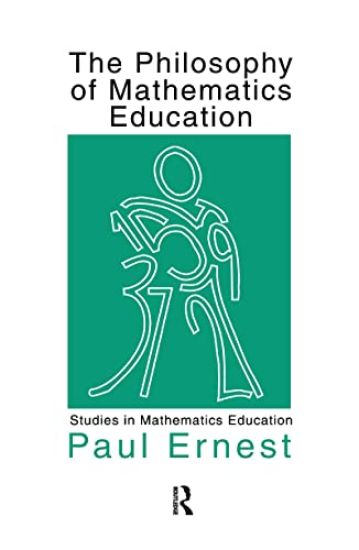
The Philosophy of Mathematics Education
First published in 1991. What is mathematics, and how can we account for its nature? What philosophies of mathematics have been developed? What philosophical assumptions, possibly implicit, underpin the learning of mathematics? What are the aims of mathematics education and are they valid? What philosophical assumptions, possibly implicit, does mathematics teaching rest on? This study looks at these questions on the philosophy of mathematics.
The Philosophy of Mathematics Education

The Philosophy of Mathematics Education

Paul Ernest

Routledge Falmer
1991
sidottu
First published in 1991. What is mathematics, and how can we account for its nature? What philosophies of mathematics have been developed? What philosophical assumptions, possibly implicit, underpin the learning of mathematics? What are the aims of mathematics education and are they valid? What philosophical assumptions, possibly implicit, does mathematics teaching rest on? This study looks at these questions on the philosophy of mathematics.
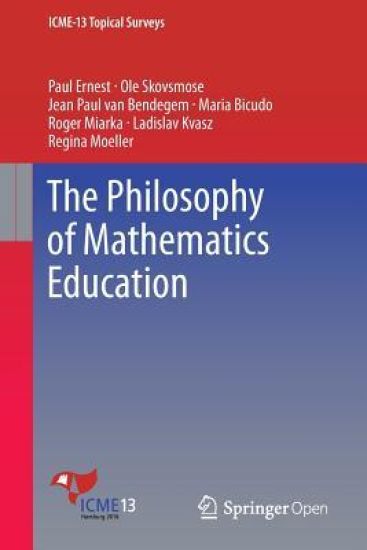
The Philosophy of Mathematics Education

The Philosophy of Mathematics Education

Paul Ernest; Ole Skovsmose; Jean Paul van Bendegem; Maria Bicudo; Roger Miarka; Ladislav Kvasz; Regina Moeller

Springer International Publishing AG
2016
nidottu
This survey provides a brief and selective overview of research in the philosophy of mathematics education. It asks what makes up the philosophy of mathematics education, what it means, what questions it asks and answers, and what is its overall importance and use? It provides overviews of critical mathematics education, and the most relevant modern movements in the philosophy of mathematics. A case study is provided of an emerging research tradition in one country. This is the Hermeneutic strand of research in the philosophy of mathematics education in Brazil. This illustrates one orientation towards research inquiry in the philosophy of mathematics education. It is part of a broader practice of ‘philosophical archaeology’: the uncovering of hidden assumptions and buried ideologies within the concepts and methods of research and practice in mathematics education. An extensive bibliography is also included.
Essai sur les tumeurs perlées du testicule

Essai sur les tumeurs perlées du testicule

Paul Ernest Désiré Viardot

Antigonos Verlag
2024
pokkari
R impression inchang e de l' dition originale de 1872. La maison d' dition Antigonos est sp cialis e dans la publication de r impressions de livres historiques. Nous veillons ce que ces ouvrages soient mis la disposition du public dans de bonnes conditions afin de pr server leur patrimoine culturel.
Classification de quelques caractères phénotypiques chez le voandzou (Vigna subterranea L. Verdc.) cultivé au Cameroun
Le voandzou (Vigna subterranea L. Verdc.) est une l gumineuse graines comestibles qui repr sente l'une des principales sources de revenus des femmes. L'objectif principal de cette tude est d'identifier les meilleurs caract res agromorphologiques responsables de la variation entre les douze g notypes tudi s dans le but d'initier une strat gie pour l'am lioration g n tique de cette plante. Les g notypes de voandzou ont t choisis par s lection ph notypique bas e sur la couleur des graines. Vingt-neuf caract res s lectionn s parmi les descripteurs de voandzou ont t valu s gr ce l'analyse en composante principale (ACP). Tous les g notypes ont atteint la maturit 90 JAS. Vingt-six caract res ont permis de diff rencier et de distinguer trois groupes. Les g notypes du groupe II (NOR6, MBYO3, et MBYO10) pr sentent les meilleurs caract res. Ces r sultats aideront les g n ticiens dans leur programme de s lection.