

Kirjahaku
Etsi kirjoja tekijän nimen, kirjan nimen tai ISBN:n perusteella.
1000 tulosta hakusanalla Paul G. Balch; Jaylee Balch

Moderne Warenhaus-Organisation
Paul Myer Mazur; Fritz Neisser; G. Bach
Springer-Verlag Berlin and Heidelberg GmbH Co. K
1928
nidottu
Dieser Buchtitel ist Teil des Digitalisierungsprojekts Springer Book Archives mit Publikationen, die seit den Anfängen des Verlags von 1842 erschienen sind. Der Verlag stellt mit diesem Archiv Quellen für die historische wie auch die disziplingeschichtliche Forschung zur Verfügung, die jeweils im historischen Kontext betrachtet werden müssen. Dieser Titel erschien in der Zeit vor 1945 und wird daher in seiner zeittypischen politisch-ideologischen Ausrichtung vom Verlag nicht beworben.


Paul G. Kirk
OmniScriptum
2026
pokkari

Vizeadmiral Paul G. Hoffmann (1846-1917): Wirken in Bewegter Zeit
Peter Max Gutzwiller
Duncker Humblot
2020
nidottu

G P S - God's Prayer Strategies
Paul G. Deneui
Createspace Independent Publishing Platform
2015
nidottu

The Wonders of the Disciple - Part 3: The Ends of the Earth - Paul's Church Planting Journeys - Acts 13-20
Paul G. Leavenworth
Createspace Independent Publishing Platform
2016
nidottu

The Wonders of the Disciple - Part 4: The Ends of the Earth - Paul's Journeys to Jerusalem and Rome
Paul G. Leavenworth
Createspace Independent Publishing Platform
2016
nidottu



High Intensity Intervall Training im Gesundheits- und Leistungsbereich
Paul G.
GRIN Verlag
2017
nidottu


A practical, packable source of clear, reassuring first aid advice, Wilderness First Aid is the only such guide written by a board-certified emergency medicine specialist. Wilderness First Aid presents 125 outdoor medical emergencies and succinct, step-by-step treatment advice. Arranged by symptom for easy access, treatments cover everything from blisters to broken bones, heat stroke to hypothermia, snake bites to poison ivy. Direct and to the point, Wilderness First Aid's spread-by-spread design gets readers where they need to be quicklymaking calm, informed treatment decisions. Like having a trusted guide at your side

Images of the Ice Age, here in its third edition, is the most complete study available of the world's earliest imagery, presenting a fascinating and up-to-date account of the art of our Ice Age ancestors. Authoritative and wide-ranging, it covers not only the magnificent cave art of famous sites such as Lascaux, Altamira, and Chauvet, but also other less well-known sites around the world, art discovered in the open air, and the thousands of incredible pieces of portable art in bone, antler, ivory, and stone produced in the same period. In doing so, the book summarizes all the major worldwide research into Ice Age art both past and present, exploring the controversial history of the art's discovery and acceptance, including the methods used for recording and dating, the faking of decorated objects and caves, and the wide range of theories that have been applied to this artistic corpus. Lavishly illustrated and highly accessible, Images of the Ice Age provides a visual feast and an absorbing synthesis of this crucial aspect of human history, offering a unique opportunity to appreciate universally important works of art, many of which can never be accessible to the public, and which represent the very earliest evidence of artistic expression.

The study of human behavior in actual social settings is an extraordinarily complex area of research. Social behavior, unlike the controlled conditions of the laboratory, is affected by an enormous number of variables and environments. Researchers, therefore, are faced with the task of designing adequate experiments that have the sophisticated controls necessary to increase the experimenter's confidence that a relationship between a particular stimulus in a social environment and a particular social response actually exists. This distinctive supplementary text for social psychology courses gives students a real feeling for the possibilities of experimentation outside the laboratory.The reprinted and abstracted articles in this book are reports of experimental studies conducted in natural settings, and the orientation is scientific--focusing on consistencies between laboratory and field research, rather than their inconsistencies. The book discusses research on discrimination, status, prosocial behavior, dissonance, attitude change, interpersonal and group influence, compliance performance, change and rumors, honesty, and participation. The chapters were selected on the basis of both content and methodology and demonstrate particularly ingenious applications of experimental methodology to the study of natural settings. Throughout the book, the editor stresses the ethical and moral issues associated with field research, demonstrating that scientific work must be humane as well as rigorous.Social Psychology in Natural Settings is appropriate for course use at introductory as well as more advanced levels. It is instructive and useful as a reference volume for graduate students and researchers as well.

The recent financial crisis led to sweeping reforms that inspired countless references to the financial reforms of the New Deal. Comparable to the reforms of the New Deal in both scope and scale, the 2,300 - page Dodd-Frank Act of 2010 - the main regulatory reform package introduced in the United States - also shared with New Deal reforms the assumption that the underlying cause of the crisis was misbehavior by securities market participants, exacerbated by lax regulatory oversight. With Wasting a Crisis, Paul G. Mahoney offers persuasive research to show that this now almost universally accepted narrative of market failure - broadly similar across financial crises - is formulated by political actors hoping to deflect blame from prior policy errors. Drawing on a cache of data, from congressional investigations, litigation, regulatory reports, and filings to stock quotes from the 1920s and '30s, Mahoney moves beyond the received wisdom about the financial reforms of the New Deal, showing that lax regulation was not a substantial cause of the financial problems of the Great Depression. As new regulations were formed around this narrative of market failure, not only were the majority largely ineffective, they were also often counter-productive, consolidating market share in the hands of leading financial firms. An overview of twenty-first-century securities reforms from the same analytic perspective, including Dodd-Frank and the Sarbanes-Oxley Act of 2002, shows a similar pattern and suggests that they too may offer little benefit to investors and some measurable harm.
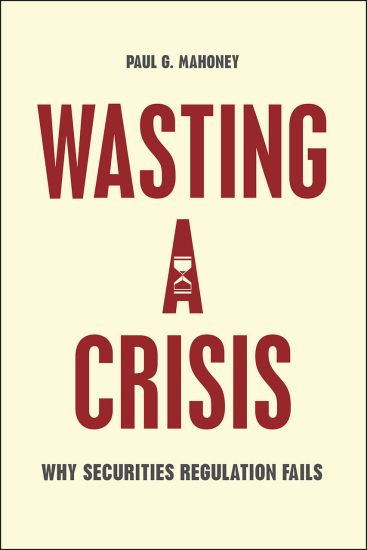
The recent financial crisis led to sweeping reforms that inspired countless references to the financial reforms of the New Deal. Comparable to the reforms of the New Deal in both scope and scale, the 2,300-page Dodd-Frank Act of 2010 the main regulatory reform package introduced in the United States also shared with New Deal reforms the assumption that the underlying cause of the crisis was misbehavior by securities market participants, exacerbated by lax regulatory oversight. With Wasting a Crisis, Paul G. Mahoney offers persuasive research to show that this now almost universally accepted narrative of market failure broadly similar across financial crises is formulated by political actors hoping to deflect blame from prior policy errors. Drawing on a cache of data, from congressional investigations, litigation, regulatory reports, and filings to stock quotes from the 1920s and '30s, Mahoney moves beyond the received wisdom about the financial reforms of the New Deal, showing that lax regulation was not a substantial cause of the financial problems of the Great Depression. As new regulations were formed around this narrative of market failure, not only were the majority largely ineffective, they were also often counterproductive, consolidating market share in the hands of leading financial firms. An overview of twenty-first-century securities reforms from the same analytic perspective, including Dodd-Frank and the Sarbanes-Oxley Act of 2002, shows a similar pattern and suggests that they too may offer little benefit to investors and some measurable harm.

A new, naturalistic theory of consciousness and sensory experience. Philosophers of mind and neuroscientists often debate what they call the hard problem of consciousness, that is, how we might account for qualia—our subjective experiences of phenomena like color, taste, pain, smell, and more. In Sensing Qualia, Paul G. Skokowski surveys the most influential theories of mind since Descartes in order to establish a new theory he calls sensory naturalism, which recognizes the senses as natural detectors of physical properties in the world. Drawing on neuroscience, physics, and philosophy, Skokowski provides a naturalistic framework for studying qualia in the physical world and explores the limits of qualia in androids and AI. The result is a compelling explanation of qualia for anyone curious about the nature of conscious experience in humans and AI.

Sensing Qualia: Solving the Hard Problem of Consciousness
Paul G. Skokowski
University of Chicago Press
2026
nidottu

It is 1995, and intelligence operative Lora Chandler, a.k.a. Agent Vogel, is tasked with investigating the claim that Professor Simon Blackmarr has cracked the invisibility problem. A mission that leads her back to the half-forgotten beach town of Lancaster, Florida. Home to estranged love interest, and newspaper reporter Richard Davis. Her feelings for him have never really died, and matters become even more complicated when Vogel learns that Blackmarr's breakthrough is legitimate. A scientific discovery that -in the wrong hands - could alter the balance of global power. The stakes become even higher when the professor is abducted from the university, forcing Vogel back into the shadowy realm of espionage to find out who and why. It will take all the skill and cunning Lora Chandler possesses to stop a threat that could have devastating consequences for her personal life - and the world at large.