Kirjojen hintavertailu. Mukana 11 244 527 kirjaa ja 12 kauppaa.

Kirjahaku

Etsi kirjoja tekijän nimen, kirjan nimen tai ISBN:n perusteella.

1000 tulosta hakusanalla Paul H Feldman

Jack The Ripper

Jack The Ripper

Paul H Feldman

Virgin Books
2018
pokkari
The Diary of Jack the Ripper, which came to light in 1991, revealed the identity of the world's most notorious serial killer. At the time it was widely believed to have been a hoax, yet, incredibly, not one person has managed to prove how it was forged or by whom. This, argues Paul Feldman, is because the diary was genuine.Discover how the largest and most detailed investigation on the subject ever to be undertaken led the author through the smokescreen of an official cover-up, via the Royals and the Masons, to the true provenance of the Diary, Jack the Ripper's watch and, ultimately, his identity.
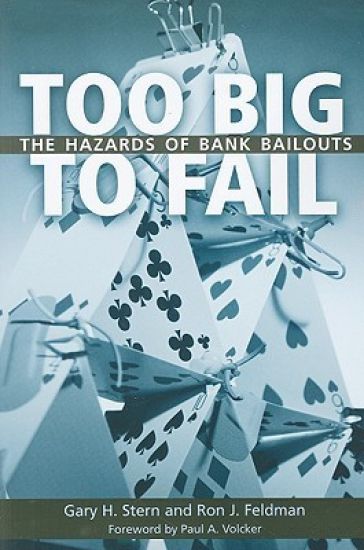
Too Big to Fail

Too Big to Fail

Gary H. Stern; Ron J. Feldman; Paul A. Volcker

Brookings Institution
2009
nidottu
"The potential failure of a large bank presents vexing questions for policymakers. It poses significant risks to other financial institutions, to the financial system as a whole, and possibly to the economic and social order. Because of such fears, policymakers in many countries—developed and less developed, democratic and autocratic—respond by protecting bank creditors from all or some of the losses they otherwise would face. Failing banks are labeled ""too big to fail"" (or TBTF). This important new book examines the issues surrounding TBTF, explaining why it is a problem and discussing ways of dealing with it more effectively.Gary Stern and Ron Feldman, officers with the Federal Reserve, warn that not enough has been done to reduce creditors' expectations of TBTF protection. Many of the existing pledges and policies meant to convince creditors that they will bear market losses when large banks fail are not credible, resulting in significant net costs to the economy. The authors recommend that policymakers enact a series of reforms to reduce expectations of bailouts when large banks fail."
Paul H. Nitze on Foreign Policy

Paul H. Nitze on Foreign Policy

Steven Reardon; Kenneth W. Thompson

University Press of America
1989
nidottu
The distinguished New York Times columnist James Reston has observed that few if any Americans have served their government with greater distinction over a longer period of time than President Reagan's Secretary of State on arms control matters, Paul H. Nitze. This volume brings together some of his most important essays, articles, speeches, correspondence, and public papers on foreign policy and national security and arms control.
Paul H. Nitze on National Security and Arms Control

Paul H. Nitze on National Security and Arms Control

Kenneth W. Thompson; Steven L. Rearden

University Press of America
1990
nidottu
This volume makes available to the general public some of Paul H. Nitze's most important papers on foreign policy and national security and arms control. Divided into three chapters, 'Strategy and Security,' 'The Military Component of National Security,' and 'The Arms Control Component of National Security,' this volume contains letters, reports, transcripts of speeches, and Nitze's comments on speeches made by other policy makers and officials involved with national security.
The Reminiscences of Cdr. Paul H. Backus, USN (Ret.)
Commander Paul Backus was a direct, forthright person--so much so that his directness may have cost him promotion to the higher ranks that many felt he deserved. He was the type of officer who was impatient to achieve results. He achieved a great many results but in the process rubbed a number of individuals the wrong way. In his oral memoir he discussed those situations candidly, particularly in the portion on the Polaris program. The success of that program is certainly to the credit of Commander Backus and his uncompromising demand for excellence. On the road to Polaris, Paul Backus was president of the Naval Academy's class of 1941, then had a brief tour of duty in the destroyer Jarvis. Next he was in the crew of the battleship Oklahoma when she was attacked by the Japanese at Pearl Harbor in De cem ber 1941. His descriptions of that event captured the human cost of being less than well prepared for war. During much of the war that followed, Backus served in the battleship South Dakota, including duty as turret officer during a celebrated night surface action off Guadalcanal in November 1942. At war's end, Backus was taking postgraduate education in ordnance engineering, leading to several subsequent billets. Among other things, he was the gunnery officer in the USS Mississippi as she was converted from a battleship to an experimental ship for development of new weapons. Then he was gunnery officer in the light cruiser Huntington, which was the last ship command for Captain Arleigh Burke, future Chief of Naval Operations. In the years that followed, Backus served in the research division of the Bureau of Ordnance and then commanded the destroyer Isherwood. Th e latter was a particular source of satisfaction to him because he had had virtually no destroyer duty up to that point. Still later, he was a representative of the Bureau of Ordnance while serving as an assistant naval attache in London. The capstone of Commander Backus's career was the long period --1956 to 1961--when he was on Admiral Burke's OpNav staff during the development of Polaris. In his interviews, Backus said that the Office of Special Projects, including Rear Admiral William Raborn and Captain Levering Smith, deserved a great deal of credit for the success of Polaris. But he als o contended that the ballistic missile section in OpNav also deserved credit--far more than it has gotten. In his oral history Backus set out to redress that shortage with a detailed recitation of the many aspects of the program in which his office was involved. Commander Backus's oral history is thus an essential source for anyone who is doing a serious study of the early years of Polaris.
The Works of Charles Darwin: v. 21: Descent of Man, and Selection in Relation to Sex (, with an Essay by T.H. Huxley)
The 21st volume in a 29-volume set which contain all Charles Darwin's published works. Darwin was one of the most influential figures of the 19th century. His work remains a central subject of study in the history of ideas, the history of science, zoology, botany, geology and evolution.
The Works of Charles Darwin: v. 22: Descent of Man, and Selection in Relation to Sex (, with an Essay by T.H. Huxley)
The 22nd volume in a 29-volume set which contain all Charles Darwin's published works. Darwin was one of the most influential figures of the 19th century. His work remains a central subject of study in the history of ideas, the history of science, zoology, botany, geology and evolution.
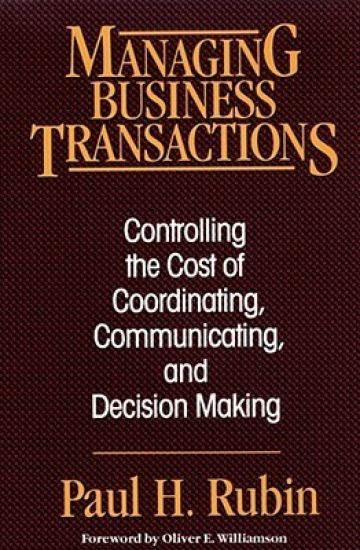
Managing Business Transactions

Managing Business Transactions

Paul H. Rubin

The Free Press
1993
pokkari
Managing Business Transactions is the first book on the principles of a new managerial economics, based on transaction cost economics.The transaction, the basic unit of business has been studied by theoretical economists for decades. Rubin has translated their research into basic principles for managers at all levels to structure transactions to best achieve both individual and company goals. Rubin analyzes and offers strategies for transactions of all kinds.
ADHD: A Guide to Understanding Symptoms, Causes, Diagnosis, Treatment, and Changes Over Time in Children, Adolescents, and A
Drawing on over forty years of clinical and research experience, Paul Wender and new coauthor David A. Tomb have created a classic, definitive model for identifying and treating children and adults who have Attention-Deficit Hyperactivity Disorder (ADHD). ADHD: Attention-Deficit Hyperactivity Disorder in Children and Adults, Fifth Edition offers insights into the progression of ADHD to those at any age and describes the best treatment. Wender and Tomb stress that drug therapy remains the most effective in treating the disorder, but psychological techniques, when combined with medication, can produce further improvement. In addition, extensive first-hand accounts from men, women, and children offer dramatic insight into what it feels like to have, and to receive medical treatment for, ADHD. Throughout, the book contains valuable information on where to seek help and what kinds of diagnostic tests exist and how reliable they are, as well as comprehensive instructions and rating scales to help parents best help their child and to help adults self-screen for the disorder. This concise and fully revised volume is a practical tool for individuals at any age, parents and teachers of children with ADHD, and clinicians.
Law without Justice

Law without Justice

Paul H. Robinson; Michael T. Cahill

Oxford University Press Inc
2006
sidottu
If an innocent person is sent to prison or if a killer walks free, we are outraged. The legal system assures us, and we expect and demand, that it will seek to "do justice" in criminal cases. So why, for some cases, does the criminal law deliberately and routinely sacrifice justice? In this unflinching look at American criminal law, Paul Robinson and Michael Cahill demonstrate that cases with unjust outcomes are not always irregular or unpredictable. Rather, the criminal law sometimes chooses not to give defendants what they deserve: that is, unsatisfying results occur even when the system works as it is designed to work. The authors find that while some justice-sacrificing doctrines serve their intended purpose, many others do not, or could be replaced by other, better rules that would serve the purpose without abandoning a just result. With a panoramic view of the overlapping and often competing goals that our legal institutions must balance on a daily basis, Law without Justice challenges us to restore justice to the criminal justice system.
Distributive Principles of Criminal Law

Distributive Principles of Criminal Law

Paul H Robinson

Oxford University Press Inc
2008
sidottu
The rules governing who will be punished and how much determine a society's success in two of its most fundamental functions: doing justice and protecting citizens from crime. Drawing from the existing theoretical literature and adding to it recent insights from the social sciences, Paul Robinson describes the nature of the practical challenge in setting rational punishment principles, how past efforts have failed, and the alternatives that have been tried. He ultimately proposes a principle for distributing criminal liability and punishment that will be most likely to do justice and control crime. Paul Robinson, is one of the world's leading criminal law experts. He has been writing about criminal liability and punishment issues for three decades, and has published dozens of influential articles in the best scholarly journals. This long-awaited volume is a brilliant synthesis of social science research and legal reasoning that brings together three decades of work in a compelling line of argument that addresses all of the important issues in assessing liability and punishment.
Structure and Function in Criminal Law

Structure and Function in Criminal Law

Paul H. Robinson

Clarendon Press
1997
sidottu
Professor Robinson provides a new critique of the often neglected problem of classification within the criminal law. He presents a discussion of the present conceptual framework of the law, and offers explanations of how and why formal structures do not match the operation of law in practice. In this scholarly exposition of applied criminal theory, Robinson argues that the current operational structure of the criminal law fails to take account of its different functions. He goes on to suggest new sample codes of criminal conduct and criminal adjudication which mark a real departure from the pragmatic approach which presently dominates code-making. This rounded exploration of the structure of systems of criminal law is an important work for law teachers and policy makers world-wide.
Beginning Group Theory for Chemistry

Beginning Group Theory for Chemistry

Paul H. Walton

Oxford University Press
1998
nidottu
Ghis accessible book covers group theory, which is a key area of chemistry at undergraduate level. The basic concepts of group theory are introduced, with separate sections on molecular symmetry, the mathematics of group theory and the application of group theory in chemistry. The level of the book is appropriate both for chemistry students who have and who don't have a mathematical background - reflecting the wider range of knowledge and experience of modern chemistry undergraduates. The "workbook" style of the book, where students write their answers to problems and compare them to model answers, helps the student to gain confidence in using group theory in chemistry. Clear, simple diagrams are provided throughout the book, and its attractive workbook format makes this an essential supplementary text for undergraduate chemistry students. Postgraduate chemists and undergraduate students of biochemistry and environmental sciences will also find this book useful.
Intuitions of Justice and the Utility of Desert

Intuitions of Justice and the Utility of Desert

Paul H. Robinson

Oxford University Press Inc
2013
sidottu
Research suggests that people of all demographics have nuanced and sophisticated notions of justice. In this intriguing new book, Paul H. Robinson demonstrates that judicial decisions that deviate from public conceptions of justice and desert can seriously undermine the American criminal justice system's integrity and legitimacy by failing to recognize or meet the needs of the communities it serves. Intuitions of Justice and the Utility of Desert sketches the contours of a wide range of lay conceptions of justice, touching many if not most of the issues that penal code drafters or policy makers must face, including normative crime control, universal understandings of justice, culpability, principles of adjudication, grading sentencing, justification defenses, and judicial discretion. Robinson warns that compromising the American criminal justice system to satisfy other interests can uncover hidden the costs incurred when a community's notions about justice are not reflected in its criminal laws. By ignoring the intuitions of justice held by the communities they serve, legislators, policymakers, and judges undermine the relevance of the criminal justice system and reduce its strength and legitimacy, creating a gap between what justice a community needs and what justice a court or law prescribes.