Kirjojen hintavertailu. Mukana 12 390 323 kirjaa ja 12 kauppaa.

Kirjahaku

Etsi kirjoja tekijän nimen, kirjan nimen tai ISBN:n perusteella.

1000 tulosta hakusanalla Paul P. Somers

Editorial Cartooning and Caricature

Editorial Cartooning and Caricature

Paul P. Somers

Greenwood Press
1998
sidottu
This reference traces the historical background of editorial cartooning and presents works that chronicle the history and criticize the aesthetics of the art. It also describes anthologies and exhibition catalogs that reprint editorial cartoons, and provides a list of libraries, museums, and historical societies which house originals and photocopies or clippings of editorial cartoons. This expansive volume examines the American editorial cartoon from its beginnings in 1747 into the second Clinton administration. It fills a gap in the literature, providing comprehensive information on a field of growing interest to scholars and collectors. This reference guide studies the evolution of editorial cartooning and places it in its historical context and provides appreciation and criticism of the cartoons presented. In addition to political cartoons, underground, radical, and propaganda cartoons are also discussed in this volume. The appendixes offer important cross-reference tools such as a chronology and include listings of selected historical periodicals, theses, and dissertations covering political cartoons. This work will be of value to a broad spectrum of readers—from collectors to scholars—and is suitable for many fields of study.
The Conspirator. a Romance of Real Life. by Count Paul P-. Edited, or Rather, Written by Frank Harkut. [Pseud i.e. F. Keruth.] Vol. II
Title: The Conspirator. A romance of real life. By Count Paul P-. Edited, or rather, written by Frank Harkut. pseud i.e. F. Keruth.]Publisher: British Library, Historical Print EditionsThe British Library is the national library of the United Kingdom. It is one of the world's largest research libraries holding over 150 million items in all known languages and formats: books, journals, newspapers, sound recordings, patents, maps, stamps, prints and much more. Its collections include around 14 million books, along with substantial additional collections of manuscripts and historical items dating back as far as 300 BC.The FICTION & PROSE LITERATURE collection includes books from the British Library digitised by Microsoft. The collection provides readers with a perspective of the world from some of the 18th and 19th century's most talented writers. Written for a range of audiences, these works are a treasure for any curious reader looking to see the world through the eyes of ages past. Beyond the main body of works the collection also includes song-books, comedy, and works of satire. ++++The below data was compiled from various identification fields in the bibliographic record of this title. This data is provided as an additional tool in helping to insure edition identification: ++++ British Library Harkut, Frank; 1890. 2 vol.; 8 . 012631.f.9.
Sensors for Mechatronics

Sensors for Mechatronics

Paul P.L. Regtien

Elsevier Science Publishing Co Inc
2012
sidottu
Mechatronics is a multidisciplinary field combining Mechanical, Electronic, Computer, and other Engineering fields to develop intelligent processes and products. Based on thirty years of extensive work in industry and teaching, this book provides an overview of the sensors and sensor systems required and applied in mechatronics with an emphasis on understanding the physical principles and possible configurations of sensors rather than simply a discussion of particular types of sensors. Well illustrated with examples of commercially available sensors and of recent and future developments, this book offers help in achieving the best solution to various kinds of sensor problems encountered in mechatronics. In a clear and detailed manner, the author reviews the major types of transducers, presents a characterization of the state-of-the-art in sensing technology and offers a view on current sensor research. This book will be a vital resource for practicing engineers and students in the field.
Sensors for Mechatronics

Sensors for Mechatronics

Paul P.L. Regtien; Edwin Dertien

Elsevier Science Publishing Co Inc
2018
nidottu
Sensors for Mechatronics, Second Edition, offers an overview of the sensors and sensor systems required and applied in mechatronics. Emphasis lies on the physical background of the operating principles that is illustrated with examples of commercially available sensors and recent developments. Chapters discuss the general aspects of sensors, with a special section on quantities, notations and relations. In addition, the book includes a section devoted to sensor errors and error minimization that apply to most of the sensors discussed. Each subsequent chapter deals with one class of sensors, pursuing a classification according to physical principles rather than measurands. Categories discussed include resistive, capacitive, inductive and magnetic, optical, piezoelectric and acoustic sensors. For each category of sensors, a number of applications is given. Where appropriate, a section is added on the interfacing of the sensor.
Disaster Preparedness and Response

Disaster Preparedness and Response

Paul P. Rega

OXFORD UNIVERSITY PRESS INC
2022
nidottu
Disaster medicine has occupied an increasingly important niche within the specialty of emergency medicine over the latter half of the 20th century. Regardless of whether an event was natural, anthropogenic, or a combination of both, emergency medicine was and is the ideal discipline to develop the human resources, the strategies, the tactics, and the evidence- based research to elevate the field of disaster medicine. It began, organizationally speaking, with Hurricane Hugo in 1989 and it is continuing through the 2019 COVID- 19 pandemic and beyond. Now that we are well into the 21st century, we must steady our footing as a specialty on the 20th century's foundation so that we can wrestle with the more intricate challenges of the future. In the past two decades our global populations have experienced sectarian violence, wars, genocide, migration, terrorism, emerging infectious diseases, and pandemics. These natural and anthropogenic events will only worsen exponentially as we become intrinsically trapped by the effects of climate change. The United Nation's Intergovernmental Panel on Climate Change has recently concluded that regardless of how we try to reverse the effects of global warming, what we are experiencing now in terms of hurricanes, floods, and droughts will continue to worsen over the next 30 years. Should we, as a species, continue to equivocate and as global temperatures climb, these events will become more frequent and more catastrophic. "Catastrophic" may even be too mild a term. It is possible that over the next few years, the academic arm of emergency medicine may need to consider developing a curriculum devoted to "Cataclysmic Medicine." To confront these possibilities, there first needs to be a knowledge of disaster medicine and disaster management at its most basic level. It begins with crisis leadership, command and control, communications, and coordination. When all these pieces of the jigsaw puzzle are fitted together properly and enclosed by a proper ethical frame, then the best and most ethical and moral disaster medical can will be provided to the patient and to the community. The intent of this book is to introduce these concepts using diverse viewpoints and scenarios. Readers are challenged to cogitate, create, and layer their own set of building blocks upon the preexisting foundation, thereby reinforcing and sustaining their own capacity to prepare for and respond to any adverse eventuality, mass casualty or otherwise. I hope that the experiential and evidence- based contents of this book will inspire readers to delve deeper into the nuances of disaster medicine and will serve as an impetus for a more profound quest for knowledge and a desire to serve those who will be experiencing the worst moments of their lives. The intent of this book is to introduce these concepts using diverse viewpoints and scenarios. Readers are challenged to cogitate, create, and layer their own set of building blocks upon the preexisting foundation, thereby reinforcing and sustaining their own capacity to prepare for and respond to any adverse eventuality, mass casualty or otherwise. It is hoped that the experiential and evidence- based contents of this book will inspire readers to delve deeper into the nuances of disaster medicine and it will serve as an impetus for a more profound quest for knowledge and a desire to serve those who will be experiencing the worst moments of their lives.
Insurance in the Soviet Union

Insurance in the Soviet Union

Paul P. Rogers

Praeger Publishers Inc
1986
sidottu
Although much has been written about the economy of the Soviet Union, little attention has been given to its insurance system. Providing a unique introduction to the topic, Insurance in the Soviet Union examines whether socialist ideology changes the legal foundations and implementation of insurance. The book describes the administrative structure, market, extent of protection, types of policies, and the place of insurance in the general structure of Soviet finance.
Insurance in Socialist East Europe

Insurance in Socialist East Europe

Paul P. Rogers; Bruno Schronfelder; Ehrenfried Schutte

Praeger Publishers Inc
1988
sidottu
A companion volume to Rogers's Insurance in the Soviet Union (Praeger Publishers, 1986), this new work provides an in-depth examination of the operations of insurance industries in eastern European socialist countries. Rogers covers the administrative structure of insurance programs, the types of policies written, the insurance markets, and the extent of insurance protection. These topics provide the background to his discussion of two important issues: the transition from private to public insurance in socialist countries and the influence of the Soviet Union. In the latter case, there is explicit recognition by Soviet writers that practices in Eastern Europe have resulted in modifications of Soviet practices.
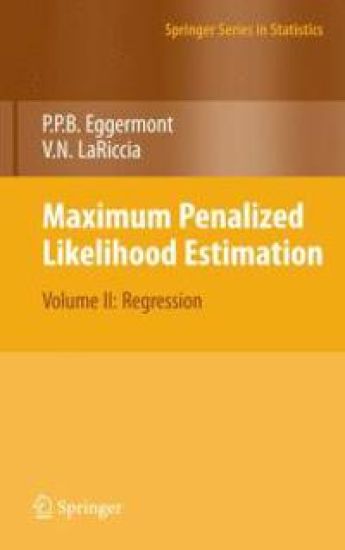
Maximum Penalized Likelihood Estimation

Maximum Penalized Likelihood Estimation

Paul P. Eggermont; Vincent N. LaRiccia

Springer-Verlag New York Inc.
2009
sidottu
This is the second volume of a text on the theory and practice of maximum penalized likelihood estimation. It is intended for graduate students in s- tistics, operationsresearch, andappliedmathematics, aswellasresearchers and practitioners in the ?eld. The present volume was supposed to have a short chapter on nonparametric regression but was intended to deal mainly with inverse problems. However, the chapter on nonparametric regression kept growing to the point where it is now the only topic covered. Perhaps there will be a Volume III. It might even deal with inverse problems. But for now we are happy to have ?nished Volume II. The emphasis in this volume is on smoothing splines of arbitrary order, but other estimators (kernels, local and global polynomials) pass review as well. We study smoothing splines and local polynomials in the context of reproducing kernel Hilbert spaces. The connection between smoothing splines and reproducing kernels is of course well-known. The new twist is thatlettingtheinnerproductdependonthesmoothingparameteropensup new possibilities: It leads to asymptotically equivalent reproducing kernel estimators (without quali?cations) and thence, via uniform error bounds for kernel estimators, to uniform error bounds for smoothing splines and, via strong approximations, to con?dence bands for the unknown regression function. ItcameassomewhatofasurprisethatreproducingkernelHilbert space ideas also proved useful in the study of local polynomial estimators.
Latent Class Analysis of Survey Error

Latent Class Analysis of Survey Error

Paul P. Biemer

John Wiley Sons Inc
2010
sidottu
Combining theoretical, methodological, and practical aspects, Latent Class Analysis of Survey Error successfully guides readers through the accurate interpretation of survey results for quality evaluation and improvement. This book is a comprehensive resource on the key statistical tools and techniques employed during the modeling and estimation of classification errors, featuring a special focus on both latent class analysis (LCA) techniques and models for categorical data from complex sample surveys. Drawing from his extensive experience in the field of survey methodology, the author examines early models for survey measurement error and identifies their similarities and differences as well as their strengths and weaknesses. Subsequent chapters treat topics related to modeling, estimating, and reducing errors in surveys, including: Measurement error modeling forcategorical dataThe Hui-Walter model and othermethods for two indicatorsThe EM algorithm and its role in latentclass model parameter estimationLatent class models for three ormore indicatorsTechniques for interpretation of modelparameter estimatesAdvanced topics in LCA, including sparse data, boundary values, unidentifiability, and local maximaSpecial considerations for analyzing datafrom clustered and unequal probability samples with nonresponseThe current state of LCA and MLCA (multilevel latent class analysis), and an insightful discussion on areas for further research Throughout the book, more than 100 real-world examples describe the presented methods in detail, and readers are guided through the use of lEM software to replicate the presented analyses. Appendices supply a primer on categorical data analysis, and a related Web site houses the lEM software. Extensively class-tested to ensure an accessible presentation, Latent Class Analysis of Survey Error is an excellent book for courses on measurement error and survey methodology at the graduate level. The book also serves as a valuable reference for researchers and practitioners working in business, government, and the social sciences who develop, implement, or evaluate surveys.
Evidence Based Practice Workbook Bridging the Gap Between Health Care Research and Practice 2E with Statistics Workbook Set
The Evidence-based Practice Workbook is an ideal tool for use by GPs, medical specialists and other healthcare professionals to learn the concepts of evidence-based practice (EBP). Practical and interactive, this workbook provides simple methods to help health professionals find and use the best evidence to answer clinical questions, developing their skills in: asking clincal questionssearching for answersdiscriminating good from poor information and researchusing the answers to make clinical decisions This attractive, colour workbook provides a clear explanation of EBP skills and concepts. Written by internationally respected authors, this expanded and updated edition has been developed from evidence-based practice workshops run by the Centre for Evidence-Based Medicine at the University of Queensland and Oxford, and contains information and exercises to help health professionals learn how to use EBP in their clinical practice.
Introduction to Survey Quality

Introduction to Survey Quality

Paul P. Biemer; Lars E. Lyberg

John Wiley Sons Inc
2003
sidottu
The principles and concepts of survey measurement quality Issues of survey quality have become increasingly more prominent in recent years. As more and more professionals who are not necessarily trained as survey researchers take on tasks associated with surveys, the need arises for a grounded, basic introduction to current survey methods and quality issues associated with them. Introduction to Survey Quality summarizes the history of survey research and outlines the essential concepts for data quality. With an emphasis on total survey error, authors Paul Biemer and Lars Lyberg review well-established, as well as recently developed principles and concepts in the field, and examine important issues that are still unresolved and being actively pursued in the current survey methods literature. Spanning a range of topics dealing with the quality of data collected through the survey process, they focus on such key issues as: *Major sources of survey error, examining the origins of each error source and the most successful methods for reducing errors from those sources *Methods most often used in practice for evaluating the effects of the source on total survey error *Implications of improving survey quality for organizational management and cost Introduction to Survey Quality is written for a broad audience that includes experienced survey researchers who would benefit from a better understanding of survey data quality as well as others with little or no prior training in survey methods. It is both a useful road map to the issues of survey measurement encountered in survey work and an essential guide to practical methods for improving the quality of survey data.