Kirjojen hintavertailu. Mukana 11 244 527 kirjaa ja 12 kauppaa.

Kirjahaku

Etsi kirjoja tekijän nimen, kirjan nimen tai ISBN:n perusteella.

1000 tulosta hakusanalla Paul Wilmott

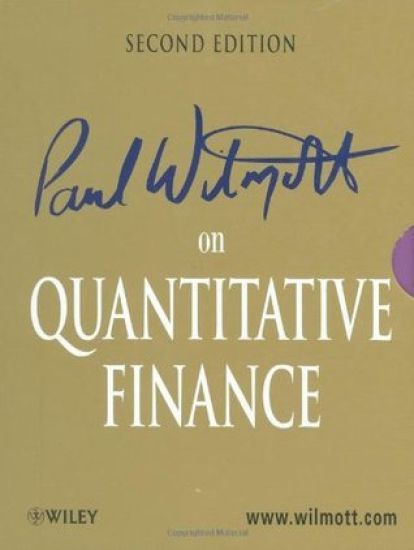
Paul Wilmott on Quantitative Finance, 3 Volume Set
Paul Wilmott on Quantitative Finance, Second Edition provides a thoroughly updated look at derivatives and financial engineering, published in three volumes with additional CD-ROM. Volume 1: Mathematical and Financial Foundations; Basic Theory of Derivatives; Risk and Return. The reader is introduced to the fundamental mathematical tools and financial concepts needed to understand quantitative finance, portfolio management and derivatives. Parallels are drawn between the respectable world of investing and the not-so-respectable world of gambling. Volume 2: Exotic Contracts and Path Dependency; Fixed Income Modeling and Derivatives; Credit Risk In this volume the reader sees further applications of stochastic mathematics to new financial problems and different markets. Volume 3: Advanced Topics; Numerical Methods and Programs. In this volume the reader enters territory rarely seen in textbooks, the cutting-edge research. Numerical methods are also introduced so that the models can now all be accurately and quickly solved. Throughout the volumes, the author has included numerous Bloomberg screen dumps to illustrate in real terms the points he raises, together with essential Visual Basic code, spreadsheet explanations of the models, the reproduction of term sheets and option classification tables. In addition to the practical orientation of the book the author himself also appears throughout the book—in cartoon form, readers will be relieved to hear—to personally highlight and explain the key sections and issues discussed. Note: CD-ROM/DVD and other supplementary materials are not included as part of eBook file.
Paul Wilmott Introduces Quantitative Finance
Paul Wilmott Introduces Quantitative Finance, Second Edition is an accessible introduction to the classical side of quantitative finance specifically for university students. Adapted from the comprehensive, even epic, works Derivatives and Paul Wilmott on Quantitative Finance, Second Edition, it includes carefully selected chapters to give the student a thorough understanding of futures, options and numerical methods. Software is included to help visualize the most important ideas and to show how techniques are implemented in practice. There are comprehensive end-of-chapter exercises to test students on their understanding.
WILMOTT's Greatest Hits – Past, present and new directions in risk and quantitative finance
This book celebrates the last 10 years of WILMOTT magazine and features articles carefully selected by Paul Wilmot that are topical and reflect the latest developments in Quantitative Finance. Paul Wilmott introduces key subject areas and sections and places them in context.The book includes introductions by Paul Wilmott as well as photo's and bio's of the regular contributors. An introduction by the Editor of WILMOTT magazine, Dan Tudball who will discuss Cover Stories throughout the last 10 years. WILMOTT Magazine artist Liam Larkin discusses his rationale and inspiration for the covers.Independent, controversial and exciting, WILMOTT magazine is a valuable collection of papers, reports, and articles. Paul Wilmott and his team of expert contributors provide a unique mix of complex content and humor to inform and entertain analysts and academics alike.WILMOTT magazine has an unrivalled stable of regular contributors and columns that will be featured in the book, such as Paul Wilmott, Emanuel Derman, Yuri Rojek, Dan Tudball, Ed Thorp, Pat Hagan, JP Bouchaud, Hyungsok Ahn, Peter Jaeckel, Elie Ayache, Wim Schoutens, Daniel Duffy, Ilya Sobol', Rudi Bogni and Nassim Taleb.For over 10 years, WILMOTT Magazine has been the indispensable resource for finance professionals, keeping them up to date with quantitative analysis, the institutions, and the people who make it happen.
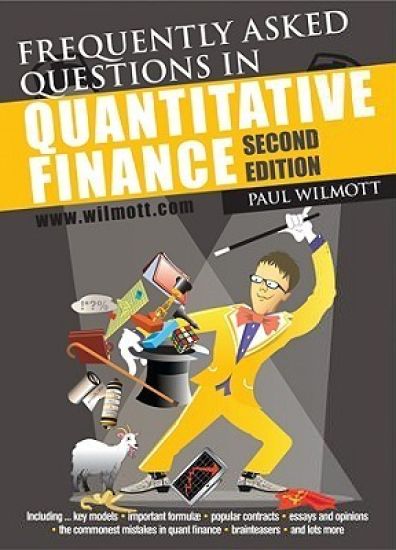
Frequently Asked Questions in Quantitative Finance
Getting agreement between finance theory and finance practice is important like never before. In the last decade the derivatives business has grown to a staggering size, such that the outstanding notional of all contracts is now many multiples of the underlying world economy. No longer are derivatives for helping people control and manage their financial risks from other business and industries, no, it seems that the people are toiling away in the fields to keep the derivatives market afloat! (Apologies for the mixed metaphor!) If you work in derivatives, risk, development, trading, etc. you'd better know what you are doing, there's now a big responsibility on your shoulders. In this second edition of Frequently Asked Questions in Quantitative Finance I continue in my mission to pull quant finance up from the dumbed-down depths, and to drag it back down to earth from the super-sophisticated stratosphere. Readers of my work and blogs will know that I think both extremes are dangerous. Quant finance should inhabit the middle ground, the mathematics sweet spot, where the models are robust and understandable, and easy to mend. …And that's what this book is about. This book contains important FAQs and answers that cover both theory and practice. There are sections on how to derive Black-Scholes (a dozen different ways!), the popular models, equations, formulae and probability distributions, critical essays, brainteasers, and the commonest quant mistakes. The quant mistakes section alone is worth trillions of dollars! I hope you enjoy this book, and that it shows you how interesting this important subject can be. And I hope you'll join me and others in this industry on the discussion forum on wilmott.com. See you there!” FAQQF2...including key models, important formulae, popular contracts, essays and opinions, a history of quantitative finance, sundry lists, the commonest mistakes in quant finance, brainteasers, plenty of straight-talking, the Modellers' Manifesto and lots more.
The Mathematics of Artificial Intelligence for High Schoolers
This is the book that introduces schoolchildren to the mathematics behind Artificial Intelligence There are books with no mathematics, just the description of what AI can do. Then there are books with no mathematics, just lots of computer code. And there are books with lots and lots of mathematics which are incomprehensible without a degree in mathematics.But there aren't books like this one This book is for children who are confident in their mathematics. They do not have to be advanced or even top of their class. But they do have to be comfortable with learning new concepts. Here are some of those concepts, and how simple they are.Representing data as a vector: A list of numbers, don't be fooled by the big parentheses Scaling the data: Taking away and multiplying. That was easy Distance measurement: Taking away and adding up. Squaring and square rooting if you are feeling really adventurous Charts: Putting dots on a piece of graph paper Exhausted, not The equation of a straight line: y = ax+b. You can do it Averages: Adding up and dividing. You know how to divide, don't you, Steve?Yes, it's mathematics, but nothing to frighten the horses The book starts with a chapter with some history of AI. This is followed by a chapter of jargon, useful mathematics, and a description of the main techniques. Then it's one chapter on each of Nearest Neighbours, Regression, Clustering, Decision Trees, Neural Networks and Reinforcement Learning. Each of these in-depth chapters covers uses of the technique, the mathematical details, a real example and then a project for readers to work through on their own or in teams. The book ends with sources for some useful data.
The Mathematics of Finance for High Schoolers

The Mathematics of Finance for High Schoolers

Paul Wilmott

Panda Ohana Publishing
2023
pokkari
It's never too early to start learning about finance. But the mathematics covered in this book is not the mathematics of balancing your check book, or splitting a restaurant bill among friends, some of whom had the set menu, and others the specials. The mathematics here is an introduction to the subject known as mathematical finance, quantitative finance or financial engineering. It's an introduction to the higher level of mathematics used in banks and hedge funds, in valuing complex financial instruments, in allocating money to different assets, and in measuring and managing risk.This book is for high-school children who are confident in their mathematics. They do not have to be advanced or even top of their class. But they do have to be comfortable with learning new concepts.The book starts with a chapter on the history of money, banks, bubbles and crashes. Then there's the jargon. Bankers do like their jargon, but it's all very straightforward. Then there's a chapter on careers in finance. There are jobs that just require familiarity with spreadsheets, then there are jobs that require a degree in mathematics or computer science. A chapter on the basic mathematics is next. That's a little bit, but only a little bit, about the exponential function, logarithms and simple ideas in probability. The last four chapters are on fixed income (that's just putting money in the bank), shares, portfolios, and finally the financial instruments known as options.
The Money Formula

The Money Formula

Paul Wilmott; David Orrell

John Wiley Sons Inc
2017
nidottu
Explore the deadly elegance of finance's hidden powerhouse The Money Formula takes you inside the engine room of the global economy to explore the little-understood world of quantitative finance, and show how the future of our economy rests on the backs of this all-but-impenetrable industry. Written not from a post-crisis perspective – but from a preventative point of view – this book traces the development of financial derivatives from bonds to credit default swaps, and shows how mathematical formulas went beyond pricing to expand their use to the point where they dwarfed the real economy. You'll learn how the deadly allure of their ice-cold beauty has misled generations of economists and investors, and how continued reliance on these formulas can either assist future economic development, or send the global economy into the financial equivalent of a cardiac arrest. Rather than rehash tales of post-crisis fallout, this book focuses on preventing the next one. By exploring the heart of the shadow economy, you'll be better prepared to ride the rough waves of finance into the turbulent future. Delve into one of the world's least-understood but highest-impact industriesUnderstand the key principles of quantitative finance and the evolution of the fieldLearn what quantitative finance has become, and how it affects us allDiscover how the industry's next steps dictate the economy's future How do you create a quadrillion dollars out of nothing, blow it away and leave a hole so large that even years of "quantitative easing" can't fill it – and then go back to doing the same thing? Even amidst global recovery, the financial system still has the potential to seize up at any moment. The Money Formula explores the how and why of financial disaster, what must happen to prevent the next one.
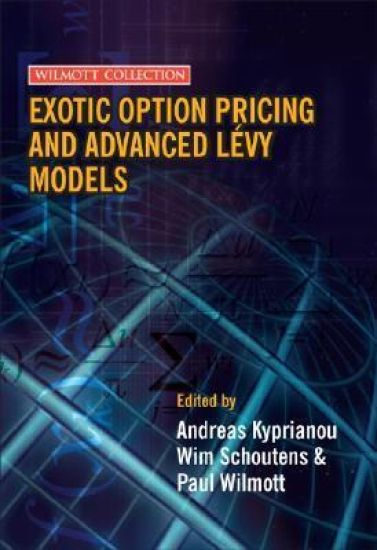
Exotic Option Pricing and Advanced Lévy Models

Exotic Option Pricing and Advanced Lévy Models

Andreas Kyprianou; Wim Schoutens; Paul Wilmott

John Wiley Sons Inc
2005
sidottu
Since around the turn of the millennium there has been a general acceptance that one of the more practical improvements one may make in the light of the shortfalls of the classical Black-Scholes model is to replace the underlying source of randomness, a Brownian motion, by a Lévy process. Working with Lévy processes allows one to capture desirable distributional characteristics in the stock returns. In addition, recent work on Lévy processes has led to the understanding of many probabilistic and analytical properties, which make the processes attractive as mathematical tools. At the same time, exotic derivatives are gaining increasing importance as financial instruments and are traded nowadays in large quantities in OTC markets. The current volume is a compendium of chapters, each of which consists of discursive review and recent research on the topic of exotic option pricing and advanced Lévy markets, written by leading scientists in this field. In recent years, Lévy processes have leapt to the fore as a tractable mechanism for modeling asset returns. Exotic option values are especially sensitive to an accurate portrayal of these dynamics. This comprehensive volume provides a valuable service for financial researchers everywhere by assembling key contributions from the world's leading researchers in the field. Peter Carr, Head of Quantitative Finance, Bloomberg LP. This book provides a front-row seat to the hottest new field in modern finance: options pricing in turbulent markets. The old models have failed, as many a professional investor can sadly attest. So many of the brightest minds in mathematical finance across the globe are now in search of new, more accurate models. Here, in one volume, is a comprehensive selection of this cutting-edge research. Richard L. Hudson, former Managing Editor of The Wall Street Journal Europe, and co-author with Benoit B. Mandelbrot of The (Mis)Behaviour of Markets: A Fractal View of Risk, Ruin and Reward
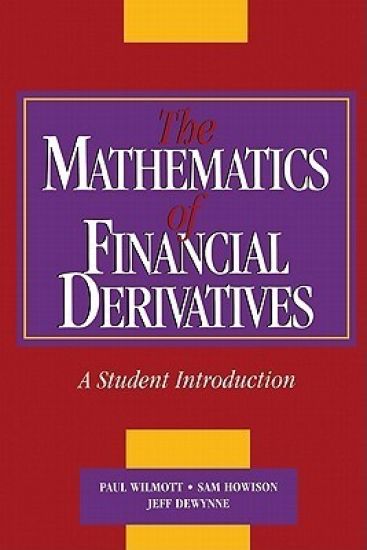
The Mathematics of Financial Derivatives

The Mathematics of Financial Derivatives

Wilmott Paul; Howison Sam; Dewynne Jeff

Cambridge University Press
1995
pokkari
Finance is one of the fastest growing areas in the modern banking and corporate world. This, together with the sophistication of modern financial products, provides a rapidly growing impetus for new mathematical models and modern mathematical methods; the area is an expanding source for novel and relevant ‘real-world’ mathematics. In this book the authors describe the modelling of financial derivative products from an applied mathematician’s viewpoint, from modelling through analysis to elementary computation. A unified approach to modelling derivative products as partial differential equations is presented, using numerical solutions where appropriate. Some mathematics is assumed, but clear explanations are provided for material beyond elementary calculus, probability, and algebra. Over 140 exercises are included. This volume will become the standard introduction to this exciting new field for advanced undergraduate students.
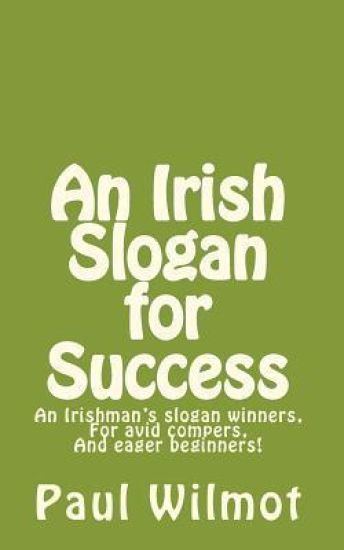
An Irish Slogan for Success!: An Irishman's Slogan Winners, for Avid Compers and Eager Beginners!
They talk about the luck of the Irish. Well Paul Wilmot, author of "An Irish Slogan for Success" has been labelled lucky many times. But Paul believes there is more to winning than just being lucky. Everybody wants to be a winner, and when it comes to competitions, Paul has found a formula for success. Good, creative slogan writing can help you capture some of the thousands of amazing competition prizes that are on offer around the world and on the internet. Having won fantastic prizes such as a Landrover 4x4 Special Edition Tomb Raider, which was presented to Paul and his wife after an Adventure Day four-wheel driving experience, Paul knows what it feels like to receive that winning call, that knock on the door from the postman declaring you a winner A fantastic cruise to the Carribean with one of the major cruise operators in the world, a BMW car, a top spec television, bicycles, sports equipment - the list of prizes to come his way just goes on. Paul has great experience writing winning slogans and wants to share some of them with other keen compers so they too, can glean inspiration and motivation to help in their own slogan-writing. In this book you will be able to get ideas and see which slogans actually won Paul major prizes. Very often the key to success is multiple entries, if the competition rules allow. Of course it takes a lot of time and effort but if the prize is a big one, it is usually worth it. Paul often pens 20-30 slogans for one competition, looking at every possible angle from the company and brand's perspective, striving to find the combination of words they want to hear. Enjoy reading over the endless rhymes and poetic lines of slogan writing which have made a vast difference to Paul and his family's lives. You too can be a winner Not by being lucky, but by using skill and imagination, writing slogans that capture the judge's attention, leading to that magical phone call or letter, letting you know you have won a major prize
John Wilmot: Comte de Rochester

John Wilmot: Comte de Rochester

Paul-Émile Daurand-Forgues

Createspace Independent Publishing Platform
2017
nidottu
" En 1657, trois ann es avant la restauration des Stuarts et Cromwell se mourant d j , les habitants de la petite ville de Spilsby, comt d'Oxford, virent avec quelque surprise un char fun bre traverser inopin ment leur cit . Aucune pompe, aucune escorte, point de flambeaux, point de draperies aux larmes d'argent; peine avait-on permis que des armoiries bien connues dans le pays d corassent le cercueil, que deux chevaux noirs tra naient vers l' glise. Un messager du parlement, charg de veiller l'ex cution du bill en vertu duquel les obs ques avaient lieu avec cette simplicit inusit e, pr c dait, en grand deuil et arm de la petite verge noire, insigne redout du pouvoir que sa mission lui conf rait, le char solitaire. Dans la chapelle, interdite au public, une femme, un enfant, quelques serviteurs l'attendaient au pied d'un autel o un ministre, rev tu de son costume ordinaire, s'appr tait officier. Les pri res d'usage furent r cit es sans musique, sans c r monies d'aucune sorte, comme s'il se f t agi du plus simple bourgeois de l'humble petite ville, apr s quoi la bi re fut d pos e dans le caveau de famille, et chacun se retira. Le messager ne partit qu'apr s le dernier des assistants; il avait s'assurer jusqu'au bout que la volont du parlement n'avait rencontr aucun obstacle..."
Paul

Paul

E. P. Sanders

Oxford University Press
2001
nidottu
Paul is the most powerful human personality in the history of the Church. A missionary, theologian, and religious genius, in his epistles he laid the foundations on which later Christian theology was built. In his highly original introduction to Paul's life and thought, E. P. Sanders, whose research on Paul has substantially influenced recent scholarship, pays equal attention to Paul's fundamental convictions and the sometimes convoluted ways in which they were worked out. ABOUT THE SERIES: The Very Short Introductions series from Oxford University Press contains hundreds of titles in almost every subject area. These pocket-sized books are the perfect way to get ahead in a new subject quickly. Our expert authors combine facts, analysis, perspective, new ideas, and enthusiasm to make interesting and challenging topics highly readable.
Paul

Paul

Jerome Murphy-O'Connor

Oxford University Press
2004
sidottu
For someone who has exercised such a profound influence on Christian theology, Paul remains a shadowy figure behind the barrier of his complicated and difficult biblical letters. Debates about his meaning have deflected attention from his personality, yet his personality is an important key to understanding his theological ideas. This book redresses the balance. Jerome Murphy-O'Connor's disciplined imagination, nourished by a lifetime of research, shapes numerous textual, historical, and archaeological details into a colourful and enjoyable story of which Paul is the flawed but undefeated hero. This chronological narrative offers new insights into Paul's intellectual, emotional, and religious development and puts his travels, mission, and theological ideas into a plausible biographical context. As he changes from an assimilated Jewish teenager in Tarsus to a competitive Pharisee in Jerusalem and then to a driven missionary of Christ, the sometimes contradictory components of Paul's complex personality emerge from the way he interacts with people and problems. His theology was forged in dialogue and becomes more intelligible as our appreciation of his person deepens. In Jerome Murphy-O'Connor's engaging biography, the Apostle comes to life as a complex, intensely human individual.
Paul

Paul

Jerome Murphy-O'Connor

Oxford University Press
2005
nidottu
For someone who has exercised such a profound influence on Christian theology, Paul remains a shadowy figure behind the barrier of his complicated and difficult biblical letters. Debates about his meaning have deflected attention from his personality, yet his personality is an important key to understanding his theological ideas. This book redresses the balance. Jerome Murphy-O'Connor's disciplined imagination, nourished by a lifetime of research, shapes numerous textual, historical, and archaeological details into a colourful and enjoyable story of which Paul is the flawed but undefeated hero. This chronological narrative offers new insights into Paul's intellectual, emotional, and religious development and puts his travels, mission, and theological ideas into a plausible biographical context. As he changes from an assimilated Jewish teenager in Tarsus to a competitive Pharisee in Jerusalem and then to a driven missionary of Christ, the sometimes contradictory components of Paul's complex personality emerge from the way he interacts with people and problems. His theology was forged in dialogue and becomes more intelligible as our appreciation of his person deepens. In Jerome Murphy-O'Connor's engaging biography, the Apostle comes to life as a complex, intensely human individual.
Paul

Paul

H.J. Schoeps

James Clarke Co Ltd
2003
nidottu
This study of the Apostle to the Gentiles combines scholarship with an unusual approach. Schoeps interprets Paul's theology in the light of his Jewish background, which coloured and conditioned his Christological teaching.
Paul

Paul

H.J. Schoeps

James Clarke Co Ltd
2002
sidottu
Since its first publication in German in 1959, Paul has been hailed as a major study of the apostle to the Gentiles, combining exceptional scholarship with an unusual approach. Schoeps interprets Paul's theology in the light of his Jewish background, which coloured and conditioned his Christological teaching. Paul's conception of Jesus differs from that of the Synoptics: what and how extensive the difference is and whence it is derived are among the questions Schoeps examines. After surveying major problems in Pauline research, the Author relates the apostle to primitive Christianity, discussing his eschatology and his teachings on salvation, the law, and saving history. The final chapter shows that Paul's distinctive doctrines result from two converging factors: that Paul never saw Jesus in the flesh, and the influence of Jewish teaching. The consequence was his concern with the resurrected Saviour of the world, the pre-existent and eternal Son of God. Schoeps shows that Paul betrayed a fundamental misconception of the law and the covenantal agreement between God and his chosen people. The result is a thought-provoking, and somewhat startling, study of the first, the greatest, and the most difficult of all Christian theologians.