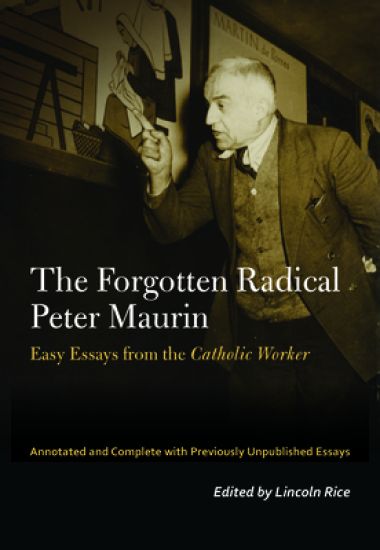
The definitive edition of Catholic Worker cofounder Peter Maurin's Easy Essays, including 74 previously unpublished works Although Peter Maurin is well known among people connected to the Catholic Worker movement, his Catholic Worker co-founder and mentee Dorothy Day largely overshadowed him. Maurin was never the charismatic leader that Day was, and some Workers found his idiosyncrasies challenging. Reticent to write or even speak much about his personal life, Maurin preferred to present his beliefs and ideas in the form of Easy Essays, published in the New York Catholic Worker. Featuring 482 of his essays, as well as 87 previously unpublished ones, this text offers a great contribution to the corpus of twentieth-century Catholic life. At first glance, Maurin’s Easy Essays appear overly simplistic and preposterous. But upon further investigation, his essays are much more complex and nuanced. Packed with demanding ideas meant to convey dense information and encourage the listener to ponder different ways to understand and interact with reality, his short poetic phrases became his modus operandi for communicating his vision and became a hallmark of his public theology. Each essay contained anywhere from one to ten or more stanzas and were part of a larger arrangement, often titled. Within the larger arrangements were individual essays, which were also titled and arranged in such a manner as to support the overall thesis. Many individual essays were later repeated in slightly altered forms in new arrangements. Previous arrangements were also repeated that omitted or added an essay. Providing scholarly and contextual information for the modern reader, this annotated collection includes more than 350 footnotes which offer a layer of intelligibility that explains Maurin’s use of obscure references to historical people and events that would have been common knowledge for readers during the 1930s. When appropriate, the footnotes explain why Maurin chose to cite a person or event. A scholarly Introduction offers a robust synthesis of contemporary scholarship on Maurin and the Catholic Worker that considers radical Catholicism and questions regarding race, ethnicity, religious difference, and gender, because many of Maurin’s essays take up these themes. This book shapes the ways Maurin is read in the present day and the ways leftist Catholicism is understood as part of twentieth-century history.
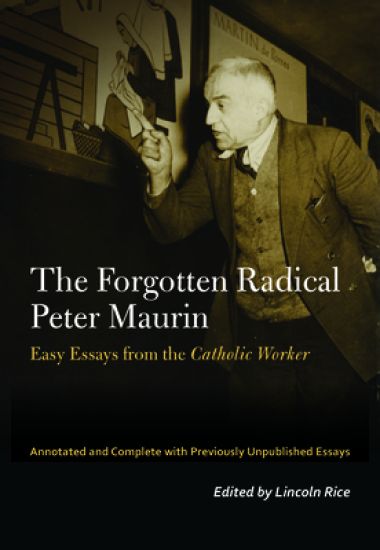
The definitive edition of Catholic Worker cofounder Peter Maurin's Easy Essays, including 74 previously unpublished works Although Peter Maurin is well known among people connected to the Catholic Worker movement, his Catholic Worker co-founder and mentee Dorothy Day largely overshadowed him. Maurin was never the charismatic leader that Day was, and some Workers found his idiosyncrasies challenging. Reticent to write or even speak much about his personal life, Maurin preferred to present his beliefs and ideas in the form of Easy Essays, published in the New York Catholic Worker. Featuring 482 of his essays, as well as 87 previously unpublished ones, this text offers a great contribution to the corpus of twentieth-century Catholic life. At first glance, Maurin's Easy Essays appear overly simplistic and preposterous. But upon further investigation, his essays are much more complex and nuanced. Packed with demanding ideas meant to convey dense information and encourage the listener to ponder different ways to understand and interact with reality, his short poetic phrases became his modus operandi for communicating his vision and became a hallmark of his public theology. Each essay contained anywhere from one to ten or more stanzas and were part of a larger arrangement, often titled. Within the larger arrangements were individual essays, which were also titled and arranged in such a manner as to support the overall thesis. Many individual essays were later repeated in slightly altered forms in new arrangements. Previous arrangements were also repeated that omitted or added an essay. Providing scholarly and contextual information for the modern reader, this annotated collection includes more than 350 footnotes which offer a layer of intelligibility that explains Maurin's use of obscure references to historical people and events that would have been common knowledge for readers during the 1930s. When appropriate, the footnotes explain why Maurin chose to cite a person or event. A scholarly Introduction offers a robust synthesis of contemporary scholarship on Maurin and the Catholic Worker that considers radical Catholicism and questions regarding race, ethnicity, religious difference, and gender, because many of Maurin's essays take up these themes. This book shapes the ways Maurin is read in the present day and the ways leftist Catholicism is understood as part of twentieth-century history.
Magnus Levinsson; Lill Langelotz; Malin Löfstedt; Johan Alvehus; Helen Asklund; Ann-Sofie Axelsson; Linda Barman; Gunnar Berg; Urban Carlén; Martin G Erikson; Martin Karlberg; Olle Larsson; Maria Lindh; Elisabeth Långström; Hanna Maurin Söderholm; Giulia Messina Dahlberg; Olle Nordberg; Sepideh Olausson; Susanne Olsson; Torsten Pettersson; Emin Poljarevic; Peter Reinholdsson; Erika Sandström; Ulrike Schnaas; Susanne Strömberg Jämsvi; Ulrika Svalfors; Cecilia Trenter; Henrik Viberg; Tomas Wahnström; Christer Wede
Kollegiala samtal är ett viktigt verktyg för att stärka kvaliteten och utveckla undervisningen. Ändå är sådana diskussioner fortfarande sällsynta inom högre utbildning. Den här boken presenterar en modell för kollegiala samtal - så kallade didaktiska utvecklingsdialoger - med utgångspunkt i autentiska undervisningssituationer, hämtade från universitetslärares vardagsarbete inom olika utbildningar. Exempel på teman som belyses och diskuteras i boken är: utmaningen i att behandla ett omfattande ämnesinnehåll på få undervisningstimmar; lärstrukturer för distansstudenter; studenters negativa attityder till ett visst ämnesinnehåll; och relationen mellan vardagsföreställningar och teoretiskt grundad begreppsförståelse. Varje tema illustreras genom reflektion i flera steg, i en dialog mellan universitetslärare, forskare och pedagogiska utvecklare från olika lärosäten runt om i Sverige. Didaktisk dialog i högre utbildning är lämplig som litteratur på högskolepedagogiska kurser, och riktar sig också till enskilda universitetslärare och lärarlag som vill utveckla sin undervisning. Förhoppningen är att dialogerna ska ge inspiration och utmana, och också fungera som modell för samtal om undervisning och om det akademiska lärarskapets komplexitet.
This book carries an ethnographic signature in approach and style, and is an examination of a small Brooklyn, New York, African-American, Pentecostal church congregation and is based on ethnographic notes taken over the course of four years. The Pentecostal Church is known to outsiders almost exclusively for its members’ “bizarre” habit of speaking in tongues. This ethnography, however, puts those outsiders inside the church pews, as it paints a portrait of piety, compassion, caring, love—all embraced through an embodiment perspective, as the church’s members experience these forces in the most personal ways through religious conversion. Central themes include concerns with the notion of “spectacle” because of the grand bodily display that is highlighted by spiritual struggle, social aspiration, punishment and spontaneous explosions of a variety of emotions in the public sphere. The approach to sociology throughout this work incorporates the striking dialectic of history and biography to penetrate and interact with religiously inspired residents of the inner-city in a quest to make sense both empirically and theoretically of this rapidly changing, surprising and highly contradictory late-modern church scene. The focus on the individual process of becoming Pentecostal provides a road map into the church and canvasses an intimate view into the lives of its members, capturing their stories as they proceed in their Pentecostal careers. This book challenges important sociological concepts like crisis to explain religious seekership and conversion, while developing new concepts such as “God Hunting” and “Holy Ghost Capital” to explain the process through which individuals become tongue-speaking Pentecostals. Church members acquire “Holy Ghost Capital” and construct a Pentecostal identity through a relationship narrative to establish personal status and power through conflicting tongue-speaking ideas. Finally, this book examines the futures of the small and large, institutionally affiliated Pentecostal Church and argues that the small Pentecostal Church is better able to resist modern rationalizing forces, retaining the charisma that sparked the initial religious movement. The power of charisma in the small church has far-reaching consequences and implications for the future of Pentecostalism and its followers.
Peter Marinello was the footballing sensation of 1970. His record £100,000 transfer from Hibs to Arsenal made front page headlines and he was instantly hailed as the new George Best. Within weeks, he had appeared on Top of the Pops, secured a modelling contract and had his own football column in the Daily Express. But drinking and reckless behaviour were already a part of his life. In three years at Arsenal, Marinello played only 51 games and was eventually transferred to Portsmouth. More drinking, involvement with gangsters, his wife running off with a DJ, swindled out of all his money, bankruptcy, being arrested for attempted murder, having to buy heroin for his addicted son... From the highs, Peter Marinello's life plummeted to terrible lows until he pulled his life back round. It is an extraordinary story.
Relying on intense ethnographic research and extensive experiences teaching human rights policing to police officers, this book teaches law enforcement professionals how to apply human rights to their everyday interactions with community members. The data collected throughout this research process offers the reader first-hand accounts of police officers addressing the most important human rights as they relate to policing, telling stories of using their human agency while on the job, and providing insights into their discussions with community members on human rights, among other important topics. Human rights remain a relatively new concept in human civilization, but one largely unrealized at this point in history. Can police officers serve as the harbingers of human rights in a world that desperately needs it? We say yes. It starts with applying human rights to police work. But this book does more than teach police officers how to apply human rights to their careers. It reimagines the institution of law enforcement as we push toward the later stages of modernity. Refusing to tell readers what to think, this book provides the intellectual tools on how to think about policing in new and creative ways. It seeks to bring out the readers’ full creative potential as law enforcement agents, police officers, and criminal justice professionals and activists.This book advances new ideas throughout each chapter on how to make human rights policing a reality. The ideas in each chapter build on each other, offering a small piece of the puzzle and all the steps necessary to advance the goals of human rights policing. The book (1) analyzes the United Nations Declaration of Human Rights and how it applies to policing, (2) develops a three-fold typology called “Human Rights Policing Social Interactions,” (3) discusses the relationship between the use of power and human rights, (4) explains the power of human agency to transcend the ordinary, (5) uncovers the creation of folk devils that threaten human rights, (6) describes how to use the sociological imagination to understand community members, (7) reveals the importance of storytelling to see the world from the actor’s point of view, (8) discusses the double consciousness and the creation of the “other,” (9) describes what we call “soulful policing” and engaging with the community— Chicago style, and (10) provides social policy suggestions at both the national level and local policing level.This book will challenge the reader in fascinating and highly surprising ways to think about, and, further, to reimagine policing as we push toward the future. It will appeal to professionals at all levels of law enforcement, and will be useful in programs offering degrees and/or certificates to students of criminal justice.
Focusing on ten islands through the Caribbean, this ethnography examines how charismatic religious leaders develop creative transnational religious networking strategies that help spread the movement and increase its potential to become a greater force in shaping the future in the English-speaking Caribbean. The large and explosive global Charismatic movement spread in powerful ways in the small and tranquil English-speaking Caribbean. It is here in the deep Caribbean world of demonic possessions, spiritual demons, and supernatural healers where the Charismatic movement continues to shape a resilient culture. Placing the Charismatic movement in the realm of culture provides some highly surprising findings that reveal the potential of a religious movement and its ability for change in a late-modern social world.
This book carries an ethnographic signature in approach and style, and is an examination of a small Brooklyn, New York, African-American, Pentecostal church congregation and is based on ethnographic notes taken over the course of four years. The Pentecostal Church is known to outsiders almost exclusively for its members’ “bizarre” habit of speaking in tongues. This ethnography, however, puts those outsiders inside the church pews, as it paints a portrait of piety, compassion, caring, love—all embraced through an embodiment perspective, as the church’s members experience these forces in the most personal ways through religious conversion. Central themes include concerns with the notion of “spectacle” because of the grand bodily display that is highlighted by spiritual struggle, social aspiration, punishment and spontaneous explosions of a variety of emotions in the public sphere. The approach to sociology throughout this work incorporates the striking dialectic of history and biography to penetrate and interact with religiously inspired residents of the inner-city in a quest to make sense both empirically and theoretically of this rapidly changing, surprising and highly contradictory late-modern church scene. The focus on the individual process of becoming Pentecostal provides a road map into the church and canvasses an intimate view into the lives of its members, capturing their stories as they proceed in their Pentecostal careers. This book challenges important sociological concepts like crisis to explain religious seekership and conversion, while developing new concepts such as “God Hunting” and “Holy Ghost Capital” to explain the process through which individuals become tongue-speaking Pentecostals. Church members acquire “Holy Ghost Capital” and construct a Pentecostal identity through a relationship narrative to establish personal status and power through conflicting tongue-speaking ideas. Finally, this book examines the futures of the small and large, institutionally affiliated Pentecostal Church and argues that the small Pentecostal Church is better able to resist modern rationalizing forces, retaining the charisma that sparked the initial religious movement. The power of charisma in the small church has far-reaching consequences and implications for the future of Pentecostalism and its followers.
Sex, Drugs, and JazzPeter Marin sings the standards in the Great American Songbook with the verve and depth of a jazz singer who was good enough to begin working Los Angeles-area nightclubs professionally as a teen. A prot g of the late, great Andy Williams, Marin was likewise schooled by the legendary Johnny Prophet.By age 52 he had his share of fame, heart breaks and financial ups and downs. His life in show business was pressure filled yet intoxicating. Glamour, sex and drugs were daily happenings. Celebrities, producers, con-men and gangsters were his clients and friends.And then one day, out of the blue, it all came crashing down.The years of fame and constantly being expected to be "On" and hide his troubles behind practiced smiles became too much. At age 53, Peter Marin suddenly lost his memory. He was a hollow shell. Hollywood Entrepreneur: Behind Practiced Smiles is a first-person account of Peter's path as a well-connected street-smart entrepreneur to his devastating breakdown and dramatic rebound. And, oh, the stories he has to tell If you want a light, fluffy read this isn't the book for you. But if you're ready to be entertained by a story that is as raw as it is real, order your copy of Hollywood Entrepreneur: Behind Practiced Smiles today.
"Saint Peter is a Marine" recounts the exploits and activities of Greensboro, North Carolina Marine Corps League Detachment 260, The Fighting 260th, from its earliest days when founding members Bill Moss and Ginny Bull - both still active in the detachment - performed their initial outreach to the community, to the present. In the decades since its founding the detachment has grown exponentially, adding members, activities ranging from rifle and pistol shooting to charitable fund-raising, conceiving and overseeing construction of the Carolina Field of Honor, and greatly expanding the detachment's influence in the community. As the detachment enters its second half-century, legions of new members have come aboard to continue the work of their predecessors. This book provides a solid foundation of knowledge and inspiration, and offers a genuine opportunity for the next generation to pick up the mantel and continue the traditions of the United States Marine Corps. Semper Fidelis
Peter Fisher's Odyssey: Marine Mammal WarfareThis is a story of marine mammal warfare involving the development and deployment of dolphins and whales as open ocean weaponry platforms created and utilized by the CIA for separate, but interrelated, missions against China, Cuba, and Russia. These marine mammal platforms are capable of delivering weapons of mass destruction into any of the world's harbors or open ocean locales.The story's significance lies in its scientific secrecy and political intrigue relative to the self-proclaimed omnipotence of those who control the development and operational use of such weaponry. The CIA's dolphin and whale weaponry bears a significant relationship to their development and deployment of drones; they are the drone's underwater counterpart.Peter's story transports its reader into the unique underwater Atlantis of dolphins and whales (70% of the earth's surface) as the opposing marine mammal weapon systems of the CIA and the Chinese attempt to resolve political differences and confusions by killing one another.The story unfurls around the CIA's determination that the Chinese are developing Pilot Whales for use in anti-submarine warfare, and to also make the technology available (capable of delivering weapons of mass destruction) to Islamic extremists so they, and not China, will become America's prime adversary. This would leave China to be the mediator, benefactor, and the moving force in reconciling the world's priorities and their assumption of world leadership. The CIA's strategy is to stop the Chinese development of marine mammal weaponry dead in its tracks. This causes Hamilton (an Assistant Director of the CIA) to send a CIA armada of biological weaponry to confront and battle the Chinese systems in the Yellow Sea of China. The CIA's development of its marine mammal weaponry, the Operant conditioning (training) of their animals, and the technical capacities implicit to their remote control over long open ocean transits, has implications that go beyond the obvious. The capacities of the CIA's animals are compared to the achievements of the Pavlovian conditioning of the Chinese whales. Therefore, the battle that takes place in the primordial womb of Mother Ocean between the American and Chinese marine mammal systems becomes a battle to the death between opposing theories of behavior and political philosophy. The significance of this showdown lies in which theory prevails and why? Peter Fisher's Odyssey is presented as a carefully drawn parallel to Melville's Moby Dick. Peter, like Ishmael, the only survivor to step forth from the whaling ship Pequod, also becomes a lone survivor. However, Peter, unlike Ishmael, is not just a passive observer and crewmember of the Pequod, but of the marine mammal control vessel, Rachel, and he, rather than being a passive observer, is Ahab's (the CIA's) unwitting alter ego. The story is symbolic of the madness of Ahab, while the implicit evilness of the Great White Whale becomes the inherent failure of civilization and theology.Peter's story, as told, is fiction, but the use and development of such systems by the CIA is real and may have even greater humanistic, scientific, and philosophic significance, for "truth is invariably stranger than fiction." Certainly, the reader's understanding of the Ocean People (dolphins and whales), will, by the advent of Hamilton's Grand Armada, have obtained an appreciation of the biological and scientific significance of these extraordinary animals - an understanding that will both surprise and challenge key beliefs, following a read which will have been as fascinating as it is politically and psychologically enlightening.