Kirjojen hintavertailu. Mukana 11 213 693 kirjaa ja 11 kauppaa.

Kirjahaku

Etsi kirjoja tekijän nimen, kirjan nimen tai ISBN:n perusteella.

1000 tulosta hakusanalla Philip Goodchild

Theology of Money

Theology of Money

Philip Goodchild

SCM Press
2007
nidottu
Goodchild examines the theory of money in a comparable manner to Adam Smith, Karl Marx and Georg Simmel. However by contrast to the conclusions of these thinkers, he proposes that money is essentially created in excess of reserves, making it a simultaneous credit and debt. Since money is a debt that must be repaid with interest in the form of money, then the creation of money imposes a social demand for an increase in profit and an increase in the creation of money in order to repay debt. This vicious circle drives the expansion of the global economy. In summary, Goodchild argues that money is a promise, a supreme value, a transcendent value and an obligation or a law. He argues that money has taken the place of God. It is the dominant global religion in practice, even if no one believes in it in principle.
Capitalism and Religion

Capitalism and Religion

Philip Goodchild

Routledge
2002
sidottu
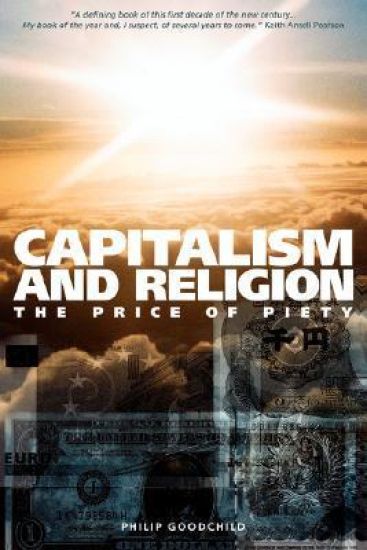
Our global ecological crisis demands that we question the rationality of the culture that has caused it: western modernity's free market capitalism. Philip Goodchild develops arguments from Nietzsche, Adorno, Horkheimer, and Marx, to suggest that our love of Western modernity is an expression of a piety in which capitalism becomes a global religion, in practice, if not always in belief. This book presents a philosophical alternative that demands attention from philosophers, critical theorists, philosophers of religion, theologians, and those in ecological politics.
Capitalism and Religion

Capitalism and Religion

Philip Goodchild

Routledge
2002
nidottu
Our global ecological crisis demands that we question the rationality of the culture that has caused it: western modernity's free market capitalism. Philip Goodchild develops arguments from Nietzsche, Adorno, Horkheimer, and Marx, to suggest that our love of Western modernity is an expression of a piety in which capitalism becomes a global religion, in practice, if not always in belief. This book presents a philosophical alternative that demands attention from philosophers, critical theorists, philosophers of religion, theologians, and those in ecological politics.
Deleuze and Guattari

Deleuze and Guattari

Philip Goodchild

SAGE Publications Ltd
1996
nidottu
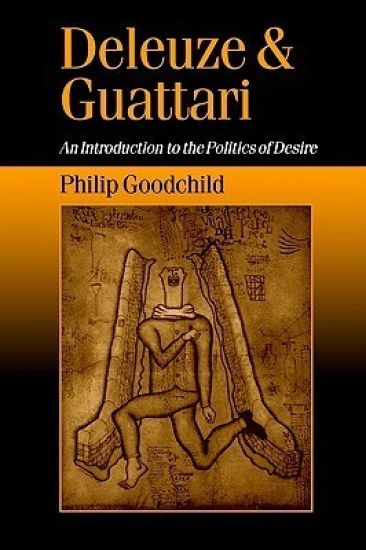
This accessible book examines critically the writings of Deleuze and Guattari, clarifying the ideas of these two notoriously difficult thinkers without over-simplifying them. Divided into three sections - Knowledge, Power, and Liberation of Desire - the book provides a systematic account of the intellectual context as well as an exhaustive analysis of the key themes informing Deleuze and Guattari's work. It provides the framework for reading the important and influential study Capitalism and Schizophrenia and, with the needs of students in mind, explains the key concepts in Deleuze and Guattari's discussion of philosophy, art and politics. Definitive and incisive, the book will be invaluable in situating the philosophy of these two major figures within the perspective of the social and human sciences.
Theology of Money

Theology of Money

Philip Goodchild

Duke University Press
2009
sidottu
Theology of Money is a philosophical inquiry into the nature and role of money in the contemporary world. Philip Goodchild reveals the significance of money as a dynamic social force by arguing that under its influence, moral evaluation is subordinated to economic valuation, which is essentially abstract and anarchic. His rigorous inquiry opens into a complex analysis of political economy, encompassing markets and capital, banks and the state, class divisions, accounting practices, and the ecological crisis awaiting capitalism. Engaging with Christian theology and the thought of Carl Schmitt, Georg Simmel, Karl Marx, Adam Smith, and many others, Goodchild develops a theology of money based on four contentions, which he elaborates in depth. First, money has no intrinsic value; it is a promise of value, a crystallization of future hopes. Second, money is the supreme value in contemporary society. Third, the value of assets measured by money is always future-oriented, dependent on expectations about how much might be obtained for those assets at a later date. Since this value, when realized, will again depend on future expectations, the future is forever deferred. Financial value is essentially a degree of hope, expectation, trust, or credit. Fourth, money is created as debt, which involves a social obligation to work or make profits to repay the loan. As a system of debts, money imposes an immense and irresistible system of social control on individuals, corporations, and governments, each of whom are threatened by economic failure if they refuse their obligations to the money system. This system of debt has progressively tightened its hold on all sectors and regions of global society. With Theology of Money, Goodchild aims to make conscious our collective faith and its dire implications.
Theology of Money

Theology of Money

Philip Goodchild

Duke University Press
2009
pokkari
Theology of Money is a philosophical inquiry into the nature and role of money in the contemporary world. Philip Goodchild reveals the significance of money as a dynamic social force by arguing that under its influence, moral evaluation is subordinated to economic valuation, which is essentially abstract and anarchic. His rigorous inquiry opens into a complex analysis of political economy, encompassing markets and capital, banks and the state, class divisions, accounting practices, and the ecological crisis awaiting capitalism. Engaging with Christian theology and the thought of Carl Schmitt, Georg Simmel, Karl Marx, Adam Smith, and many others, Goodchild develops a theology of money based on four contentions, which he elaborates in depth. First, money has no intrinsic value; it is a promise of value, a crystallization of future hopes. Second, money is the supreme value in contemporary society. Third, the value of assets measured by money is always future-oriented, dependent on expectations about how much might be obtained for those assets at a later date. Since this value, when realized, will again depend on future expectations, the future is forever deferred. Financial value is essentially a degree of hope, expectation, trust, or credit. Fourth, money is created as debt, which involves a social obligation to work or make profits to repay the loan. As a system of debts, money imposes an immense and irresistible system of social control on individuals, corporations, and governments, each of whom are threatened by economic failure if they refuse their obligations to the money system. This system of debt has progressively tightened its hold on all sectors and regions of global society. With Theology of Money, Goodchild aims to make conscious our collective faith and its dire implications.
Rethinking Philosophy of Religion

Rethinking Philosophy of Religion

Philip Goodchild

Fordham University Press
2002
sidottu
"Philosophy of religion," in recent decades, has been the study of the rationality, coherence, and truth-claims of classical theism. Yet philosophical reflection on religion has included much more than this: it has been the creative construction of a religious philosophy; it has critically examined claims for religious authority and certainty; it has explored the principles underlying religious thought and life; it has exposed domination, deception, and illusion, it has explored the subjective, practical, and spiritual dimensions of religion. This collection brings together essays by a variety of contemporary philosophers who are working in this broader tradition: Pamela Sue Anderson, Gary Banham, Bettina Bergo, John Caputo, Matthew Haltman, Wayne Hudson, Grace Jantzen, Donna Jowett, Greg Sadler, Graham Ward, and Edith Wyschogrod.
Credit and Faith

Credit and Faith

Philip Goodchild

Rowman Littlefield International
2019
sidottu
In line with the development of political theology and economic theology in contemporary European thought, Credit and Faith offers a critical account of the faith structures within economic life and institutions. Goodchild’s ground-breaking work provides a philosophical appropriation of the economic dimension of the New Testament and fresh theological, philosophical and economic perspectives on the present. Covering the theological roots of the way economic life was, and is, articulated, the philosophical roots of value and debt and the economic roots of credit and creation, this book charts the emergence of early theories of capital and banking through a consideration of credit. It draws on some neglected historical figures, as well as Jules Lagneau, Simone Weil, the Kantian problem of freedom and necessity and a critical reading of the early Marx and of Nietzsche’s genealogy; through this Goodchild explains how the Financial Revolution was able to conceal the credit economy which was its foundation and foster the pursuit of self-interest instead of the common good. This innovative interweaving of theology, philosophy and economics constructs a new metaphysical framework for a critical account of the faith structures within economic life and institutions and returns to the practice of philosophy as a way of life – a practical, engaged, worldy discipline.
Credit and Faith

Credit and Faith

Philip Goodchild

Rowman Littlefield International
2019
nidottu
In line with the development of political theology and economic theology in contemporary European thought, Credit and Faith offers a critical account of the faith structures within economic life and institutions. Goodchild’s ground-breaking work provides a philosophical appropriation of the economic dimension of the New Testament and fresh theological, philosophical and economic perspectives on the present. Covering the theological roots of the way economic life was, and is, articulated, the philosophical roots of value and debt and the economic roots of credit and creation, this book charts the emergence of early theories of capital and banking through a consideration of credit. It draws on some neglected historical figures, as well as Jules Lagneau, Simone Weil, the Kantian problem of freedom and necessity and a critical reading of the early Marx and of Nietzsche’s genealogy; through this Goodchild explains how the Financial Revolution was able to conceal the credit economy which was its foundation and foster the pursuit of self-interest instead of the common good. This innovative interweaving of theology, philosophy and economics constructs a new metaphysical framework for a critical account of the faith structures within economic life and institutions and returns to the practice of philosophy as a way of life – a practical, engaged, worldy discipline.
Economic Theology

Economic Theology

Philip Goodchild

Rowman Littlefield International
2020
sidottu
In Economic Theology, Goodchild offers a philosophical analysis of the contemporary economy in terms of the way it structures credit and faith. The Great Financial Crisis of 2007 and onwards has exposed the extent to which the economy functions as a network of credits and debts. Credit and debt may now be understood as the driving force of economic behaviour.In this analysis, economic theories of markets and money are also ways of ordering trust. Similarly, the institutions of money, finance and banking provide the framework enabling trust and cooperation. Goodchild explores how reliance on such theories and institutions produces disequilibrium dynamics, growing inequalities, increasing enclosure, resource depletion and breakdown. Nevertheless, the failures of the system only intensify efforts to extend the system itself.Building on and extending Goodchild’s Theology of Money, the author exposes the extent to which humanity has become enslaved within theories and institutions of its own making. As the second volume in his Credit and Faith trilogy, Goodchild explains how the economy itself is a way of shaping time and attention, care and evaluation, trust and cooperation, so directly assuming a theological role. This volume extends the theological critique of the dynamics of financial capitalism.
Economic Theology

Economic Theology

Philip Goodchild

Rowman Littlefield International
2020
nidottu
In Economic Theology, Goodchild offers a philosophical analysis of the contemporary economy in terms of the way it structures credit and faith. The Great Financial Crisis of 2007 and onwards has exposed the extent to which the economy functions as a network of credits and debts. Credit and debt may now be understood as the driving force of economic behaviour.In this analysis, economic theories of markets and money are also ways of ordering trust. Similarly, the institutions of money, finance and banking provide the framework enabling trust and cooperation. Goodchild explores how reliance on such theories and institutions produces disequilibrium dynamics, growing inequalities, increasing enclosure, resource depletion and breakdown. Nevertheless, the failures of the system only intensify efforts to extend the system itself.Building on and extending Goodchild’s Theology of Money, the author exposes the extent to which humanity has become enslaved within theories and institutions of its own making. As the second volume in his Credit and Faith trilogy, Goodchild explains how the economy itself is a way of shaping time and attention, care and evaluation, trust and cooperation, so directly assuming a theological role. This volume extends the theological critique of the dynamics of financial capitalism.
The Metaphysics of Trust

The Metaphysics of Trust

Philip Goodchild

Rowman Littlefield International
2021
sidottu
Following Credit and Faith and Economic Theology, this third volume in the series develops a metaphysics which is missing when trust is ordered around economic theories and institutions. Human existence may be conceived according to its temporal dimensions of appropriation, participation, and offering.Engaging with the Western philosophical tradition from the Neo-Pythagoreans and Plato to Heidegger and Arendt, drawing especially from Augustine and Weil, Goodchild offers striking reconstructions of the meanings of economic, political and religious dimensions of life. The outcome is an elaboration of conceptions of wealth, power, contingency, necessity and grace which give a new orientation to human life and endeavour.Goodchild situates this discussion within the current historical era of the breakdown of global financial capitalism. He draws from the Financial Revolution in England as a time of crisis which illuminates our own. Faced with a range of global crises, Goodchild proposes an alternative between strategies for survival: either submission before a Great Machine of Credit as an autonomous, unthinking system for regulating human behaviour or accession to the necessity of grace as a way of empowering the pursuit of wealth, justice and thought.
Always Due, Never Done: Celebrating 20 Years of TBAWP

Always Due, Never Done: Celebrating 20 Years of TBAWP

Phillip C. Goodchild; Pat Jones

Createspace Independent Publishing Platform
2018
nidottu
Celebrating 20 years of the Tampa Bay Area Writing Project Since 1998, a collection of various educators, students, and vagabonds have gathered every summer to participate in an incredible time of learning, writing, and self-discovery. Over the course of several weeks, the participants create a wide variety of writing, some of which is collected here in this year's 2018 anthology. To mark the 20th anniversary of TBAWP, pieces from past gatherings are also included for your enjoyment
Philip

Philip

Gyles Brandreth

Hodder Stoughton
2022
pokkari
____________________________________________________________________________________ THE SUNDAY TIMES TOP 10 BESTSELLER 'It is a beautifully written book about a unique and extraordinary man who was the longest-serving consort to the longest reigning monarch in British history. I have read many other books about Philip but this is the best.' - DAILY EXPRESS'Gloriously witty and incisive' - DAILY MAIL'It's bloody brilliant, totally inspiring ... it's a joy to read a book that comes from a perspective of fondness. There are whole pages I want to read to the kids and stick to the fridge.' - KIRSTIE ALLSOPP, THE TIMES'As a sparkling celebration of Prince Philip, the book will be hard to beat' - THE TELEGRAPH'Brandreth explores a temperament on the brink of anger and agitation with immense tact, even affection.' - THE SPECTATOR'This affectionate biography of Prince Philip is stuffed with entertaining anecdotes ... so readable and refreshing even after the millions of words that have been written about Prince Philip in the past couple of weeks.' - THE TIMES'Brilliant... there is so much in this book you won't find anywhere else.' - LORRAINE'A stately, respectful and joyful tribute. It is an extraordinary story, told with unique insight and authority by an author who knew him for more than 40 years.' - EDINBURGH EVENING NEWS'A warm, affectionate portrait of the much-missed Duke ... a rich source of insights and anecdotes.' - SAGA MAGAZINE______________________________________________________________________________________This is the story of Prince Philip, Duke of Edinburgh - the longest-serving consort to the longest-reigning sovereign in British history. It is an extraordinary story, told with unique insight and authority by an author who knew the prince for more than forty years. Philip - elusive, complex, controversial, challenging, often humorous, sometimes irascible - is the man Elizabeth II once described as her 'constant strength and guide'. Who was he? What was he really like? What is the truth about those 'gaffes' and the rumours of affairs? This is the final portrait of an unexpected and often much-misunderstood figure. It is also the portrait of a remarkable marriage that endured for more than seventy years. Philip and Elizabeth were both royal by birth, both great-great-grandchildren of Queen Victoria, but, in temperament and upbringing, they were two very different people. The Queen's childhood was loving and secure, the Duke's was turbulent; his grandfather assassinated, his father arrested, his family exiled, his parents separated when he was only ten. Elizabeth and Philip met as cousins in the 1930s. They married in 1947, aged twenty-one and twenty-six. Philip: The Final Portrait tells the story of two contrasting lives, assesses the Duke of Edinburgh's character and achievement, and explores the nature of his relationships with his wife, his children and their families - and with the press and public and those at court who were suspicious of him in the early days. This is a powerful, revealing and, ultimately, moving account of a long life and a remarkable royal partnership.