Kirjojen hintavertailu. Mukana 11 241 044 kirjaa ja 12 kauppaa.

Kirjahaku

Etsi kirjoja tekijän nimen, kirjan nimen tai ISBN:n perusteella.

1000 tulosta hakusanalla Philip Pusey

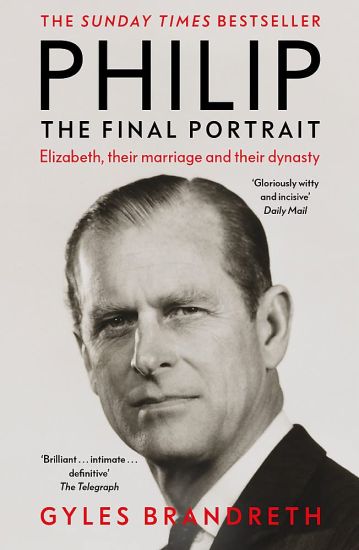
Philip

Philip

Gyles Brandreth

Hodder Stoughton
2022
pokkari
____________________________________________________________________________________ THE SUNDAY TIMES TOP 10 BESTSELLER 'It is a beautifully written book about a unique and extraordinary man who was the longest-serving consort to the longest reigning monarch in British history. I have read many other books about Philip but this is the best.' - DAILY EXPRESS'Gloriously witty and incisive' - DAILY MAIL'It's bloody brilliant, totally inspiring ... it's a joy to read a book that comes from a perspective of fondness. There are whole pages I want to read to the kids and stick to the fridge.' - KIRSTIE ALLSOPP, THE TIMES'As a sparkling celebration of Prince Philip, the book will be hard to beat' - THE TELEGRAPH'Brandreth explores a temperament on the brink of anger and agitation with immense tact, even affection.' - THE SPECTATOR'This affectionate biography of Prince Philip is stuffed with entertaining anecdotes ... so readable and refreshing even after the millions of words that have been written about Prince Philip in the past couple of weeks.' - THE TIMES'Brilliant... there is so much in this book you won't find anywhere else.' - LORRAINE'A stately, respectful and joyful tribute. It is an extraordinary story, told with unique insight and authority by an author who knew him for more than 40 years.' - EDINBURGH EVENING NEWS'A warm, affectionate portrait of the much-missed Duke ... a rich source of insights and anecdotes.' - SAGA MAGAZINE______________________________________________________________________________________This is the story of Prince Philip, Duke of Edinburgh - the longest-serving consort to the longest-reigning sovereign in British history. It is an extraordinary story, told with unique insight and authority by an author who knew the prince for more than forty years. Philip - elusive, complex, controversial, challenging, often humorous, sometimes irascible - is the man Elizabeth II once described as her 'constant strength and guide'. Who was he? What was he really like? What is the truth about those 'gaffes' and the rumours of affairs? This is the final portrait of an unexpected and often much-misunderstood figure. It is also the portrait of a remarkable marriage that endured for more than seventy years. Philip and Elizabeth were both royal by birth, both great-great-grandchildren of Queen Victoria, but, in temperament and upbringing, they were two very different people. The Queen's childhood was loving and secure, the Duke's was turbulent; his grandfather assassinated, his father arrested, his family exiled, his parents separated when he was only ten. Elizabeth and Philip met as cousins in the 1930s. They married in 1947, aged twenty-one and twenty-six. Philip: The Final Portrait tells the story of two contrasting lives, assesses the Duke of Edinburgh's character and achievement, and explores the nature of his relationships with his wife, his children and their families - and with the press and public and those at court who were suspicious of him in the early days. This is a powerful, revealing and, ultimately, moving account of a long life and a remarkable royal partnership.
Young Prince Philip

Young Prince Philip

Philip Eade

Harpercollins Publishers
2012
pokkari
'The narrative is as suspenseful as any thriller. Truly, an excellent read' Lynn Barber, Sunday Times Married for almost seventy years to the most famous woman in the world, Prince Philip is the longest-serving royal consort in British history. Yet his origins have remained curiously shrouded in obscurity.
Philip V of Macedon in Polybius' Histories

Philip V of Macedon in Polybius' Histories

Emma Nicholson

Oxford University Press
2023
sidottu
Philip V of Macedon in Polybius' Histories: Politics, History, and Fiction offers a historiographical and literary study of Polybius' portrait of Philip V and aims to advance our knowledge of both the Macedonian king and the historian. It takes a chronological and thematic approach, exploring how Polybius' political, historiographical, and didactic aims impact the king's depiction from beginning to end. The first half focuses on political and rhetorical aspects: it highlights the embedded Achaean perspective of the narrative and how this fundamentally shapes Philip's image; it re-evaluates key character-defining episodes, such as the sack of Thermum and the attempt on Messene; and it problematizes Polybius' claim that Philip became increasingly treacherous and tyrannical towards the Greeks after 215 BC. The second half explores how Polybius develops his interpretation of the king through ideological and literary means: it investigates how Polybius uses cultural politics to blacken Philip's image and justify the exchange of Macedon and Rome as hegemonic powers in the Greek world; it rationalizes his use of a tragic mode for Philip's last years, examining the implications this styling has for our historical understanding of the king; and it considers how tensions between Polybius' narrative and commentary on Philip may be the result of his combination of historiographical and biographical modes of presentation. It finishes by resituating Philip in the broader context of the Histories, drawing comparisons between his portrait and that of other kings and leaders, and discussing how kings are shaped by and contribute to the arguments in the Histories.
Philip Pullman and the Historical Imagination

Philip Pullman and the Historical Imagination

Kristen Poole

Oxford University Press
2025
sidottu
Philip Pullman and the Historical Imagination takes the general reader on a fascinating tour of seventeenth-century thought, exploring how this time period shaped Pullman's extraordinary trilogies His Dark Materials and The Book of Dust. In Part One, readers are taken into the mysteries of Renaissance allegory and hieroglyphics, tracing how the alethiometer and Lyra's way of reading the device emerged from these traditions. Part Two enters the exciting and revolutionary world of seventeenth-century science. We see how the amber spyglass imitates Galileo's telescope, how early modern fantasies of space travel led to ideas of multiple worlds, how alchemy entered Lyra's later adventures in Oxford and Prague, and how the concept of Dust shares in the physics and philosophies of early scientists like Margaret Cavendish. Part Three invites readers into the thrilling epic poem Paradise Lost--John Milton's dramatic account of the creation of the world following a violent war in Heaven--that was Pullman's inspiration for His Dark Materials. Pullman's vibrant re-telling of this core story brings us rebel angels, recasts Satan as a brooding Lord Asriel, and presents Lyra as the new Eve. Written by an eminent scholar of seventeenth-century literature and history, Philip Pullman and the Historical Imagination is crafted in an engaging and accessible style aimed at popular readers and fans of Pullman's work. It enlivens a historical period that has long attracted Pullman himself, bringing to life intriguing figures and the richly complex ideas of the time. This book is an exploration of history through the worlds and characters Pullman has invented. Ultimately, it not only reveals how seventeenth-century history helps readers better understand Pullman's novels, but shows how reading history through the lens of Pullman's imagination offers new ways of thinking about the past.
Philip's Phoenix

Philip's Phoenix

Margaret P. Hannay

Oxford University Press Inc
1990
sidottu
Although previous studies have portrayed Mary Sidney as a demure, retiring woman, Hannay, basing her work on primary sources (account books, legal documents, diaries, family letters), has discovered that she was brilliant, learned, witty, articulate, and adept at self-presentation. Married to the wealthy Earl of Pembroke, she ruled over her little court at Wilton just as Elizabeth ruled in London. Her wisdom, poetry, and scholarship were extravagantly praised by those who sought to gain her favour. When Philip, her older brother, died fighting for the Protestant cause, she moved to London to take up his literary activities, publishing his writings, writing and translating works of which he would have approved, assuming his role as literary patron and supporting the Protestant cause for which he died. All the literary work for which she is celebrated took place between her return to London in 1588 and her husband's death in 1601. While previous biographers contended that her widowhood was quiet and uneventful, Hannay shows, via court cases, that her final years were colourful indeed, as, administering the properties she retained, she contended with jewel thieves, pirates, and murderers, finally bringing them to trial after complex legal and political manoeuvres.
Philip the Chancellor and Eudes of Châteauroux
Sermones Contra Hereticos presents an edition and translation of a group of mostly unpublished Latin sermons which were originally preached in the context of the Albigensian Crusade of 1226 and during the fight against heresy in northern France in 1231. The nine extant sermon texts are unique in that they can be connected to specific preaching events for which the identity of the preacher, the time, and location, as well as the audience are known. The sermons were originally preached before academics at the University of Paris, to King Louis VIII of France at the start of his crusade in Bourges, at a procession in Paris in aid of the crusade army at the siege of Avignon, for the recruitment of additional crusaders, and at an episcopal synod at Laon and to laypeople at Bruyères-et-Montbérault in an attempt to ward off the spread of heretical beliefs. These texts provide us with an opportunity to tie particular strands of crusade ideology and doctrine to specific moments of the crusade movement and to the church's endeavours to counteract heresies by intensifying pastoral preaching. In addition, the texts can tell us a great deal about the way in which oral preaching was recorded and about the differences between the surviving textual record and the historical spoken word.
Sir Philip Sidney

Sir Philip Sidney

Philip Sidney

Oxford University Press
2008
nidottu
This authoritative edition was originally published in the acclaimed Oxford Authors series under the general editorship of Frank Kermode. It brings together a unique combination of Sidney's poetry and prose - all the major writing, complemented by letters and elegies - to give the essence of his work and thinking. Born in 1554, Sir Philip Sidney was hailed as the perfect Renaissance patron, soldier, lover, and courtier, but it was only after his untimely death at the age of 31 that his literary accomplishments were truly recognized. This collection ranges more widely through Sidney's works than any previous volume and includes substantial parts of both versions of the Arcadia, The Defence of Poesy and the whole of the sonnet sequence Astrophil and Stella. Supplementary texts, such as his letters and the numerous elegies which appeared after his death, help to illustrate the whole spectrum of his achievements, and the admiration he inspired in his contemporaries. ABOUT THE SERIES: For over 100 years Oxford World's Classics has made available the widest range of literature from around the globe. Each affordable volume reflects Oxford's commitment to scholarship, providing the most accurate text plus a wealth of other valuable features, including expert introductions by leading authorities, helpful notes to clarify the text, up-to-date bibliographies for further study, and much more.
Philip Roth

Philip Roth

Patrick Hayes

Oxford University Press
2014
sidottu
When we try to find words to express our most visceral and primary responses to literature, we are often inclined to speak of its power. But in academic contexts, that intuitive feeling for the vividness, energy, and special intensity of literary experience is all too often subdued, and exchanged for a supposedly more sophisticated discussion of its ethical or political significance. Philip Roth has long thumbed his nose at the 'virtue racket', as one of his characters called it, and his fiction has repeatedly satirised the moralistic idiom that tends to rule the public discussion of literature. In doing so he has earned the disapproval of an unusually wide range of university teachers and intellectuals. Philip Roth: Fiction and Power argues that Roth's importance derives precisely from his revaluation of what counts as sophisticated and serious in our response to literature. As well as examining how Roth emerged as a writer, and defining the main lines of influence on him, the book measures his impact on the dominant ways of thinking about literary value in post-war America. Attention is given to particular questions: about the place of emotion and affective experience, the nature and value of tragedy, the relevance of art to life, the relationship between literature and the unconscious, the concept of the author, the idea of a literary canon, and the ways that fiction illuminates America's complex post-war history. The book will be of importance to readers of modern American literature, and indeed to anyone interested in why literature matters.