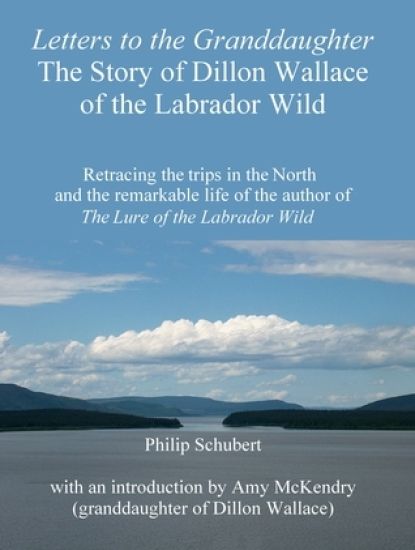
The North seduces you. It can kill you too. Philip Schubert discovered the joys and dangers of travel in trackless wilderness starting in 1999 after reading Dillon Wallace's "The Lure of the Labrador Wild". He spent a decade retracing the routes in Labrador and northern Quebec described in "The Lure", in Wallace's follow-on book, "The Long Labrador Trail", and in Mina Hubbard's "A Woman's Way Through Unknown Labrador". Nothing in Dillon's early life as an impoverished youth on a farm suggested that he would still fascinate people nearly 150 years later. Dillon was blessed in fact with "Grit A'Plenty", which no one would suspect from his unimpressive physique and unsmiling face. He pulled himself up by his bootstraps, rising from gristmill employee, to self-trained telegraph operator, to stenographer, to finally becoming a lawyer. His life from that point on, however, was equal parts tragic and heroic, but continued to be marked by splendid accomplishments. Starting at the age of 40 in 1903, he carried out a series of trips in Labrador and today's northern Quebec covering several thousand miles. No one person to date has been equal to the task of fully retracing them. The first trip sadly resulted in the tragic death of his trip leader and best friend, Leonidas Hubbard, and a narrow escape for him. His book on the trip, "The Lure of the Labrador Wild", published in 1904, became a best seller and is still in print. It would change Dillon's life forever. It told the story of the trip as it was documented in his and Leonidas' trip journals. Leonidas' widow, Mina Hubbard, who would be forever changed also due to the unbearable loss of "her laddie", had commissioned the book. When Dillon refused to rewrite the book and make Leonidas into the larger than life figure she had been expecting, she became Dillon's sworn enemy for life. There then followed two extraordinary trips in 1905 across Labrador, following the route planned in 1903. Dillon led one. Mina, drawing on skills that no one had realized she had, led the other. She planned hers in secret, and then provoked a life-long estrangement from Leonidas' family by telling the press as she left that she suspected that Dillon played a role in her husband's death and was on her way to investigate it. A third fascinating figure, voyager George Elson, the other survivor of the first trip, safely canoed Mina the length of Labrador down some of the most challenging rivers that George and his crack team of outdoorsmen had ever seen. No one was more impressed than George, or more disappointed than Mina, when Dillon and his only team member, forestry student Clifford Easton, successfully completed the trip as well. The evidence that George, a heroic figure in his own right, had fallen in love with Mina and which may have motivated him to agree to organize the trip at Mina's behest, added another fascinating dimension to the saga. The 1905 trip formed the basis for Dillon's second book and he went on to publish another 25 books, becoming a legend in his time. This is the story of Dillon Wallace as told by Philip Schubert, with an introduction by Dillon's granddaughter, Amy McKendry. It includes extensively illustrated maps and dozens of Philip's photographs of the challenges faced and overcome in the wilds by the saga participants.
Paul von Hindenburg und Philippe P tain wurden zu gefeierten Weltkriegshelden stilisiert und wirkten zugleich als umstrittene Staatschefs. Anhand dieser Parallele nimmt Stefan Schubert die politischen Ordnungen in Deutschland und Frankreich zwischen 1914 und 1945 in den Blick und untersucht den Zusammenhang zwischen der Heroisierung der beiden Milit rs und ihrem politischen Wirken. ber einen vergleichenden Zugriff auf die deutschen und franz sischen Gesellschaften entschl sselt er die Deutungsk mpfe, mit denen Deutsche und Franzosen soziokulturelle und politische Normen konstruierten, aushandelten, hinterfragten und sich somit in einer von Umbr chen gepr gten Epoche selbst verorteten. Stefan Schubert deckt die Bedeutung umk mpfter heroischer Figuren f r die zeitgen ssische Suche nach integrativen Symbolen auf. Seine Analyse der Heroisierungen von Hindenburg und P tain erlaubt R ckschl sse darauf, wie sich politische Ordnungen legitimierten und stabilisierten. Dieser Vergleich sch rft den Blick f r Besonderheiten und Gemeinsamkeiten zweier Staaten, die sich den Herausforderungen von Nationalisierung, Kriegen und radikalen Ideologien stellen mussten.
Just five months after Martin Luther published his Ninety-Five Theses, thirteen-year-old Philipp was declared Landgrave of Hesse, ruler of one of the most powerful principalities of the Holy Roman Empire.During his forty- nine-year reign, he proved a divisive leader-he boldly promoted the Reformation but was openly married to two wives at the same time, against the advice of Luther and other theologians. He ruled his land well but ignored sage advice from friends.Some people admired Philipp as a hero. Others despised him as scandalous. However he was viewed, one thing was for sure: God was able to use Philipp's leadership skills to unite the Reformation movement and allow it to grow.This comprehensive look at the life and role of Philipp invites readers to take a deeper look at the intertwining history of the Church, the Reformation, and politics.