Kirjojen hintavertailu. Mukana 11 244 527 kirjaa ja 12 kauppaa.

Kirjahaku

Etsi kirjoja tekijän nimen, kirjan nimen tai ISBN:n perusteella.

1000 tulosta hakusanalla Philippa Williams

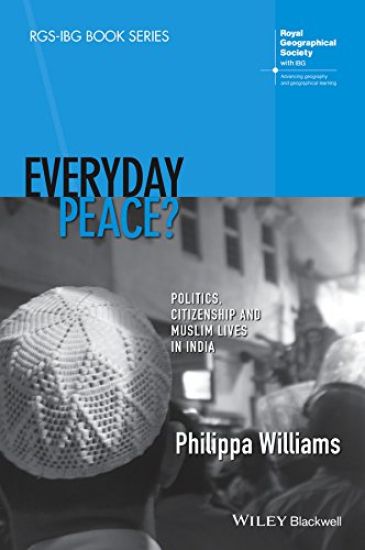
Everyday Peace?

Everyday Peace?

Philippa Williams

John Wiley Sons Inc
2015
nidottu
Winner of the 2016 Julian Minghi Distinguished Book Award of the Political Geography Specialty Group at the AAGProviding important insights into political geography, the politics of peace, and South Asian studies, this book explores everyday peace in northern India as it is experienced by the Hindu-Muslim community. Challenges normative understandings of Hindu-Muslim relations as relentlessly violent and the notion of peace as a romantic endpoint occurring only after violence and political maneuveringsExamines the ways in which geographical concepts such as space, place, and scale can inform and problematize understandings of peaceRedefines the politics of peace, as well as concepts of citizenship, agency, secular politics, and democracyBased on over 14 months of qualitative and archival research in the city of Varanasi in Uttar Pradesh, India
Everyday Peace?

Everyday Peace?

Philippa Williams

John Wiley Sons Inc
2015
sidottu
Winner of the 2016 Julian Minghi Distinguished Book Award of the Political Geography Specialty Group at the AAGProviding important insights into political geography, the politics of peace, and South Asian studies, this book explores everyday peace in northern India as it is experienced by the Hindu-Muslim community. Challenges normative understandings of Hindu-Muslim relations as relentlessly violent and the notion of peace as a romantic endpoint occurring only after violence and political maneuveringsExamines the ways in which geographical concepts such as space, place, and scale can inform and problematize understandings of peaceRedefines the politics of peace, as well as concepts of citizenship, agency, secular politics, and democracyBased on over 14 months of qualitative and archival research in the city of Varanasi in Uttar Pradesh, India
Privacy Techtonics

Privacy Techtonics

Philippa Williams; Lipika Kamra

Bristol University Press
2026
sidottu
Today, privacy is more than a personal choice—it’s a terrain shaped by power, politics and everyday life. This book shifts the lens from established western narratives to India, WhatsApp’s largest market, exploring how digital privacy is lived, built, and regulated on the world’s digital peripheries. Drawing on rich field-based research, it examines encrypted technologies, the ties between big tech and governments, and the role of messaging apps in political life. This is a sharp and grounded account of how privacy can both strengthen and erode democracy in the digital age.
Privacy Techtonics

Privacy Techtonics

Philippa Williams; Lipika Kamra

Bristol University Press
2026
nidottu
Today, privacy is more than a personal choice—it’s a terrain shaped by power, politics and everyday life. This book shifts the lens from established western narratives to India, WhatsApp’s largest market, exploring how digital privacy is lived, built, and regulated on the world’s digital peripheries. Drawing on rich field-based research, it examines encrypted technologies, the ties between big tech and governments, and the role of messaging apps in political life. This is a sharp and grounded account of how privacy can both strengthen and erode democracy in the digital age.
How to be a Nurse or Midwife Leader

How to be a Nurse or Midwife Leader

David Ashton; Jamie Ripman; Philippa Williams

Wiley-Blackwell
2017
nidottu
How to be a Nurse or Midwife Leader is an indispensable guide for all nurses and midwives who wish to develop and improve their practice as leaders. Written in collaboration with the NHS Leadership Academy, this practical book draws on the real experience of over 10,000 nurses and midwives to bring leadership dilemmas to life in specific situations. Key learning features include: How to develop your self-awarenessHow to develop your personal impact and presenceHow to survive and thriveHow to get your message acrossHow to get the best out of othersHow to work with and lead other professionals and patientsHow to have courageous conversationsHow to balance conflicting demands and needs Containing exercises and reflective questions to help apply theory to leadership practice, How to be a Nurse or Midwife Leader is an ideal companion for all nurses and midwives, whether you are newly qualified, or stepping into a team leader role.
Time Bomb

Time Bomb

Barbara Pocock; Natalie Skinner; Philippa Williams

NewSouth Publishing
2012
nidottu
Relevant and sharp, this record turns a careful eye to the issue of time poverty, throwing light on poor urban planning, workplace policies, and other sociopolitical issues that rob working families of time. While maximising productivity and enhancing professional skills, Australians must raise their children, care for their elderly, be involved in their communities, and shrink their carbon footprints. This book investigates what it costs Australian families to do it all: how men’s time is taken up by work, crowding out their capacity to care, and how women struggle to strike a balance between professional ambition and household obligations. It also investigates how work impacts the response to the greatest concern of the 21st century—the planet’s sustainability.
Geographies of Peace

Geographies of Peace

McConnell Fiona; Megoran Nick; Williams Philippa

I.B. Tauris
2014
sidottu
From handshakes on the White House lawn to Picasso's iconic dove of peace, the images and stereotypes of peace are powerful, widespread and easily recognizable. Yet if we try to offer a concise definition of peace it is altogether a more complicated exercise. Not only is peace an emotive and value-laden concept, it is also abstract, ambiguous and seemingly inextricably tied to its antithesis: war. And it is war and violence that have been so compellingly studied within critical geography in recent years. This volume offers an attempt to redress that balance, and to think more expansively and critically about what peace means and what geographies of peace may entail. The editors begin with an examination of critical approaches to peace in other disciplines and a helpful genealogy of peace studies within geography. The book is then divided into three sections. The opening section examines how the idea of peace may be variously constructed and interpreted according to different sites and scales. The chapters in the second section explore a remarkably wide range of techniques of peacemaking.This widens the discussion from the archetypical image of top-down, diplomatic state-led initiatives to imperial boundary making practices, grassroots cultural identity assertion, boycotts, self-immolation, ex-paramilitary community activism, and 'protective accompaniment'. The final section shifts the scale and focus to everyday personal relations and a range of practices around the concept of coexistence. In their concluding chapter the editors spell out some of the key questions that they believe a geography of peace must address: What spatial factors have facilitated the success or precipitated the failure of some peace movements or diplomatic negotiations? Why are some ideologies productive of violence in some places but co-operation in others? How have some communities been better able to deal with religious, racial, cultural and class conflict than others? How have creative approaches to sharing sovereignty mitigated or transformed territorial disputes that once seemed intractable? Geographies of Peace is the first book wholly devoted to exploring the geography of peace.Drawing on both recent advances in social and political theory and detailed empirical research covering four continents, it makes a significant intervention into current debates about peace and violence.
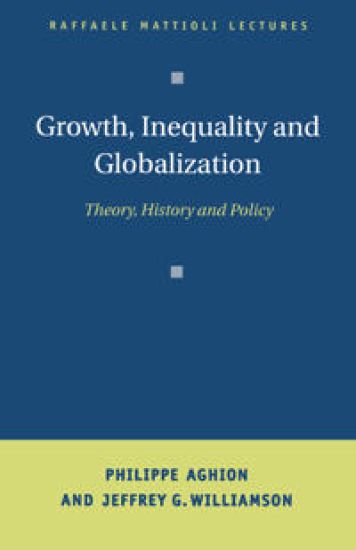
Growth, Inequality, and Globalization

Growth, Inequality, and Globalization

Philippe Aghion; Jeffrey G. Williamson

Cambridge University Press
1999
sidottu
The question of how inequality is generated and how it reproduces over time has been a major concern for social scientists for more than a century. Yet the relationship between inequality and the process of economic development is far from being well understood. These Raffaele Mattioli Lectures have brought together two of the world’s leading economists, Professors Philippe Aghion (a theorist) and Jeffrey Williamson (an economic historian), to question the conventional wisdom on inequality and growth, and address its inability to explain recent economic experience. Professor Aghion assesses the affects of inequality on growth, and asks whether inequality matters: if so why is excessive inequality bad for growth, and is it possible to reconcile aggregate findings with macroeconomic theories of incentives? In the second part Jeffrey Williamson discusses the Kuznets hypothesis, and focuses on the causes of the rise of wage and income inequality in developed economies.
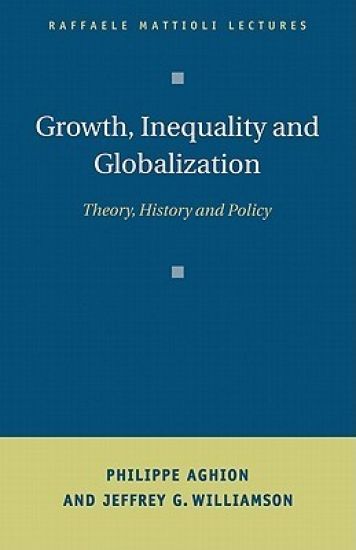
Growth, Inequality, and Globalization

Growth, Inequality, and Globalization

Philippe Aghion; Jeffrey G. Williamson

Cambridge University Press
1999
pokkari
The question of how inequality is generated and how it reproduces over time has been a major concern for social scientists for more than a century. Yet the relationship between inequality and the process of economic development is far from being well understood. These Raffaele Mattioli Lectures have brought together two of the world’s leading economists, Professors Philippe Aghion (a theorist) and Jeffrey Williamson (an economic historian), to question the conventional wisdom on inequality and growth, and address its inability to explain recent economic experience. Professor Aghion assesses the affects of inequality on growth, and asks whether inequality matters: if so why is excessive inequality bad for growth, and is it possible to reconcile aggregate findings with macroeconomic theories of incentives? In the second part Jeffrey Williamson discusses the Kuznets hypothesis, and focuses on the causes of the rise of wage and income inequality in developed economies.
Syntax-based Statistical Machine Translation

Syntax-based Statistical Machine Translation

Philip Williams; Rico Sennrich; Matt Post; Philipp Koehn

Springer International Publishing AG
2016
nidottu
This unique book provides a comprehensive introduction to the most popular syntax-based statistical machine translation models, filling a gap in the current literature for researchers and developers in human language technologies. While phrase-based models have previously dominated the field, syntax-based approaches have proved a popular alternative, as they elegantly solve many of the shortcomings of phrase-based models. The heart of this book is a detailed introduction to decoding for syntax-based models. The book begins with an overview of synchronous-context free grammar (SCFG) and synchronous tree-substitution grammar (STSG) along with their associated statistical models. It also describes how three popular instantiations (Hiero, SAMT, and GHKM) are learned from parallel corpora. It introduces and details hypergraphs and associated general algorithms, as well as algorithms for decoding with both tree and string input. Special attention is given to efficiency, includingsearch approximations such as beam search and cube pruning, data structures, and parsing algorithms. The book consistently highlights the strengths (and limitations) of syntax-based approaches, including their ability to generalize phrase-based translation units, their modeling of specific linguistic phenomena, and their function of structuring the search space.
Philippe Quinault, Dramatist

Philippe Quinault, Dramatist

William Brooks

Verlag Peter Lang
2008
nidottu
Much work has been done in recent years on Quinault’s librettos, but no major study of his spoken plays has appeared since the monumental thesis by Etienne Gros, published in 1926. Moreover, he has never been the subject of a monograph in English. There is a need to re-assess the influence of his life on his plays, and to re-evaluate Gros’s findings in the light of eighty years’ research into seventeenth-century French theatre in general. This book rejects the deterministic approach that sees his plays as apprentice pieces for the greater achievement that is his corpus of librettos, as well as the implicit comparative approach that pigeon-holes his work, in passing, by borrowing from the pithy judgements of Boileau. To what extent does Quinault’s steady move away from comedy and light tragi-comedy to tragedies that combine love and menace go hand in hand with his search for greater integrity, better characterisation, and ever more credible plotting? How did he come to create and retain a tremendously faithful audience that even the withering mockery of Boileau failed to discourage? And is there any purpose in retaining the time-worn comparison between the author of Andromaque and the author of Astrate?